
Signs of a Honey Bee Infestation in Your Walls or Attic
A honey bee infestation in a house is not the same problem as wasps, and treating it the same way is how a small job becomes an expensive one. Bees in a wall are worth removing alive, they are worth removing early, and they are the one stinging insect where killing the colony can leave you worse off than you started. The signs below tell you which situation you actually have, because a cluster hanging in a tree and a colony behind your drywall need opposite responses.

- A resting swarm holds 5,000 to 20,000 bees and usually moves on by itself once its scouts settle on a permanent site.
- Swarming runs mainly through April and May, so bees found in a wall in August most likely moved in during spring.
- A colony can hold as much as 40 pounds of honey inside a wall by the end of spring, which is what makes removal a construction job rather than a spray job.
- Never plug the entrance hole. The bees look for another way out and can find it through a baseboard, an outlet or a vent, which puts them in the room.
- Killing a colony and leaving the comb is what produces the stained, sticky ceiling people picture. The honey ferments and leaks once nothing is tending it.





Is It a Swarm or a Hive in the Wall?
These are two different situations and only one of them is urgent. A swarm is a dense ball of bees resting in the open, usually on a branch, a fence post or under an eave, while scout bees look for a permanent home.
A hive is a colony that has already moved into a cavity and started building comb inside it.
A swarm is temporary and it is not defensive, because there is nothing behind it to defend. University of California Agriculture and Natural Resources puts a departing swarm at 5,000 to 20,000 bees, settling usually within 100 to 200 yards of the hive it came from, with the scouts reaching a decision within a few hours to a few days. Left alone it leaves on its own. A beekeeper will often collect one for free, and that is the cheapest outcome any of these situations offers.
A hive in a structure is the situation that costs money, and the difference is visible from the ground. Swarm bees hang together in a mass with none of them going anywhere. Hive bees stream in and out of one fixed opening all day, in a steady two way line, like traffic through a gate. If you are watching a line rather than a lump, there is a colony behind the wall.
The Signs of an Established Hive Inside a Wall or Attic
An established colony in McKinney or Allen gives itself away in four ways, and each one tells you roughly how long it has been there.
| What you are seeing | What it means | Roughly how old |
|---|---|---|
| Bees using one fixed opening | A colony is established behind that point. They use it all day, and they are not bees passing through the yard | Any age, and the first sign to appear |
| A steady hum inside the wall | Tens of thousands of bees are active behind that surface. Easiest to hear from a quiet room | Weeks at least, once the colony is large enough to hear |
| Dark sticky staining on drywall | A large, long established colony, or one that was killed and left. Shows on walls and ceilings alike | A season, and the point removal gets expensive |
| Single bees indoors at an outlet | The colony is directly behind that surface and has found a way through, often at an outlet or a light fitting | Established, and the sign people act on last |
Where to expect them matters as much as what to look for. Honey bees choose cavities of at least four gallons and prefer something nearer nine, dark, with an entrance they can defend that sits at least nine feet off the ground. In a Collin County house that description fits a soffit, a gable vent, the space above a bay window and a chimney chase almost exactly, which is why those four come up again and again in the calls.
Can Honey Bees Damage Your Home?
Yes, though not the way termites do, and the distinction is worth getting right because it changes what you should do. Honey bees do not eat wood and NC State Extension states plainly that they cause no direct structural damage to a building.
What they do is fill a cavity with wax and honey, and it is the weight and the sugar that cause the trouble rather than any chewing.
There are two real damage routes. The first is the comb itself. A colony that moved in during the April and May swarming season can be holding as much as 40 pounds of honey by the end of that spring, sitting inside a wall cavity that was never built to carry it or to be washed out afterwards. The second is expansion. University of California Agriculture and Natural Resources notes that bees occasionally soften drywall with water and remove it to enlarge the nest, and that they sometimes open a hole clean through it so that bees out working can get in and out into a room. Those two findings are not in conflict. They describe different scales of the same colony, and a homeowner deciding whether to act deserves both rather than the tidier half.
 Source:
 Why Spraying a Hive and Leaving the Comb Makes It Worse
A live colony spends its whole day tending the nest. It fans the cavity to hold temperature, it caps the honey, and it keeps everything where it belongs. Kill it and all of that stops at once, while 40 pounds of honey stays exactly where it is.
What follows is well documented by both sources and is the part worth remembering. The honey ferments, then leaks through the wall and the ceiling, discoloring and damaging the surfaces on the way. The abandoned comb and the honey become a food source for other pests, so roaches and ants arrive at a house that did not have them. The dead bees themselves can bring on carpet beetles, which then move on to other natural fibers in the house.
So the sequence people imagine as the cheap option, spray it and forget it, is the one that produces the stained ceiling, the second pest problem and the wall that has to come open anyway. It is cheaper on the day and dearer by autumn.
The other tempting shortcut fails for a related reason. Plugging the entrance hole does not seal the colony in. NC State is direct about it: the bees simply look for another exit, and the ones they find lead through baseboards, electrical outlets and vents, which is to say into the room you were trying to keep them out of.
What Should You Do If You Find Bees in a Wall?
Call a beekeeper first, and call early. A colony that has been active for less than two or three weeks has built little enough comb that live removal is usually straightforward, and a healthy colony is worth something to a beekeeper, so the visit is often free or close to it.
Past that point NC State advises opening the space to take out the wax and the honey, which means a beekeeper and somebody who can open and close a wall properly.
Four things to do, and two not to.
- Note the exact entry point and photograph it, because that is the first thing anybody you call will ask about.
- Keep people and pets away from the flight path, which is a straight line out from the opening rather than the whole yard.
- Watch for bees appearing inside the room, and say so when you call, because that changes the job.
- Act inside the first few weeks if you can. Every week of delay is more comb to remove.
- Do not plug the hole, for the reason above.
- Do not spray it, for the reason above that.
If you are seeing bees around the house but nothing has moved in yet, the prevention is ordinary and cheap. Seal every gap a pencil would fit into around soffits, vents, utility penetrations and the roof line in Frisco, Plano and anywhere else with the kind of framing that leaves voids. That is the whole of it, and it is far easier in February than in May.
The same goes for a house that has already had a colony removed. The University of Kentucky, Controlling Nuisance Honey Bees advises plugging or screening every entrance once the nest is out and the damage repaired, because odors left by the colony can linger for a long time and attract other swarming bees.
Are They Honey Bees or Yellowjackets?
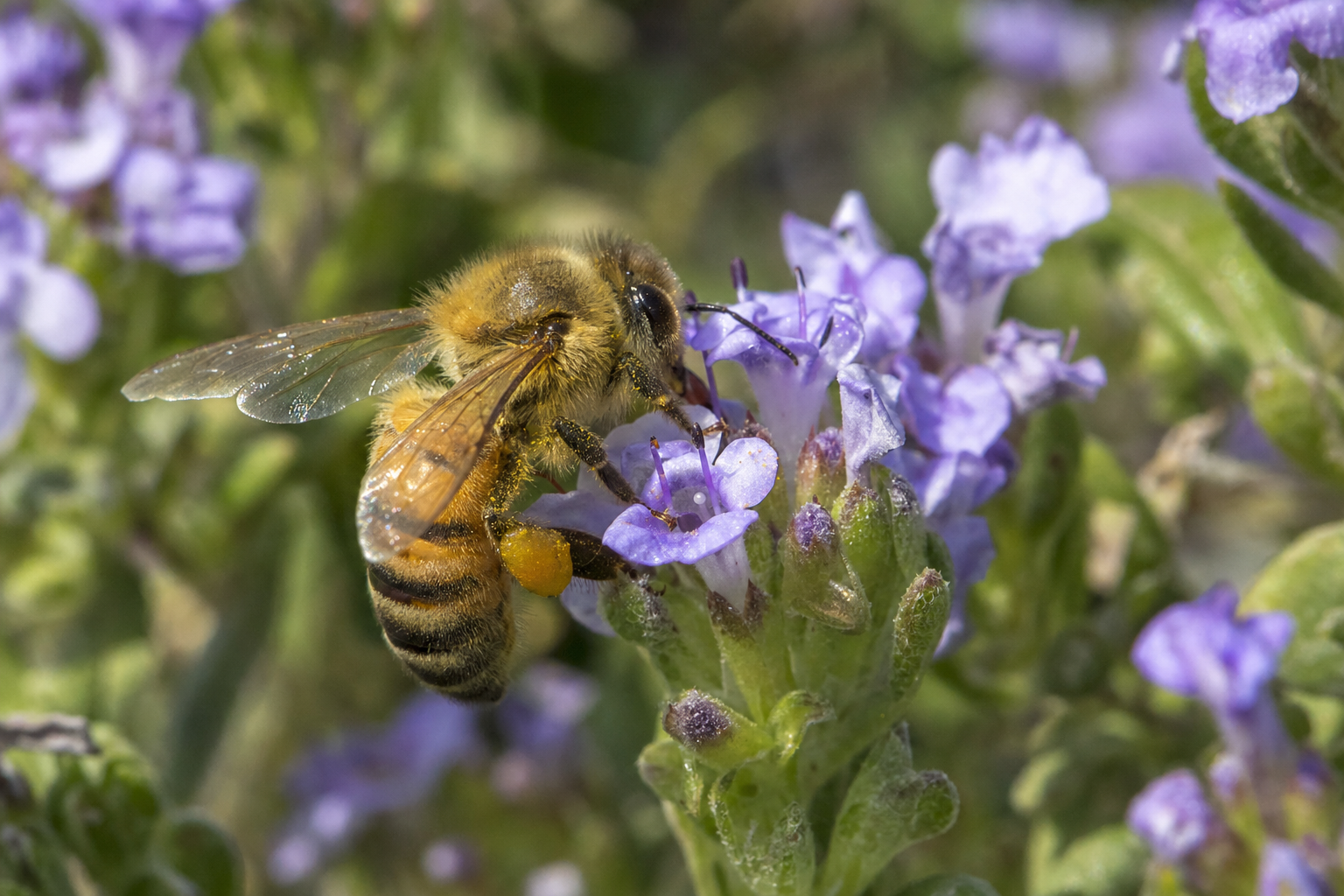
It matters, because the answer decides who you call, and people get it wrong in both directions. A honey bee is furry, amber and brown banded, and thickset. A yellowjacket is smooth, hard looking, and a much brighter yellow and black, and it flies with its legs tucked rather than hanging.
Behavior separates them faster than appearance from a distance. Honey bees work flowers and carry visible lumps of pollen on their back legs. Yellowjackets are the ones interested in your food and your drink at a table in late summer, and they get noticeably more aggressive as the season goes on. A nest of grey papery material, whether a ball in a shrub or a hole in the ground with insects streaming out of it, is not honey bees at all.
If what you have turns out to be wasps or yellowjackets, that is treated directly and it is a same day job rather than a beekeeper referral. If you genuinely cannot tell, send us a photo and we will tell you which one you are looking at before anybody quotes you for anything.
When Pest Me Off Is the Right Call and When a Beekeeper Is
We will say plainly that a live honey bee colony in a wall belongs with a beekeeper, and that is not us being modest. The colony is worth saving, the removal needs the comb taken out rather than the insects killed, and a beekeeper does that better than a spray truck ever will. Sending you to one costs us the job and it is still the right answer.
Where Pest Me Off is the right call is everything around that. Identifying what you actually have, so you are not paying a beekeeper to look at a yellowjacket nest. Treating wasps, yellowjackets and hornets, which is a different job with a different answer. Sealing the entry points afterwards so the same cavity does not take a new colony next April, which is the step that gets skipped and is the reason houses get bees twice. And handling the secondary pests, the ants and roaches that arrive at abandoned comb, which is the part nobody warned the homeowner about.
If you have bees at the house in Prosper, Allen, Frisco or anywhere in Collin County and you are not sure what they are or who should be handling them, get a free estimate and we will start by telling you honestly which of us you need.
Not sure if it is bees or wasps? Same-day identification in McKinney and the surrounding cities when you call before noon.
We identify the species, treat what should be treated, and tell you straight when a beekeeper is the right call instead.

Ryan has spent more than 16 years in pest control and wildlife management across McKinney and Collin County, from inspecting homes and treating infestations to sealing the entry points pests use to get in. He built Pest Me Off on that field experience, and every technician on the team is trained against it.
More about the Pest Me Off team