How Mosquito Misting Systems Work, and Whether They Are Worth It
A mosquito misting system is a line of small nozzles around your yard that sprays a fine mist of insecticide on a schedule. A pump and tank tucked out of the way feed it. Here is how one works, what the EPA says about whether it works, what it sprays, who can install one in Texas, and what it takes to keep it running.

- The EPA says the products most often used in home misting systems contain pyrethrins and permethrin.
- Nozzles mounted less than 10 feet off the ground cut down drift, the EPA says.
- A misting system never reaches the eggs in standing water, so the water still has to be dumped.
- The Asian tiger mosquito bites in the daytime, so a system that mists only at dusk misses it.
- In Texas, a company that installs a system and then refills it needs a structural pest control license.





What is a mosquito misting system?
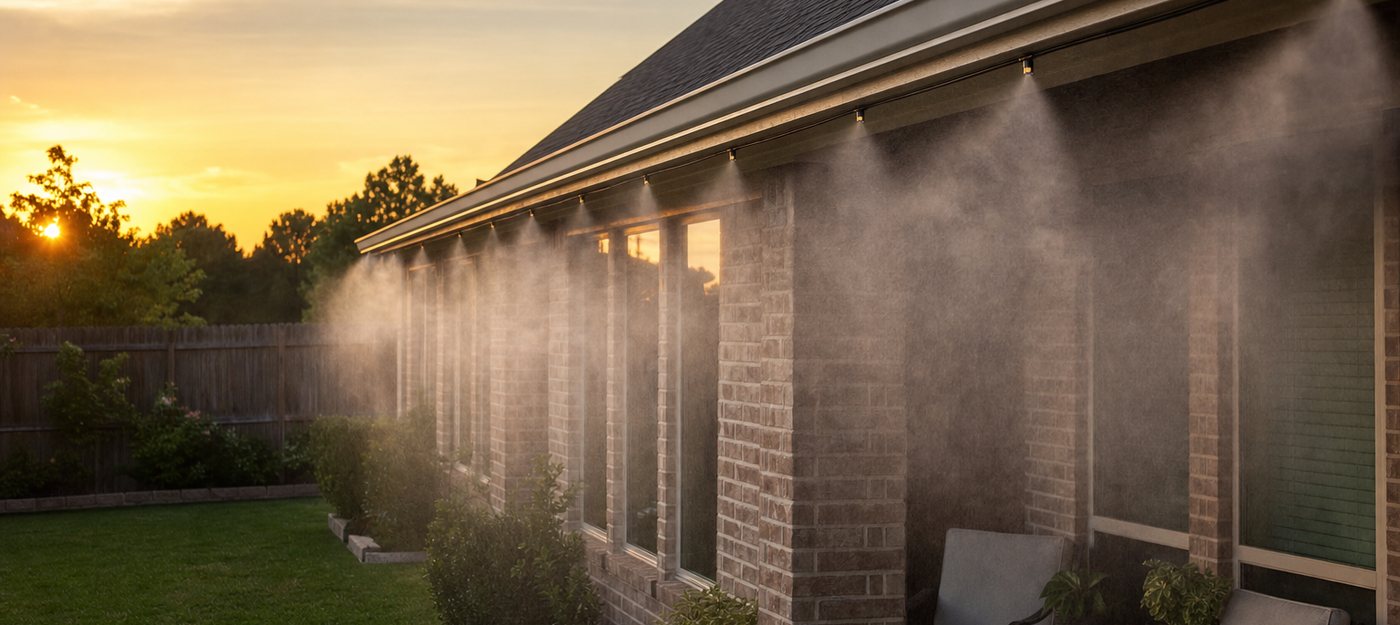
It is a fixed set of small mist nozzles along your fence line, beds and eaves, joined by thin tubing to a pump and a tank. The EPA describes these systems as spraying insecticide in a fine mist to kill mosquitoes outdoors, with some turned on at preset times by a timer.
On the schedule set for it, the pump sends a short burst of fine mist through the nozzles to hit the mosquitoes resting and flying in those zones. A Pynamite system can be stopped, skipped or switched off from a phone app as well as at the unit. A system like this is also called a mosquito mister, an automatic mosquito misting system or a backyard mosquito spray system.
It is not a fogger you run before a cookout. A fogger treats once and is done. A misting system works in short bursts, day after day, across only the part of the yard its nozzles are built to cover.
Do mosquito misting systems work?
The mist is meant to kill the mosquitoes it reaches, but the EPA says home misting systems have not yet been studied enough to document how well they control mosquitoes. The EPA, the CDC and many mosquito professionals say a combination of methods works best, so a system works best alongside dumping standing water and treating where mosquitoes breed.
| Point | Where it helps | Where it falls short |
|---|---|---|
| Schedule | Runs on a set schedule, with nobody having to remember | Misses daytime biters if it mists only at dusk |
| Coverage | Treats the fence line, beds and eaves its nozzles reach | Stops at the edge of those zones |
| Between visits | Keeps working between service visits through the season | Needs refills and checks all season |
| Eggs in water | Reaches adults resting and flying near the nozzles | Never touches the eggs in a saucer or clogged gutter |
| Next door | Suits a patio, pool deck or play area you use often | Cannot stop mosquitoes coming from the next yard |
From Pest Me Off’s own Pynamite service procedures.
Timing matters in Collin County because of one mosquito. Texas A&M AgriLife says the tiger mosquito bites readily during the day, especially in shade, and usually flies less than a block or two from where it breeds. Our article on the Asian tiger mosquito explains why that matters for a yard.
Are mosquito misting systems worth it?
They can be, for the right yard. A system suits you if you use the backyard most evenings and weekends from spring through fall, want coverage that keeps running between service visits, and have a fence line, beds or eaves where nozzles can run without pointing at people or a neighbor’s yard.
It is a poor fit if most of the yard is a vegetable garden, a koi or fish pond, or flower beds bees work all day, or if the only place to run the line would send mist toward the house next door. It also does little where most of the mosquitoes breed beyond your fence. For those yards, a seasonal mosquito control program may serve you better.
What chemical is used in mosquito misting systems?
The EPA says the products most often used in home misting systems contain pyrethrins and permethrin, and it says to check the active ingredients on the product label. It also says it is illegal to put a pesticide in a misting system when its label forbids that use, so only products labeled for it go in.
The EPA’s page on mosquito misting systems also says these products can kill honeybees, ladybugs, butterflies and other insects that are not the target. That is why the design step marks the flowering plants bees work, and why the schedule avoids the hours bees are on blooms near a nozzle. Never add your own bug spray, oils or scents to the tank.
Can kids and pets be in the yard while a misting system runs?
Plan on keeping them out of the mist. The EPA says not to run a misting system when people, pets or food are present. Every nozzle is aimed away from patios, play sets, pools and pet areas. You can stop or skip any run from the app, and your technician tells you when to keep it off.
The same EPA page says mist can drift past your yard and reach people and animals beyond it, and that some neighbors object to drift on their property. It says to aim nozzles away from any water, swimming pools and fish ponds included, and to turn the system off when it is not needed for long stretches.
How much does a mosquito misting system cost?
It depends on the yard. The cost turns on how much line runs along your fence, beds and eaves, how many nozzles that takes, and where the unit can sit near power. Pest Me Off prices a system after a free site walk, with refills and service quoted at the same time, so you see the whole cost first.
The running cost is part of the picture too. A system needs refills through the season, a check of its filters, lines and nozzles, and a shutdown before the first hard freeze. Ask any company quoting a system who does those visits and how often, before anything goes in the ground.
Who can install a mosquito misting system in Texas?
A company that installs a system and then fills or refills it needs a structural pest control license in the Pest category, the Texas Department of Agriculture says. A company that only installs a system and never fills, refills or mixes anything for it afterwards needs no license. Ask who will refill yours.
The Texas Department of Agriculture’s guide to mosquito control in Texas sets out that split. The installation itself has real steps to it: the unit needs its own outdoor outlet with ground fault protection, never an extension cord, and the tubing has to be clamped so it does not sag or kink, with the spots where it meets the house sealed against water.
Before any insecticide goes in, the whole system should pass a test with plain water: every nozzle spraying steady, no leaks at any fitting, and the spray pattern checked so no mist reaches a place marked to avoid.
How often does a mosquito misting system need a refill?
It depends on how many nozzles you have and how often the system runs, so refills are best set by what your system actually uses rather than a fixed guess. Each refill visit should include a check of the filters, lines and nozzles, a spray test, and a reset of the tank level in the app.
The tank level the app shows is usually worked out from the schedule and the nozzle count, not measured in the tank, which is why it has to be reset after every refill. Turn the system off and call for service if you see weak or sputtering mist, a nozzle that drips or stops, a leak or wet ground along the line, or a pump running with an empty tank.
How do you winterize a mosquito misting system?
Shut it down before the first hard freeze, usually in late fall. The product left in the tank is recovered and handled as the label requires, then the tank, pump and lines are flushed with clean water and blown clear with air, and the nozzle tips are stored. A freeze setting on the controller does not replace this.
Collin County gets hard freezes most winters, and water left in a pump or a line can crack it. In spring, before the mosquitoes come back, the system is put back together and run through the plain water test again before any product goes back in. Our article on when mosquito season starts in Texas covers the timing.
How Pest Me Off designs and services Pynamite misting systems
We design, install and service Pynamite mosquito misting systems across McKinney, Plano, Frisco, Allen and the rest of Collin County. A licensed technician walks the whole property with you first, maps the fence line, beds and eaves where mosquitoes rest, and marks what the mist must stay away from: the grill, the pool, ponds, play sets, pet areas, flowering plants, doors, windows, air intakes and your neighbor’s yard. You see the plan before anything is installed.
After the plain water test passes, we add the product, set the schedule to when your mosquitoes bite, within the label, and watch a full run. At handoff we show you how to stop it, skip a run or turn it off, and then we handle the refills, tune-ups and winterizing. If a system is not the right fit for your yard, we will say so on the site walk, and our seasonal mosquito control program may serve you better. For water beyond your fence, read whether mosquito dunks work.
Thinking about a mosquito misting system? Book a free site walk in McKinney and the surrounding cities.
A licensed Pest Me Off technician will show you where a Pynamite system would run on your property, and where it would not.