
Are Jumping Spiders Dangerous? The Bold Jumping Spider in Texas Homes
A small black spider with a white spot that turns to look at you from a windowsill is a jumping spider, and in Collin County it is usually the bold jumping spider. This article covers whether jumping spiders are dangerous or poisonous, whether they bite, why one turns up in the house, and how to get it back outside.
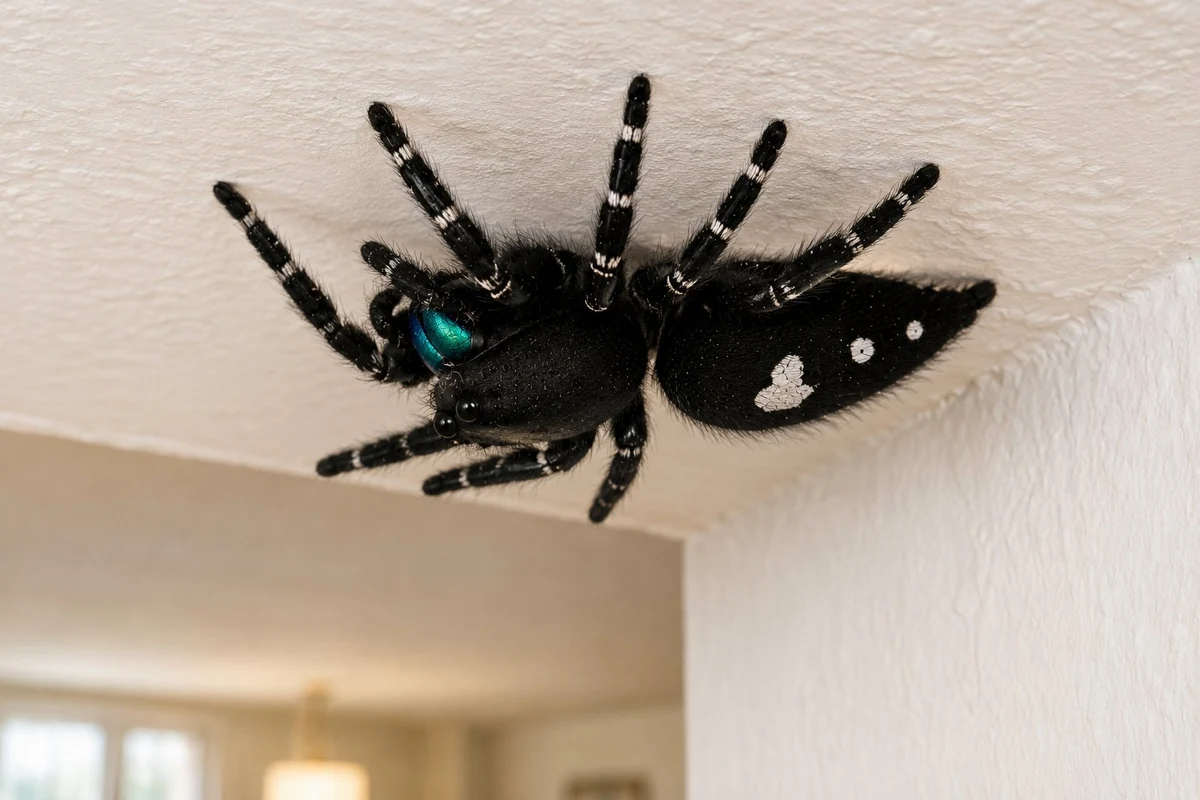

- Their venom is not considered medically significant to people.
- Bites are uncommon and happen when the spider feels threatened.
- They see movement up to 18 inches away and hunt in daylight.
- They build no web to catch prey. They stalk it and pounce.
- Clemson Extension says a female makes several egg sacs of 80 to 100 eggs.





Are jumping spiders dangerous?
Jumping spiders are not dangerous to people. They have fangs and venom, but PestWorld says the venom is not considered medically significant to humans. Clemson Cooperative Extension says these spiders are not harmful and usually flee once they are noticed, even though one will often look straight at you first.
People also ask whether jumping spiders are poisonous, and the answer is no. The PestWorld guide to jumping spiders answers the same way: they do produce venom, and it is not a medical threat. The Missouri Department of Conservation’s page on the bold jumper says the bite of this species is harmless.
The worry usually comes from a mix-up. PestWorld says jumping spiders are often mistaken for black widows because both have compact black bodies with fairly short legs. The tell is the face. A jumping spider has eight eyes in three rows, with a very large middle pair facing forward, and the bold jumping spider’s mouthparts shine metallic green or blue. If you cannot see those big front eyes, do not pick the spider up. Our article on black widow spiders covers the one that does matter.
The bold jumping spider is the one most people in Collin County meet. Missouri’s field guide gives its length as 1/4 to 3/4 inch for females, not counting legs, with males usually under 1/2 inch, and describes a fuzzy black body with white, orange or reddish spots on the abdomen.
Do jumping spiders bite?
Jumping spiders can bite, but it is rare. PestWorld says they may bite in self defense when they feel threatened, and are far more likely to run from people. A bite can bring redness, itching, stinging and swelling. Wash it with soap and water, and see a doctor if it keeps getting worse after 24 hours.
A bite usually means the spider was squeezed or handled. Missouri’s field guide says the bold jumper can bite if squeezed or otherwise handled roughly. A University of Illinois Extension writer who picked one up and was bitten said it felt like a pin prick, because the spider could not make enough venom to do harm.
For the bite itself, PestWorld suggests cleaning it with soap and water and then holding a cold compress on it. If the symptoms keep getting worse for more than 24 hours, it says to get medical attention, and to take the spider along for identification if you can.
Why is there a jumping spider in my house?
A jumping spider in the house has usually wandered in while hunting, or ridden in on a plant, a box or clothing. PestWorld says jumping spiders are unlikely to infest a home, and that indoors they are usually found hunting around windows and doors, where more insects gather and sunlight helps their eyesight.
Clemson Cooperative Extension’s fact sheet says jumping spiders wander into homes when hunting prey or are brought in by people, and that they hunt during the day both indoors and outdoors. They prefer the outside, PestWorld says, with plenty of sun, plants and insects to eat. Outdoors they run over tree bark, fences, decks and the sunny sides of buildings.
One indoors does not mean a nest in the walls. PestWorld says the most common sign of jumping spiders inside is simply seeing one, usually near a window or door. On our own calls, indoor sightings come mostly in late spring and summer, when doors stand open and adults hunt near the windows. If they keep turning up by the same window or door, the gap there is worth closing.
Do jumping spiders make webs?
Jumping spiders do not build webs to catch prey. PestWorld says they spin loosely woven, saclike retreats instead, used for molting, resting at night, getting through winter and laying eggs. The Missouri Department of Conservation says a jumping spider also trails a single silk line as a safety tether when it explores or jumps.
A jumping spider hunts with its eyes. Missouri’s field guide says the two large front eyes give it 3D vision to judge a jump, while its other six eyes look out in nearly every direction. PestWorld says jumping spiders have the best vision of any spider and can spot movement up to 18 inches away, though they see poorly at night. PestWorld also says they are active in the daytime and prefer sunshine.
How far one can jump depends on who is counting. Clemson Cooperative Extension estimates about 10 times its body length, PestWorld says 20 times when it is threatened, and University of Illinois Extension says up to 50 times. Illinois Extension explains that jumping spiders have no special jumping legs. They change the fluid pressure inside the body to snap the legs straight.
What they catch is mostly good news. Clemson lists houseflies, beetles, stinkbugs and armyworms, and PestWorld adds mosquitoes.
The jumping spider, trait by trait
These come from PestWorld, Clemson Cooperative Extension and the Missouri Department of Conservation.
| Trait | What the sources say | What it means at home |
|---|---|---|
| Venom | Not considered medically significant to people | No need to panic over one on the wall |
| Bite | Rare, in self defense, if squeezed or handled | Do not pick one up with bare hands |
| Eyes | Eight eyes in three rows, two very large ones in front | The big front eyes tell it from a black widow |
| Webs | No web for catching prey, only saclike silk retreats | Webs in corners belong to a different spider |
| When it hunts | In daylight, around windows and doors indoors | Seen at a sunny window, not in a dark closet |
| Eggs | Several egg sacs, 80 to 100 eggs in each | Young spiders spread out on their own |
| Infesting a home | Unlikely, it prefers sunny places outdoors | One inside is a visitor, not a colony |
A jumping spider is out in the open and in daylight. A small spider hiding in dark storage may be something else, and is worth a closer look.
How to get a jumping spider out of the house
- Check that it is a jumping spider. Look for the two large front eyes and, on the bold jumping spider, mouthparts that shine green or blue. If you are not sure what it is, leave it alone and send us a photo.
- Move it out with a cup. Clemson Cooperative Extension says the best way to get rid of a jumping spider indoors is not a can of insect spray. Pick it up with a glass or dish and let it go outside.
- Or vacuum it up. PestWorld suggests vacuuming the spider and throwing the vacuum bag away outside.
- Close the way in. Clemson says to keep windows and doors closed and screened, and sealed with weather stripping. PestWorld adds sealing cracks and openings in walls with a silicone caulk and patching torn screens.
- Check what you carry in, and cut the food supply. PestWorld says jumping spiders can ride in on boxes, grocery bags and plants, and Clemson says keeping the home free of other pests discourages spiders from coming in.
How Pest Me Off handles jumping spiders
On every spider control call, Pest Me Off confirms the species first, so you know which spider you have. Nearly every spider in a Collin County home is harmless, and only two, the brown recluse and the black widow, are medically significant. The jumping spider is one of the harmless ones. Our spider control page lists it as part of general service, and the fix it names is sealing window and door gaps.
When we find jumping spiders during a broader spider service, our answer is identification and plain advice. We explain why the spider helps you and recommend against treating it, and if you want fewer indoors, we find the gaps they use and seal them rather than spraying. Not sure which spider you have? Send us a photo and we will confirm it. The inspection and estimate are free, with same-day service when you call before noon, in McKinney and across Collin County.
A spider at the window you cannot name? Spider control across Collin County.
We identify the species before anything is treated, tell you plainly when a spider is harmless, and seal the gaps spiders and the insects they hunt come through. Free inspection and estimate.
