No-See-Um Bites, What They Look Like and What Keeps Them Off
A sharp sting on your arm at dusk, nothing to slap, and an hour later a cluster of small, hot red welts. That is the usual story of a no-see-um bite. Here is how to recognize them, how long they itch, how they differ from chigger bites, and what actually keeps no-see-ums off your skin.

- No-see-ums are also called biting midges, biting gnats, sand flies, sand gnats and punkies.
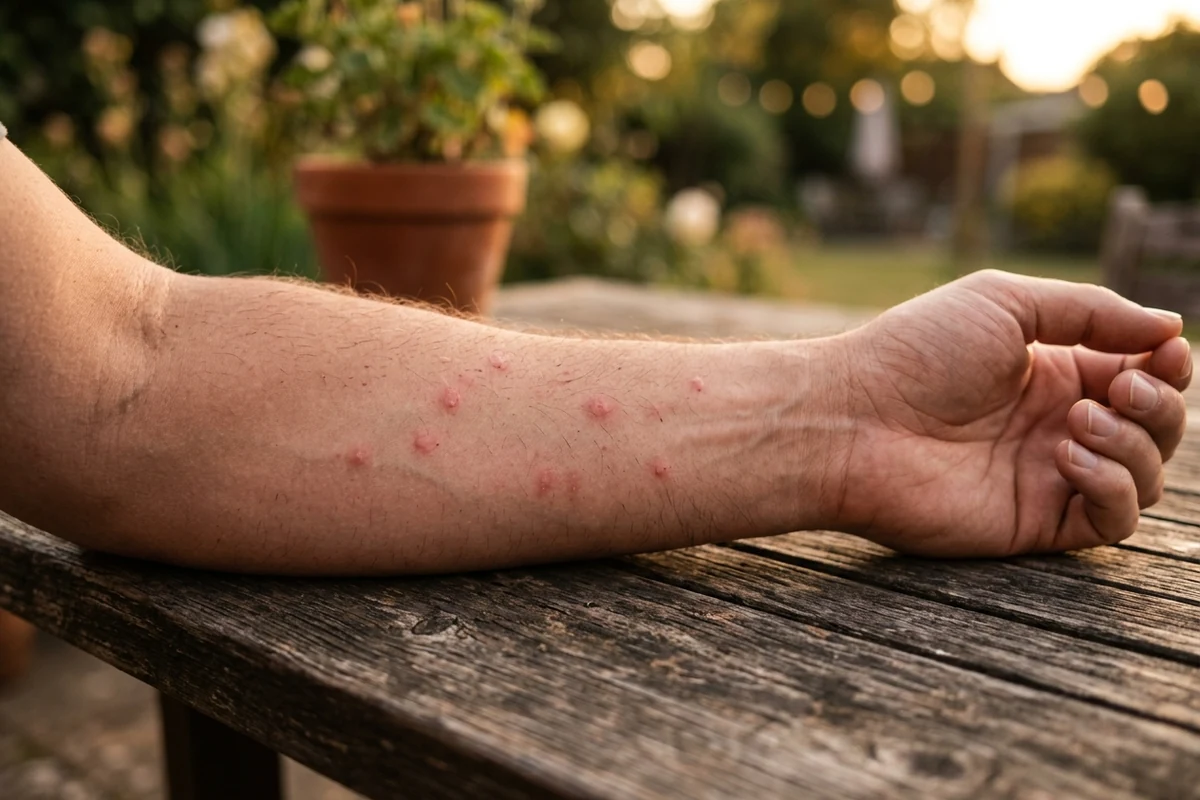
- A bite is usually a small red welt about 1/8 inch across, or a small blister.
- The sting fades in minutes to hours, but hypersensitive people may itch for 2 to 3 days.
- Most bite at dusk, at night or in the morning.
- Repellents that work on mosquitoes also work on no-see-ums.





What do no-see-um bites look like?
Small red welts or tiny water-filled blisters that itch hard. The University of Arizona Cooperative Extension says a bite usually starts as a red welt about 1/8 inch across. The University of Florida says the bite itself feels like a local sting or burn, with a defined red area around each bite. Scratching can break them open.
Look at where and when they showed up. No-see-um bites land on skin that was left bare, and the University of Arizona says the head and neck are often where they happen, after time outside near dusk. The University of Arizona’s no-see-um sheet says the welts can break open and bleed when scratched, and the itching may carry on after that.
A bite alone cannot prove which pest it was. If the bites appeared overnight in bed, or only where your clothes were tight, read the comparison further down before deciding it was a no-see-um.
Why are no-see-um bites so itchy, and how long do they last?
The University of Arizona says the main medical issue with no-see-ums is an allergic reaction to the bite. The University of Florida says the discomfort usually lasts minutes to hours, but people who are hypersensitive to the bites may itch for 2 to 3 days. Arizona adds that sensitive people can get long-lasting itchy sores.
Only the female bites, the University of Florida IFAS profile of biting midges says, because she needs blood to develop her eggs. Her mouthparts include blades the University of Florida describes as used for cutting flesh, so even a bite this small is felt as a sting.
Do no-see-ums bite at night?
Yes, and at dusk and in the morning. The University of Florida says most biting midges bite at dusk, at night or in the morning, though in cold weather and near the coast many species bite in broad daylight. The University of Arizona says they are usually active at dawn or dusk.
That timing is the best clue you have, because you will rarely see the insect. Bites that come on as the sun goes down, while you sit on the patio or water the beds, fit a no-see-um. The University of Arizona’s Backyard Gardener sheet puts the worst of it in the early mornings and evenings of mid to late summer.
They can get inside, too. The University of Florida says regular window screens do not keep them out, so bites at night indoors are possible with the windows open. Our guide to no-see-ums and where they come from covers screens and the wet spots they breed in.
No-see-um bites or chigger bites?
Look at where the bites are. Texas A&M AgriLife Extension says chigger bites are most common where clothing is tight, around sock lines, the waist and the groin. No-see-ums bite exposed skin, often the head and neck, at dusk. Chigger itching peaks 24 to 48 hours later, while a no-see-um bite is felt as a local sting or burn.
Both leave small red bumps after time outdoors in summer, so people mix them up all the time. The table below sets out what each of the two university sources says. For the full chigger picture, read our article on chigger bites and why they itch so long.
| Question | No-see-um bite | Chigger bite |
|---|---|---|
| Where on the body | Exposed skin, often head and neck | Where clothing is tight: socks, waist |
| When you notice it | Felt as a sting or burn | Itch peaks 24 to 48 hours later |
| How long it itches | Minutes to hours, 2 to 3 days if hypersensitive | A week or more for some people |
| Where you were | Outside at dusk, near wet ground | Tall grass, brush, leaf litter |
| Can you see the biter? | Barely, usually 1 to 2 mm | Typically not without magnification |
From the University of Florida, the University of Arizona, Texas A&M AgriLife Extension and Ohio State University Extension.
What repellent works on no-see-ums?
The same repellents you use for mosquitoes. The University of Arizona Cooperative Extension says repellents that work against mosquitoes work against biting midges, and the University of Florida says DEET is the main repellent used for them. One Arizona sheet says DEET seems only marginally effective against them, so cover up as well. Follow the label.
Plant oils come up often. The University of Florida reports a laboratory study in which lemon eucalyptus essential oil was up to 100 percent repellent to one biting midge species, against 75 percent for DEET. That was one species in a laboratory, not a Texas back yard, so treat it as promising rather than settled. Our comparison of DEET, picaridin and permethrin covers how each one is used and how long it lasts.
Clothing does a lot of the work. The University of Arizona suggests light-colored long sleeves, long pants, shoes and socks, and a hat with fine mesh netting for the face and neck when you will be outside at dusk near wet ground.
What helps no-see-um bites stop itching?
An over-the-counter cortisone cream usually does. The University of Arizona Cooperative Extension says topical cortisone creams usually relieve the itching, and that an over-the-counter anti-inflammatory may help with pain or swelling. For a severe reaction, it says to see a dermatologist or physician. Try not to scratch, because a broken welt can bleed and keep itching.
Then stop the next round of bites. Bites that keep coming at the same time of day, in the same part of the yard, point to a nearby source: a bed the sprinklers keep soaked, a low corner that never dries, or a drain line dripping onto the soil. The University of Arizona says letting those wet spots dry out kills the eggs and larvae, and that a fan helps keep no-see-ums away, so set one blowing across the patio seats.
When to call Pest Me Off about bites
If your family keeps getting bitten at home in McKinney, Allen, Frisco or Plano and you cannot see what is doing it, call us. We identify the insect before anything else, because a bite alone does not tell us which pest it was. No-see-ums, chiggers, fleas and mosquitoes all leave small red bumps.
Then we inspect the yard and the house for what fits: wet ground and irrigation leaks where no-see-ums breed, the screens and door seals they get through, or the grass and brush where chiggers wait. When treatment is warranted, we target the places where they rest. We explain what we found and what we recommend before any work is done.
Before we come, note where and when the bites happen, keep a photo of the bites or the insect if you can, and tell us about any earlier treatments. If we apply anything, we give you specific instructions for getting ready and for when you can go back out. Our no-see-um control page explains the service.
Bitten every evening by something you cannot see? Same-day pest control in McKinney and the surrounding cities when you call before noon.
We ask where and when the bites happen and look at the yard before we recommend anything. Free inspection and estimate.