
Yellowjacket Nests in the Ground, and What a Sting Means
Most people find a yellowjacket nest by accident, with a mower or a string trimmer, and usually late in the summer. This article covers where yellowjackets nest, why they turn aggressive in the fall, what to do for a sting, whether they leave a stinger, and how a nest in the ground gets treated.
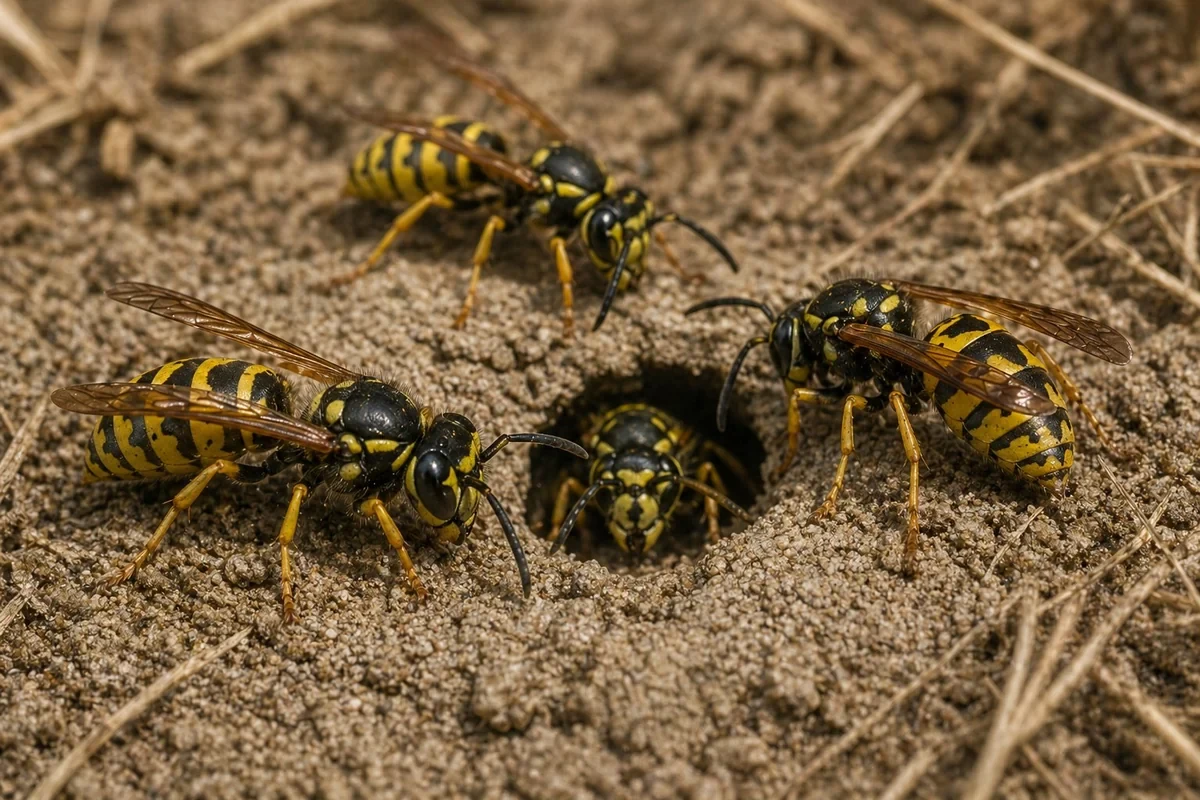

- Most yellowjacket nests are underground, often in an old rodent burrow.
- Colonies peak in late summer and early fall, when they defend the nest hardest.
- A yellowjacket keeps its stinger and can sting again and again.
- A ground nest is treated at night, when the workers are home.
- Never plug the hole or pour gasoline into it.





Do yellow jackets live in the ground?
Most of them do. NC State Extension says yellowjacket nests are usually underground, often under a landscape timber or some other spot nobody looks at, and the University of California says they commonly take over old rodent burrows and dig them bigger. Some nest in wall voids instead. From outside, the only sign is a busy hole.
The nest itself is out of sight. The University of California describes tiers of paper cells wrapped in a paper envelope with a single entrance, and says the nest can sit some distance from the hole you see. Its colonies run from 1,500 to 15,000 wasps, depending on the species, and NC State puts an eastern yellowjacket colony at about 3,000 workers.
That is why most people meet one by surprise. NC State says most people discover a nest by accident when working or mowing nearby. Many Texans call these ground hornets, as our yellowjacket library page notes, though they are wasps rather than true hornets. Our articles on paper wasp nests and hornets in Texas cover the wasps whose nests you can see.
Why are yellow jackets so aggressive in the fall?
Their colonies are at or near their peak and food is getting scarce. The University of California says defensive behavior increases as the season goes on, while colonies grow and food becomes scarcer, and Clemson Extension says populations peak in late summer and early fall, when yellowjackets go after the same foods and drinks people do.
Are yellowjackets aggressive the rest of the year? NC State says they sting repeatedly and many workers swarm out aggressively whenever a nest is disturbed, and the University of California says even a yellowjacket away from its nest will sting if someone swats at it near food.
Earlier in the year the workers hunt insects to feed the young, and Clemson Extension counts them as useful around gardens because they eat caterpillars and harmful flies. By late summer they want sugar. The University of California says workers out looking for food in the fall turn up at picnics, garbage cans, outdoor pet food and overripe fruit, and that they crawl into open soda cans and can sting the lips, mouth or throat.
Clemson says live yellowjackets have been swallowed from drinks, causing a life-threatening sting in the throat, so check an open can before drinking from it outside.
What should you do for a yellow jacket sting?
Get away from the nest first, then wash the sting and hold a cold compress on it. The University of California says over-the-counter products, a cold compress or an antihistamine cream with a skin coolant can ease the pain and itching. Get medical help at once for a sting on the neck or mouth, or any trouble breathing.
The University of California's note on bee and wasp stings says a sting starts as a sharp pain for a few minutes and settles into a dull ache, and the spot can stay tender for a few days. The redness and swelling are the body flushing the venom, and they can be much larger in someone stung before. Try not to scratch, because that can let in an infection. NC State says the soreness, swelling and itching may persist for days.
The same note warns that an allergic reaction can start right away or up to 30 minutes later. It lists hives, nausea, vomiting and cramps as allergic reactions that are not life-threatening, and says anyone who may be allergic should see a doctor or allergist for testing. Dizziness, trouble breathing or swelling in the throat need emergency care at once, and anyone who knows they are allergic should carry the epinephrine a doctor prescribes.

Do yellow jackets leave a stinger?
No. Clemson Extension says a yellowjacket does not leave a stinger in its victim, so it can sting several times, while a honey bee has a barbed stinger and can sting only once. A stinger left in the skin points to a honey bee, and the University of California says to remove it right away.
Speed matters with a bee stinger. The University of California says it keeps pumping venom for 45 to 60 seconds, that fingernails or the edge of a credit card work equally well, and that getting it out within 15 seconds makes the sting less severe.
The University of California's yellowjacket note says a wasp stinger can be used again and again, especially once the wasp gets inside clothing, and its sting note says insect repellent does nothing to keep stinging insects away.
How do you get rid of yellow jackets in the ground?
Hiring a professional reduces the risk, the University of California says, and any treatment goes in at night, when the workers are home. Clemson Extension says to mark the entrance in daylight and treat in the late evening or at night, and NC State says never to pour gasoline or any fire accelerant down a nest.
Even at night it is risky work. The University of California says stings are likely even after dark and that the nest can be too far from the entrance for a spray to reach. Clemson adds that yellowjackets are attracted to light, so do not hold a flashlight while treating a nest.
Our own rule is to never plug the hole. Our yellowjacket control page says a blocked exit sends the wasps through the wall into the living space, so the entry stays open until the colony is dead.
Do yellow jackets die in the winter?
Most of the colony does. Clemson Extension says the original queen and the workers die with the onset of cold and the first hard freeze eliminates most colonies, while newly mated queens spend the winter alone in a sheltered spot. NC State says yellowjackets do not reuse old nests, so each spring starts a new one.
A nest nobody ever walks near can be left for the cold, Clemson says, though in Collin County that can mean waiting into winter. The University of California notes that in very mild winters some colonies survive for several years and grow quite large.
Yellowjacket sting reactions, and what each one needs
These come from the University of California's note on bee and wasp stings and NC State Extension.
| What you notice | What it means | What to do |
|---|---|---|
| Sharp pain, then a dull ache | The usual sting, tender a few days | Wash it and use a cold compress |
| Redness, swelling and itching | The body flushing out the venom | An antihistamine, and no scratching |
| Hives, nausea or cramps | Allergic signs the note calls not life-threatening | Get checked promptly, and emergency care if breathing changes |
| Dizziness or trouble breathing | A life-threatening allergic reaction | Emergency care, and epinephrine if prescribed |
| Many stings at once | The venom can harm the kidneys days later | Tell a doctor, and watch for a week or two |
A sting on the neck or in the mouth needs medical attention right away, allergy or not.
If you run into a ground nest while mowing
- Walk away from the nest, covering your face with your hands, and head for a building, a car or thick plants, as Clemson advises.
- Do not swat. Clemson says fast movements draw more yellowjackets, and they keep stinging.
- Wash each sting and hold a cold compress on it, as the University of California advises.
- Watch the person stung for the next 30 minutes, since the University of California says an allergic reaction can start that late. Call 911 for trouble breathing, swelling of the throat or face, or fainting, and use their epinephrine if a doctor prescribed it.
- Mark the spot from well back while it is light, keep children and pets away, and leave the hole open. Our yellowjacket control page says to mark the spot, stay well back, and call.
How Pest Me Off treats a yellowjacket nest
On a yellowjacket control visit, Pest Me Off locates the real nest and every entry, not just the one hole you found, because the nest can sit 12 to 24 inches below ground or deep inside a wall. A licensed applicator in protective gear applies a professional dust the workers carry deep to the queen, at the right time of day. We leave the entry open until the nest is confirmed dead, then seal the void so a new queen cannot reuse it, because a plugged hole sends the wasps into the living space.
We also install the Scorched Earth Barrier around the foundation, and you are back outside in 1 to 2 hours once the treatment settles. The inspection and estimate are free, with same-day service when you call before noon, in McKinney, Plano, Frisco, Allen and across Collin County. Our yellowjacket page in the pest library shows how to tell one from a honey bee.
Yellowjackets coming out of the lawn or a wall? Same-day pest control in McKinney and the surrounding cities when you call before noon.
We find the real nest and every entry, treat it when the colony is home and seal the gap only once it is dead. Free inspection and estimate.
