
Pigeons Nesting on the House, and Which Birds the Law Protects
Cooing on the roof, sticks poking out from under the solar panels and white streaks down the wall usually mean pigeons have started nesting on the house. This article covers where pigeons nest and when, whether Texas law protects them, how to tell a pigeon from a dove, and how to get pigeons off the roof for good.
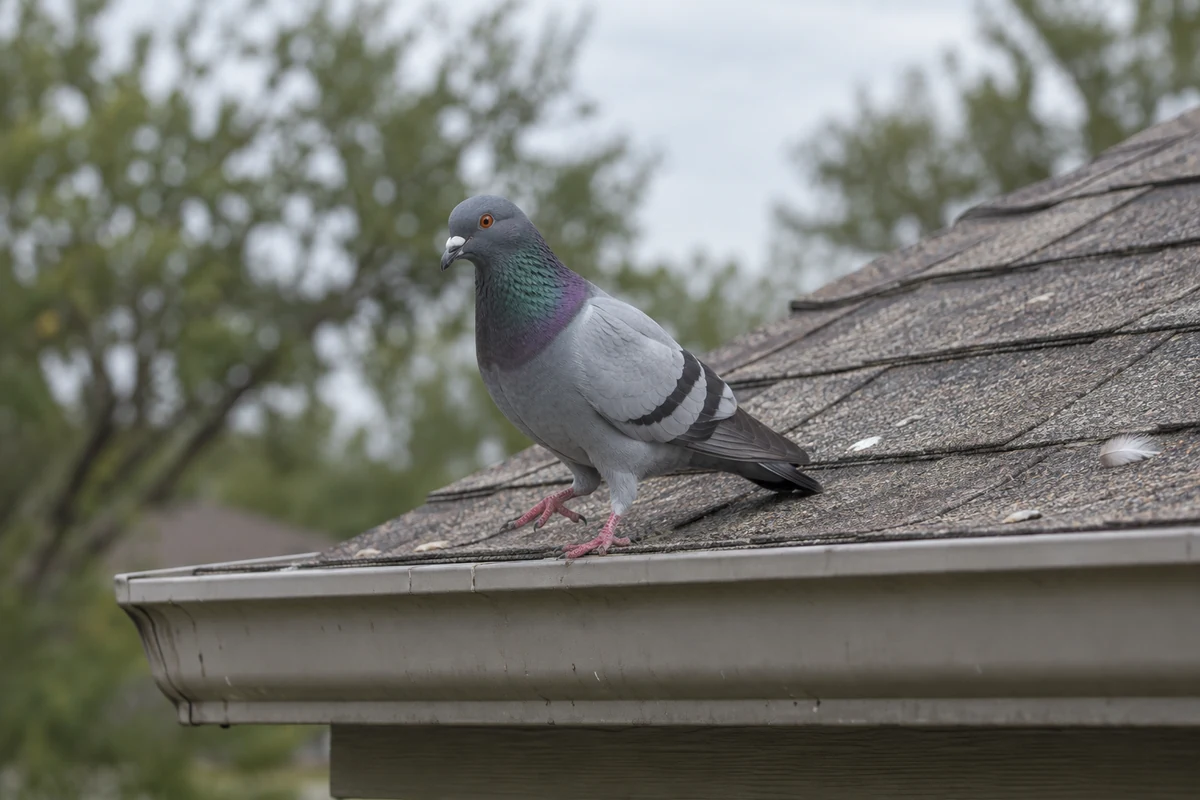

- Pigeons can breed in every season, with peaks in spring and fall.
- A pair raises 5 to 6 broods a year, 1 or 2 eggs at a time.
- Texas law does not protect feral pigeons, starlings or house sparrows.
- Native birds, their eggs, nests and young are protected.
- Piled droppings can grow the fungus that causes histoplasmosis.





Where do pigeons nest on a house?
Pigeons nest on sheltered ledges and inside openings in a building. The Internet Center for Wildlife Damage Management lists attics, lofts and building features with openings, and describes the nest as a crude platform of sticks, twigs and grass. Around Collin County homes we also find pigeon nests under rooftop solar panels.
What a pigeon wants is a flat spot with a roof over it, close to food and water. The wildlife damage center’s pigeon biology page says pigeons depend heavily on people for food and for places to roost and nest, eat mainly grain and seed, and need about 1 ounce of water a day. Spilled bird seed, pet food on a patio and a dripping faucet all help hold a flock.
The nest itself causes problems. The center’s damage identification page says nests can block exhaust vents and may cause fires, and that piled droppings plug roof gutters and cause water damage. The droppings are acidic and wear down building materials. On our own calls, nuisance birds in bathroom and dryer vents are usually starlings and house sparrows, while pigeons take the ledges over porch lights and the space under solar panels. That split is where the nuisance birds page in our pest library starts.
When is pigeon nesting season?
Pigeons can nest in any season. The Internet Center for Wildlife Damage Management says they breed all year, with peaks in spring and fall, and raise 5 to 6 broods a year. Each time the female lays 1 or 2 eggs, which hatch after 18 days, and the young leave the nest at 4 to 6 weeks.
The same page adds that most of those broods are raised in spring and summer, when temperatures stay above freezing, and that a pair often lays the next eggs before the first young have left. So a ledge that held one nest in March can hold another in May.

That pace is why pulling one nest rarely settles it. The center’s control page says most pest birds are quick to rebuild, often in the same spot, so the place has to be blocked, or the nests removed again and again from spring through fall.
Are pigeons protected in Texas?
Feral pigeons are not protected in Texas. Texas Parks and Wildlife says wild birds native to Texas or migrating through it are protected with their eggs, nests and young, but European starlings, English sparrows and feral pigeons may be killed at any time and their nests destroyed. No bird may be controlled by means a local ordinance makes illegal.
That comes from the department’s page on protected wildlife species in Texas, which also says no bird may be controlled by any means a city or county ordinance makes illegal. It adds that grackles, cowbirds, several blackbirds, crows and magpies may be controlled without a permit when they are a nuisance or a public health hazard. The Internet Center for Wildlife Damage Management’s pigeon page says feral pigeons are not protected by federal law either, but that state and local laws should be checked before any control, and that some cities are bird sanctuaries protecting every species.
The catch is the bird you think is a pigeon. Most native birds that nest on houses are protected, and pulling an active nest of one is against the law. If you are not sure which bird it is, leave the nest alone until it has been identified.
What is the difference between pigeons and doves?
Pigeons and doves belong to the same bird family, and Texas Parks and Wildlife says there is technically no difference between the words. The difference that matters is the law. The feral pigeon, also called the rock dove, is not protected, while the native mourning dove is, so check the bird before touching a nest.
Texas Parks and Wildlife’s guide to doves and pigeons calls the plump bird on a building ledge a rock dove, says it has been introduced into almost all parts of the world, and notes that it usually flies in flocks. It describes the mourning dove’s pointed tail. The wildlife damage center says the pigeon is larger than the tawny-brown mourning dove, which is native and protected by federal and state rules.
A feral pigeon is about 12 inches long, usually blue-gray with two black bands on each wing, a black band on the tail, a white rump and red feet, according to the wildlife damage center. Its colors vary, from all white to mottled brown to sooty black.
How do you get rid of pigeons on a roof?
To get rid of pigeons on a roof, take away their food and water, then block the places they sit and nest. The Internet Center for Wildlife Damage Management says to close openings with 1/4 inch rust-proofed wire mesh and to angle ledges at 45 degrees or more. Noise and scare devices have little lasting effect.
The center’s control page lists porcupine wires and coils, stainless steel prongs or coils fixed along a ledge, as ways to keep pigeons from landing, and says the prongs sometimes get covered with nesting material and need clearing. It says noise makers have little permanent effect on roosting pigeons, high-frequency sound does not work on them, and owl models, balloons and flags do little or nothing.
New Mexico State University’s extension guide to nuisance birds agrees that scare devices have little or no effect on pigeons, and gives one more reason not to trap and drive them somewhere. Pigeons are likely to come back even when released 50 miles or more away. It also reports Salmonella, a cause of food poisoning, in about 2% of pigeon droppings.
Which birds on a house the law protects
These come from Texas Parks and Wildlife, the Internet Center for Wildlife Damage Management and New Mexico State University.
| Bird | Protected in Texas? | How to tell it |
|---|---|---|
| Feral pigeon (rock dove) | No | About 12 inches, blue-gray, two black wing bands, red feet |
| European starling | No | Robin sized, short square tail, black with light speckles |
| House sparrow | No | About 5 3/4 inches, brown and chunky, male has a black throat |
| Mourning dove | Yes, it is a game bird | Smaller and tawny brown, with a pointed tail |
| Other native birds | Yes, with their eggs, nests and young | Name the bird before any nest is moved |
Only three birds may be killed at any time and their nests destroyed under Texas law. Grackles, cowbirds, blackbirds, crows and magpies may be controlled without a permit when they are a nuisance. Anything else gets identified before its nest is touched.
How to keep pigeons from nesting on the house
- Name the bird first. A feral pigeon, starling or house sparrow nest may be removed. A native bird’s active nest may not.
- Take away the food and water. The wildlife damage center says removing feeding, watering, roosting and nesting sites is important in controlling pigeons in the long run. Clean up spilled seed under feeders, bring pet food in and fix standing water.
- Close the openings. Block vents and eaves with 1/4 inch wire mesh. New Mexico State University says to close openings over 3/4 inch to keep out house sparrows and over 1 inch to keep out starlings. The gap under rooftop solar panels is an opening like any other, and the wildlife damage center lists wire mesh or netting for shutting birds out of nest sites.
- Make the ledges unusable. The wildlife damage center says changing a ledge to an angle of 45 degrees or more discourages pigeons from roosting on it, and lists porcupine wires and coils for ledges and sills.
- Clean up with care. The center says soil holding bird droppings encourages the fungus that causes histoplasmosis, and advises gloves and a plastic bag for nest material because of nest mites and lice. Leave a large pile of droppings to a professional.
How Pest Me Off handles pigeons and nesting birds
Birds are part of Pest Me Off’s wildlife removal work. We confirm the species first, because many birds are protected, and confirm whether the nest is active before anything is removed. Most native birds and their active nests are protected by state and federal law, while European starlings, house sparrows and feral pigeons are not. Then we remove and screen the opening where the law allows.
We clear nesting and droppings from the access area, then the vent or soffit gets screened so the birds cannot come back, through our rodent proofing and exclusion service. The wildlife inspection is free, and the job is quoted after it, never guessed over the phone. Same-day service when you call before noon, in McKinney and the surrounding cities.
Pigeons on the roof or birds in a vent? Wildlife removal across Collin County.
We name the bird and check the nest first, remove what the law allows, clear the nest and droppings, and screen the opening so the next pair cannot move in. Free wildlife inspection.
