
Are Cicada Killers Dangerous? The Giant Ground Wasps in Collin County Lawns
The giant wasp flying low over a Collin County lawn in July, going in and out of a hole with a pile of dirt beside it, is almost always a cicada killer. It looks frightening and it is close to harmless. This article covers whether cicada killers are dangerous, how to tell them from the ground yellowjackets that really are, and what to do about the holes in the yard.
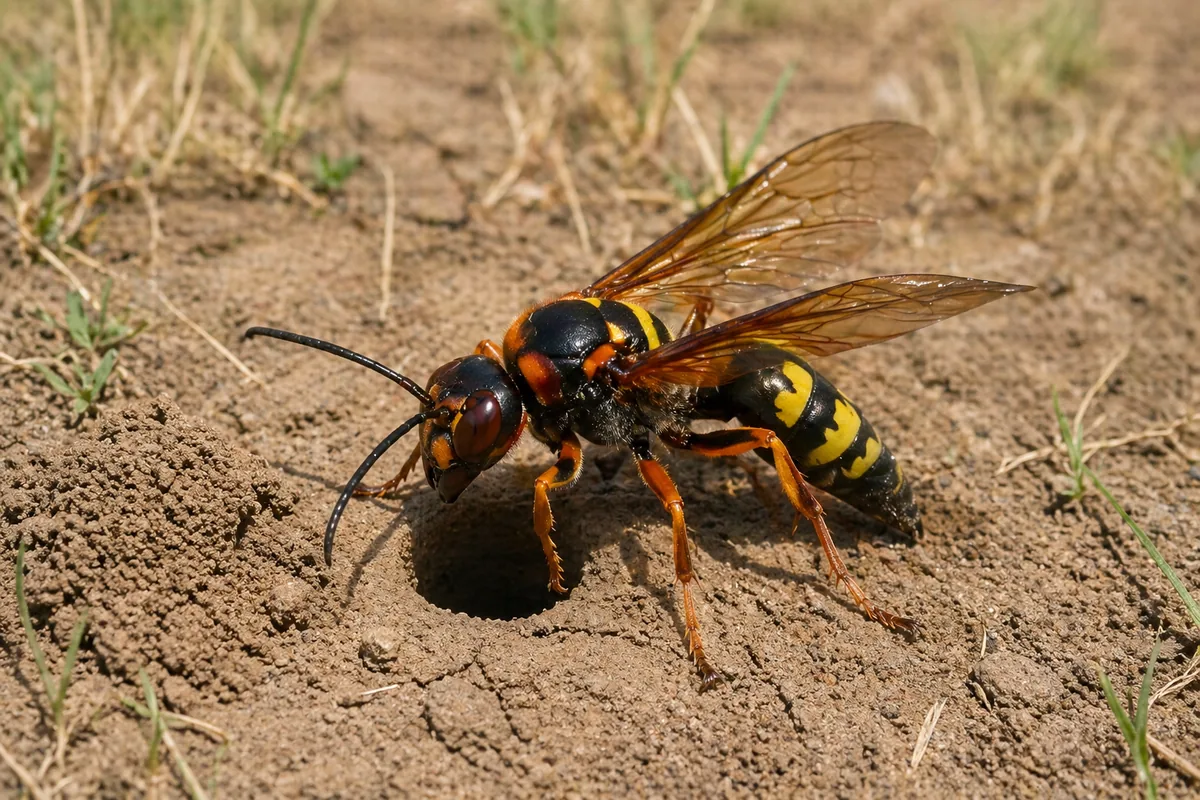

- Only female cicada killers can sting, and they rarely sting people.
- The males that dive at people have no stinger at all.
- Cicada killers are among the largest wasps in North America, with females close to 2 inches long.
- Each female digs her own burrow in bare, sunny soil, with a U-shaped mound of dirt at the hole.
- Adults are seen most in July and August.





Are cicada killers dangerous?
Cicada killers are not dangerous to people unless one is grabbed or stepped on. The Missouri Department of Conservation says the eastern cicada killer is not aggressive to people and is virtually harmless unless handled roughly. The University of Kentucky says that despite their size they are not stinging hazards unless directly disturbed.
Kentucky adds that the trouble their digging causes is mostly about how the lawn looks.
The size is what scares people. The Ohio State University fact sheet on the cicada killer calls it one of the largest wasps in North America, about 1⅛ to 1⅝ inches long, with a dark red head and middle, a black body striped with yellow and brownish wings. The University of Kentucky puts the biggest females at nearly 2 inches. Our cicada killer page in the pest library has close-up photos and the burrow at each stage.
One group should keep its distance. The Missouri Department of Conservation says people allergic to wasp stings should stay away from all wasps, cicada killers included.
Do cicada killers sting?
Only female cicada killers can sting, and they rarely sting people. The University of Kentucky says the males have no stinger at all, only a false one that cannot sting, and that stings almost always happen when someone steps on a female or grabs her.
The University of Maryland explains that the female saves her sting for the cicadas she hunts, which she paralyzes and carries back to her burrow.
A female cicada killer has no colony to defend. The Missouri Department of Conservation page on the eastern cicada killer explains that a solitary wasp has little reason to attack, because if she dies there are no sisters to keep her nest going. Ohio State says females are usually mild-mannered and fly away when disturbed. Shoes in the yard in July and August are the simplest protection, since stepping on a female or grabbing her is how nearly every sting happens.
What do male cicada killers do?
Male cicada killers guard a patch of lawn and fly at anything that moves through it, people included. Ohio State says the males are very territorial and will approach humans, animals and other males near the nesting area, and that while they may appear aggressive, they are harmless.
The University of Kentucky adds that males hover at eye level to inspect people, and that they have no stinger to attack with.
Males may defend their patch by diving at people’s heads and shoulders, Ohio State says, which is when homeowners tend to decide something has to be done. The males come out before the females, according to the University of Kentucky, and Ohio State says they typically die soon after mating. Adults live about 60 to 75 days, so the buzzing over the lawn ends on its own by late summer.
Cicada killer or ground yellowjacket, told apart
Both nest in the ground around Collin County homes, and only one of them is a real stinging risk. These details come from Ohio State, the University of Kentucky, the Missouri Department of Conservation and the University of California.
| Feature | Cicada killer | Ground yellowjacket |
|---|---|---|
| Size | About 1⅛ to nearly 2 inches | ½ to 1 inch |
| Color | Reddish head and middle, black body with yellow stripes, brownish wings | Jagged bright yellow and black stripes |
| Nest | One burrow in bare, sunny soil with a U-shaped mound of dirt at the hole | A hole in the ground, often an old rodent burrow, or a space inside a wall |
| Wasps in a nest | One female, with no colony | 1,500 to 15,000, depending on the species |
| Defends the nest | Rarely. A female stings only when grabbed or stepped on | Yes, vigorously, when the nest is disturbed |
A huge wasp with a mound of soil at its hole is a cicada killer. A stream of smaller wasps flying in and out of one hole in the lawn is a yellowjacket nest.

The University of California page on yellowjackets says ground and cavity nesting yellowjackets defend their nests vigorously when disturbed, and that an underground nest can sit some distance from the hole you see. Yellowjackets have their own page in our pest library, and a nest in the lawn is a job for yellowjacket control. The black and white wasps with a gray paper ball in a tree are covered in our article on hornets in Texas.
What attracts cicada killers to a yard?
Cicada killers are drawn to bare, dry, sunny soil and to the cicadas living in nearby trees. Ohio State says females prefer to dig in full sun where the soil drains well and plants are sparse, and that they may burrow near sidewalks or patio edges.
The University of Kentucky says they want well-drained, light soil in full sunlight, and that the females hunt the annual cicadas that come out in July and August.
Around Collin County homes we find them most often in the thin strip of lawn beside a driveway or sidewalk. According to Ohio State, each female digs her own burrow 6 to 10 inches deep and about half an inch wide, throwing out enough soil to leave a U-shaped mound at the hole. The Missouri Department of Conservation says females usually dig in groups, so one yard can end up with a dozen holes. It also points out that the digging aerates the soil and helps rain soak in.
How to get rid of cicada killers in your yard
- Decide whether they have to go. Ohio State and the University of Maryland both call cicada killers beneficial, Ohio State and the University of Kentucky say control is rarely needed, and Maryland says the nest building is temporary.
- Change the spot they like. The University of Maryland suggests thickening thin lawn by overseeding in the fall, running a sprinkler over the nesting area, and covering bare soil in beds with 2 to 3 inches of mulch or a thick groundcover.
- Skip spraying the lawn. The University of Kentucky says liquid insecticides on the turf above the tunnels will not help, and Ohio State says sprays are rarely effective.
- To treat the burrows yourself, Ohio State says to find them in daylight, then treat after dark or before dawn while it is cool, wearing protective clothing. Put an insecticidal dust on each entrance without disturbing the hole, and repeat for two to three weeks if new wasps move in. The University of Maryland says to use a dust labeled for ground-nesting bees and wasps. Read and follow the label.
- Call a professional when someone in the house is sensitive to stings, as Ohio State advises, when the holes are by a pool, a play set or a walkway, or when the wasps turn out to be yellowjackets.
How Pest Me Off handles cicada killers and ground wasps
Pest Me Off’s wasp and hornet control starts by confirming which wasp is coming out of the ground, because a lawn full of cicada killers and one hole full of yellowjackets need very different answers. A technician treats yellowjacket nests and the cicada killer burrows beside pools, patios, play areas and walkways, and tells you plainly when the cicada killers in the back of the yard can be left to finish their season.
Same-day service is available for McKinney and the surrounding cities when you call before noon, with no-contract options.
Giant wasps digging in the lawn, or a hole full of yellowjackets? Same-day pest control in McKinney and the surrounding cities when you call before noon.
We tell you which wasp it is, treat the yellowjacket nests and the burrows by your pool, patio and play areas, and say plainly when the cicada killers can be left to finish their season. No-contract options.
