
Clover Mites in Collin County, TX | Identification and Control
A clover mite is a tiny plant-feeding mite, often called a tiny red bug, little red bug or red mite, that lives in the lawn and climbs the sunny walls of a house in spring and fall. Penn State Extension says an adult is 0.75 mm long. Clover mites do not bite people and they are not chiggers, but they stain when crushed.
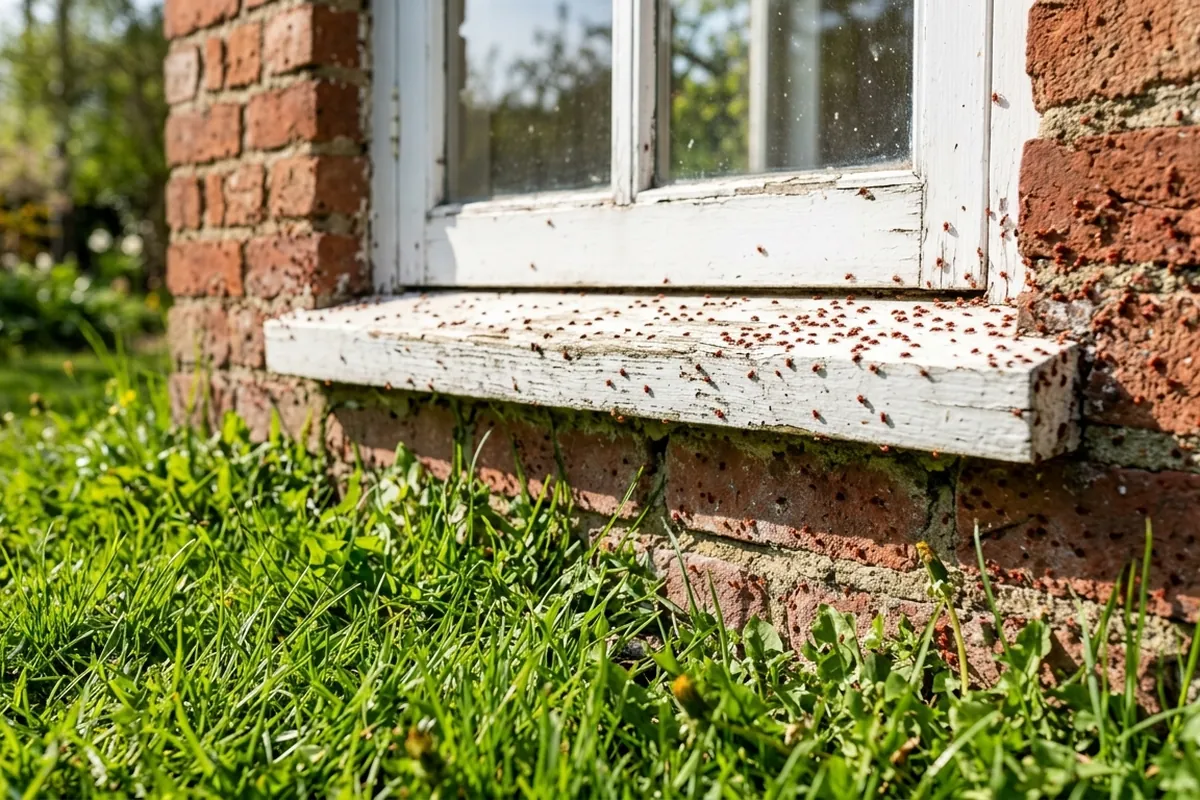
Tiny red bugs on the windowsills or the sunny wall? Our office sits where McKinney, Plano, Frisco and Allen meet, 5 to 10 minutes from most homes in those four cities. Call and tell us where and when you see them. We inspect first, then explain what we recommend.
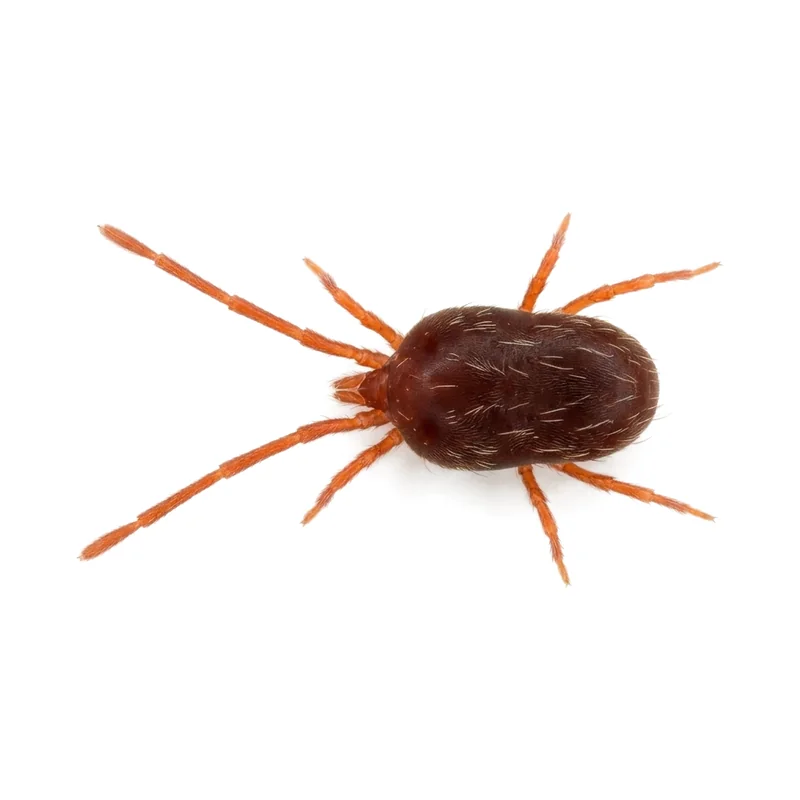
Clover Mite
The clover mite is an eight-legged mite, a close relative of ticks and spiders rather than an insect, Oklahoma State University Extension says. It feeds on plants, and Penn State Extension says it does not attack people.
Risk Assessment
Choose a row for the full detail- Color
- Adults reddish or greenish brown, eggs and young bright red
- Diet
- Grass, clover and other low plants, over 200 kinds
- Threat level
- Low, a nuisance that does not bite
- Where it hides
- Lawns beside the house, with eggs in cracks in concrete, under bark and between walls
- Active season
- Spring and fall, quiet in summer heat
- Adult lifespan
- About 2 weeks outdoors
- Generation time
- About 1 month
- Size
- 0.75 mm, about 1/30 inch
What Does a Clover Mite Look Like?
Penn State Extension says adult clover mites are 0.75 mm long, reddish or greenish, with a greatly lengthened first pair of legs. Oklahoma State University Extension puts them at about 1/30 inch, red or brown, with flattened, scale-like hairs on the back and front legs that can look like antennae.
Texas A&M AgriLife Extension’s Insects in the City blog says those front legs are nearly twice the length of the others and reach forward past the head. The eggs and the six-legged young are bright red. Utah State University Extension says they are about the size of a period on a typed page, and to use a hand lens to be sure.
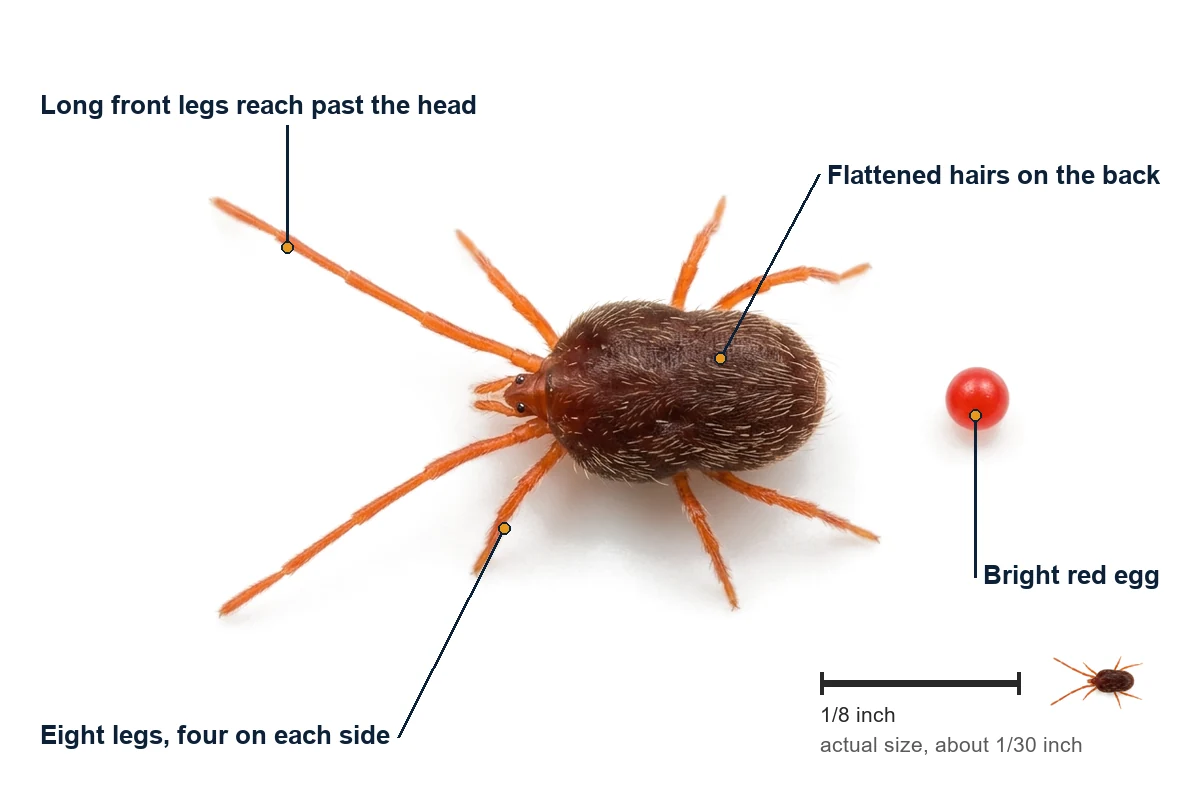
Texas A&M says the clover mite’s front legs are nearly twice the length of the rest.
- Red or greenish dots walking on a sunny wall, windowsill or patio
- A front pair of legs much longer than the rest, reaching past the head
- Hundreds or thousands at once, most on the south and west sides of the house
- A rusty red smear when one is crushed
- No bites, even with mites crawling on the sill
- Seen mostly in spring and fall, gone in the summer heat
Other Names for the Clover Mite
People often call clover mites tiny red bugs, little red bugs or red mites. Texas A&M AgriLife Extension’s Insects in the City blog says they are also known as brown mites, and Colorado State University Extension says they are often described as walking dust specks. Their scientific name is Bryobia praetiosa.
Texas A&M places them in the spider mite family, Tetranychidae. Texas A&M AgriLife Extension’s chigger guide says chiggers belong to a different mite family, Trombiculidae, so a clover mite is not a chigger. Oklahoma State University Extension notes some debate over whether the clover mite is one species or a group of close relatives.
| Name | What it means |
|---|---|
| Tiny red bug | An everyday name for the red specks on walls and windowsills. |
| Little red bug | The same everyday name, said another way. |
| Red mite | A name for the color, and a reminder that it is a mite, not an insect. |
| Brown mite | Another name Texas A&M gives for the clover mite. |
| Walking dust speck | How Colorado State says clover mites are often described. |
| Bryobia praetiosa | The scientific name. |
How to Tell Clover Mites from Chiggers and Other Mites
Clover mites and chiggers are both red mites that live in yards, and only one of them bites. Where you find them tells them apart. Clover mites walk in the open on sunny walls, patios and windowsills. Chiggers wait in shaded grass and brush, a job for Chigger Control, and are covered in Chiggers in our pest library.
| Species | Size and Color | Key Feature | Where Found |
|---|---|---|---|
|
Clover Mite
AKA: Tiny Red Bug
Bryobia praetiosa
This species
|
0.75 mm, about 1/30 inch. Reddish or greenish brown, with bright red eggs and young. | Front legs much longer than the rest. Does not bite. Leaves a rusty red stain when crushed. | Lawns beside the house, and sunny walls, windowsills and doors, mostly in spring and fall. |
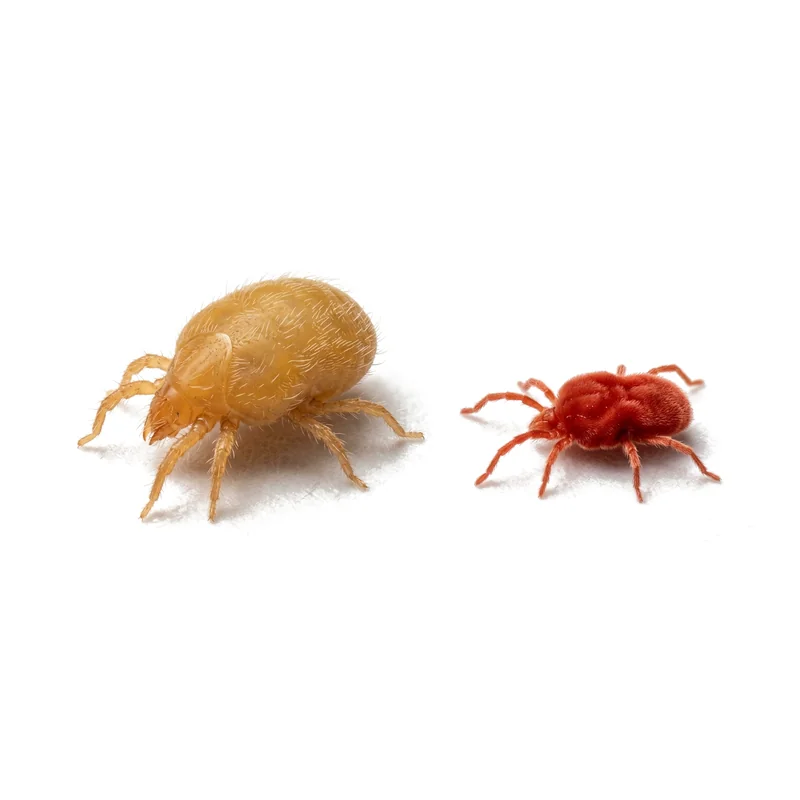
Chigger
AKA: Red Bug
Eutrombicula species
|
The biting young is about 1/100 inch, yellowish to light red. The adult is about 1 mm, bright red and velvety. | The biting young is rarely seen. Bites cluster where clothing is tight, at sock lines and waistbands. | Shaded soil under grass, weeds and brush, late spring to fall. |
|
Banks Grass Mite
Oligonychus pratensis
|
Smaller and lighter than a clover mite. Green most of the season, sometimes bright red. | Lacks the clover mite’s long front legs. Turns dry grass a bleached straw color. | Drought-stressed lawns, and not as concentrated around buildings. |
Clover Mites vs Chiggers
The Clover Mite in Three Numbers
0.75 mm
Penn State Extension says an adult clover mite is 0.75 mm long.
Penn State Extension
Up to 70
Texas A&M AgriLife Extension says a female clover mite can lay up to 70 eggs.
Texas A&M AgriLife Extension
200+
Texas A&M AgriLife Extension says clover mites have been found on over 200 plant species.
Texas A&M AgriLife Extension
Do Clover Mites Bite People?
No. Penn State Extension says clover mites are plant feeders that do not attack people, and Colorado State University Extension says they do not bite people, transmit diseases or feed on household furnishings. That makes clover mites a nuisance indoors rather than a biter.
If you have itchy bites after time in the yard, clover mites are not the cause, and chiggers are worth a look.
Do Clover Mites Stain?
Yes, when crushed. Oklahoma State University Extension says a crushed clover mite can leave a reddish orange stain on curtains, bedspreads, furniture, walls or carpets, and Colorado State University Extension says the rusty red stains show up on white surfaces.
Texas A&M says wiping them up makes a smear that messes up fabrics and walls, and suggests a handheld vacuum instead, emptied straight away. Penn State says a strong vacuum also keeps them from staining.
Are Clover Mites Harmful?
Not to people or the house. Utah State University Extension lists them as not a health threat, Texas A&M says they do not damage food or structures, and Oklahoma State says they do not feed on anything in the home. The harm is the sheer number of them coming inside at once.
Utah State says hundreds or thousands at once can be a major nuisance.
When Clover Mites Are Worth a Call
Hundreds Coming In Every Day
Utah State says hundreds or thousands at once can be a major nuisance. Steady numbers inside point to a way in on the sunny side.
Stains on Curtains and Carpet
Crushed mites leave reddish orange stains, Oklahoma State says. Switch to a vacuum before the stains spread.
A Handful on the Patio
A few clover mites outdoors do no harm to the house. Texas A&M says mowing, weeding and a strong spray from a hose can cut their numbers.
Bites After Time in the Yard
Clover mites do not bite. If you have itchy bites after time in tall grass, read about chiggers, a different mite that does.
Why You Have Clover Mites in the House
Clover mites live in the lawn and feed on grass and other low plants. Penn State Extension says those near a house may climb the outside walls and get in around windows or doors, and that how well fed the lawn is and how close it sits to the house appear to govern how likely an invasion is. Texas A&M AgriLife Extension says they are more likely on heavily fertilized lawns.
Some start inside the walls. Penn State says the eggs spend the winter in cracks in concrete, under tree bark and between the walls of buildings, and that mites hatching inside a wall can walk into the living areas instead of going outside. The good news, Penn State adds, is that they do not reproduce indoors and die within a few days from drying out.
Where Clover Mites Live Around Collin County Homes
Clover mites live in lawns and favor clover and grass. Colorado State University Extension says the lawn damage they cause almost always sits within 10 feet of a building, tree or other upright surface, because they climb out of the lawn to shed their skins and lay eggs. That same habit puts them on your walls.
Clover Mite Pressure Across Collin County
Clover mites follow the lawn and the sun, not the city line. In McKinney, Frisco, Allen and Plano, the homes that fit what Texas A&M and Penn State describe are the ones where a well-fed lawn runs right up to a sunny wall.
The same holds in Princeton, Prosper and Farmersville, wherever grass runs right up to the foundation on the sunny side of the house.
Clover mites are a cool-weather pest. Texas A&M says they prefer about 50 to 80 degrees and go quiet once it passes about 85 degrees, until fall cools things down again.
A general pattern from Texas A&M AgriLife Extension’s Insects in the City blog, which says clover mites show up in our part of Texas as the end of winter approaches and temperatures rise, are most active in spring and fall, and go quiet above about 85 degrees. The exact weeks follow the weather each year, and this is not a count of local sightings.
Why Clover Mites Keep Coming Back
How Pest Me Off Handles Clover Mites
Clover mite work starts with asking where and when you see them, and inspecting where they gather and how they get in. Then we explain what we found and what we recommend, before any work is done.
Ask and Inspect
We ask where you see them, how many, and whether they are inside, outside or both. Then we look at the sunny walls, the windows and doors, the cracks in the slab and walkways, and where the lawn meets the foundation.
Explain What We Found
We tell you what we found, what we recommend and why, and what you can do yourself, before any work is done.
Show You Where a Strip Would Help
We point out where a bare strip along the foundation would help most, and which window seals need attention.
Vacuum, Do Not Crush
Indoors, vacuum the mites rather than wiping them up. Tell us if they keep coming in, and where.
Indoors
How to Keep Clover Mites Out Yourself
Texas A&M AgriLife Extension says much of the work happens outside at the lawn edge, with a vacuum for the ones that get in.
Why Some DIY Responses Fail for Clover Mites
Most DIY clover mite trouble comes from crushing them indoors, spraying inside the house, or leaving the lawn against the sunny walls.
Wiping or Squashing Them
Texas A&M says wiping them up leaves a smear that stains fabrics and walls. Use a vacuum instead.
Spraying Inside the House
Penn State says there is no need to treat indoors with a chemical, because clover mites die inside within a few days from drying out.
Ignoring the Lawn Edge
Penn State says how close the lawn sits to the house appears to govern how likely an invasion is. Working only at the windows leaves the lawn edge they climb from.
Common Clover Mite Questions
What are clover mites?
Do clover mites bite?
Are clover mites chiggers?
What do clover mites look like?
Why are clover mites in my house?
Can clover mites live in my house?
Why do clover mites leave red stains?
When are clover mites worst?
Do clover mites damage the lawn?
How do I get rid of clover mites?
Tiny Red Bugs on the Sunny Side of the House? We Look Where They Get In.
We ask where and when you see them, inspect first and explain what we recommend before any work. Clover mite control across McKinney, Allen, Frisco, Plano, and all of Collin County.