
The Asian Tiger Mosquito, the Daytime Biter in Texas Yards
If you get bitten on the ankles while weeding at two in the afternoon, the mosquito doing it is almost certainly the Asian tiger mosquito. This article covers how it reached Texas, why it goes for your legs in daylight, how it differs from the mosquito that bites at night, the diseases it can carry and which repellent to wear.
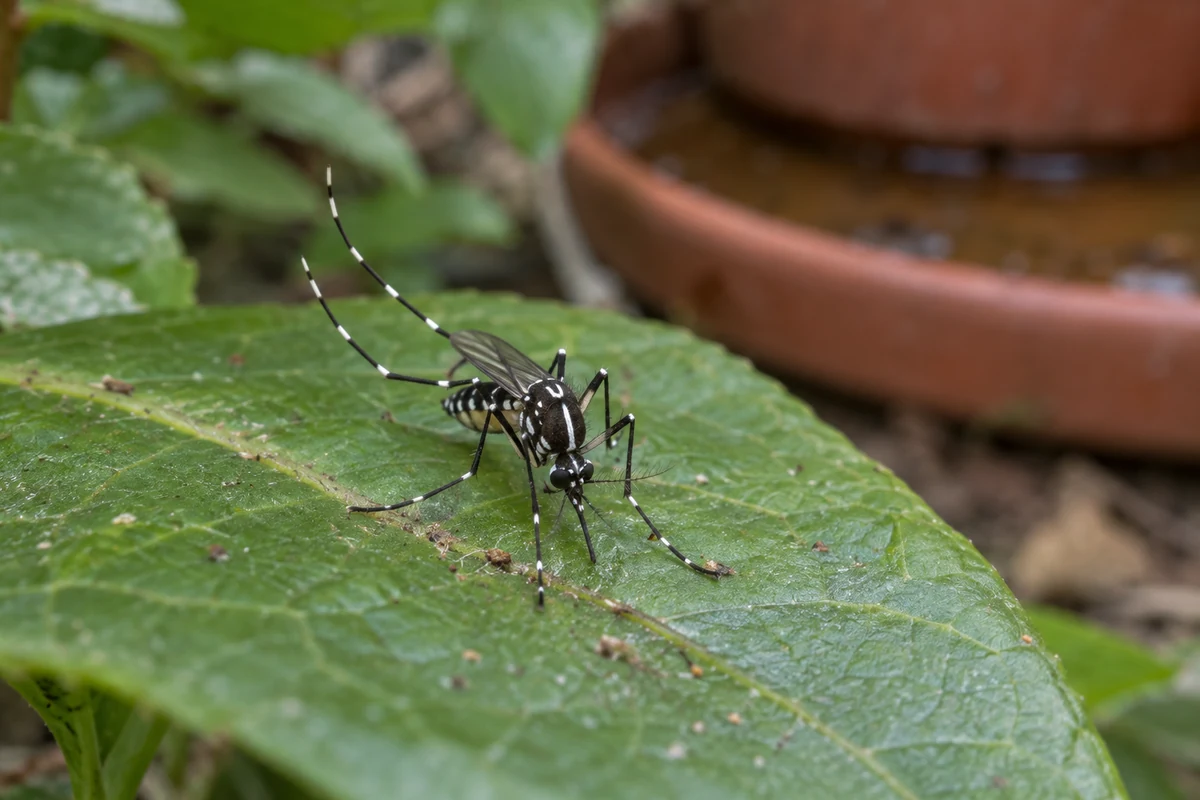

- It was first found in the United States at a tire dump near Houston in 1985.
- It bites by day, and the females generally go for the legs, feet and ankles.
- Its young can grow up in half an ounce of water.
- It usually flies less than a block or two from where it hatched.
- It can carry dengue, Zika and chikungunya, and rarely if ever West Nile virus.





How did the Asian tiger mosquito get to Texas?
It came in used tires. Rutgers says the first ones in the United States were collected at a tire dump near Houston in 1985, and the University of Florida says the species most likely spread along the highways in shipments of used tires imported for retreading. Rainwater sitting in a tire gave the eggs and larvae a home.
The species is native to Asia and the Pacific islands, according to the University of Florida species account. A year after Houston it turned up at a tire dump near Jacksonville, Florida, and in January 1988 the U.S. Public Health Service began requiring used tires from countries where it lives to arrive dry, clean and fumigated. By then it was already moving. Ohio State University Extension says the trade in those tires carried it across the eastern and midwestern states.
Today Texas A&M Mosquito Safari says it is the nuisance mosquito found most widely in towns across the southern 2/3 of the eastern United States. The Texas Department of State Health Services says its kind of mosquito is found throughout Texas and can stay active year-round where winters are mild. When it starts biting each spring in Collin County is in our article on mosquito season in Texas.
Why do Asian tiger mosquitoes bite your ankles?
Because they hunt low and in the shade. Ohio State University Extension says the females generally bite people on the legs, feet and ankles, and the University of Florida says they rest in shrubs near the ground in shady spots. Their feeding peaks in the early morning and late afternoon, so a walk past the flower bed sets them off.
Texas A&M Mosquito Safari says the tiger mosquito bites readily during the day, especially in shady areas, and Ohio State adds that it prefers shade and cloudy weather to direct sun. That is why a covered patio at noon can be worse than the open lawn.
It is also persistent. Ohio State describes it as aggressive and opportunistic, often striking the same target many times to get a full blood meal, and it feeds on dogs, cats, squirrels and even birds as well as people. If one person in the family comes in covered in welts while another has none, our article on why mosquito bites swell explains that part.
How is a tiger mosquito different from a normal mosquito?
Look at the clock and the stripes. Texas A&M says the tiger mosquito is small and strikingly marked black and white, and that it bites readily in daylight. The mosquito that bites after dark around Collin County homes is the plain brown southern house mosquito, which our mosquito control page names as the main West Nile carrier here.
Size will not help much. The University of Florida puts the tiger mosquito at 0.08 to 0.4 inch, with males about 20 percent smaller, and Ohio State says it averages about 6 millimeters. The tell is the single white stripe running down the middle of its back, which our Asian tiger mosquito page in the pest library compares side by side with the look-alikes. Ohio State says that stripe is what tells it from the yellow fever mosquito.
Where it breeds is different too. Ohio State says it lays its eggs on the walls of containers, flowerpots and tree holes, never in marshes or flooded ditches, and Texas A&M says it usually flies less than a block or two from that water. The night biter that slips indoors is covered in our article on the house mosquito.
Is the Asian tiger mosquito dangerous?
It can carry disease, but it is not the main threat. The CDC says it can spread dengue, chikungunya and Zika, though it is less likely to than the yellow fever mosquito, because it also feeds on animals. Texas DSHS says some local Zika spread has been reported in Texas, but most Texas cases are linked to travel.
The CDC page on the range of Aedes mosquitoes notes local outbreaks of these viruses in parts of Hawaii, Florida and Texas. The DSHS dengue page says most dengue cases in the United States trace back to travel, with sporadic outbreaks in the Gulf coastal area and the far south of Texas. Texas A&M says the tiger mosquito is not thought to carry West Nile virus, and Ohio State, which lists West Nile among what it could carry, says other mosquitoes are more likely to spread it.
The University of Florida says the species should be watched for disease but is not considered a public health threat at this time. Ohio State lists canine heartworm among what it can carry, and our library page covers what that means for dogs.

What the Asian tiger mosquito can carry, and the Texas picture
These come from the CDC, Texas DSHS, Texas A&M Mosquito Safari and Ohio State University Extension.
| Disease | Can the tiger mosquito carry it? | What the health agencies say |
|---|---|---|
| Dengue | Yes, but less likely than the yellow fever mosquito | Symptoms start 3 to 14 days after infection, DSHS says, and most U.S. cases are linked to travel |
| Zika | Yes, DSHS names it as a carrier | About 80 percent of people have no symptoms, but infection in pregnancy can cause birth defects |
| Chikungunya | Yes, but less likely than the yellow fever mosquito | Fever and pain in many joints usually clear in 7 to 10 days, DSHS says |
| West Nile virus | Rarely. Texas A&M says it is not thought to, and Ohio State says other mosquitoes are more likely to | The night-biting house mosquito is the one to watch |
| Dog heartworm | Yes, Ohio State says | Ohio State lists it among what the tiger mosquito can carry. Our library page covers dogs |
A fever, bad headache, rash or joint pain after mosquito bites, above all after travel, needs a doctor. Say where you have been.
What repellent works on Asian tiger mosquitoes?
Any repellent registered with the EPA, worn in the daytime and on your legs. The CDC lists deet, picaridin, IR3535, oil of lemon eucalyptus, PMD and 2-undecanone, and says to look for the EPA registration number on the label. The ankles matter most, since Ohio State says the females bite the legs, feet and ankles.
Timing is the part people get wrong. The DSHS dengue page says to take precautions throughout the day with a day-biting mosquito, especially in the early morning and late afternoon, and to wear long sleeves, long pants, socks and shoes. Repellent put on for the evening cookout does nothing for the yard work at 3 in the afternoon.
The CDC page on preventing mosquito bites also recommends clothing treated with permethrin, which keeps working through multiple washings but never goes on skin. A potted citronella plant is not a substitute, as our article on plants that repel mosquitoes explains.
Before an afternoon in a Collin County yard
- Wear long sleeves, long pants, socks and shoes, as the DSHS dengue page advises, because the ankles are the first target.
- Tip out and scrub every saucer, bucket and toy that holds water once a week, since Rutgers says this species needs only 1/4 inch of water to finish its life cycle.
- Use a repellent with an EPA registration number on the label, and reapply it as the label directs.
- For children under 3, skip products with oil of lemon eucalyptus or PMD. The CDC says to keep repellent off a child's hands, eyes, mouth, cuts and irritated skin, and never to put it on skin under clothing.
- Wear clothing treated with permethrin for long jobs in the garden, and keep the permethrin itself off your skin.
The general rules for wearing repellent, sunscreen included, are in our article on why mosquito bites swell.
Why the tiger mosquito is so hard to get rid of
Ohio State says its larvae can finish growing in half an ounce of water, which Ohio State compares to the top of a 1-liter drink bottle, and that the whole life cycle can take as little as 7 days. For this species, the University of Florida says the eggs can survive drying out for up to a year. Ohio State says the adults live up to one month. A yard can look dry and still hold enough water in a saucer, a toy or a gutter to keep them coming. For water you cannot dump, our article on whether mosquito dunks work covers it.
The University of Florida also reports the adults tolerate the insecticides malathion and temephos, and our library page notes that misting timers set for dusk miss a mosquito that bites in the daytime. Because it rarely flies more than a block or two, Texas A&M says, the source is close, but it can be in the yard next door. Ohio State sums it up: these habits make the Asian tiger mosquito hard to suppress.
How Pest Me Off handles Asian tiger mosquitoes
On a mosquito control visit, Pest Me Off confirms the species first, because daytime bites point to the Asian tiger mosquito. We treat the shaded resting zones, the shrubs, fence lines, spots under decks and around tree bases, and walk the whole yard to find, drain and flag every breeding site, from the clogged gutter to the forgotten dog bowl. The Scorched Earth Barrier keeps working on the foliage for 3 to 4 weeks, and In2Care stations can be added for yards near ponds, creeks and greenbelts.
The Skeeter Beater seasonal program returns every 3 weeks, April through October, to renew the barrier and check for new standing water. Pets and kids are back in the yard in 1 to 2 hours. The inspection and estimate are free, with same-day service when you call before noon, in McKinney, Plano, Frisco, Allen and across Collin County.
Bitten in the yard in broad daylight? Same-day mosquito control in McKinney and the surrounding cities when you call before noon.
We confirm the species, treat the shade where they rest and find the water they breed in. Free inspection and estimate.
