
Clothes Moths, the Holes in Your Wool, and How to Clear a Closet
Clothes moths are the small golden moths fluttering in a dark closet, and their caterpillars, not the moths, chew the holes in wool, fur and felt. On a Pest Me Off visit the moths you see are treated as a clue, not the problem, because spraying a room does nothing to caterpillars inside the wool. This article covers what clothes moth larvae and cocoons look like, how to clear a closet and a rug, whether traps work, and the methods that need no spray.
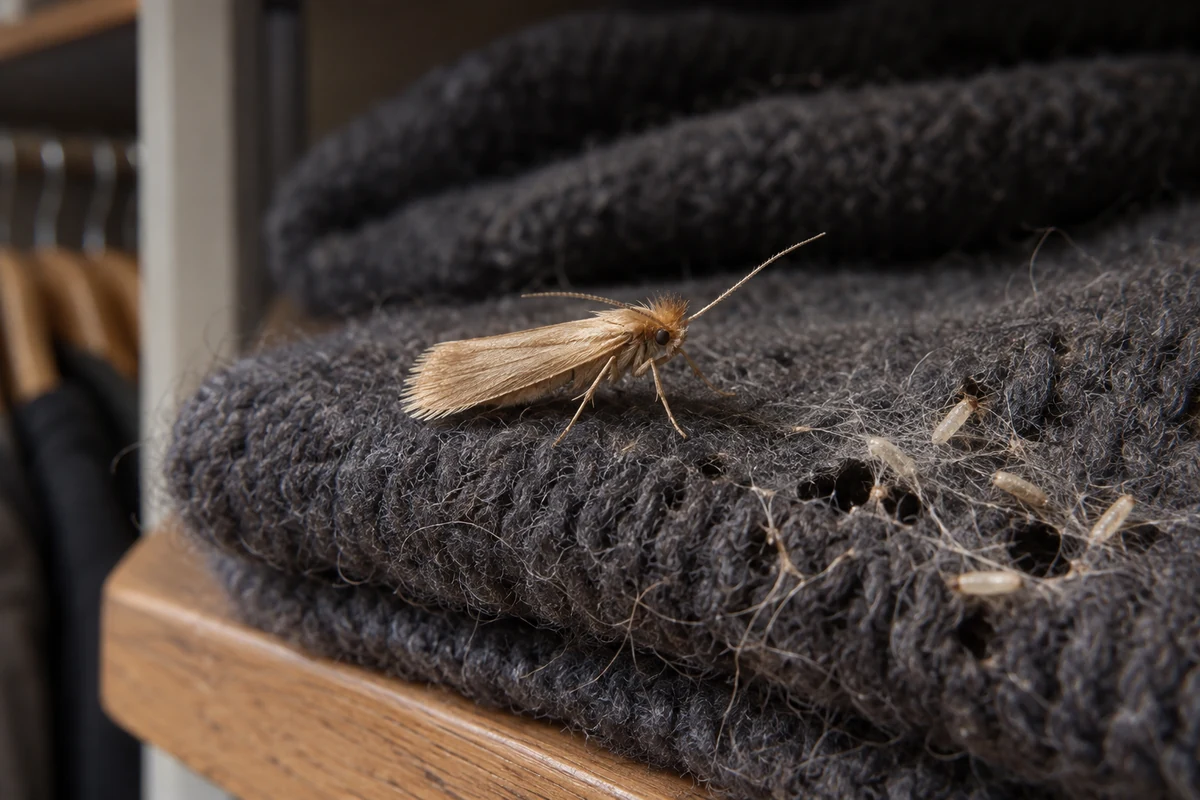

- Clothes moth larvae are shiny white with a dark head and grow to about 1/2 inch.
- They feed out of sight, under collars and cuffs, in folds and on rug edges beneath furniture.
- The adult moths never eat. Only the caterpillars damage fabric.
- A 20 to 30 minute wash at 120°F or hotter kills every stage.
- Traps baited with the female moth's mating scent catch only the male moths, so they find a problem rather than end it.





What do clothes moth larvae look like?
Clothes moth larvae are shiny white caterpillars with a dark head, up to about 1/2 inch long. Webbing clothes moth larvae spin silk feeding tubes on the fabric, mixed with droppings and fibers, while casemaking larvae drag a silk case, the University of California says. The droppings are the same color as the fabric eaten.
Entomologists at the University of Kentucky describe the larvae as creamy white and up to 1/2 inch long. They graze along the surface and leave threadbare spots where the fibers are cut at the base, and on a fur, hairs clipped at the base leave loose fur and bare hide, according to the University of California. Adult moths do not feed at all, the Kentucky fact sheet says, so every hole a clothes moth makes is the work of its caterpillar.
A clothes moth cocoon is a small silk case. The webbing clothes moth spins its cocoon right on the fabric, according to the University of California, and Rutgers Cooperative Extension puts that case at 1/6 to 1/4 inch long. A fully grown casemaking clothes moth larva lives in a cigar-shaped case about 3/8 inch long, open at both ends and often the color of the fabric, and it crawls off to a crack to pupate.
Young that are hairy or bristly, with no silk at all, point to carpet beetles instead, as our clothes moth page in the pest library explains. Our article on carpet beetle larvae and the damage they do shows what those look like.
How do you get rid of clothes moths in a closet?
Empty the closet, clean every item in it, and clean the closet itself before anything goes back. California's pest notes say to remove and clean all the clothes and fabric stored inside, then vacuum and wash the closet, especially its cracks. Clean wool then goes back in airtight bags or containers, not loose on a shelf.
Start with what has sat untouched. Clothing and blankets in regular use are seldom infested, the University of Kentucky says, and the source may be a wool scarf or a felt hat at the back of a closet. Check seams, folds, cuffs and collars, where the larvae prefer to feed.
A wash of 20 to 30 minutes in water of at least 120°F kills every stage, according to the University of California, and wool which cannot take hot water goes to a dry cleaner. Fabric stained with food, sweat or urine is more likely to be eaten, the same note says, so clean wool before it is stored. Kentucky adds that the heat of a clothes dryer works too, and that badly infested items should be bagged before they are thrown out. Empty the vacuum right after the closet is done, because the bag can hold eggs, larvae and moths, the University of California warns.
Mothballs on an open shelf do not fix a closet. Their vapors only reach a level that kills in an airtight container, the University of California says, and outside one they only somewhat repel the adults while the larvae keep feeding. Rutgers says a closet is opened too often to hold the vapors, and Kentucky warns never to scatter mothballs in open closets or anywhere children or pets can reach them. If holes keep appearing after a clean closet, look further. The University of Kentucky names an old rug in storage and an abandoned bird or squirrel nest in the attic as possible sources.
How do you get rid of clothes moths in carpet?
Check the edges and the parts under furniture first, because that is where clothes moth larvae feed on a rug. Rugs that get normal foot traffic or regular vacuuming are seldom attacked, the University of Kentucky says. Area rugs can be dry cleaned, or hung in the sun and then vacuumed, the University of California says.
Wall-to-wall carpet is usually safe. Rugs made entirely of synthetic fibers are not affected, the University of California says, and that covers most wall-to-wall carpeting. Wool carpet is another matter, and Kentucky's entomologists suggest lifting its outer edge from the tack strip along the baseboard with needle-nose pliers to look underneath.
Kentucky's fact sheet says to vacuum along and beneath carpet edges, along baseboards, under furniture and inside heat vents and floor ducts, where larvae feed on lint and pet hair. It calls an insecticide with fabric insects on its label, used as the label directs, a supplement to that cleaning, aimed at carpet edges, the line where floor meets wall, beneath furniture and the bottoms of closets. Carpet beetles feed in the same edges, and our carpet beetle control page covers that pest.
Do clothes moth traps work?
Clothes moth traps work for finding moths, not for ending them. Scent-baited traps draw in only male moths, the University of California says, which helps spot an infestation and gives some control because trapped males cannot mate. The caterpillars already in the wool keep eating, so the infested items still have to be cleaned.
Rutgers Cooperative Extension says scent-baited traps are much more effective than plain sticky traps, and that they belong on floors, shelves or other flat surfaces near the suspected source, checked every 1 or 2 weeks. Kentucky's entomologists add that webbing and casemaking clothes moths each answer to their own scent, so know which one you have, and that in a big storage area the traps with higher catches tend to sit closer to the infested items.
A pantry moth trap catches no clothes moths, and the University of California says the reverse is true too. It also says a clothes moth is only about 1/4 inch long at rest, while food moths are about double that, and that clothes moths flutter about rather than flying in a steady line the way food moths do. Rutgers says grain moths are attracted to light. A moth circling the kitchen light is a pantry moth, and our article on where pantry moths come from covers that one.
How do you get rid of clothes moths naturally?
Heat, cold, sunlight and a stiff brush kill clothes moths without a spray. A 20 to 30 minute wash in water of at least 120°F kills every stage, the University of California says, and brushing wool in the sun, along seams and inside folds and pockets, destroys eggs and makes the larvae drop off.
The larvae dislike bright light and fall from clothing when they cannot find cover, the University of California says. Freezing works on what cannot be washed. Kentucky's fact sheet says to seal the item in plastic and hold it at 0°F for at least 1 week, or at minus 20°F for 72 hours, then let it warm for about 24 hours before opening the bag. Check first that the fabric can take the cold. Heat is the other choice. The University of California says an oven at over 120°F for at least 30 minutes kills them too, if the heat will not damage the fabric.
Scents are weaker than they sound. Little is known about how well herbal oils work, according to the University of California, and cedar oil kills only small larvae and loses that quality after some years. Kentucky calls cedar closets and chests seldom effective, because they do not seal tightly enough. Rutgers says larvae are inactive below 40°F, which is why furs go to cold storage.
Where clothes moth larvae hide, and how to clear each spot
These come from the University of California and University of Kentucky clothes moth guides.
| Item | Where to look | What clears it |
|---|---|---|
| Wool sweaters and coats | Collars, cuffs, seams and folds | A hot wash or dry cleaning, then airtight storage |
| Wool area rugs | The edges and the underside beneath furniture | Dry cleaning, or sun and then a vacuum |
| Wool wall-to-wall carpet | Under the edge, lifted from the tack strip | A vacuum along the edge, then an insecticide labeled for clothes moths on both sides |
| Down pillows and upholstery | Inside the stuffing | Dry ice or a professional fumigation, since a surface spray misses it |
| Furs | Hairs cut at the base, loose fur | Shaking and airing, or cold storage, and no spray |
| Heat vents and floor ducts | Lint and pet hair inside | A vacuum inside the vent |
Infested clothing and bedding should not be treated with insecticides at all, the University of Kentucky says.
Dry ice needs care. The University of California says never to handle it with bare hands and to seal the bag only loosely until the ice has vaporized, so the bag does not burst, and Rutgers says to wear gloves and do it in a vented place.
Clearing a closet of clothes moths, step by step
- Take everything out and check each wool, fur, silk or feather item at the collars, cuffs, seams and folds, as the University of Kentucky advises.
- Wash what you can for 20 to 30 minutes at 120°F or hotter, dry clean wool that cannot take it, or seal it in plastic and freeze it at 0°F for at least 1 week. Bag anything past saving before it goes out.
- Vacuum the closet floor, corners, baseboards and shelf cracks, then empty the vacuum outside right away, as the University of California advises.
- Set a scent-baited clothes moth trap on the closet floor or a shelf and check it every 1 or 2 weeks, as Rutgers advises.
- Put only clean woolens back, in tight plastic bags or sealed containers, never loose with mothballs on an open shelf.
How Pest Me Off helps with clothes moths
A Pest Me Off clothes moth visit starts with a free inspection, because the moths you see are a clue, not the problem. We confirm whether it is a clothes moth, a carpet beetle or a pantry moth, since each is fixed in a different place, and we check closets, stored woolens, rug edges, under and behind furniture, vents and attic openings for what the caterpillars are feeding on.
We apply a targeted treatment along baseboards, closet corners and carpet edges where the young travel and hide, and your clothes and bedding are never sprayed. We show you which items to launder, dry clean, freeze or throw out, and how to store woolens in airtight containers so they cannot be reinfested. Other companies run 20 or more stops a day, and we cap ours at 12, so there is time to open the closets, lift the rug edges and check the vents and attic in McKinney, Plano, Frisco, Allen and across Collin County. See all our pest control services, and our clothes moth page in the pest library for the eggs, size and life cycle.
Holes in your wool? Pest control across Collin County.
We confirm whether it is a clothes moth or a carpet beetle, find the closet, rug, vent or nest they are living in, and never spray your clothes. Free inspection.
