
Kissing Bugs in Texas, Where They Hide and What a Bite Means
Kissing bugs live in every region of Texas, according to the state health department, so Collin County homes are no exception, and they matter because some carry the parasite that causes Chagas disease. The parasite travels in the bug’s droppings, not its bite, so a bite is a reason to talk to a doctor rather than a reason to panic. Pest Me Off, a pest control company in McKinney, keeps kissing bugs out the same way it keeps out other night insects: by sealing the gaps around a home and keeping the animals they feed on away from the house.
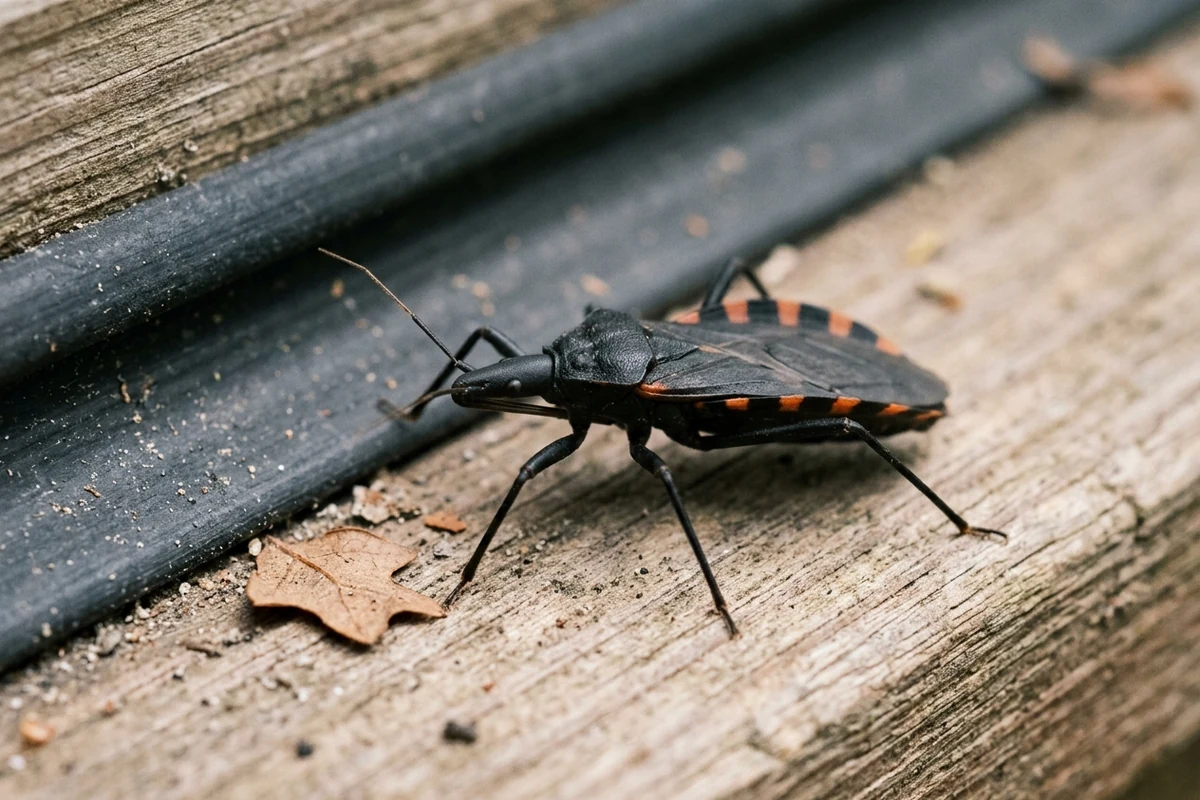

- Adult kissing bugs are about half an inch to an inch long and feed on blood at night.
- Eleven kinds of kissing bug live in the United States, and Texas has more of them than almost any other state.
- About 55 percent of the kissing bugs people sent to Texas A&M’s program carried the Chagas parasite.
- The parasite is in the bug’s droppings, not its saliva, so infection needs the droppings to get into a cut, an eye or the mouth.
- Dogs can catch Chagas disease by eating a kissing bug, which makes outdoor dogs the family members most at risk.





Are kissing bugs in Texas?
Yes. Kissing bugs and the Chagas parasite are present in all regions of Texas, according to the Texas Department of State Health Services, and that includes McKinney and the rest of Collin County. Texas, New Mexico and Arizona have the most kinds and the most finds, Texas A&M University’s kissing bug program says.
The program counts eleven kinds of kissing bug in the United States.
Kissing bugs have been found in 29 states in all. What makes Texas different is how many people meet them: since 2012, almost 1,500 people have sent the Texas A&M Kissing Bugs and Chagas Disease program more than 7,000 bugs to test.

What a kissing bug looks like
Texas health officials also call kissing bugs cone-nose bugs. Our kissing bug identification page has close photos and the bugs most often mistaken for one. These are the features Texas A&M’s program uses to describe them, from its home page and its Texas A&M kissing bug questions page.
| Feature | What to look for |
|---|---|
| Size | About half an inch to an inch long as an adult |
| Body edge | Usually, a band around the edge striped with orange or red |
| Legs and mouth | Thin, long legs with no thick sections, and a straight beak tucked under the body |
| Young bugs | Five stages of smaller, wingless young before the adult, all of them blood feeders |
| When it is active | At night, which is when it feeds on people, dogs and wild animals |
| Rear end | Rounded on males and pointed on females, where the egg laying tube sits |
Harmless bugs can look similar at a glance. If you are not sure, the Texas A&M program will look at photos and say whether it is a kissing bug.
What does a kissing bug bite look like?
A kissing bug bite usually looks like any other bug bite, and people often never notice it, because the bite does not usually hurt while the bug feeds. The sign doctors watch for is swelling where the parasite got in, according to the Texas Department of State Health Services.
The best known is swelling of the eyelids on one side of the face, called Romaña’s sign.
Kissing bugs do not attach the way ticks do. They feed for minutes and leave. If you wake up with a bite and find a cone-nosed bug in the bed, keep the bug and tell your doctor, because a bite alone cannot say whether a parasite was passed.
How Chagas disease spreads from a kissing bug
The Chagas parasite lives in the gut of an infected kissing bug and leaves in its droppings. Some kinds of kissing bug pass droppings while they feed. If a sleeping person rubs or scratches those droppings into the bite, a cut, the eye or the mouth, the parasite can get in, as the Texas Department of State Health Services explains.
The bugs pick the parasite up from the animals they feed on. In the United States those are woodrats, raccoons, opossums, coyotes and other mammals, Texas A&M reports, which is why kissing bugs turn up where those animals rest. Chagas disease does not pass from person to person through ordinary contact.
Are kissing bugs dangerous to humans?
Kissing bugs can be dangerous to humans, but infection in Texas is uncommon. The Texas Department of State Health Services says human cases acquired in Texas do occur but are uncommon, and the CDC estimates about 300,000 infected people in the whole United States, most of them infected in Latin America.
The risk comes from the parasite in the droppings, not from the bite.
When infection does happen, the first phase lasts about 8 weeks and often causes no symptoms, or only fever, tiredness, aches or a rash. Of those infected, 20 to 30 percent go on to develop heart or digestive problems years later, the state health department reports, and the rest carry the parasite for life without illness. Testing and treatment exist, so anyone worried about an exposure should ask a doctor.
What should you do if you find a kissing bug?
If you find a kissing bug, do not crush it or pick it up with bare hands. Catch it with a glove or a small plastic bag, keep it in a closed bag or jar, and consider cleaning the spot with a bleach solution, as the Texas A&M program advises.
Then send photos to the Texas A&M kissing bug program to confirm what it is, and call your doctor if it was found in a bed or you think it fed on someone.
- Keep the bug, dead or alive, in a sealed container. A confirmed kissing bug is far more useful to a doctor than a description.
- Check the room it came from: under the bed, along baseboards, in pet bedding and in cracks near where people or pets sleep.
- If a dog sleeps outside or hunts bugs, ask your vet about a Chagas test. The Texas Veterinary Medical Diagnostic Laboratory offers one, according to Texas A&M.
- Find out how it got in, which is usually a gap around a door, a window or a pipe.
Keeping kissing bugs out of a Collin County home
Kissing bugs come to a house for one of two reasons: an animal nesting on or under it, or a gap that lets a night-active bug inside. Both are fixable, and the CDC’s advice on preventing Chagas disease lists the same steps Pest Me Off’s technicians work through.
| Step | Why it works |
|---|---|
| Seal gaps and screens | Weatherstripping, door sweeps, torn window screens and pipe openings are the way in for a bug that hunts at night |
| Move animal hosts away | Raccoons, opossums and rats nesting under a deck or in an attic bring the bugs and the parasite with them |
| Bring pets in at night | Dogs sleeping outdoors are an easy blood meal, and the CDC advises pets sleep indoors |
| Clear what touches the house | Brush, stacked wood and rock piles against the foundation give hosts and bugs a place to shelter |
| Move yard lights away | The CDC notes lights can attract kissing bugs, so a bright light by the door draws them to it |
| Treat the perimeter | A residual treatment around the foundation and entry points catches bugs before they reach a door |
Remove the animals they feed on and close the gaps, and kissing bugs have no reason to stay.
How Pest Me Off helps with kissing bugs
Pest Me Off’s general pest control covers the work in the table above: a technician inspects the outside of the home for gaps and signs of nesting animals, treats the foundation and entry points, and points out the fixes that close the house up. Where raccoons, opossums or rats are living under or in the home, our wildlife removal takes the host away, which takes the kissing bugs’ food away too.
A bug found in a bed is often a different biter. If you are finding small, flat, reddish bugs and itchy bites rather than one large cone-nosed bug, our guide to bed bugs covers how to tell. Same-day service is available for McKinney and the surrounding cities when you call before noon, with no-contract options.
Found a kissing bug in or near your home? Same-day pest control in McKinney and the surrounding cities when you call before noon.
A technician inspects the outside of the house for the gaps and nesting animals that bring them in, treats the foundation and entry points, and shows you the fixes that close the house up. No-contract options.
