
Bats in Texas Homes, and How to Get Them Out Legally
Squeaking at the roofline on a hot afternoon, a stream of small dark shapes at dusk, a bat circling the living room at night. This article covers how to get bats out of an attic, what Texas law allows, whether Texas bats carry rabies, and how fast the Mexican free-tailed bat flies and what it eats.
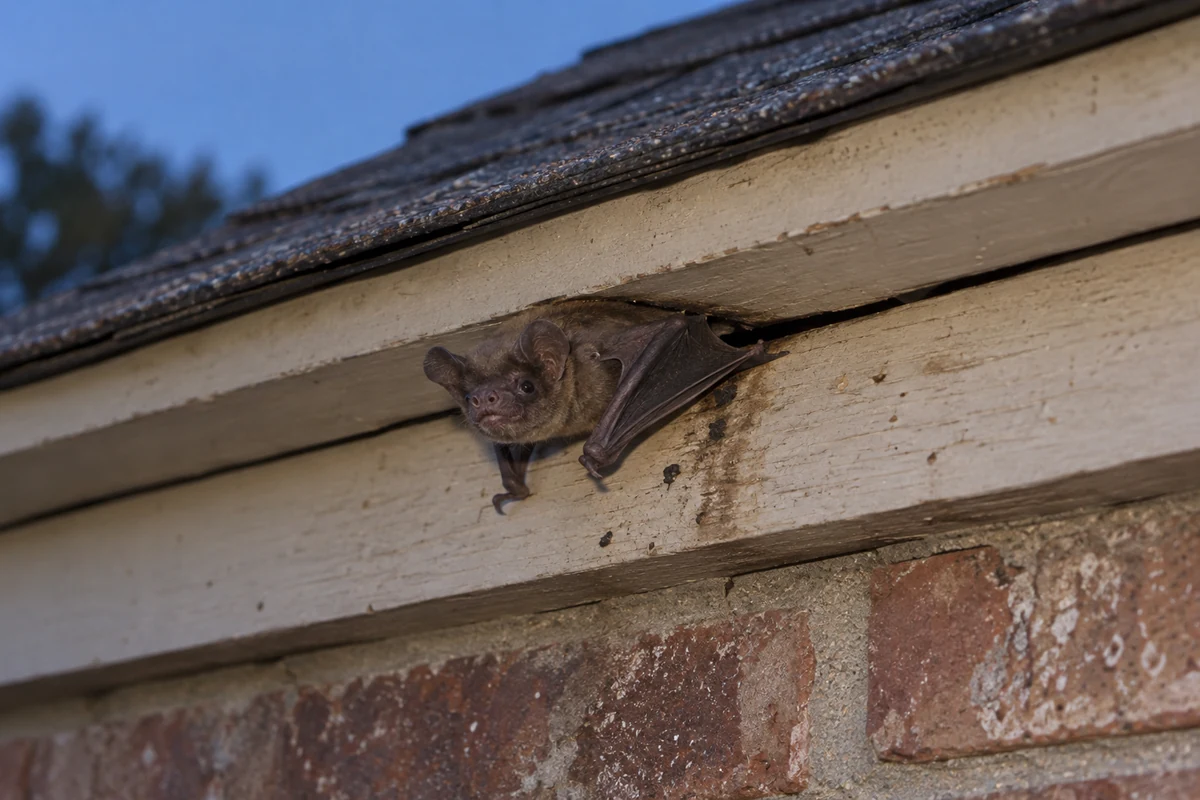

- Texas discourages shutting bats out of a building from May 1 to August 15, while the young cannot fly.
- The CDC says a bat can fit through an opening as small as a quarter inch.
- Bats were half of all rabid animals confirmed in Texas in 2024, 205 of 412.
- Texas free-tailed bats eat an estimated 6,000 to 18,000 metric tons of insects a year.
- Never pick up a bat with bare hands, alive or dead.





How do you get rid of bats in the attic?
Let the bats fly out, then keep them from coming back. Texas Parks and Wildlife discourages excluding bats from May 1 to August 15, while the young cannot fly and may be trapped inside, so the work waits until the young are flying. One-way exclusion devices let the bats leave at dusk, then every gap gets sealed.
The gaps are smaller than most people expect. The CDC says bats can fit through openings as small as a quarter inch, and advises caulking any opening larger than a dime and using screens, chimney caps and draft guards on attic doors. It names fall and winter as the best time to bat-proof a home, because most bats leave then, and warns against trapping young bats inside between May and August.
The CDC also describes the do-it-yourself version. Watch where the bats leave at dusk, hang plastic sheeting or bird netting over those holes so the bats can get out but not back in, and seal the openings with steel wool or caulk once you are sure every bat has gone. It adds a reminder to check local rules, since some bats are endangered.
A colony is no sign of a dirty home, as our bat library page says. Texas Tech University's Mammals of Texas, which calls this species the Brazilian free-tailed bat, says it seems to need a dark, dry retreat with open space below to drop into when it takes flight, and lists hollows under roofs, attics, the spaces between signs and buildings, and the spaces in walls. The wildlife damage reference adds that the buildings bats pick usually get a lot of sun.
Chimneys need the same care. The CDC names chimney caps among the fixes, and the wildlife damage reference says nursery colonies gather behind chimneys. If the noise turns out to be scratching in daylight instead, our article on squirrels or rats in the attic covers the other animals that live up there.
Are bats protected in Texas?
Yes, with one narrow exception. Texas Parks and Wildlife says bats may not be hunted, killed, possessed, purchased or sold, but may be moved, trapped or killed if inside or on a building occupied by people. It also discourages shutting bats out of a building from May 1 to August 15, while young cannot fly.
The Texas Parks and Wildlife rule also lets a person take a bat to a laboratory for rabies or white-nose syndrome testing. The exception is not a reason to reach for a poison or a swatter. Killing bats does nothing about the gap they came through, and a colony that is let out stays out as long as every gap is sealed.
Texas has good reason to want them alive. Texas Tech estimates the state's free-tailed bats eat 6,000 to 18,000 metric tons of insects a year, and Texas made the free-tailed bat its official flying mammal.
Do bats in Texas carry rabies?
Some do. Bats were the most common rabid animal in Texas in 2024, 205 of the 412 confirmed by the Department of State Health Services, though only 12 percent of the bats tested were positive. Skunks tested positive more often, at 31 percent. Most bats are healthy, but never touch one with bare hands.
Only bats that people send in for testing are counted, so the figure says nothing about healthy colonies. Texas Tech says the free-tailed bat is sent in more often than any other species, and that 258 of 1,455 tested from 1994 to 1998, 18 percent, had rabies. The 2024 state rabies report found the most rabid bats in October, 33 of them, when bats are on the move, and Texas law lists bats among the high-risk animals for rabies.
The CDC says bats are the most reported animals with rabies in the United States, and that most people in the country who die of rabies were exposed to a rabid bat. It says to be wary of a bat that is out in the daytime, found somewhere unusual, unable to fly or easy to approach, and to call the health department after any contact with one. Wash any bite or scratch with soap and water and get medical help right away.

How fast is a Mexican free-tailed bat?
Very fast for an animal under half an ounce. A University of Tennessee study tracked seven free-tailed bats by airplane from Frio Cave in southwestern Texas and recorded short bursts of ground speed of up to 100 miles per hour, faster than had been documented before for any bat or bird.
The bats in that study, described in the University of Tennessee news release, weighed 11 to 12 grams each and carried radio transmitters of half a gram. They flew faster into a headwind and slowed with a tailwind, the way airplanes and birds do.
Texas Tech says they take wing several minutes before dark and usually feed 50 feet up or higher. Texas A&M AgriLife gives the bat a length of 3 1/2 to 4 inches, a wingspan of 11 to 14 inches and a weight of 0.28 to 0.49 ounces.
What do Mexican free-tailed bats eat?
Flying insects, especially moths. Texas Tech’s Mammals of Texas says moths made up nearly 90 percent of the insects found in droppings collected at San Antonio, and estimates that Texas free-tailed bats eat 6,000 to 18,000 metric tons of insects a year. They take small prey, 2 to 10 mm long.
A second study Texas Tech cites found moths, flying ants, June beetles and leaf beetles, leafhoppers and true bugs. The bats often feed on swarms, which is one reason a colony in the neighborhood is good news for a garden and bad news for an attic.
Texas A&M AgriLife's page on the free-tailed bat calls it the species most likely to meet people, living in bridges, buildings and any abandoned structure. Texas Tech puts the colony under the Congress Avenue Bridge in Austin at about 2.5 million bats each summer.
The Texas bat year, and when to act
These come from Texas Tech, the wildlife damage reference, Texas Parks and Wildlife, the state rabies report and the CDC.
| Time of year | What the bats are doing | What a homeowner can do |
|---|---|---|
| Spring, before May 1 | Colonies arrive and pregnant females gather in nursery colonies | Exclusion is allowed, before the young are born |
| May 1 to August 15 | Young born, most around mid June, flying within 3 to 4 weeks | No exclusion, the state discourages it |
| July and August | Young weaned, then nursery colonies break up | Book the inspection and plan the work |
| Late August to fall | Young flying, the most rabid bats found in October | Exclusion, then seal every gap |
| Winter | Many fly south, some stay all year in eastern Texas | Caulk, screen and cap, as the CDC advises |
The gap a colony used this summer is the one the next colony finds next spring.
What to do when a bat gets into the house
These steps follow the CDC, with the precaution in the first step our own. None of them means touching a bat with bare hands.
- Call animal control or the health department so the bat can be caught safely and tested. Meanwhile, close the room and keep children and pets out.
- If it has to be caught before help comes, put on leather work gloves and find a box or jar big enough for the bat, and a piece of cardboard with small air holes punched in it.
- Wait for the bat to land, approach slowly and set the container over it, then slide the cardboard underneath and tape it to the container.
- If you cannot catch it safely, speak with the health department for advice instead of trying again.
- Do not release the bat until you have talked with a public health expert, because a bat bite can be tiny and you may not know you were bitten.
How Pest Me Off gets bats out
Bats are protected in Texas, so Pest Me Off's wildlife removal work on bats is legal one-way exclusion only, timed around the maternity season and never lethal. It starts with a free inspection from the roofline to the attic to confirm it is bats, find the gaps they use and check whether young are in the roost. Once the colony is out, we clear droppings and nesting debris from the access area and close every gap with metal and mesh an animal cannot chew through.
Our team carries the Get Bent Academy certification in advanced wildlife exclusion and is a member of the National Wildlife Control Operators Association. Wildlife jobs are quoted per job after the inspection, with same-day inspections for McKinney and the surrounding cities when you call before noon. Our bat page in the pest library shows the droppings and stains to look for.
Bats in the attic or the walls? Same-day pest control in McKinney and the surrounding cities when you call before noon.
We confirm it is bats, let the colony out through one-way devices at the right time of year and seal every gap behind them. Free wildlife inspection.
