
Why Millipedes Come Inside After Rain, and Whether They Are Harmful
Millipedes come inside after heavy rain because soaked soil drives them up and out of the mulch and leaf litter they live in, and some of them crawl under doors and through foundation gaps. They are harmless to people: they cannot bite or sting, and they do no damage to the house. Indoors, the dry air kills them within days. Pest Me Off gets these calls across Collin County after spring and fall storms, and the fix is almost always outside the house, not inside it.
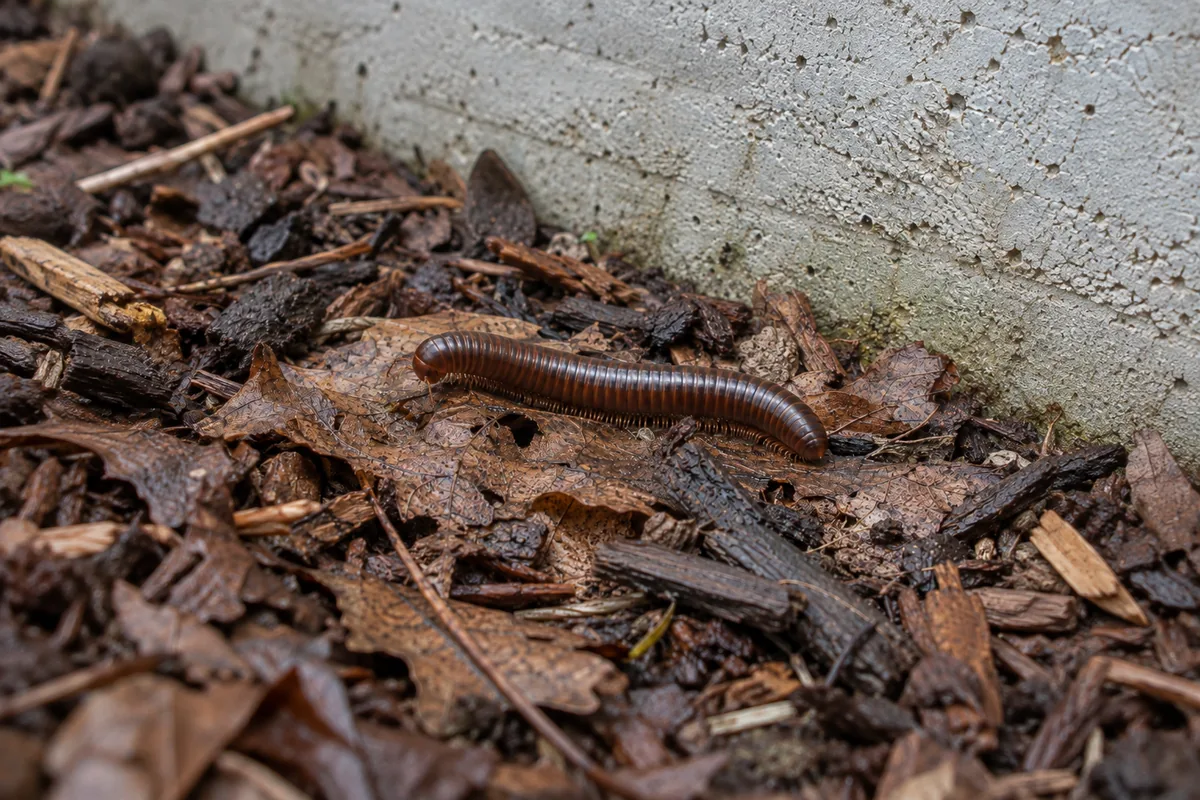

- Millipedes live in damp places such as mulch, leaf litter, compost and the soil under rocks, and they dry out quickly without moisture.
- They move in large numbers after heavy rain or cooler weather, most often in spring and fall.
- Millipedes cannot bite or sting, and they do not damage the house, food or furniture.
- Some give off a smelly fluid that can irritate skin and is harmful if rubbed into the eyes.
- The ones that wander into homes are usually about an inch long, with two pairs of legs on nearly every body segment.





Why do millipedes come out after rain?
Millipedes come out after rain because soaked ground pushes them to the surface. Ohio State University Extension says they cannot tolerate water-saturated soil, which forces them up and onto higher ground, and that a drought can set them moving too.
Penn State Extension adds that these mass movements often follow heavy rains or cooler weather and may also be tied to mating, especially when millipedes are seen climbing walls and fences.
Nobody has pinned down a single cause. The University of Kentucky’s fact sheet on centipedes and millipedes says large groups can show up on sidewalks, pavers and foundations, sometimes around heavy rains, but that it is unclear exactly what causes these migrations. Clemson University says the garden millipede, the one that most often invades homes in large numbers, sometimes moves in huge numbers, especially after heavy spring rains, climbs walls easily and can get in through any small opening.
On our calls in Collin County, that usually means a run of millipedes on the patio, the garage floor and the bottom few feet of brick the morning after a storm. The millipede page in our pest library shows what the common ones look like.
Why are there millipedes in my house?
Millipedes in the house usually come from a large group living outdoors nearby, in mulch, leaf litter, thick grass or compost around the home. Clemson’s Home and Garden Information Center says large numbers indoors usually mean a large population around the home.
Iowa State University Extension adds that millipedes cannot breed indoors, so every one found inside wandered in by mistake through a gap at a door, window or the foundation.
Some yards hold more than others. Penn State points to one setup as a problem: gravel or mulch spread over plastic sheeting along the foundation, which keeps the soil underneath damp and cool, exactly what millipedes need. Ohio State notes that newly built neighborhoods on wooded land are often troublesome after heavy, continuous rain, and on Pest Me Off’s calls after storms, the homes often back onto creeks, open fields or wooded lots. Iowa State says millipedes from nearby woods and fields can travel 50 feet or more to reach a house.

Are millipedes dangerous to humans?
Millipedes are not dangerous to humans. Iowa State University Extension says they are not harmful, cannot bite or sting, and do not attack people, property or pets. The one caution is the fluid some of them release when handled, which Clemson says is irritating and can harm the eyes.
Clemson adds that the fluid can cause allergic reactions, so wash your hands after touching a millipede and keep it away from your face.
The University of Kentucky says some millipedes give off a fluid that can cause a skin reaction similar to a burn, and that while certain species release a trace of hydrogen cyanide, it is not enough to harm people. The Missouri Department of Conservation page on millipedes notes that brightly colored ones are the more likely to release foul or toxic fluids, so the bright ones are the ones to leave alone. Ohio State adds that a crushed millipede can stain rugs and fabric, which is a good reason to sweep them up rather than step on them.
Do millipedes bite?
Millipedes do not bite. Clemson’s Home and Garden Information Center says they mainly eat decaying plants and do not bite people or pets, unlike centipedes, which have venomous jaws and hunt small insects. Ohio State University Extension describes the millipede head as rounded, with no poison jaws.
A bite from a long, many-legged pest in the house points to a centipede instead, which the University of Kentucky says can bite when handled. The table below shows how to tell the two apart, with details from the University of Kentucky, Penn State Extension and the Missouri Department of Conservation.
| Feature | Millipede | Centipede |
|---|---|---|
| Legs | Two pairs on nearly every body segment | One pair on each body segment |
| Body | Usually rounded, like a short piece of wire | Flattened, with long antennae |
| Speed | Slow, and often curls up when disturbed | Fast, built for running |
| Bites | No | Can bite when handled |
| Indoors | Dies within days in the dry air | The house centipede can live indoors |
Only the house centipede survives for long inside a home.
Our article on how centipedes are different from millipedes covers the two side by side in more detail.
Why do millipedes curl up?
Millipedes curl up to protect themselves. The Missouri Department of Conservation says they often coil up when disturbed, and some can give off a foul-smelling fluid. Ohio State University Extension describes the shape as a tight C, like a watch spring, held without moving.
A curled millipede that never uncurls may simply be dead, since Penn State notes that a millipede curls into a spiral when it dies.
Curling tucks the legs inside the hard outer skin that Penn State describes, and Ohio State says a millipede that is touched often stays curled and motionless. That is why one swept into a dustpan so often looks lifeless while it is still alive.
Why are there dead millipedes in my house?
Dead millipedes in the house are a sign the indoor air did its job. The University of Kentucky says millipedes usually die shortly after getting inside because there is not enough moisture, and they are often found dead in piles.
Penn State says they last only days indoors, which is why spraying inside the house is not needed. Sweep them up, then find the gap they came through, or call us and we will find it.
In our experience, where they pile up usually shows where they got in. A cluster just inside the garage door, along a back door threshold or at the base of a slab wall marks the spot to seal. The Penn State Extension page on millipedes recommends vacuuming or sweeping them into a dustpan rather than treating indoors.
How to get rid of millipedes in the house
- Sweep or vacuum up the millipedes inside and throw them out. Iowa State calls this the most practical option indoors, and indoor sprays add little.
- Rake mulch, leaf litter and grass clippings back from the house, leaving a strip about 3 feet wide along the foundation bare so the soil dries, as Ohio State advises.
- Fix the damp spots. Make sure gutters and downspouts carry water away from the house, repair dripping outdoor faucets and sprinklers, and water the lawn in the morning so it dries before millipedes come out at night.
- Seal the way in. Caulk cracks in the foundation and fit door sweeps and weather stripping on exterior doors, including the door from the garage.
- Skip foggers and bug bombs. Ohio State says they do not keep millipedes out, while a treatment around the outside of the foundation, using a product labeled for millipedes, can help stop them before they get to the door.
How Pest Me Off handles millipedes
Pest Me Off’s general pest control starts outside, because that is where millipedes live. A technician walks the foundation to find the damp mulch beds, leaky faucets, low spots and gaps under doors that let them in, then treats around the outside of the house with a product labeled for millipedes. We point out the gaps and the moisture problems worth fixing, since a dry, sealed foundation is what keeps the next storm’s millipedes out.
Quarterly visits keep that barrier in place through the spring and fall rains when millipedes move most. Same-day service is available for McKinney and the surrounding cities when you call before noon, with no-contract options.
Millipedes in the house after every storm? Same-day pest control in McKinney and the surrounding cities when you call before noon.
We find the damp spots and gaps that let millipedes in, treat around the outside of the foundation, and keep that barrier in place through the wet seasons. Same-day visits when you call before noon, and no-contract options.
