
Carpet Beetles in Your Home, the Larvae, the Bites and the Damage
Carpet beetles are small round beetles whose hairy young eat wool, fur, feathers, silk and leather, and carpet beetles do not bite. What people call carpet beetle bites can be a skin reaction to the hairs on the larva, which Texas A&M AgriLife says irritate some people. Pest Me Off inspects for carpet beetles across McKinney and Collin County. The source we find most often is a bird nest in an attic vent or a build-up of pet hair and dust behind the furniture.
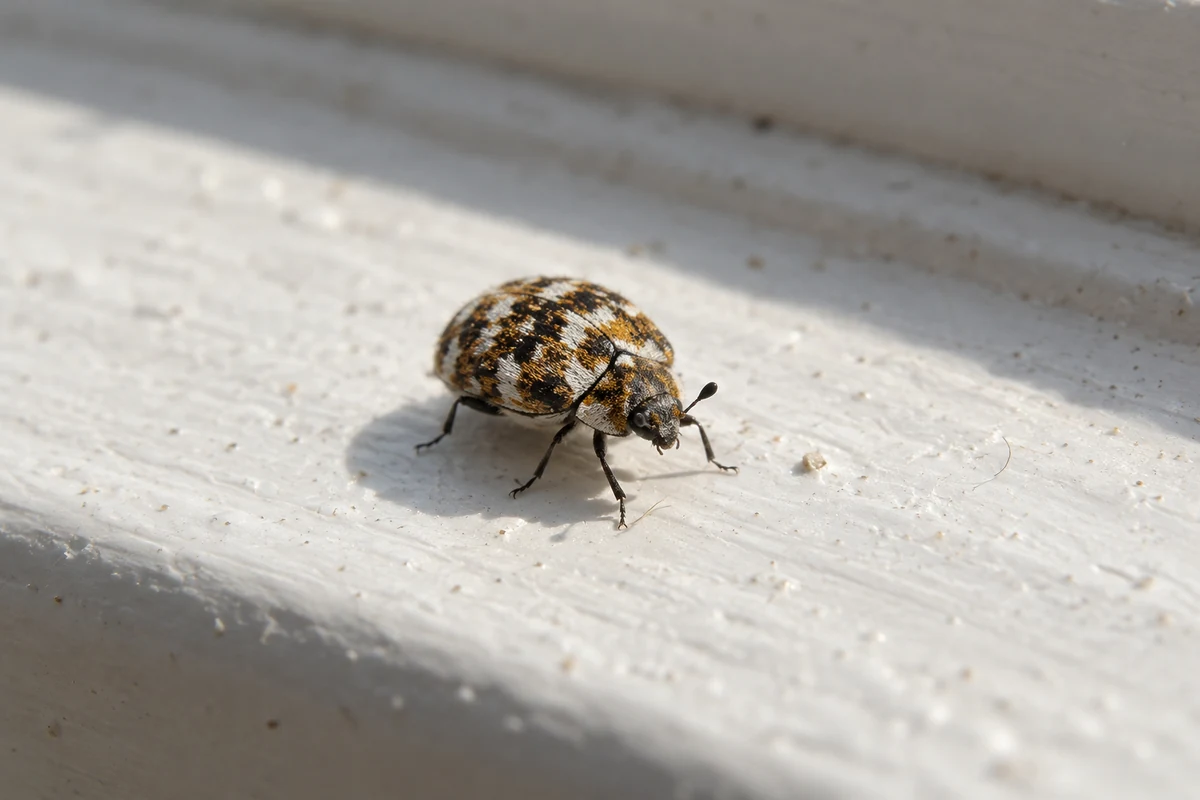

- Carpet beetles do not bite. The hairs on the larva can irritate some people’s skin.
- An adult carpet beetle is 1/16 to 1/8 inch long and eats flower pollen, never fabric.
- The larva does the damage, eating wool, fur, felt, silk, feathers and leather.
- One female lays about 50 to 100 eggs on or near the fabric her young will eat.
- A varied carpet beetle can live as a larva for 220 to 630 days before it pupates.





Do carpet beetles bite?
No, carpet beetles do not bite. Texas A&M AgriLife’s guide to mysterious bug bites says the hairs on carpet beetle larvae irritate some people. Bite-like marks can form where skin is pressed against a larva. A second Texas A&M AgriLife fact sheet calls the reaction rare, and notes the hairs can also irritate when swallowed in infested food.
So the itch comes from contact, not from a beetle feeding on you. The same Texas A&M AgriLife guide to mystery bites lists other everyday causes of skin reactions mistaken for bites, including enzyme detergents, fabric softeners, soaps and other toiletries. Finding the larva or its shed skins near where you sit or sleep is what settles the question. Texas A&M adds that thorough vacuuming and removing the food source is usually enough to keep carpet beetle numbers low.
Carpet beetle or bed bug, told apart
Both turn up in beds and both get blamed for itchy skin, but the two live very different lives.
| Clue | Carpet beetle | Bed bug |
|---|---|---|
| Bites | Never bites. The larva’s hairs can irritate skin | Feeds on blood, usually at night |
| Size | Adult 1/16 to 1/8 inch, round and often speckled | Adult 5 to 7 millimeters, flat, oval and brown, about the size of an apple seed |
| What it eats | Wool, fur, feathers, silk, leather and pet hair | Blood |
| What you find | Brown, bristly shed skins and damaged wool | Rusty stains and dark spots on sheets and mattress seams |
Rusty stains on the sheets point to bed bugs, not carpet beetles.
The bed bug size comes from the US Environmental Protection Agency’s page on bed bug appearance and life cycle, and the stains from its guide to finding bed bugs. If the signs on your mattress match the right-hand column, read about bed bugs instead.
What does a carpet beetle larva look like?
A carpet beetle larva is a slow-moving, tan to brown crawler about 1/8 to 1/4 inch long, densely covered in hairs or bristles. That is the University of Kentucky entomology department’s description. It looks like a fuzzy or hairy maggot, slightly longer than the adult beetle, in the University of California’s description.
The black carpet beetle’s larva is the odd one out, shiny and hard, up to 5/16 inch long and ending in a tuft of long hairs.
As a larva grows it sheds its skin, and those brown, shell-like, bristly skins are often the first thing a homeowner finds, at the edge of a rug, in a closet corner or under the bed. Finding skins means the larva has been feeding there for a while.
The three carpet beetles found in homes
The University of California’s carpet beetle guide names the three species that cause the most damage in homes, and its life cycle table shows how differently they grow.
| Beetle | What the adult looks like | Eggs | Days as a larva |
|---|---|---|---|
| Varied carpet beetle | About 1/10 inch, black with a patchy pattern of white, brown and dark yellow scales | 40 | 220 to 630 |
| Furniture carpet beetle | Slightly larger and rounder, mottled black, white and yellow to orange | 60 | 70 to 94 |
| Black carpet beetle | 1/8 to 3/16 inch, shiny black and dark brown with brownish legs | 90 | 166 to 330 |
The varied carpet beetle can feed as a larva for well over a year.

That long feeding stage is why a carpet beetle problem builds quietly. A larva in a stored wool blanket can eat for a year or more before anyone opens the closet, and the University of Kentucky notes that one female lays about 50 to 100 eggs on or near the material her young will eat.
What do carpet beetles eat?
Carpet beetle larvae eat wool, fur, felt, silk, feathers, skins and leather, because those materials hold keratin, an animal protein they can digest. That comes from the University of Kentucky’s entomology department. The adult beetles never eat fabric, they feed on flower pollen.
Cotton, polyester and rayon are rarely attacked unless they are blended with wool or stained with food or body oils.
Fabric is only part of the menu. Texas A&M AgriLife lists dried milk and cheese, dead insects, dead mice and birds, dried meat, stuffed trophies and even pet dander, and the University of Kentucky adds lint and hair under baseboards and in floor vents. Some carpet beetles also feed on cereal, pet food and bird seed.
Carpet beetle damage, and the clues that tell it from clothes moths
Carpet beetle damage and clothes moth damage look alike at first glance. These clues for telling them apart come from the University of California and the University of Kentucky.
| What you see | What it points to |
|---|---|
| One large eaten patch | Carpet beetles, which tend to graze a large area on one part of a garment or carpet |
| Small holes scattered about | More often clothes moths |
| Brown, bristly shed skins | The larva, which leaves its skins behind as it grows |
| No webbing on the fabric | Carpet beetles rather than clothes moths |
| Damage in seams, cuffs and collars | The folds and creases where the larva prefers to feed |
| Beetles on windowsills in spring | Adults heading for the light, a sign the infestation may be indoors |
Bristly skins and no webbing point to carpet beetles.
Where do carpet beetles come from?
Carpet beetles come from outdoors. The University of California says the adults feed on pollen from flowering plants, fly in through open windows and doors, and often ride in on cut flowers. Outdoors the females lay eggs in spider webs and in bee, wasp and bird nests, which hold the dead insects, feathers and debris the young feed on.
Indoors the source is rarely the carpet itself. The University of Kentucky lists a seldom-used wool hat or scarf on a closet shelf, an old rug rolled up in storage, pet hair in floor vents and ducts, and the remains of a bird or squirrel nest in the attic. That is why homes with no wool carpet at all still get carpet beetles.
What to do this week if you find carpet beetles
- Find the source before treating anything. Check stored wool, fur and feather items, the edges of rugs, under upholstered furniture, floor vents and the attic, and look closely at seams, cuffs and collars.
- Vacuum woolen rugs, baseboards, windowsills and light fixtures, where Texas A&M AgriLife says pet hair, dust and dead insects collect, and the floor vents the University of Kentucky names.
- Wash or dry clean infested clothing and blankets before they go back into storage, as the University of California advises.
- For items that cannot be washed, the University of California gives two options. Seal the item in a plastic bag in the freezer for 2 weeks below 18 degrees, or heat it in an oven at 120 degrees or higher for at least 30 minutes, but only if the item can take it.
- Do not spray clothing or bedding with insecticide, which the University of California warns against.
- Skip the bug bomb. Texas A&M AgriLife says foggers do not work well unless every infested item is found and treated first.
- Store clean woolens in sealed bags or containers. Cedar chests are not reliable, the University of California notes, because the oil fades over time.
How Pest Me Off treats carpet beetles
Pest Me Off’s carpet beetle control starts with a free inspection that looks for what is feeding the larva, not just the beetles on the windowsill. A licensed technician opens the closets, checks the attic vents and looks behind and under the furniture and through any wool, fur or feather items. Bird nests in vents and hidden build-ups of pet hair and dust are the two sources our technicians find most.
On the same visit, infested items are bagged and treated, a bird nest in a vent is pulled, and the build-up is cleaned out. The technician then treats the baseboards, closet corners and entry points the beetles use, and screens attic, eave and dryer vents so birds cannot nest there again. Pets and children can go back into treated rooms once the treatment dries, in 1 to 2 hours. Service is available across McKinney, Plano, Frisco, Allen and the rest of Collin County, with no-contract options.
Finding carpet beetles or holes in wool and fur? Same-day pest control in McKinney and the surrounding cities when you call before noon.
Our free inspection finds what is feeding the larva, from bird nests in vents to hidden build-ups of hair and dust, then we clean out the source, treat the baseboards and closets and screen the vents. No-contract options.
