
Rats or Mice? How to Tell Which One Is in Your House
Droppings in the pantry or scratching in the attic tell you a rodent is in the house, but not which one, and the answer changes the trap, where it goes and how the house gets sealed. This article covers how to tell rats from mice by their droppings, their size and where you hear them, how to tell a young rat from a mouse, and what to do once you know.
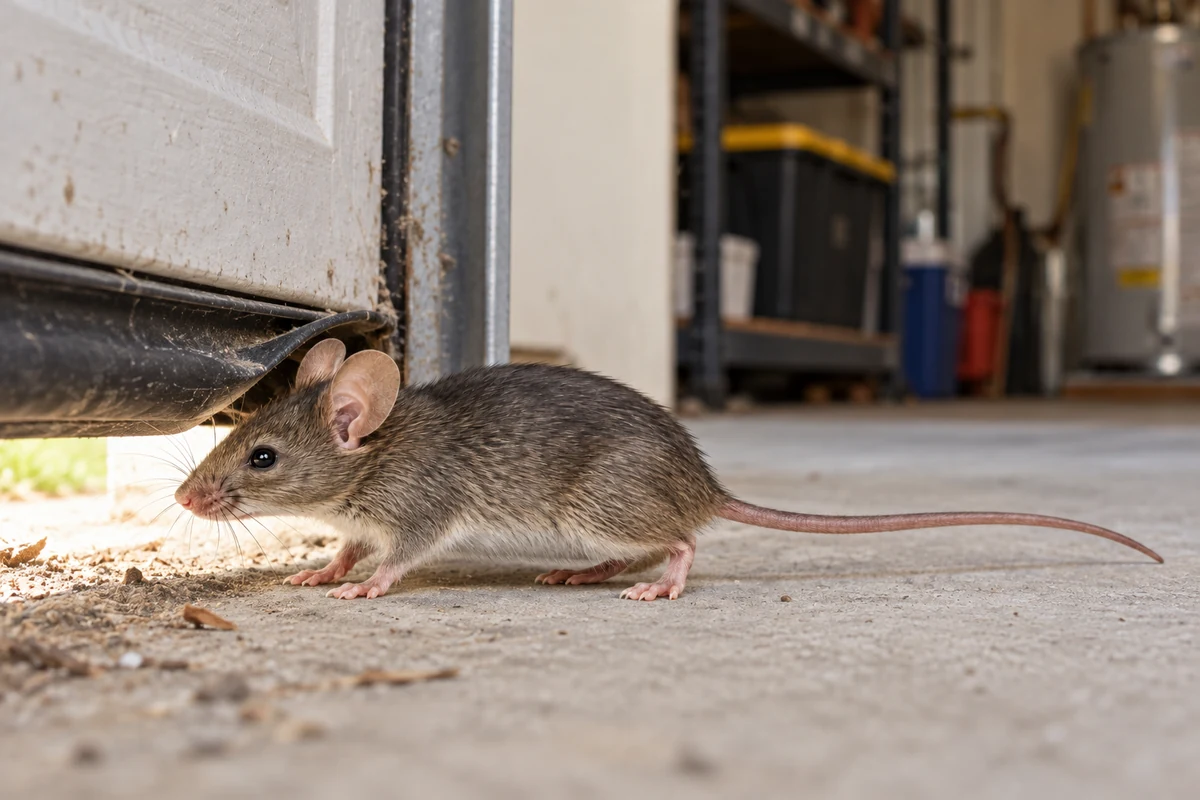

- Mouse droppings are about 1/4 inch long. Rat droppings run 1/2 to 3/4 inch.
- A young rat has a big head and big feet for its body. A mouse does not.
- Noises in the attic at night are often the first sign of roof rats.
- A mouse can squeeze under a gap 1/4 inch tall.
- Never sweep or vacuum droppings. Soak them with a bleach solution first.





How do you tell if you have rats or mice?
The quickest way to tell is the droppings, because a rat’s are two to three times as long as a mouse’s. The Internet Center for Wildlife Damage Management says house mouse droppings average 1/4 inch long, roof rat droppings are about 1/2 inch with pointed ends, and Norway rat droppings can reach 3/4 inch with blunt ends.
Where you find the signs helps too. Roof rats nest up high, in attics, walls and false ceilings, according to the University of California page on rats, while Norway rats live on the ground floor and, Texas Tech’s Mammals of Texas says, in burrows under sidewalks and sheds. Burrow holes 2 to 3 inches wide along a wall, a fence or under a bush point to Norway rats.
Smell and timing are clues as well. A musky odor is a positive sign of mice, the wildlife damage center’s house mouse page says, and one that tells them from rats. Its biology page adds that a mouse seen in daylight does not necessarily mean a large population, but a rat seen in daylight usually does.
What is the difference between rat and mouse droppings?
Rat droppings are bigger and usually left in small clumps, while mouse droppings are small and spread out. The Internet Center for Wildlife Damage Management says a Norway rat’s droppings are up to 3/4 inch long, while house mouse droppings average 1/4 inch.
The same source says a Norway rat leaves about 40 to 50 droppings a day, usually clumped in small groups, while other rodents scatter theirs.
Shape tells the two rats apart. The wildlife damage center’s roof rat page describes roof rat droppings as about 1/2 inch long with pointed ends, and its Norway rat page describes theirs as blunt-ended and about 1/4 inch thick. Fresh droppings are soft, it adds.
Very small droppings are not always a mouse. Cockroach droppings run 1/8 to 1/4 inch, and under a magnifying glass they show ridges along their length and squared-off ends.
Is it a baby rat or a mouse?
A young rat has a large head and large feet for the size of its body, while an adult mouse’s head and feet are much smaller in proportion. That is how the University of California tells the two apart, and it matters, because mice and small young rats often will not set off a rat-sized snap trap.
An adult house mouse weighs about half an ounce and is 5 to 7 inches long including its 3 to 4 inch tail, the University of California page on the house mouse says. A grown roof rat averages about 14 1/2 inches from nose to tail tip, Texas Tech’s Mammals of Texas says. A rodent with a white belly and a furred tail, dark on top and light underneath, is likely a deer mouse rather than a house mouse, which is gray with an almost hairless tail.
The house mouse page in our pest library has photos of the mouse side by side with both rats.
Do I have rats or mice in my attic?
Either one can live in an attic, but roof rats are the ones that favor it. The University of California says roof rats nest in attics, walls and false ceilings, and Texas Tech’s Mammals of Texas says they are common over most of Texas, especially in towns.
The Internet Center for Wildlife Damage Management says noises in the attic are often the first sign of roof rats.
Mice nest in attics too, along with garages and closets, and their movements on a drop ceiling can be loud, the wildlife damage center notes. Mice like to nest beside warmth, such as a water heater or a pilot light, and they are most likely to come indoors as the weather cools in the fall.
Roof rats reach the roof by climbing. The University of California says they travel along utility lines and fence tops, and that tree limbs within 6 feet of the roof should be cut back. Our roof rat page and Norway rat page in the pest library show each one and its signs.
House mouse, roof rat and Norway rat, told apart
These details come from the University of California, Texas Tech’s Mammals of Texas and the Internet Center for Wildlife Damage Management. Both rat sizes are Texas Tech’s averages.
| Feature | House mouse | Roof rat | Norway rat |
|---|---|---|---|
| Size, nose to tail tip | 5 to 7 inches | About 14 1/2 inches | About 17 inches, and chunkier |
| Tail | Almost hairless, with scale rings | Longer than the head and body | Shorter than the head and body |
| Droppings | About 1/4 inch | About 1/2 inch, pointed ends | Up to 3/4 inch, blunt ends |
| Where it lives | Near warmth, in garages, closets and attics | Attics, walls and false ceilings | The ground floor, and burrows under sidewalks and sheds |
| Squeezes under a gap of | 1/4 inch | 1/2 inch, especially a young rat | 1/2 inch, especially a young rat |
Droppings high up and noises overhead point to roof rats. Burrows along the foundation point to Norway rats.

Texas Tech’s Mammals of Texas says both rats are found across the state. The roof rat is common over most of Texas, and the Norway rat is widespread in Texas.
What to do once you know which one it is
- Use the right size of trap, in the right spot. The University of California says mice and small young rats often will not trip a rat trap. For mice it says to set traps no more than about 10 feet apart, since a mouse seldom goes more than 30 feet from its nest. For Norway rats it suggests traps 10 to 20 feet apart, along the walls, with the trigger end nearly touching the wall. For roof rats it says traps often need to go above the ground as well, on ledges, shelves, pipes or overhead beams.
- Give rats time. Rats avoid anything new, the University of California says, and may stay away from traps for days or even weeks. It suggests leaving rat traps baited but not set until the bait has been taken several times.
- Clean droppings the safe way. The CDC’s guide to cleaning up after rodents says never to sweep or vacuum droppings or urine. Put on rubber or plastic gloves, open the doors and windows for 30 minutes first, then soak the droppings with 1.5 cups of household bleach in a gallon of water and let it sit 5 minutes before wiping up.
- Seal the gaps with metal. The University of California says to seal every hole larger than 1/4 inch to keep out both rats and mice, using steel wool, wire screen or sheet metal, because rats chew through plastic, foam, wood and caulk. For roof rats, the gaps above the ground count too.
- Skip the plug-in noise devices. The University of California says ultrasonic sound devices do not work against rats in homes, and that there is little evidence any sound device drives mice out. Call a professional when droppings keep turning up after the trapping and sealing.
How Pest Me Off handles rats and mice
Pest Me Off’s rodent control starts by confirming the species, because roof rats run the attic, Norway rats the foundation line and house mice the kitchen walls. The free inspection maps the runways and entry points, the technician sets traps on the routes the animals already use, and we come back in 7 to 10 days to collect the traps and confirm the house has gone quiet. Tamper-resistant bait stations go along the outside of the home, and every gap found goes on a written entry point map.
Our rodent proofing service then seals those gaps so the next rodent cannot use them. Same-day service, when you call before noon, is available across McKinney, Plano, Frisco, Allen and the rest of Collin County, with no-contract options.
Droppings in the pantry or scratching in the attic? Same-day pest control in McKinney and the surrounding cities when you call before noon.
We confirm whether it is rats or mice, trap them on the routes they use, come back to make sure the house is quiet, and seal the gaps they came through. Free rodent inspection. No-contract options.
