
Tiny Ants in the Kitchen, Sugar Ants or Odorous House Ants, and What Works
“Sugar ants” is a nickname, not one kind of ant. In Collin County kitchens the tiny ant on the counter is most often the odorous house ant, which smells like rotten coconut when crushed. Tiny ants come in for food and water, and after heavy rain or a hot dry spell. Spraying the trail kills only the few you can see, and with some kinds it splits the colony. Clean up, seal the way in and use bait the ants carry home, and once the bait is out, leave their trail alone.
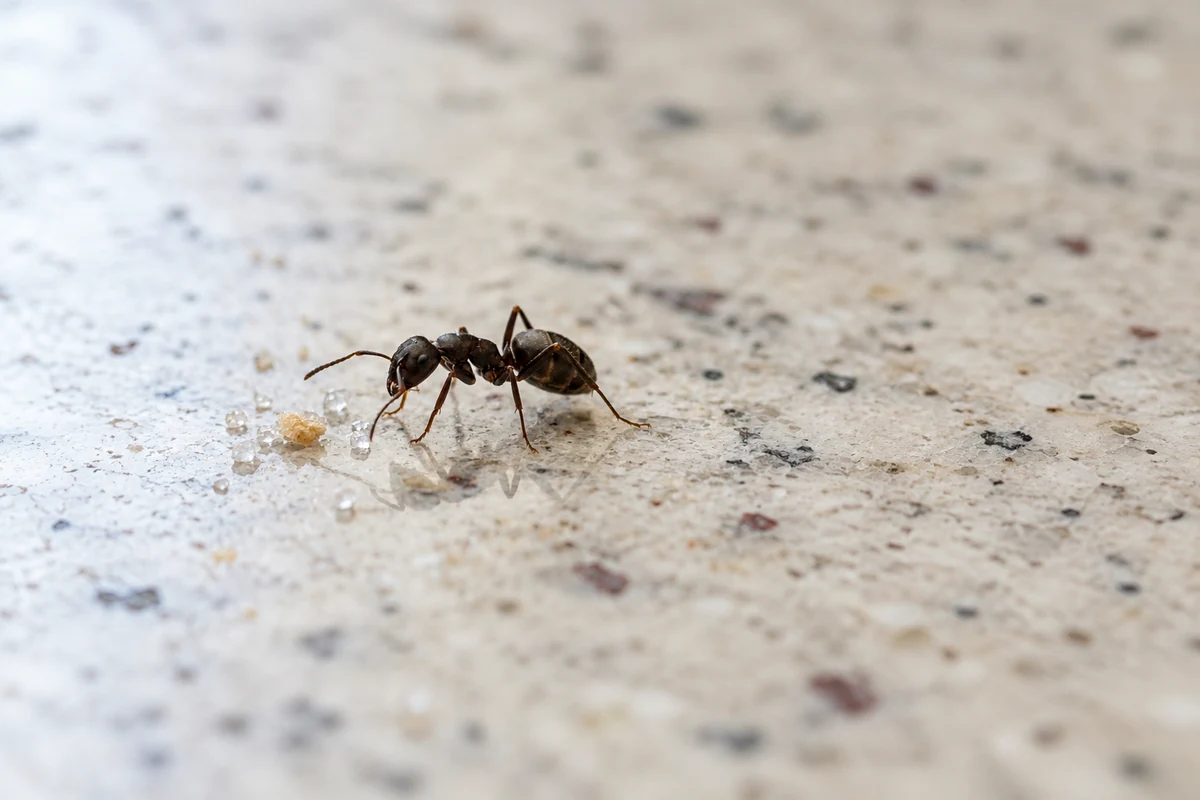

- “Sugar ants” is a nickname for small ants drawn to sweet food, such as the odorous house ant, not one species.
- The odorous house ant is about an eighth of an inch long, blackish, and smells like rotten coconut when crushed.
- Its colonies have many egg-laying queens, and they can split into smaller colonies.
- The ants you see on the counter are only a small part of the colony, so spraying them rarely ends it.
- With bait, it can take 5 to 10 days to see fewer ants.




What are sugar ants?
Sugar ants are not one species. Washington State University says two common kitchen ants, the pavement ant and the odorous house ant, are sometimes called sugar ants because they are attracted to sweet foods. In Collin County the tiny ant on the kitchen counter is most often the odorous house ant, on Pest Me Off’s calls.
Pharaoh ants, ghost ants and crazy ants turn up in kitchens too.
Knowing which one you have matters, because they do not all respond to the same treatment. This is how to tell the common ones apart. Ant size is given the way the sources give it, in fractions of an inch or millimeters, and 1.5 millimeters is about a sixteenth of an inch.
| Ant | Size and colour | How to tell it |
|---|---|---|
| Odorous house ant | About an eighth of an inch, brownish black | Smells like rotten coconut when crushed, and walks in clear trails |
| Pharaoh ant | About a sixteenth of an inch, yellowish to light brown or red | The end of the body is often darker, nearly black |
| Ghost ant | 1.3 to 1.5 millimeters | Dark head and middle, milky white legs and rear, hard to see |
| Tawny crazy ant | 2 to 2.4 millimeters, reddish brown | One of the crazy ants, which look like they run around aimlessly instead of in a line |
Sources: University of Kentucky and Utah State for the odorous house ant, University of Florida for the pharaoh, ghost and tawny crazy ants, Ohio State for how crazy ants move.
Why are there ants in my kitchen all of a sudden?
Ants come into a kitchen for food and water. The University of California says ants enter buildings looking for food, water, warmth and shelter, or to escape dry, hot weather or flooding, and that they may appear suddenly when their outdoor food runs out or the weather changes.
Penn State says ants that nest under slabs, odorous house ants among them, may occasionally come in through foundation cracks for food or after heavy rain.
Once one ant finds crumbs or a sticky spill, the rest follow. The University of Kentucky’s guide to ant control for householders explains that ants lay down invisible odor trails, which the workers follow between the food and the nest. That is why a single ant becomes a line along the counter within hours. Our technicians see odorous house ants show up on Collin County kitchen counters after a hard rain more than at any other time.
Are sugar ants harmful?
Odorous house ants are mainly a nuisance. Utah State University Extension says they do not bite unless provoked and cannot sting. The pharaoh ant is different. The University of Minnesota says it has been known to carry some diseases, such as Salmonella, though that is not common. Any ant crossing food should be cleaned up.
The real trouble with odorous house ants is how hard they are to get rid of. Kentucky’s entomologists call the odorous house ant the most common and difficult ant to control in Kentucky and much of the Midwest. Its colonies have many egg-laying queens and can split into smaller colonies for no clear reason, nesting outdoors under mulch, stones and woodpiles and indoors in wall cavities near moisture.
How do you get rid of tiny ants in the kitchen?
Take away what they came for, wipe out their trail, then bait them instead of spraying. The University of California says to clean up crumbs, grease and spills, store food in clean sealed containers, fix leaky faucets and caulk the cracks they use to get in.
Wiping the trail with a sponge and soapy water removes the scent the next ants follow.
- Wipe the trail and the ants on it with soapy water, especially where they come in, unless you are baiting that trail.
- Clean up crumbs, grease and sticky spills, and store food in sealed containers, not open bags.
- Fix leaky faucets and other drips, since water draws ants too.
- Caulk the cracks and gaps the trail leads back to.
- Put out bait where the ants are walking, and stop wiping that trail so they can find the bait and carry it home.
The step to skip is the can of spray. Kentucky says the usual mistake is spraying only the ants they see, which usually fails because those ants are a small part of the colony. The University of California’s guide to ants adds that spraying ants indoors will not stop more ants from coming in.
Once bait is out, Kentucky adds one caution: do not disturb the trails the ants are using to reach it.
Do ant baits work?
Ant baits work, and the University of California says that used properly they are more effective and safer than sprays. Worker ants carry small amounts of bait back to the nest and pass it to the other ants and the queens, which is how a bait reaches the part of the colony you never see.
It is slow. The University of California says it can take 5 to 10 days to see fewer ants.

Two things undo a bait. The University of California says not to use any insecticide spray while baiting, and Kentucky adds that sprays or cleaners around the bait can keep ants from eating it. Place baits where the ants can find them but pets and small children cannot. If the ants ignore one bait, Kentucky suggests trying another, because ants change what they want to eat through the year.
Do ant baits attract more ants?
Yes, for a little while, and that is a good sign. The University of Kentucky says you should at first see more ants around the bait, which means they are feeding and carrying it back to the nest. Do not spray them.
Kentucky says activity usually drops off in a few days as the number of ants in the colony goes down.
This is the moment it is tempting to give up on a bait and reach for a spray, which kills the ants doing the carrying. Leave the bait where it is, keep it topped up, and give it the 5 to 10 days the University of California says it can take.
How do you get rid of pharaoh ants?
Pharaoh ants need bait, not spray, and often a professional. The University of Florida calls the pharaoh ant the most difficult household ant to control. Its colonies split into daughter colonies, and Florida says repellent baits can make a colony break apart and spread.
The University of Minnesota says the baits sold to homeowners are generally not effective on pharaoh ants, and recommends an experienced pest professional.
The University of Florida’s page on the pharaoh ant explains what happens when a repellent bait splits a colony: ant activity drops for a short time while the new colonies settle in, then becomes a problem again once they start feeding. The University of Minnesota says insecticides can make pharaoh ants split into new colonies the same way. Our pharaoh ant page in the pest library shows what to look for.
Is there a home remedy for tiny ants in the kitchen?
The common home remedies do not get rid of ants. The University of Minnesota lists spearmint gum, red pepper, orange peels, cinnamon and other herbs, and lavender and other essential oils, as methods that are not effective against ants. A mild mix of vinegar and water only disrupts a trail for a while, Minnesota says.
Soapy water does the same job on a trail, as the University of California notes. Either one is a way to clean up today’s ants, not to stop tomorrow’s. The University of Minnesota’s page on ants also says persistent odorous house ant problems should be treated by a pest professional. If yours keep coming back, call us.
How Pest Me Off handles tiny kitchen ants
Pest Me Off’s odorous house ant control starts by tracing every active trail back to the wall it disappears into. Instead of spraying the counter, we place a slow-acting bait the ants cannot detect along the trails and at each entry point, so the workers carry it home to every queen. Outside, we treat the foundation and keep that treatment clear of the indoor bait, seal gaps around pipes, weep holes and door sweeps, and point out the moisture that drew the ants in. Call us and we start with the trail on your counter.
Not every tiny ant is an odorous house ant, so our ant control identifies the species first and treats the colony at its source. Same-day service is available for McKinney and the surrounding cities when you call before noon, with no-contract options.
Tiny ants back on the counter every week? Same-day ant control in McKinney and the surrounding cities when you call before noon.
We trace the trail to the wall it comes from and bait the whole colony, every queen, instead of spraying the few you can see. Free estimate. No-contract options.
