
Which Snakes You Will See in Collin County Yards, and What Keeps Them Away
Only 15 of about 120 kinds of snakes in Texas are venomous, and the one Pest Me Off is called about most in Collin County yards is the Texas rat snake, a long climber that follows rats and mice into garages and sheds. The venomous snake to know here is the copperhead. Snakes come for food and cover, so a short lawn, no woodpiles on the ground and fewer rodents do more than any repellent. If you see one, keep your distance and let it leave, or call us.
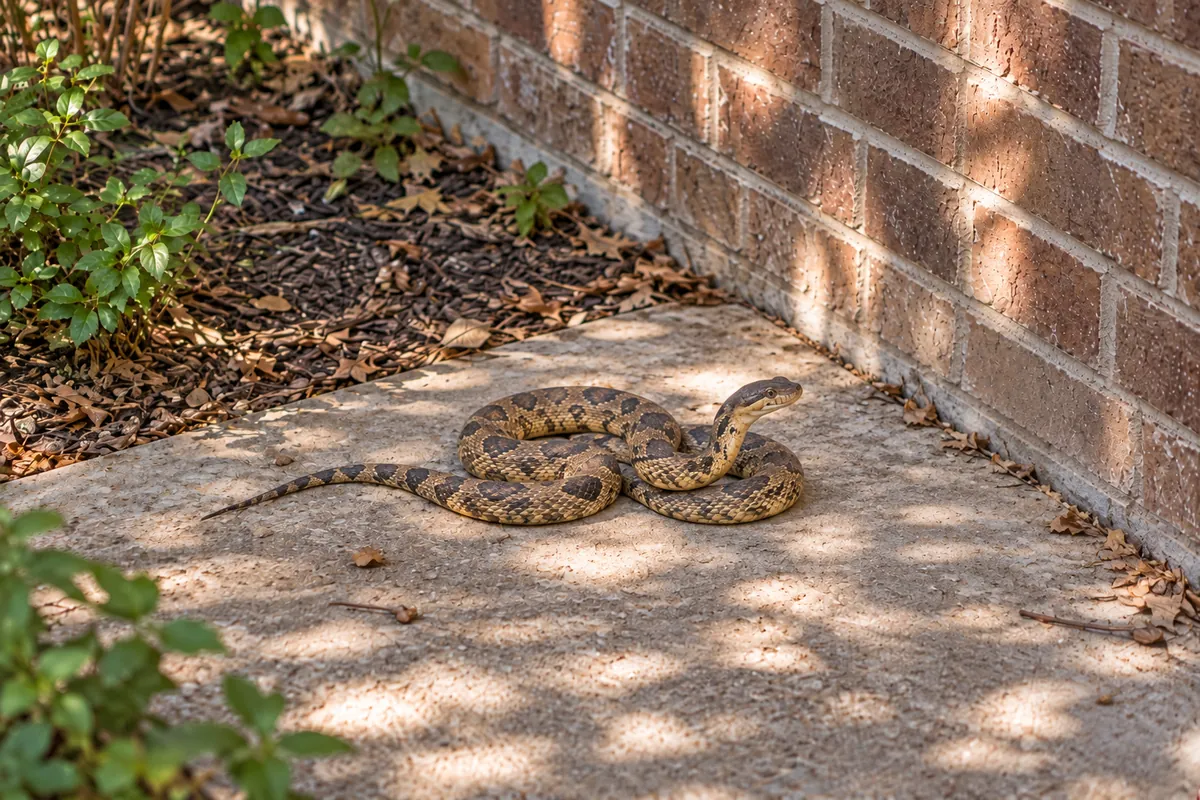

- Texas has about 120 kinds of snakes, and only 15 of them are venomous.
- The Texas rat snake has no venom. It eats rodents, birds and eggs, and it climbs well.
- Copperheads cause most venomous bites where they live, and they do well in wooded suburbs.
- Openings an eighth of an inch and larger are big enough to let a snake into a building.
- No chemical repellent has been proven to keep snakes away.




What snakes are in Collin County, Texas?
Most snakes in Texas are harmless, and on Pest Me Off’s calls that holds in Collin County too. Texas A&M AgriLife Extension counts about 120 kinds of snakes in Texas and only 15 venomous ones. On Pest Me Off’s calls the snake people meet most is the Texas rat snake, in garages, sheds and yards.
The venomous one to know is the copperhead, which Texas A&M says adapts well to urban areas, especially wooded suburbs.
Our technicians have also found a coiled snake on a garage door in McKinney, a copperhead resting in dry grass beside a McKinney property and a striped garter snake in a Frisco yard. Near creeks and ponds, water snakes show up too. Texas A&M notes that they are sometimes mistaken for cottonmouths, so a snake near water is not automatically a venomous one. The snake page in our pest library has photos of the rat snake and the copperhead side by side.
Are rat snakes venomous?
Rat snakes are not venomous. The Missouri Department of Conservation describes a long snake, 3 and a half to 6 feet as an adult, that eats rodents, small rabbits, bats, birds and their eggs. If one is cornered or caught it will bite to defend itself and release a strong, unpleasant musk.
Rat snakes are excellent climbers, and one that is alarmed may vibrate its tail.
That bite is the reason to leave a rat snake alone, even though it carries no venom. A rat snake in the garage is often there for the same rats and mice you would want gone, and the Missouri Department of Conservation’s page on the western ratsnake notes that they shelter in brush piles, hollow trees and farm buildings. Seeing one is a sign that something is feeding it.
What does a copperhead look like?
A copperhead is pale brown to light tan, often with a pinkish tint, and crossed by dark hourglass-shaped bands. Texas Parks and Wildlife describes the bands as wider at the base and narrow across the back, and Texas A&M says adults are usually 18 to 24 inches long.
Texas A&M AgriLife Extension counts 10 to 18 of these markings and says the head is plain on top except for a small dark spot near each eye. Young copperheads have a yellowish tail tip.
The two snakes this county sees most are easiest to tell apart by their pattern, from a safe distance. Every fact in the table comes from the sources listed under it.
| What to look at | Copperhead | Texas rat snake |
|---|---|---|
| Venom | Venomous | None |
| Body colour | Pale brown to light tan, often pinkish | Tan with dark blotches in our local photos, often darker in adults |
| Pattern | 10 to 18 hourglass markings, wider at the base | Dark blotches, not hourglass bands |
| Adult length | Usually 18 to 24 inches | 3 and a half to 6 feet |
| Young | A yellowish tail tip | Gray or tan with dark blotches |
| When it hunts | At night in the summer heat | By day in spring and fall, at night in hot weather |
Sources: Texas Parks and Wildlife and Texas A&M AgriLife Extension for the copperhead, the Missouri Department of Conservation and Pest Me Off’s own photos for the rat snake.
Texas A&M is blunt that there is no easy way to recognize every venomous snake quickly in the field, and that proper identification often needs a close look. The close look is the part to skip. Treat any snake you cannot name as venomous and keep your distance.
What attracts snakes to your yard?
Snakes come to a yard for food and cover. Texas A&M AgriLife Extension says they are attracted by rodents and insects, and by the cool, damp, dark areas of buildings. Rock piles, brush piles, woodpiles, tall grass and clutter on the ground give them places to hide.
Rats and mice use the same cover, so a yard that feeds rodents is a yard that feeds snakes.
That is why the rat snake turns up where it does. Garages, sheds and the gap under a stored board all give a snake shade, cool air and a chance at a mouse. AgriLife Today’s advice on avoiding snakes in spring notes that snakes are often seen sunning on rocks and logs early in the spring, then turn to hunting at night or at dusk as the weather heats up.
How do you keep snakes away from your house?
Take away the cover and the food, then close the way in. Texas A&M AgriLife Extension says removing shelter is one of the most effective ways to discourage snakes, and that lumber and woodpiles should sit at least 18 inches off the ground. Keep the grass short and control rodents.
The Internet Center for Wildlife Damage Management says to seal every opening an eighth of an inch and larger.
- Keep the grass short and cut back tall, overgrown plants.
- Move woodpiles, lumber and boards at least 18 inches off the ground, and clear brush and rock piles.
- Get rid of the rats and mice the snakes are hunting.
- Seal the gaps around water pipes, electrical outlets, doors and windows, and patch holes in the foundation.
- For a small area such as a play yard, consider a snake fence.

The Texas A&M guide to snake damage and control describes the fence: a quarter inch hardware cloth, 36 inches wide, with the bottom edge buried at least 6 inches and the fence slanted outward at 30 degrees. It also says the fence is costly enough to make sense only for small areas, and that tall plants beside it have to be cut so a snake cannot climb over.
Does snake repellent work?
Snake repellent has not been proven to work. AgriLife Today says no chemical repellents have been proven to keep snakes away. The Internet Center for Wildlife Damage Management says research on how well repellents work is either lacking or inconsistent. Taking away cover and food, and sealing gaps, is what the sources recommend instead.
Mothballs are a common home remedy, and they are the wrong one. The Internet Center for Wildlife Damage Management’s page on mothballs does not recommend them to repel nuisance wildlife, for legal and safety reasons, and notes that a pesticide must be used according to its label. The same center’s page on snake control covers what does work. Texas A&M adds that no poison or fumigant is registered to control snakes, and that the registered repellents sold for some kinds of snakes must be used according to the label.
What should you do if you see a snake in your yard?
Leave it alone and let it go its way, which is the advice from AgriLife Today. Keep children and pets back, and do not try to catch or kill it. Texas A&M’s school pest program says most bites happen when a person is trying to handle a snake or kill it.
If the snake is in the garage or the house, or will not leave, call a professional to remove it.
Texas A&M also notes that many snakes in Texas are protected by state law, so killing them is not just risky but can be illegal. The CDC warns never to handle a venomous snake, not even a dead one. If someone is bitten, the CDC’s page on venomous snakes says to get emergency medical care as soon as possible, stay calm and wash the bite with soap and water. Do not use a tourniquet, cut the wound, try to suck out venom or put ice on it.
How Pest Me Off handles snakes
Pest Me Off’s wildlife removal covers snakes in the garage, on the deck and in the yard. We identify the snake, remove it safely and point out what is drawing it in, whether that is a woodpile, a gap under the door or the mice it came for. Then we seal the way in so the next one cannot follow. Never handle an unknown snake yourself.
When rodents are the reason a snake keeps coming back, our rodent control takes away its food, and our article on rats in the house in winter shows the signs to look for. Same-day service is available for McKinney and the surrounding cities when you call before noon, with no-contract options.
A snake in the garage or by the back door? Same-day removal in McKinney and the surrounding cities when you call before noon.
Keep your distance and call. We identify the snake, remove it safely and seal the way it got in, then show you what was drawing it to your home. Free estimate. No-contract options.
