
Rats in the House in Winter, the Signs and How They Get In
Rats end up in the house in winter because they do not hibernate: they stay active all year, and a half inch gap under a door is all it takes for one to reach a warm attic or wall. The signs come before the rat does, as droppings, gnaw marks, greasy rub marks and scratching in the attic at night. Pest Me Off’s technicians find the way in on rodent jobs across Collin County in the same few places, around pipes and wires, under doors and along the roofline, and sealing those with metal is the fix that lasts.
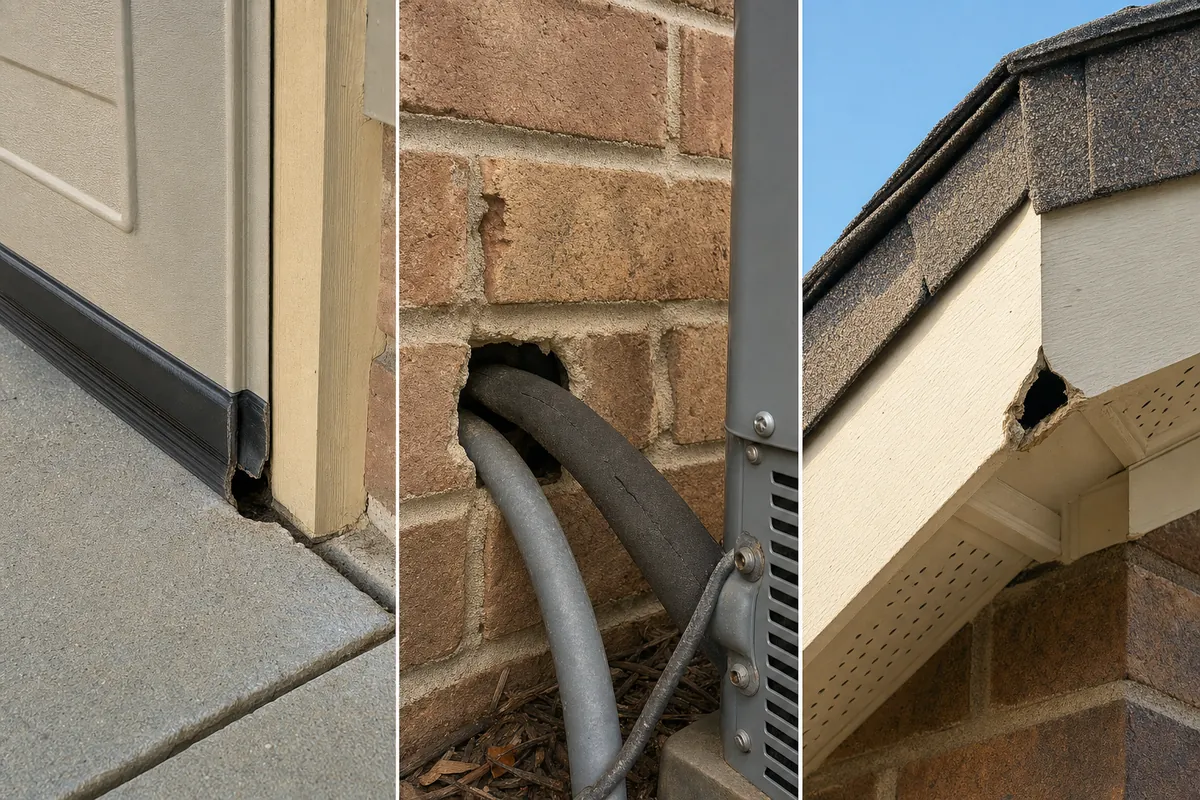

- Rats are active throughout the year, so they do not hibernate through the winter.
- A rat, especially a young one, can squeeze under a door with only a half inch gap.
- A Norway rat leaves about 40 to 50 droppings a day, usually clumped in small groups.
- Rats are mostly active at night, and sounds in the attic are often the first sign of roof rats.
- The average female Norway rat has 4 to 6 litters a year and can raise 20 or more young.





Do rats come inside in winter?
Rats come inside in winter whenever a house gives them a way in, and they do not hibernate. The University of California says rats are active throughout the year, and that once rats live in the yard, unless the house is truly rodent proof, it is only a matter of time before signs show up indoors.
In northern climates, the Internet Center for Wildlife Damage Management says, Norway rats prefer to nest near sources of heat.
Winter changes what rats are doing more than whether they are around. Norway rat breeding peaks in spring and fall and often stops in winter, depending on habitat, according to the Internet Center for Wildlife Damage Management page on Norway rat biology. Rats already living around a house keep feeding all winter, and roof rats nest in enclosed, raised spaces such as attics and wall voids. The average female Norway rat has 4 to 6 litters a year and can raise 20 or more young, according to the University of California Pest Notes on rats, so a pair that settles in is a much bigger problem within a year.
What are the signs of rats in the house?
The signs of rats in the house are droppings, gnaw marks, greasy rub marks, scratching in the attic or walls at night, and nests. Rub marks are dark smudges along walls and beams, and nests are shredded paper, cloth or insulation.
Rats are mostly active at night, so people seldom see them, but the signs are easy to find. Control takes less time when it starts early.
| Sign | What it means |
|---|---|
| Droppings | Norway rat droppings run up to 3/4 inch long with blunt ends, clumped along runways and near food. Fresh ones are soft. |
| Gnaw marks | Chewed wood, wires, doors and food packaging, with tooth marks larger than a mouse leaves. Fresh shavings mean rats are active now. |
| Rub marks | Dark smudges on beams, rafters, pipes and walls, left by oil and dirt in the fur along routes rats use often. |
| Noises at night | Scratching and scurrying in the attic, walls or ceiling once the house is quiet. Often the first sign of roof rats. |
| Nests | Shredded insulation, paper or cloth behind boxes, in drawers in the garage or in the attic. |
| Around pet food | Droppings by the dog or cat dishes or around the pet food bin. |
Fresh droppings and fresh shavings mean the rats are there now.

The signs matter beyond the mess. The University of California warns that roof rats living in an attic can cause electrical sparks and fires by gnawing wires, and lists typhus, leptospirosis, food poisoning from germs such as salmonella, and rat bite fever as the diseases rats most often pass to people. Never touch droppings or a dead rat with bare hands, and never sweep or vacuum droppings. The CDC’s guide to cleaning up after rodents says to put on rubber or plastic gloves, soak the droppings with a bleach solution for 5 minutes, then wipe them up with paper towels.
How do rats get in the house?
Rats get into a house through gaps around pipes, wires and vents, under doors, at the foundation and along the roofline. A rat, especially a young one, can squeeze under a door with only a half inch gap, and may gnaw a wooden door to widen it.
Roof rats climb in from trees, vines and utility lines, so openings high on the house matter as much as those at ground level.
The University of California says rats get into buildings by gnawing, climbing, jumping, and swimming through sewers to come up through toilets or broken drains. The two species come at a house from different ends. Norway rats burrow along foundations and come in low, while roof rats often enter from the roof or near overhead utility lines they run along at night. Our guide to how roof rats get into your attic and why they stay covers the roofline in detail.
Where do rats hide in a house?
Rats hide in a house where nobody disturbs them and food is close. Roof rats nest high, in attics, wall voids, false ceilings and cabinets. Norway rats usually stay low, on the ground floor and in burrows along the foundation.
Both kinds nest behind boxes in a cluttered garage and in woodpiles, and they travel along walls, pipes and beams at night. The City and County of San Francisco’s rat and mouse guide says to stack woodpiles and lumber 18 inches off the ground and 12 inches away from walls, which takes that cover away.
When both species share one building, Norway rats usually take the lower floors and roof rats the upper ones, according to the University of California. Rats do not stay put in those hiding places, either. Roof rats routinely travel up to 300 feet or more for food, and Norway rats forage anywhere from 100 to 500 feet from the nest, so a rat in the attic may be feeding on a neighbor’s fruit tree. The same guide notes that roof rats are strongly tied to their nest sites and come back to them if the nests are not removed.
How do you keep rats out of your house?
You keep rats out of a house by sealing every opening larger than a quarter inch with steel wool, wire screen or sheet metal, and by taking away the food and cover that draw them in. Rats can chew through plastic, foam, wood and caulk, so caulk alone does not stop a rat.
The University of California also advises removing overhanging tree limbs within 6 feet of the roof.
| Where | What to do |
|---|---|
| Pipes, wires and cables | Seal every opening where they pass through a wall or the foundation, with metal rather than foam or caulk. |
| Vents and screens | Cover vents with galvanized metal mesh of 1/2 inch, never chicken wire, and repair torn attic and eave screens. |
| Doors and the garage door | Make every outside door fit tight and seal the threshold with a door sweep or weather stripping. |
| Trees, vines and shrubs | Remove climbing plants from the walls, cut overhanging limbs within 6 feet of the roof and keep shrubs 2 feet off the house. |
| Woodpiles and lumber | Stack them 18 inches off the ground and 12 inches away from the walls. |
| Food and garbage | Bring pet food in at night, pick up fallen fruit and keep garbage in bins with tight lids. |
Steel wool, wire mesh and sheet metal stop a rat, and caulk, foam and plastic do not.
Some of what gets sold for rats does nothing. The University of California says rats quickly get used to repeated sounds, so ultrasonic devices do not control them, and that no repellent has solved a rat problem for more than a very short time. Snap traps placed along walls and in the attic, where the droppings and rub marks are, are what the same guide calls the safest and most effective way to trap rats. Our article on why do it yourself rodent control falls short explains where home efforts usually miss.
How Pest Me Off handles rats
Pest Me Off’s rodent control starts with a full inspection of the roofline, attic, garage and foundation to find how the rats are getting in and which kind you have, because roof rats and Norway rats are trapped in different places. A technician sets traps on the routes the droppings and rub marks show, then seals the entry points with metal, not caulk or foam, and comes back to check the traps and confirm no new activity.
Trapping without sealing only buys time, because the next rats find the same warm attic through the same gap. Same-day service is available for McKinney and the surrounding cities when you call before noon, with no-contract options.
Scratching in the attic or droppings in the garage? Same-day pest control in McKinney and the surrounding cities when you call before noon.
We find how the rats are getting in, trap the ones inside and seal the gaps with metal so the next ones cannot follow. Free estimate. No-contract options.