
Carpenter Ants or Termites? How to Tell a Flying Ant From a Swarming Termite
Flying carpenter ants and flying termites show up in the same spring weeks, and three things tell them apart. An ant has a pinched waist, bent antennae and front wings longer than its back wings. A termite has a thick waist, straight antennae and four wings of the same length. The difference matters, because termites eat the wood in a home while carpenter ants hollow it out to nest, usually starting in wood that is already wet or rotting. Pest Me Off’s technicians sort the two out across McKinney and the rest of Collin County every spring.
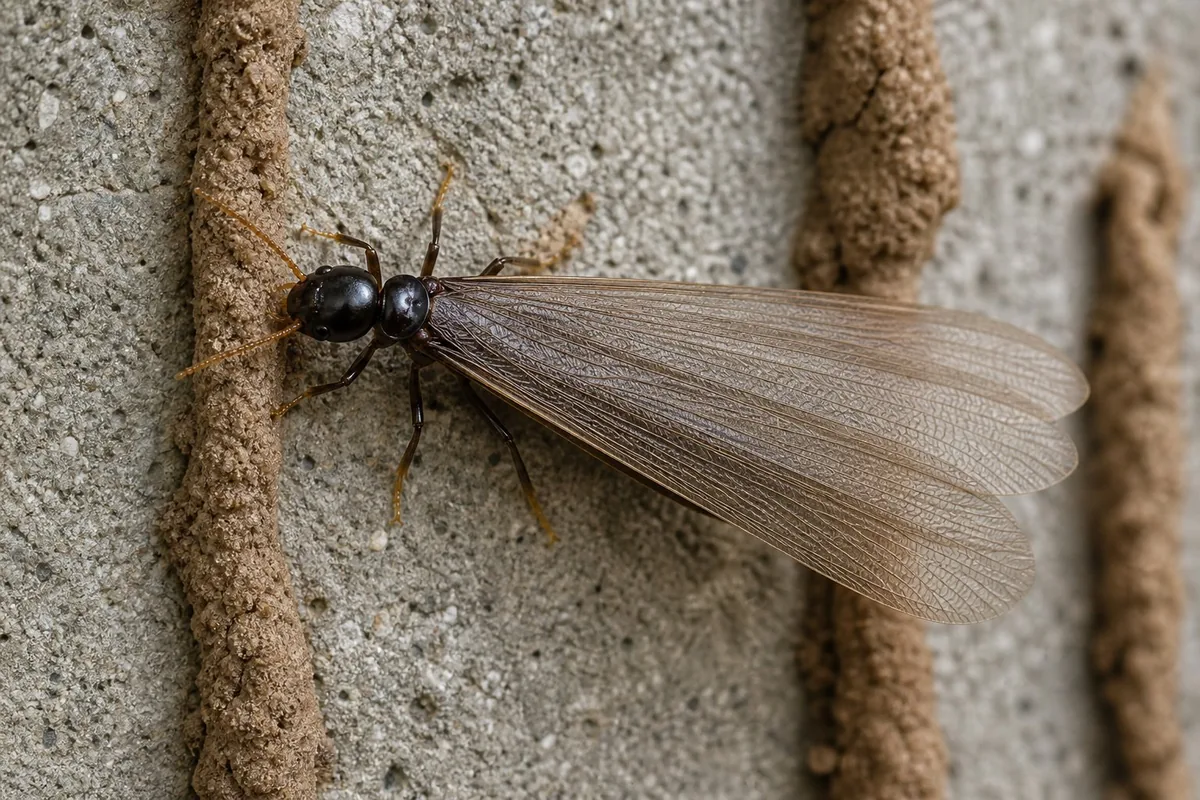

- Ants have a pinched waist and termites have no waist, the simplest way to tell them apart.
- A flying termite has four wings of about equal length, while a carpenter ant’s back wings are shorter than its front wings.
- April and May are the main months termites swarm in Texas.
- Carpenter ants do not eat wood. They hollow it out to nest, usually where it is already wet or rotting.
- Termites swarming inside a home usually mean there is an infestation somewhere in the house.




Are flying ants termites?
Flying ants are not termites, but the two are easy to confuse because some kinds of ants swarm at the same times of year as termites, according to NC State Extension. Look at three things. An ant has a narrow, pinched waist, bent antennae and back wings shorter than its front wings.
A termite has a broad waist, straight antennae and four wings of equal length.
Both insects send out winged males and females in spring to mate and start new colonies, which is why they turn up at the same windows in the same weeks. In Collin County the two that cause the most worry are the carpenter ant and the eastern subterranean termite, which Texas A&M AgriLife Extension calls the most common termite in Texas. The University of Minnesota Extension page on carpenter ants sets out the same three checks: waist, antennae and wings.
Carpenter ant or termite, told apart
A flying insect on a windowsill can be checked against this table with a phone camera and a little patience. These details come from Penn State Extension, the University of Minnesota, the University of Kentucky and NC State.
| Feature | Flying carpenter ant | Flying termite |
|---|---|---|
| Waist | Narrow and pinched | Broad, with no waist to speak of |
| Antennae | Bent at an elbow | Straight, with bead-like segments |
| Wings | Back wings shorter than front wings | Four wings of about equal length |
| Size | Up to about three quarters of an inch | About three eighths to half an inch |
| What it does to wood | Hollows it out to nest, but does not eat it | Eats it, along with paper, cardboard and anything else made of cellulose |
| Inside the damaged wood | Smooth, clean tunnels with no soil, and coarse sawdust pushed out | Wood hollowed out along the grain, lined with bits of mud or soil |
The waist is the simplest check: pinched means ant, straight means termite.
Penn State’s Extension page on carpenter ants explains why it is worth the trouble: each needs its own method of control.
What do flying termites look like?
Flying termites, also called termite swarmers, are brown or black and about three eighths to half an inch long, according to Penn State Extension. They have straight, bead-like antennae, a thick body with no pinched waist, and four long wings of about the same length.
Shed wings on a windowsill or along the edge of a floor are one of the telltale signs the University of Kentucky lists.
A flying termite looks nothing like the termites doing the damage. The workers inside the colony are small, creamy white and wingless, and University of Minnesota Extension says they avoid light and are rarely seen outside the colony. Our article on the signs of subterranean termite infestation in Collin County covers the mud tubes and damaged wood they leave behind.
Do carpenter ants eat wood?
Carpenter ants do not eat wood. University of Minnesota Extension says they remove it as they dig tunnels for their nests, and the University of California says they excavate wood rather than consume it the way termites do. They feed on other insects, sweet honeydew and the sugars and fats in a kitchen.
The damage comes from the nest itself, and it usually builds slowly, over years.
Carpenter ants pick soft wood. Penn State says they seldom tunnel into dry, sound wood, and usually will not infest sound wood with a moisture content under 15 percent. That points them at leaking window frames, rotting fascia boards, wet bathroom subfloors and old tree stumps. One of our technicians found carpenter ant tunnels and coarse sawdust inside a tree stump in a Fairview yard, a typical outdoor parent nest. The University of California page on carpenter ants adds that they are most active after sunset, which is the best time to follow a trail back to the nest.
When do termites swarm in Texas?
Termites swarm mostly in April and May in Texas, according to Texas A&M AgriLife Extension. The eastern subterranean termite, the most common kind in the state, usually swarms in mid-spring, and the Formosan subterranean termite usually swarms in May. Swarms usually come on warm days after rain, NC State Extension adds.
A sunny afternoon after a spring storm is the time to watch.
Texas A&M says swarming in most of the state starts with a swarm tube in late March or early April, a small dab of mud that appears on an indoor wall. Within 7 to 14 days, when the weather is right, that tiny hole lets out dozens to thousands of winged termites. Carpenter ants fly in the same season. Penn State says their winged males and females leave the nest on warm days in spring and early summer. Our page on how Formosan termites get into a home covers the termites that swarm in May.
What does a termite swarm in the house mean?
Termites swarming inside the house usually mean there is an infestation somewhere in the home, according to NC State Extension. Texas A&M calls indoor swarming a sure sign of an active infestation. The swarmers themselves are unlikely to start a new nest indoors. They cannot reach soil, so they die quickly.
The colony that sent them out is the problem, it has been growing for 3 to 5 years, and it is usually in or under the building.

A swarm outside is different. The NC State Extension guide to termites says winged termites near tree stumps and landscape timbers outdoors do not mean the house is infested, only that termites live nearby. Carpenter ants follow the same rule. University of Minnesota Extension says large numbers of winged ants indoors are a sure sign of a nest inside, while the odd winged queen is probably a newly mated ant that wandered in looking for a place to nest.
What to do when winged insects appear inside
- Catch one or two on clear tape, or take a sharp close-up photo, before they die and get swept up.
- Check the waist, the antennae and the wings against the table above.
- Note where they came from: a windowsill, a bathroom near the slab, a garage wall or a dab of mud on drywall.
- Do not rely on spraying them. NC State says spraying the winged termites you see does not stop the infestation or protect the house.
- Book an inspection, because a swarm is the time of year a colony is most likely to show itself.
How Pest Me Off handles carpenter ants and termites
A Pest Me Off technician starts by identifying the insect, from a sample, a photo or the shed wings, because the treatment depends on it. For termites, our termite treatment starts with an inspection of the slab edge, bathroom traps, garage walls and the foundation for mud tubes and damaged wood. For carpenter ants, our carpenter ant control follows the trail at dusk to the wet or rotting wood the nest is in, and to the parent colony outside in a tree, stump or landscape timber.
Spring swarms are the busiest weeks for both, and we answer them across McKinney, Allen, Frisco, Plano and the rest of Collin County with a free estimate. Call us when they show up.
Winged insects at the window and not sure what they are? Same-day pest control in McKinney and the surrounding cities when you call before noon.
Call us and we identify whether it is a carpenter ant or a termite, find the colony behind it, and treat the one you actually have. Free estimate.
