
Little Black Ants in the House, and Which Black Ant You Have
A small black ant in a Collin County home is usually one of three species, and each one needs a different fix. This article covers how to tell them apart, when a black ant is really a carpenter ant, which black ants bite, why they turn up in the bathroom, what winged ones mean, and how to get rid of them.
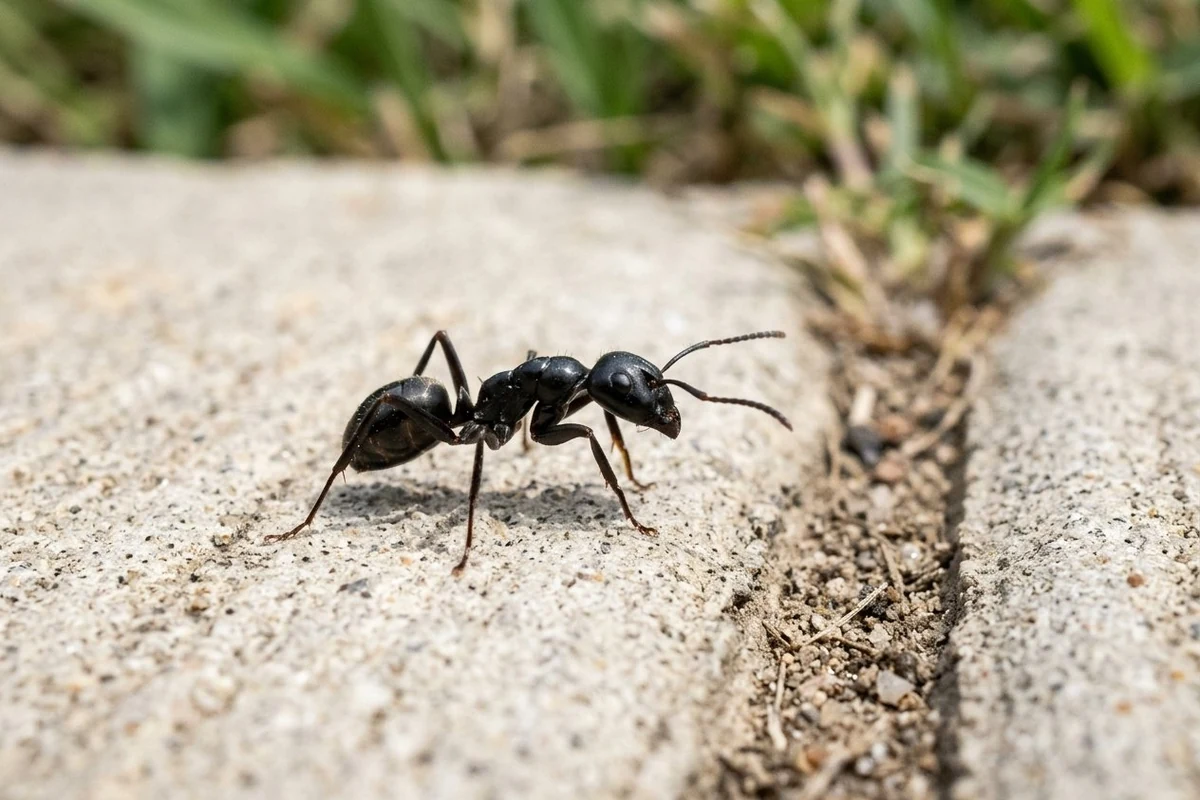

- A little black ant is about 1/16 inch long and shiny black all over.
- A crushed ant that smells rotten is an odorous house ant, not a little black ant.
- Little black ants and pavement ants cannot sting through your skin.
- A black ant 1/4 inch or longer, in mixed sizes and out at night, is most likely a carpenter ant.
- Winged ants swarming indoors point to a nest inside the house.





What are the little black ants in my house?
Usually one of three ants: the little black ant, the pavement ant or the odorous house ant. Texas A&M puts the little black ant at 1/16 inch, shiny black and all one size. A black ant 1/4 inch or longer, in mixed sizes, is most likely a carpenter ant, which NC State Extension puts at 1/4 to 5/8 inch.
The other two are a little bigger. Utah State University Extension puts pavement ant workers at 2.5 to 3 mm, dark brown, with parallel grooves on the head and thorax that show best under a hand lens. Penn State Extension puts odorous house ant workers at 2.4 to 3.3 mm, brown to black, and says a crushed one gives off a rotten odor, which our own pages describe as rotten coconut.
What small black ants in the house mean is food. Our little black ant page explains that a kitchen trail is workers from a colony outside, with the nest usually within 10 to 20 feet of where they come in. Our pavement ant page covers the sandy piles at driveway cracks and how that ant differs from what people call sugar ants, and our article on tiny ants in the kitchen covers the odorous house ant.
Do little black ants bite?
Not in any way you would feel. Our little black ant page notes a stinger too weak to get through human skin, and Utah State says the pavement ant's stinger usually stays out of sight. The black ant that can give a painful bite is the carpenter ant, which PestWorld says has powerful jaws, though its bites are very uncommon.
PestWorld adds that a carpenter ant may inject formic acid into the bite, which burns, but the pain fades and is not a significant health threat. If the bite breaks the skin, wash it with soap and water, put on an antibiotic ointment and cover it with a bandage.
Our pavement ant page says a barefoot step on a trail gives a faint prickle at most, and our odorous house ant page lists no sting and only a rare minor bite. An ant that stings hard in a group is a fire ant, which our library pages describe as reddish-brown, 1.6 to 6 mm and mixed in size, not black. Our article on fire ant bites covers what to do for those.
Why are little black ants in my bathroom?
Usually for the water. Utah State University says pavement ants are drawn indoors by food, garbage and moisture, and that the less common colony inside a home often sits in bathrooms under toilets and showers. Wisconsin Extension says indoor pavement ant nests sit in wall voids near heat and humidity, such as hot water lines.
The odorous house ant does the same. Penn State says it nests indoors near moisture and warmth, in wall voids. A bigger black ant at the tub or sink is worth a closer look, because the University of Minnesota lists behind bathroom tiles and around tubs, sinks and showers as carpenter ant nest sites, and says the workers come out around toilets and sinks looking for moisture.
Little black ants in the kitchen are after food. Texas A&M says they hunt insects and feed on honeydew from aphids, and are easy to spot on their trails once they reach food cabinets and pantries. Penn State says pavement ants take sweets, grease, dead insects and small seeds, and nearly any crumb that falls to the floor.
What does it mean when little black ants have wings?
A colony is old enough to send out new queens and males. The University of Minnesota says winged ants swarming inside a building point to a nest indoors. Utah State says pavement ants swarm in late spring but can swarm any time of year near a heated slab, and a swarm indoors can go on for over a week.
Texas A&M says little black ant colonies raise their winged males and females during the summer. For carpenter ants, the University of Minnesota draws a useful line: large numbers of winged ants indoors are a sure sign of a nest inside, while a single winged queen does not mean a nest indoors, because she is likely a new queen that wandered in looking for a place to start.
Winged ants are easy to mistake for termites. The University of Minnesota says an ant has a pinched waist, bent antennae and hind wings shorter than the front ones, while a termite has straight, beaded antennae and 4 wings of equal size. Our article on carpenter ants and termites walks through the difference.
How do you tell pavement ants from carpenter ants?
Size and the waist tell them apart. NC State Extension puts carpenter ant workers at 1/4 to 5/8 inch, in mixed sizes, and the University of Minnesota says they have 1 node in the waist. Utah State puts pavement ants at 2.5 to 3 mm, all one size, with 2 nodes and grooves on the head.
Where you find them helps too. Utah State says pavement ants leave small, volcano-shaped mounds of soil at cracks in concrete. The University of Minnesota says carpenter ants forage between sunset and midnight, leave coarse sawdust where they nest and do not eat wood, they only tunnel through it.
NC State Extension says carpenter ants prefer wood with a moisture content of 15 percent or higher, so a carpenter ant problem often comes with a leak or a damp spot. Our carpenter ant page has the full look at that ant, and carpenter ant control is a separate service.
How do you get rid of little black ants?
Name the ant first, then get bait back to the queens. The University of Minnesota says killing the workers you see does little, because only a small share of the colony is out of the nest. Penn State says slow-acting baits let workers share the bait with the queen, which can take 2 weeks or longer.
Penn State says to set baits where children and pets cannot reach them, and the University of Minnesota says not to spray while using a bait, because the spray stops the ants from carrying it home.
The species changes the plan. Our ant control page warns never to spray odorous house ants, because a repellent spray can split the colony into more nests. A carpenter ant nest also needs the damp wood fixed, as NC State notes. Texas A&M adds clearing litter and objects ants can nest under and sealing cracks in the outside walls.
Our little black ant and pavement ant pages each list the do-it-yourself steps that work on that ant and the ones that fail, such as setting bait beside the food instead of where the trail comes in.

The small black ants of Collin County homes, told apart
Sizes come from Texas A&M, Utah State, Penn State and NC State, and the smell and sting notes from our own library pages.
| Ant | Size | Color | Where you see it | Smell when crushed | Bites or stings |
|---|---|---|---|---|---|
| Little black ant | 1/16 inch | Shiny jet black | Kitchen trails from a nest outside | None | Stinger too weak for skin |
| Pavement ant | 2.5 to 3 mm | Dark brown | Sandy piles at concrete cracks | None | Stinger too weak for skin |
| Odorous house ant | 2.4 to 3.3 mm | Brown to black | Trails near water and warmth | Rotten, like coconut | No sting, a rare minor bite |
| Carpenter ant | 1/4 to 5/8 inch | Black, or red and black | Damp wood, mostly at night | Not a test for this ant | Can bite, and it hurts |
| Fire ant | 1.6 to 6 mm | Reddish-brown | Dirt mounds in the lawn | None | Stings within seconds |
Size is the first cut and the smell test is the second. An ant that does not fit any row is worth a photo.
Sorting a small black ant in five steps
- Lay one ant beside a ruler. Texas A&M puts the little black ant at 1/16 inch, and NC State puts carpenter ant workers at 1/4 to 5/8 inch.
- Crush one and smell it. Penn State says a rotten odor means an odorous house ant, and our library pages say little black ants and pavement ants have no smell.
- Look for where they come from. Utah State says sandy, volcano-shaped piles at a concrete crack mean pavement ants, and the University of Minnesota says coarse sawdust points to carpenter ants.
- Leave the trail alone. Our ant control page asks you not to spray it before a visit, since that scatters some ants and wipes out the trail used to find the nest. Throw out food the ants reached and wipe the surface with soap and water.
- Take a clear photo. Our ant control page says to send it, and we will confirm which ant you have.
How Pest Me Off treats little black ants and other small black ants
On an ant control visit, Pest Me Off confirms the species first, because the right product depends on it. A licensed applicator uses a non-repellent product the workers cannot detect and carry home to the queen, whether she is in the yard, under a slab, in a wall void or in dead wood. On the same visit we install the Scorched Earth Barrier around the foundation and treat the entry points: foundation cracks, expansion joints, weep holes, door frames and utility lines.
For little black ants and pavement ants, one non-repellent visit usually ends it. Pets and kids are back inside in 1 to 2 hours, once the treatment dries, and an optional quarterly plan keeps the barrier live year-round. The inspection and estimate are free, with same-day service when you call before noon, in McKinney, Plano, Frisco, Allen and across Collin County.
Small black ants in the kitchen or bathroom? Same-day pest control in McKinney and the surrounding cities when you call before noon.
We confirm which ant you have, treat the colony at the source and install the Scorched Earth Barrier around the foundation. Free inspection and estimate.
