
Tawny Crazy Ants in Texas, and How to Tell Them From the Black Crazy Ant
Small ants running in every direction at once, too fast to follow, earn the name crazy ant. In Texas that name covers two different ants: the tawny crazy ant, an invader that shorts out electrical equipment along the coast, and the black longhorn crazy ant, which is common in Texas towns. This article covers where the tawny crazy ant has spread, whether it bites, why it gets into electronics, and how to tell it from fire ants and from the black crazy ant.
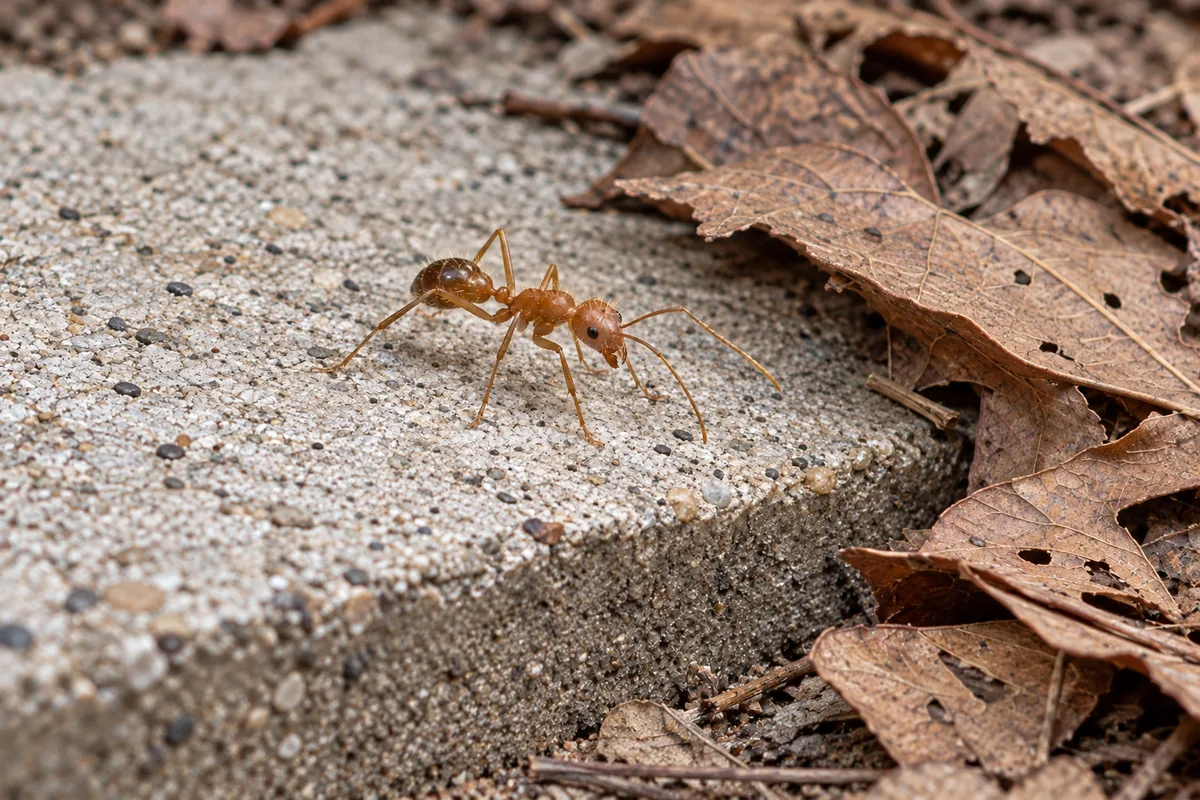

- Workers are reddish brown, hairy and all about 1/8 inch long.
- Texas A&M had confirmed them in 43 Texas counties by October 2022. Collin County was not one.
- They have no stinger. A bite is a small pain that quickly fades.
- They pack into electrical equipment in numbers that short it out.
- Fire ant bait does little to them, so get the ant identified first.





Are there tawny crazy ants in Texas?
Yes, tawny crazy ants are established in Texas, from the Gulf Coast inland to central and east Texas. Texas A&M AgriLife Extension had confirmed them in 43 Texas counties by October 2022, spreading out from Harris County, where they were first found in 2002.
Collin County is not on that list, and neither is Dallas, Denton, Grayson, Fannin, Hunt or Rockwall County.
That October 2022 list is the newest county list Texas A&M has published that we could find, so a find closer to Collin County since then would not appear on it. The ant mostly travels with people. The Texas A&M AgriLife Extension guide to managing tawny crazy ants says it has spread in plants, construction materials, mulch, yard debris, hay bales and recreational vehicles. On its own it moves slowly: the Texas A&M urban entomology page on the tawny crazy ant puts its spread through neighborhoods at about 20 meters a month.
Cold may be what holds it back. That same Texas A&M page calls it a semi-tropical ant whose spread north should be limited by cooler weather, and the University of Texas field station program describes it as currently restricted to the Gulf Coast region. Texas A&M asks that any tawny crazy ant found in a county not on its map be reported to its Rollins Urban and Structural Entomology Facility, at 979-845-5855.
Do tawny crazy ants bite?
Tawny crazy ants can bite, but they have no stinger, and the bite is minor. Texas A&M’s urban entomology program says a bite causes a minute pain that quickly fades. The University of Georgia adds that the workers can also spray small amounts of formic acid, which can irritate the skin and eyes.
Their numbers, not their bite, are the problem.
Where they are established, the numbers are hard to picture. The University of Texas at Austin reported in 2013 that tawny crazy ants can reach densities up to 100 times as great as all other ants in an area combined. The University of Florida’s guide to the tawny crazy ant says they spoil time outdoors by crawling quickly over people.
When they die, they pile up. The University of Georgia’s report on the tawny crazy ant says dead ants can collect in the hundreds of thousands around buildings and in yards.
Why do crazy ants get into electronics?
Tawny crazy ants nest in almost any sheltered space, and where they are established they pack into electrical equipment in numbers that short it out. Texas A&M’s urban entomology program says large numbers have caused short circuits and clogged switching mechanisms, and that in some cases the ants have caused several thousand dollars in damage and repair costs.
Texas A&M says their colonies can be found under or inside almost any object or void, from stumps and rocks to potted plants. Its management guide says tawny crazy ants have been seen to infest and destroy electrical equipment in homes and in vehicles. The University of Texas says they also invade homes and nest in crawl spaces and walls.
That is why, on a property with tawny crazy ants, Pest Me Off checks the equipment first: the air conditioner outside, the outdoor electrical boxes, the sprinkler controller and the car.
What is the difference between crazy ants and fire ants?
Fire ants build mounds and sting, while tawny crazy ants build no mound, have no stinger and run in fast, erratic paths. Texas A&M says tawny crazy ant workers are all close to the same size, about 1/8 inch, and covered in coarse hairs.
Fire ant workers range from 1.5 to 4 millimeters and are reddish brown with a darker rear.
Where the two meet, the crazy ant usually wins. The University of Texas at Austin found in 2013 that tawny crazy ants were displacing fire ants on the Texas Gulf Coast, and the Texas Field Station Network explains how: a crazy ant spreads its own formic acid over the parts of its body that fire ant venom has touched, which detoxifies the venom. Even so, Texas A&M says that after living with tawny crazy ants, most residents prefer the fire ant.
Bait that works on fire ants does little on them. The University of Texas, which notes they do not sting the way fire ants do, says tawny crazy ants do not eat most of the poison baits that kill fire ant mounds, and Texas A&M says they are not attracted to most bait products. Our fire ant control page covers the ant that does take bait.
Tawny crazy ant, black crazy ant and fire ant, told apart
The black crazy ant is the longhorn crazy ant, and Texas A&M says it is common in Texas towns and cities, so it is the crazy ant a Collin County home is more likely to have. These details come from Texas A&M’s urban entomology program, its fire ant project and the University of Texas at Austin.
| Feature | Tawny crazy ant | Black crazy ant | Fire ant |
|---|---|---|---|
| Color | Reddish brown | Grayish black | Reddish brown, darker rear |
| Worker size | About 1/8 inch, all alike | About 1/8 inch, all alike | 1.5 to 4 mm, mixed sizes |
| Nest | No mound, under anything damp | Mulch, pots, and indoors near hot water pipes | Mounds up to 18 inches tall |
| Workers in a colony | Millions, in colonies that run together | Up to about 2,000 | 100,000 to 500,000 on average |
| Granular bait | Mostly ignored | Works, Texas A&M says | Fire ant bait kills mounds |
A black crazy ant in a Collin County kitchen is a household ant problem with its own treatment. A reddish-brown crazy ant here would be a new find worth reporting.

The Texas A&M page on the longhorn crazy ant says it nests outdoors in rotten wood, potted plants and mulched beds, and indoors in wall voids and under floors, especially near hot water pipes and heaters. Our tawny crazy ant page in the pest library has close-up photos of the tawny crazy ant beside the fire ant.
What to do if you think you have crazy ants
- Get the ant identified before you treat. Texas A&M’s management guide says tawny crazy ants are hard to identify without a high-resolution microscope and recommends having an entomologist confirm them. Send us a photo, or report a reddish-brown crazy ant in a county not on Texas A&M’s map to its Rollins Urban and Structural Entomology Facility at 979-845-5855.
- Do not reach for fire ant bait. Texas A&M says tawny crazy ants are not attracted to most bait products, and its guide says baits that do kill some of them leave little protection, with ants moving back in within 2 to 4 weeks. The black crazy ant is different: Texas A&M says granular baits are attractive and effective against it.
- Clear what they nest under. Texas A&M advises removing fallen limbs, rocks, leaf litter and anything sitting on the ground that is not needed, and cutting back the watering, fixing leaks and improving drainage, because crazy ants prefer humid, wet conditions.
- Check what you bring home. Texas A&M says the best way to manage tawny crazy ants is to never bring them onto a property, and to inspect plants and growing media for ants before moving them.
- Sweep up dead ants after a treatment, and do not hose them away. The University of Florida says to use a blower or a broom, because water washes off the treatment. Texas A&M says the products that work on tawny crazy ants are not readily available to homeowners, so call a professional if you suspect them.
How Pest Me Off handles crazy ants
Pest Me Off confirms the species before any product goes down, because bait that works on a black crazy ant or a fire ant does little on a tawny crazy ant, so the species decides the plan. If it is a tawny crazy ant, we inspect every piece of electrical equipment on the property, including the air conditioning condenser, outdoor junction boxes, irrigation controllers and vehicle engine compartments, then apply non-repellent liquids and baits at the perimeter, at the gathering points we find and along the routes into the house.
Follow-up inspections check how the ants are responding, and we reapply as needed. We also note the utility openings, conduit entry points and air conditioning line sets the ants use, with sealing recommendations for you or a contractor. For the black crazy ant and other household ants, our ant control service offers same-day service Monday through Friday, when you call before noon, across McKinney, Plano, Frisco, Allen and the rest of Collin County, with no-contract options.
Ants running everywhere at once? Send us a photo before you spray anything.
We confirm which ant it is, protect your air conditioner and electrical equipment first, and use the treatment that works on that ant. Same-day service when you call before noon, and no-contract options.
