
Why Are Roly Polies in My House? Pill Bugs in Collin County Homes
Roly polies by the back door after a rainy week, or a dozen dried-up ones on the kitchen floor, both point to the same place: the damp beds outside the house. This article covers why pill bugs come inside, why they are so often found dead, whether they bite or do any harm, and what keeps them out.
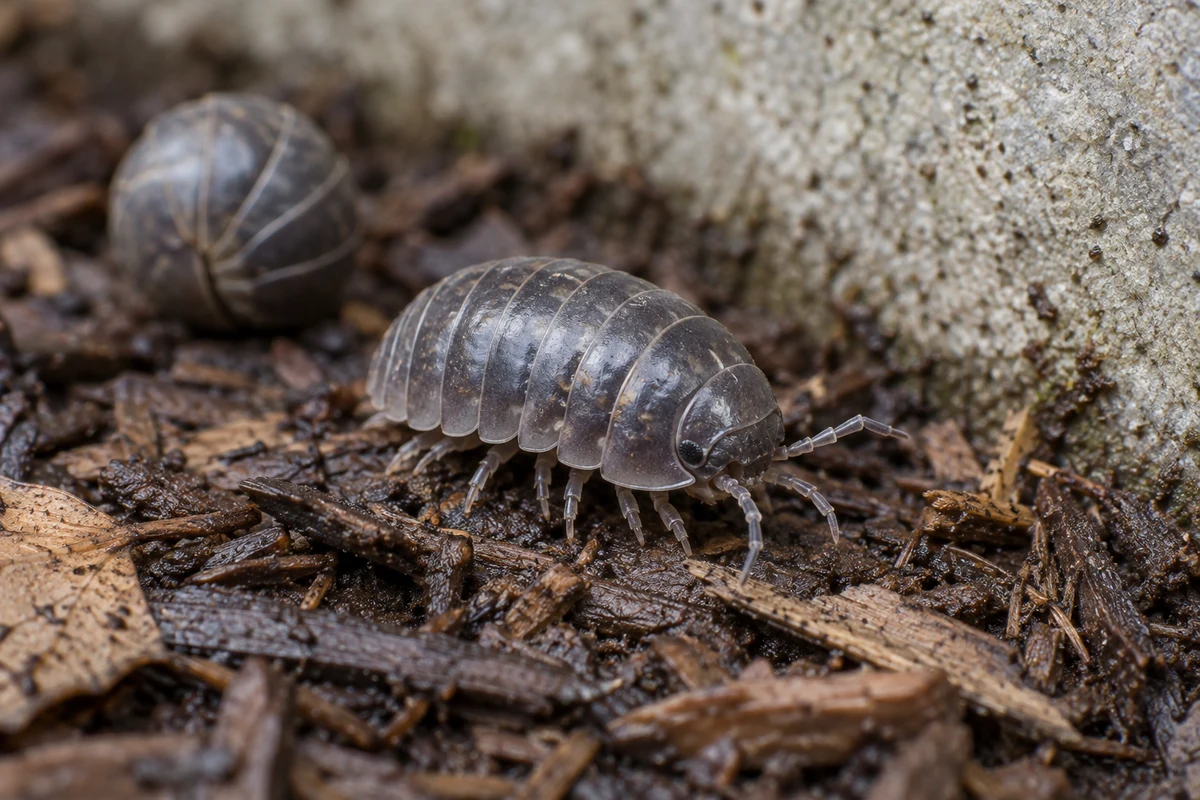

- A pill bug is small, well under an inch long, with seven pairs of legs.
- It is a crustacean, not an insect, and breathes with gill-like parts that need damp ground.
- Indoors, a pill bug rarely lives more than one or two days.
- Pill bugs do not bite or sting, and they are harmless to people and pets.
- The fix is outside: drier beds against the house and sealed gaps at the doors.





Why are there roly polies in my house?
Roly polies come inside because the ground against the house is damp and full of them, most often after a long wet spell. Clemson’s Home and Garden Information Center says pill bugs indoors in numbers usually means a large population outside.
The University of Kentucky says finding them often can point to a moisture problem or a gap at a door, window or seal.
Mulch is a big part of it. Pill bugs eat rotting plant matter, and they are among the few animals of their kind that can digest cellulose, the Texas A&M AgriLife Extension post on a roly poly invasion notes, so a deep bed of wood mulch against the slab is both food and shelter. In years of high rainfall, Texas A&M says, their numbers climb, and Texas pill bugs can raise two to three generations a year.
The weather turning cold can bring them in too. Penn State Extension says these isopods burrow into the soil in fall and winter and may move into damp, dark places to get away from the cold. It adds that the common pill bug came from Europe and is carried in mulch, plants and compost.
Why are there dead roly polies in my house?
Dead roly polies indoors are the ones that wandered in and dried out, because a house is far too dry for them. Texas A&M AgriLife Extension says pill bugs rarely survive more than one or two days indoors, due to lack of moisture, and Clemson says they dry out and die quickly inside a house.
Finding them dead does not mean they are breeding in the walls.
That is also why spraying inside does little. The University of Kentucky’s page on sowbugs and pillbugs says indoor insecticide is typically of little use, since the ones that get in usually die anyway, and that a broom or a vacuum takes care of both the live ones and the dead. It adds that rolling into a ball is not only for defense. It also helps a pill bug hold in water.
The one place they can last indoors is somewhere wet. Clemson notes they may set up in house plants, and Iowa State University Extension says dark, damp parts of a house can become a breeding site, though most found indoors are accidental visitors from outside.
Are pill bugs harmful?
Pill bugs are not harmful to people, pets or the house. The University of Kentucky says they are harmless to people and pets, and Iowa State University Extension says sowbugs and pill bugs are a nuisance only and cannot damage household furnishings.
The only harm they do is in the garden, where Texas A&M AgriLife Extension says that in wet years they can eat new transplants to the ground overnight.
The Texas A&M fact sheet on pillbugs lists pansies, zinnia and verbena among the plants they chew, and strawberries and other fruits that touch the soil. The Clemson fact sheet adds tomatoes, cucumbers, lettuce and beans. Clemson calls them primarily beneficial, because they recycle dead plant material back into the soil, and says they only occasionally become garden pests.
Something else in the yard eats them. The red spider people find in the same damp beds is the woodlouse spider, which hunts pill bugs, and our woodlouse spider page in the pest library shows what it looks like.
Do roly polies bite?
No, roly polies do not bite or sting. The University of Kentucky says pill bugs and sowbugs are completely harmless and will not bite or sting, and Clemson’s Home and Garden Information Center says the same. Their mouthparts chew soft, rotting plant matter, and Kentucky says they tend to feed on living plants only when the plants are tender enough.
Kentucky also says it is safe to simply pick one up and carry it outside. A pill bug is not an insect at all. Clemson calls pill bugs crustaceans, closer kin to lobsters and shrimp, with seven pairs of walking legs where an insect has three.
The table below shows how to tell a pill bug from the two creatures most often found with it after rain. Our pill bug page in the pest library has close-up photos of each.
Pill bug, sowbug and millipede, told apart
These details come from the University of Kentucky and Clemson’s Home and Garden Information Center. All three live in damp beds and walk in under the same doors.
| Feature | Pill bug | Sowbug | Millipede |
|---|---|---|---|
| When you touch it | Rolls into a tight ball | Cannot roll up | Curls up, or gives off a smelly fluid |
| Legs | Seven pairs | Seven pairs | Two pairs on each body segment |
| Rear end | No tail you can see | Two small tail-like parts | A long, worm-like body |
| Size | 1/4 to 5/8 inch | 1/4 to 5/8 inch | 1/2 to 3/4 inch, the garden millipede |
| Bites or stings | No | No | No, but the fluid can irritate skin and eyes |
A tight ball means a pill bug. Rows of legs and a coil means a millipede, and our article on millipedes after rain covers those.

Texas A&M says a female carries 30 to 80 young at a time, and Kentucky says pill bugs live about 3 years, which is why a soaked bed keeps sending more for as long as it stays wet.
How to get rid of pill bugs in the house
- Sweep or vacuum the ones inside. Texas A&M says pill bugs are harmless and can be removed by hand or with a vacuum, and both Kentucky and Clemson advise against spraying insecticide indoors, because the pill bugs in the house are already drying out.
- Thin the mulch and pull it back from the slab. Texas A&M’s post on a roly poly invasion says a four-inch layer of mulch is generally enough, and to keep mulch 6 to 12 inches away from the foundation. The Texas A&M pillbug fact sheet also says to clear unnecessary piles of leaves and grass clippings, and Clemson says to keep them away from the outside of the house.
- Lift what sits flat on the ground. Texas A&M suggests raising flower pots, planters, dog houses, firewood and bricks so air can dry the ground under them, and Clemson adds a thick braided door mat to the list of places they hide.
- Let the soil dry between waterings. Texas A&M says to set the sprinklers so the soil around the home has a chance to dry out, and Kentucky says good drainage along the foundation is key to keeping those beds dry.
- Seal the gaps at the doors and the slab. Texas A&M says careful sealing of doors and foundation cracks keeps pill bugs out when they are plentiful. Kentucky says a treatment along the foundation in spring or fall can limit how many get in, but will not solve a problem that keeps coming back unless the moisture is fixed.
How Pest Me Off handles pill bugs
Pest Me Off treats pill bugs outside, where they breed, because the ones in the house are already dying. The technician walks the foundation beds, pots, pavers, porch and shed, confirms it is a pill bug and not a sowbug or a millipede, and finds where they breed and where they get in. Granules go into the mulch beds and lawn, a liquid treatment goes along the foundation, and the weep holes along the brick are treated.
We also show you the worn door sweeps, garage door seals and slab cracks they walk through, and what keeps the ground wet, from sprinklers hitting the brick to deep mulch against the slab. Our pest control services include same-day service Monday through Friday, when you call before noon, across McKinney, Plano, Frisco, Allen and the rest of Collin County, with no-contract options.
Roly polies coming in under the back door? Same-day pest control in McKinney and the surrounding cities when you call before noon.
We find the damp beds they breed in, treat the foundation and mulch outside, and show you the gaps and the moisture to fix so fewer come back. No-contract options.
