
Are There Hornets in Texas? Bald-Faced Hornets and Yellowjackets Explained
The black and white wasp that builds a gray paper ball in a Collin County tree is the bald-faced hornet. It is not a true hornet at all but a yellowjacket that nests in the open. The only true hornet established in the United States is the European hornet, and the giant hornet that made the news has never been found in Texas. This article sorts out which is which, how dangerous each one is, and what to do about a nest near the house.
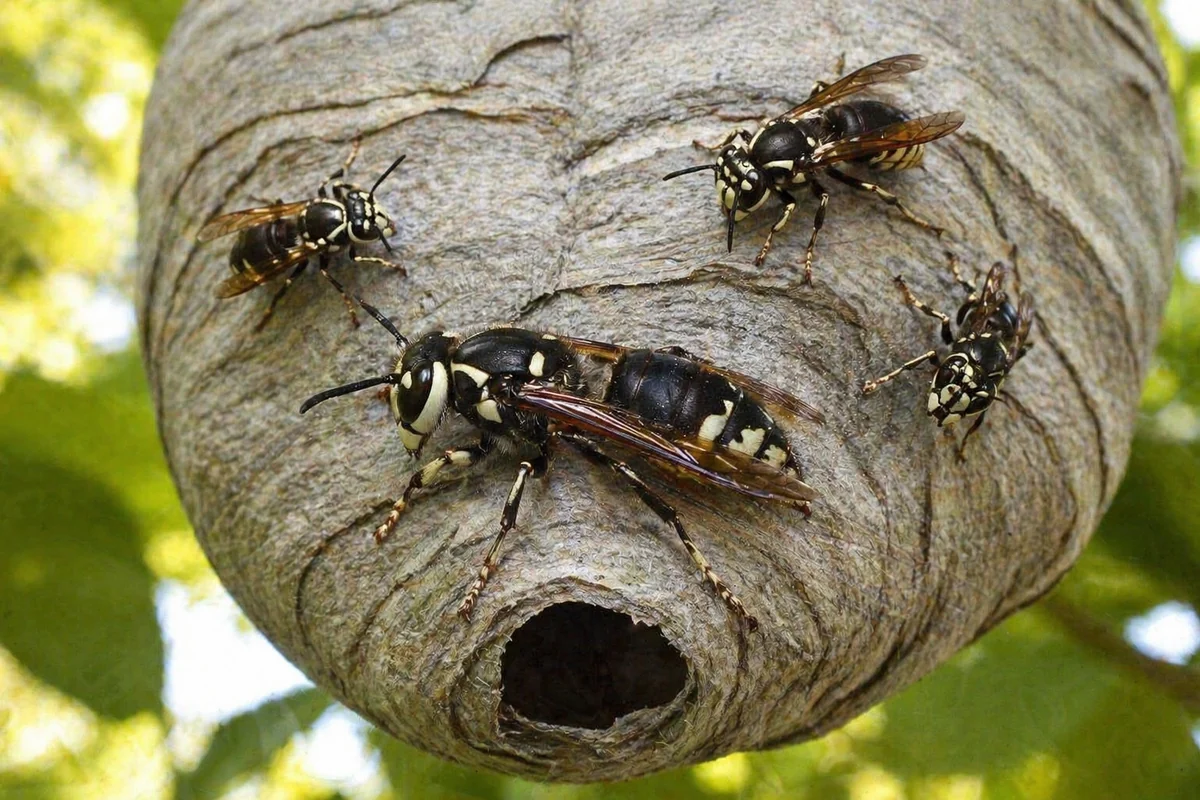

- The bald-faced hornet is not a true hornet. It is a yellowjacket that builds its nest in the open.
- The European hornet is the only true hornet established in the United States.
- A bald-faced hornet colony reaches 100 to 400 workers by the end of summer.
- Bald-faced hornets will usually attack anyone who comes within 3 feet of the nest.
- Each nest lasts one season, and most of the colony dies around the first hard frost.





Are there hornets in Texas?
Texas has the wasps people call hornets, but the black and white hornet that nests in Collin County trees is not a true hornet. Penn State Extension says the bald-faced hornet is really a yellowjacket, and that the only true hornet in North America is the European hornet, an introduced species commonly found across most of eastern North America.
The University of Maryland calls it the only true hornet established in the U.S.
The European hornet has been spreading. The Penn State Extension page on the European hornet says it was first detected in North America in the 1840s, has kept spreading west, and was first reported from Arkansas in 1999. It is a big wasp, with workers up to an inch long and queens up to 1.3 inches, red and brown at the front and mostly yellow at the rear. The Missouri Department of Conservation says it nests in hollow trees and in the spaces between walls, and is sometimes drawn to lights at night.
Are bald-faced hornets yellow jackets?
Yes, bald-faced hornets are yellowjackets. Penn State Extension says the bald-faced hornet is not a true hornet but an aerial yellowjacket, one of 7 or 8 species in its group in North America. It got the name hornet from its large size and its nest above ground, the University of Florida explains.
Hornet is generally used for wasps that nest above ground and yellowjacket for those that nest underground.
Its other name is the white-faced hornet, from the ivory-white markings on its face. Penn State says it is found in most of the 48 contiguous states, and builds a gray, football-shaped paper nest in bushes and trees, sometimes on the outside of a building. Our bald-faced hornet page in the pest library has close-up photos and the nest at each stage.
Hornet or yellowjacket, told apart
Both nest around Collin County homes, and the nest is the quickest way to tell them apart. These details come from Penn State Extension, Iowa State University and the University of California.
| Feature | Bald-faced hornet | Ground yellowjacket |
|---|---|---|
| Color | Black with ivory-white markings on the face and the end of the body | Jagged bright yellow and black stripes |
| Size | About ⅞ inch | ½ to 1 inch |
| Nest | A gray paper ball hanging in a tree or shrub, or on a building | Usually in a hole in the ground or inside a wall, sometimes a hanging gray paper nest |
| Wasps in a nest | 100 to 400 workers at the end of summer | 1,500 to 15,000, depending on the species |
| Food | Hunts other insects, including flies | Scavenges at picnics, garbage cans and pet food dishes |
A gray paper ball hanging in a tree is almost always a bald-faced hornet nest. Wasps going in and out of a hole in the lawn are yellowjackets.

Yellowjackets get their own page in our pest library, and a nest in the ground or a wall is a job for yellowjacket control. The slender wasps with open, umbrella-shaped nests under the eaves are paper wasps, covered in our article on paper wasp nests near the house.
Are bald-faced hornets aggressive?
Bald-faced hornets are aggressive near their nest and much less so away from it. Iowa State University says disturbing a nest or threatening a single hornet will bring stings, and that they will usually attack anyone who comes within 3 feet of the nest.
Iowa State also says their aggressiveness does not match their appearance, and that they are very protective of the colony.
That 3-foot line is why the place matters more than the size of the nest. The Penn State Extension page on the bald-faced hornet says a nest can be ignored unless it is within 10 feet of a door into the house, under a low eave, or in shrubs beside a lawn that gets mowed. A nest 30 feet up an oak in the back of the yard is a different matter from one in the hedge by the front walk.
Are hornets in Texas dangerous?
Hornets in Texas are dangerous mainly to people allergic to stings and to anyone who disturbs a nest. The University of California says that for most people a bee or wasp sting causes only temporary pain, and that one to two people out of 1,000 are allergic.
The Missouri Department of Conservation says a European hornet sting is not usually medically serious except for people allergic to wasp venom.
Multiple stings at once are a bigger worry than one. The University of California page on bee and wasp stings says multiple stings can harm the kidneys days after the attack, and that allergic symptoms can begin right after a sting or up to 30 minutes later. Dizziness, trouble breathing or swelling in the throat need emergency care at once.
Are there giant hornets in Texas?
No giant hornet has ever been found in Texas. The Missouri Department of Conservation says the Asian giant hornet, the so-called murder hornet, was found only in British Columbia and Washington state, now and then from 2019 to 2021, and as of December 2024 it has been declared eradicated from the United States.
It has never been found anywhere in eastern North America.
Two big wasps get mistaken for it. The University of Maryland says the European hornet and the eastern cicada killer are often misidentified as the giant hornet because of their large size. The cicada killer lives alone and, as the Missouri Department of Conservation describes, digs a tunnel in the soil instead of building a paper nest. Our cicada killer page in the pest library shows what to look for.
How to get rid of a hornet nest
- Decide whether it has to go. Penn State says a bald-faced hornet nest can be left alone unless it is close to a door, under a low eave or in shrubs beside a mowed lawn, and the University of Maryland says a nest stops being a threat after the first killing frost.
- If anyone in the house is allergic to stings, Penn State advises having any nest close to the home removed by a pest control company.
- Never flood a nest or set it on fire, and do not knock down a nest with wasps in it. The University of Maryland warns that home remedies such as flooding or burning a nest raise the risk of stings as the angry wasps escape.
- Anyone treating a nest alone should scout it in daylight, then spray a product labeled for wasp and hornet nests straight into the opening at night, as Penn State describes, wearing long sleeves, long rubber gloves and goggles. Spraying only the outside angers the colony and raises the risk of stings for days.
- Call a professional for a nest that is high in a tree, hard to reach, or by a door, a play set or a walkway.
How Pest Me Off handles hornet nests
Pest Me Off’s wasp and hornet control starts by confirming what built the nest, because a bald-faced hornet ball in a tree, a yellowjacket nest in the ground and a paper wasp comb under the eaves each need a different answer. A technician treats the bald-faced hornet nests that sit near doors, walkways, play sets and the hedges you trim, after dark when the hornets are home, and tells you plainly when a nest high and far from the house can be left for the frost.
Same-day service is available for McKinney and the surrounding cities when you call before noon, with no-contract options.
Gray paper nest in a tree by the house or a hedge by the walk? Same-day pest control in McKinney and the surrounding cities when you call before noon.
We confirm what built it, treat the hornet nests near the places your family walks after dark, and tell you which ones can wait for the frost. No-contract options.
