
Snakes in Collin County, TX | Identification and Control
Most snakes found around Collin County homes are harmless, and the one people meet most is the Texas rat snake, a big climber that follows rats and mice into garages, sheds and attics. Copperheads live here too, and they are the venomous snake to know on sight. A bite needs a hospital fast, but the Texas Department of State Health Services says that on average 1 to 2 people in Texas die each year from venomous snake bites.
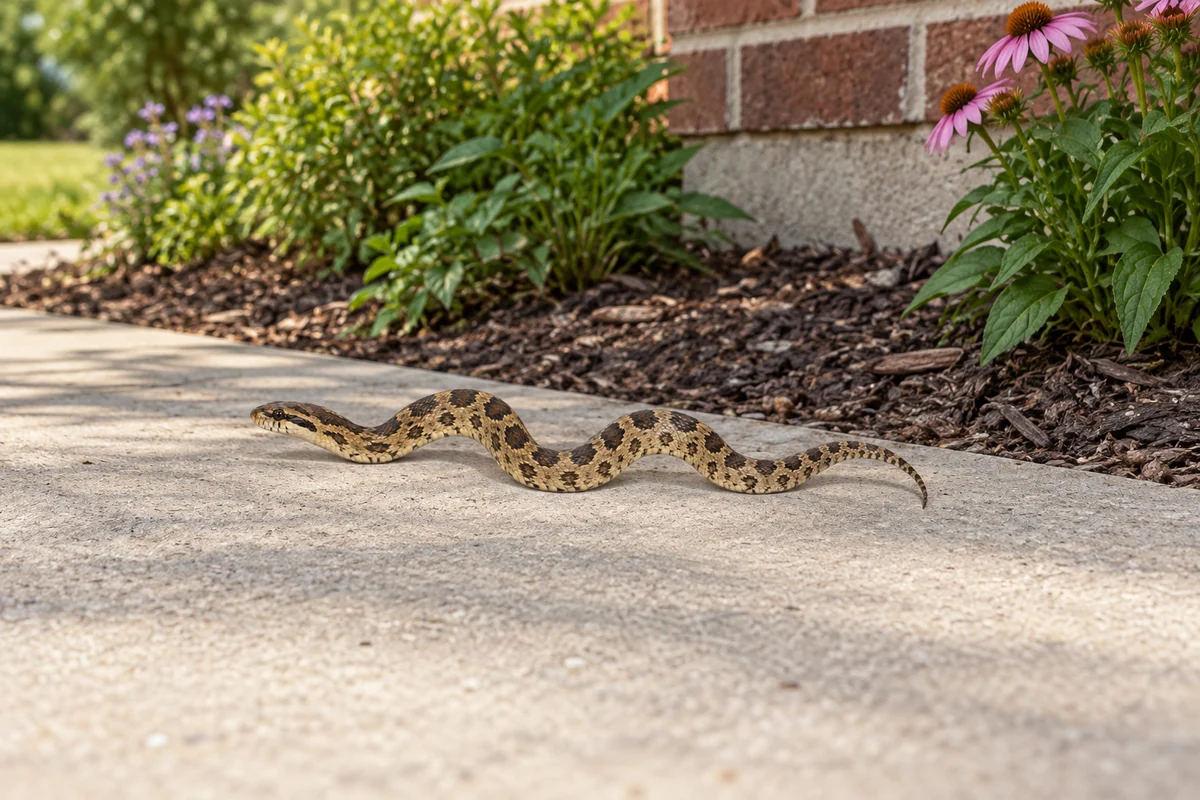
A snake in the garage or under the deck? Our office sits where McKinney, Plano, Frisco and Allen meet, 5 to 10 minutes from most homes in those four cities. Keep your distance and call. We will identify it, remove it safely and show you what drew it in.
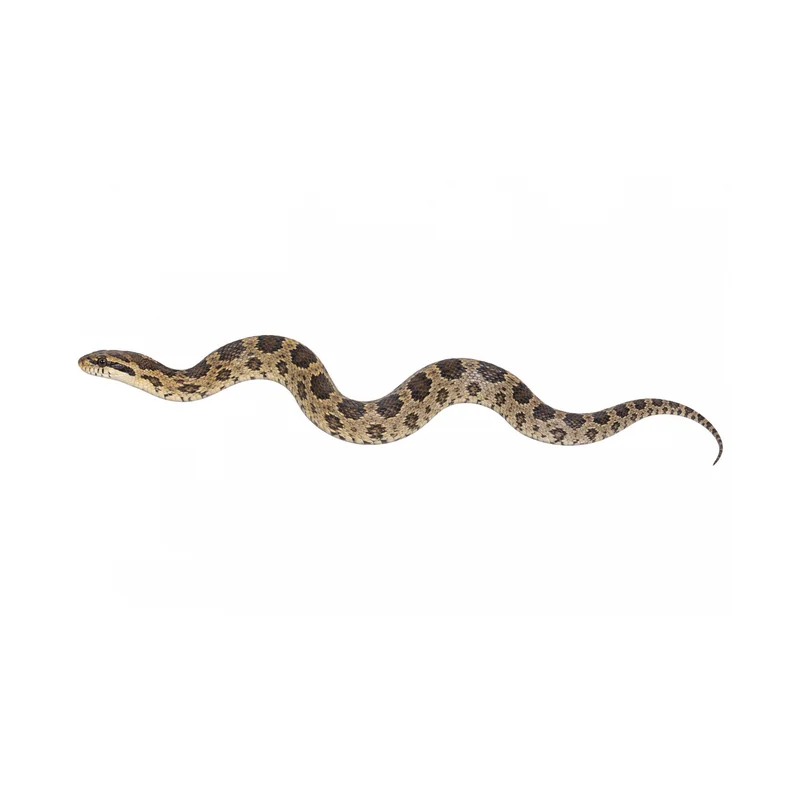
Texas Rat Snake
The Texas rat snake is a large snake that is not venomous, hunts rats, mice, birds and eggs, and climbs walls and trees with ease. The City of Lucas in Collin County calls it the most commonly encountered snake in Texas.
Risk Assessment
Choose a row for the full detail- Color
- Olive brown blotches on a yellowish tan body, with a dark gray head
- Diet
- Rats, mice, birds, eggs and other small animals
- Threat level
- Not venomous, but it bites if handled
- Defining behavior
- Hisses and shakes its tail like a rattlesnake when cornered
- Where it hides
- Garages, sheds, woodpiles, attics, trees and under decks
- Lifespan
- Recorded up to 33.9 years in captivity
- Eggs
- 12 to 20 eggs, hatching after 65 to 70 days
- Size
- Usually 3.5 to 6 feet, with some over 7 feet
What Do Snakes Around Collin County Homes Look Like?
The Texas rat snake is long and blotched with a gray head, and the copperhead is shorter, pinkish tan and banded
The snake most people find is the Texas rat snake. Texas Parks and Wildlife magazine describes it as 3.5 to 6 feet long, with records over 7 feet, a dark gray head and olive brown blotches on a yellowish tan body. Its belly is flat with scales that project at the edges, which lets it climb trees, walls and even window blinds. It is not venomous and kills its prey by squeezing.
The copperhead is the venomous snake to know. Texas Parks and Wildlife’s southern copperhead account gives adults of 24 to 26 inches, pale brown to light tan with a pinkish tint, crossed by dark bands shaped like an hourglass, wide at the sides and narrow across the back. It has yellow eyes with cat-like pupils and a heat-sensing pit between each eye and nostril.
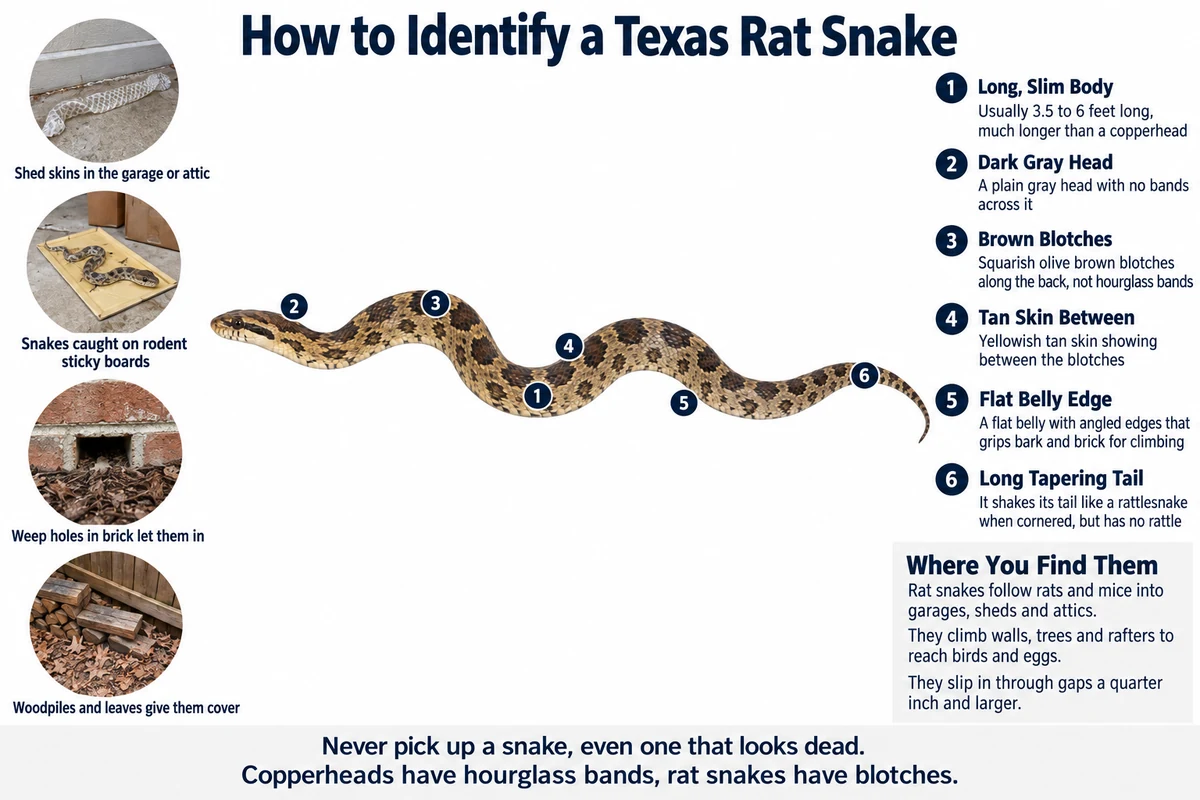
How to identify a Texas rat snake by its long blotched body and dark gray head, with the shed skins and hiding places that show a snake is around
- A shed skin in the garage, the attic, a flower bed or along the fence
- A snake caught on a sticky board or found inside a rodent bait box
- Wavy drag lines in dust and torn spider webs low along a garage wall
- Rats or mice on the property, the food that brings snakes in
- Woodpiles, lumber, rock piles or thick leaf litter next to the house
- Birds upset around a nest, or eggs gone from a nest or a coop
Other Names for Snakes Around Collin County
Snake names cause real mix-ups, and some of them matter for safety. Texas A&M AgriLife notes that rat snakes are also called chicken snakes, after their habit of raiding henhouses for eggs, and that garter snakes are the ones many people call garden snakes. Older books name the rat snake Elaphe obsoleta, the name Texas Parks and Wildlife magazine still used in 2008. In Spanish any snake is a culebra or a serpiente.
The name to watch is water moccasin. It is another name for the cottonmouth, a venomous snake, while the harmless water snakes that swim in Collin County ponds and creeks are often wrongly called moccasins.
| Name | What it means |
|---|---|
| Chicken snake | The rat snake, named for the eggs it steals. |
| Texas ratsnake | The same rat snake, written as one word. |
| Garden snake | A garter snake, small and not venomous. |
| Water moccasin | The cottonmouth, a venomous snake. |
| Culebra | The Spanish word for a snake. |
How to Tell a Texas Rat Snake from a Copperhead
Both turn up around Collin County homes, and both are brown and patterned, so they are easy to confuse at a glance. Tell them apart from a safe distance, never by getting close, and if you are not sure, treat the snake as venomous and leave it alone.
| Species | Size and Color | Key Feature | Where Found |
|---|---|---|---|
|
Texas Rat Snake
AKA: Chicken Snake
Pantherophis obsoletus
This species
|
Usually 3.5 to 6 feet. Olive brown blotches on yellowish tan, with a dark gray head. | Not venomous. Blotches rather than hourglass bands, and it climbs walls and trees. | Garages, sheds, attics, trees and woodpiles, wherever rats, mice and birds are. |
|
Copperhead
AKA: Southern Copperhead, Broad-banded Copperhead
Agkistrodon contortrix
|
About 2 feet, 24 to 26 inches. Pale brown to pinkish tan with darker chestnut bands. | Venomous. Hourglass bands wide at the sides and narrow on the back, and young with a yellow tail tip. | Leaf litter, woodpiles, brush and wooded creeks and greenbelts, lying still on the ground. |
Texas Rat Snake vs Copperhead
Snakes in Three Numbers
1 to 2
The Texas Department of State Health Services says that on average 1 to 2 people in Texas die each year from venomous snake bites, so a bite is serious but rarely deadly with fast hospital care.
Texas Department of State Health Services
1/4 inch
The Internet Center for Wildlife Damage Management advises sealing every opening 1/4 inch and larger to keep snakes out of a building.
Internet Center for Wildlife Damage Management
4 to 8
Texas Parks and Wildlife reports that a female southern copperhead gives birth to 4 to 8 live young, each 7 to 10 inches long, rather than laying eggs.
Texas Parks and Wildlife
Are Snakes in Collin County Venomous?
Most are not. Texas A&M AgriLife counts about 75 snake species in Texas, of which only about a dozen are venomous, and names the copperhead, the cottonmouth or water moccasin, the coral snake and the rattlesnakes as the venomous ones to watch for. Its list of common snakes that are not venomous includes rat snakes, garter snakes, bull snakes, racers and diamondback water snakes. The Texas Department of State Health Services snake page sorts the venomous ones into the pit vipers, which are the copperhead, cottonmouth and rattlesnakes, and the Texas coral snake. Around homes in Collin County, the copperhead is the venomous snake people most often find, and the City of Lucas lists the cottonmouth, rattlesnakes and the coral snake as rarer local snakes.
What Does a Copperhead Look Like?
A copperhead is a thick, medium sized snake, about 2 feet long, colored pale brown to pinkish tan with darker chestnut or reddish brown bands. Seen from above, each band is wide at the sides and narrow across the back, like an hourglass. Texas Parks and Wildlife adds that young copperheads look like duller adults with a yellowish tail tip that fades by their third or fourth year, and that a female gives birth to 4 to 8 live young, each 7 to 10 inches long. They lie still on dead leaves and trust their camouflage, which is why people step on them. If you see one, stop, back away slowly and keep children and pets back. Never try to catch, move or kill it. Call for help and keep an eye on where it goes from a safe distance.
What to Do If a Snake Bites You
Get to a hospital right away and do not wait for symptoms. The Texas Department of State Health Services advises calling 911, keeping the person calm, removing rings, watches and tight clothing before swelling starts, keeping the bitten limb still and level with the heart, and washing the bite gently with soap and water. Do not cut the bite, suck out venom, or use a tourniquet, ice or electric shock. The CDC’s page on venomous snakes adds not to drive yourself, to take a photo of the snake only from a safe distance, and never to handle it, even dead. The Texas Poison Center Network answers at 1-800-222-1222.
When a Snake Needs Fast Action
A Bite to a Person
Call 911 and get to a hospital, even if the bite looks small. Roughly half of venomous bites carry no venom, but nobody can tell which at home.
A Bite to a Dog or Cat
Keep the pet calm and still and call your vet or an emergency vet on the way.
A Snake Inside the House
Keep everyone and every pet out of the room, close the door, roll a towel along the gap under it and call. Do not try to catch it.
A Snake on a Sticky Board
A snake stuck on a glue board can still bite, and so can one that looks dead. Leave the board where it is and call rather than lifting it.
Why You Have a Snake in Your Garage or House
Snakes come for food and cover. Texas A&M AgriLife wildlife specialist Maureen Frank points to rats and mice as what draws snakes to a yard, along with brush, debris and lumber piles to hide in. The wildlife damage reference on snake biology lists firewood piles, old lumber and flower beds with heavy mulch among the places they shelter. A garage with rodents, a bait station, bird seed or stored boxes against the wall offers both at once, and a rat snake is a skilled hunter of exactly those rodents.
Snakes do not chew or dig their way into a house. They slip through gaps that are already there, under a garage door with a worn seal, through weep holes in brick, along plumbing and air conditioner line openings, and up into the attic by climbing. Homes beside creeks, greenbelts, open fields or a lot being cleared for building see more, because snakes move in from that cover. It is not a sign of a dirty home.
Where Snakes Live Around Collin County Homes
Texas Parks and Wildlife places copperheads in rocky areas and wooded bottomlands, in mixed pasture and wooded lowlands with leaf litter and logs, and in spring along streams and in weedy vacant lots. Rat snakes go wherever rodents and birds are, and they climb, so they turn up in rafters, sheds, trees and attics as well as on the ground.
Snake Pressure Across Collin County
Snake calls come to us most from McKinney and Frisco, usually a snake in the garage, under a deck or porch, or near the rodent bait stations along the house. Homes backing onto greenbelts and creeks, and yards next to overgrown or cleared lots, see the most.
In Celina, Princeton, Little Elm and Plano we find snakes and their shed skins in garages, attics, storm shelters and yards, often where new homes meet open land.
Snakes slow down in the cold and come out as the weather warms in February and March. Sightings peak in spring and again from late summer into fall, when copperheads give birth and young snakes spread out. In the heat of summer they move more at dusk and at night.
Pattern from Texas A&M AgriLife on when Texas snakes emerge, Texas Parks and Wildlife on when copperheads give birth, and Pest Me Off snake calls, which climb in spring and again from August to October.
Why Snakes Keep Coming Back
How Pest Me Off Handles Snakes
Snake work is four steps, every job. Taking the snake away is only part of the fix, because the food and the gaps that brought it in will bring the next one.
Inspect and Identify
A free inspection of the garage, yard, deck, foundation and attic. We identify the snake, whether it is a harmless rat snake or a copperhead, and look for where it is hiding and how it got in.
Remove It Safely
We remove the snake safely, including one stuck on a sticky board or curled in a bait box, so nobody in the family has to get near it.
Show What Draws It In
We point out what is bringing snakes to the property, from rodent activity and bait stations to woodpiles, thick mulch, stored boxes and gaps at the slab or under the deck.
Seal It Out for Good
The ways in are closed, from weep holes and garage door corners to pipe and air conditioner line gaps, with materials that last. This is the rodent proofing and exclusion work that keeps snakes and the rodents they hunt outside.
& Other Companies
How to Get Rid of Snakes Yourself
The wildlife damage reference on snake control puts habitat and sealing first, because snakes go where food and cover are.
Why Some DIY Responses Fail for Snakes
Most snake trouble in a yard comes from trying to kill or catch the snake, or from trusting a product to keep snakes away while their food and cover stay.
Killing or Catching the Snake
Texas A&M AgriLife advises leaving a snake alone and never trying to kill or handle it. It puts you within striking reach, and a harmless rat snake was eating your rodents.
Snake Repellents and Mothballs
The wildlife damage reference says research on snake repellents is either lacking or inconsistent, and no poison is registered for snakes. A repellent leaves the food and cover in place.
Picking Up a Snake on a Glue Board
A snake caught on a sticky board can still twist and bite, and so can one that looks dead. Leave the board where it lies and call.
Common Snake Questions
What snakes live around Collin County homes, and which are venomous?
What does a copperhead look like?
Is a Texas rat snake venomous?
How can I tell a copperhead from a rat snake?
What should I do if a snake bites me or my dog?
Why is there a snake in my garage?
What does a snake skin in my yard or attic mean?
When are baby copperheads born?
Do mothballs or snake repellents keep snakes away?
Should I kill a snake I find in my yard?
How do I get rid of snakes?
A Snake in the Garage? Keep Back and Let Us Handle It.
We identify the snake, remove it safely, show you what drew it in and seal the gaps it used. Wildlife removal across McKinney, Allen, Frisco, Plano, and all of Collin County.