
House Mice in Collin County, TX | Identification and Control
The house mouse (Mus musculus) is the small gray brown mouse that moves into Collin County garages, attics, walls and kitchens, most often as the nights cool in fall. It weighs under an ounce, chews wiring and stored goods, and fouls food with its droppings and urine. The Internet Center for Wildlife Damage Management advises sealing every opening larger than 1/4 inch, because that is all a mouse needs to get in.
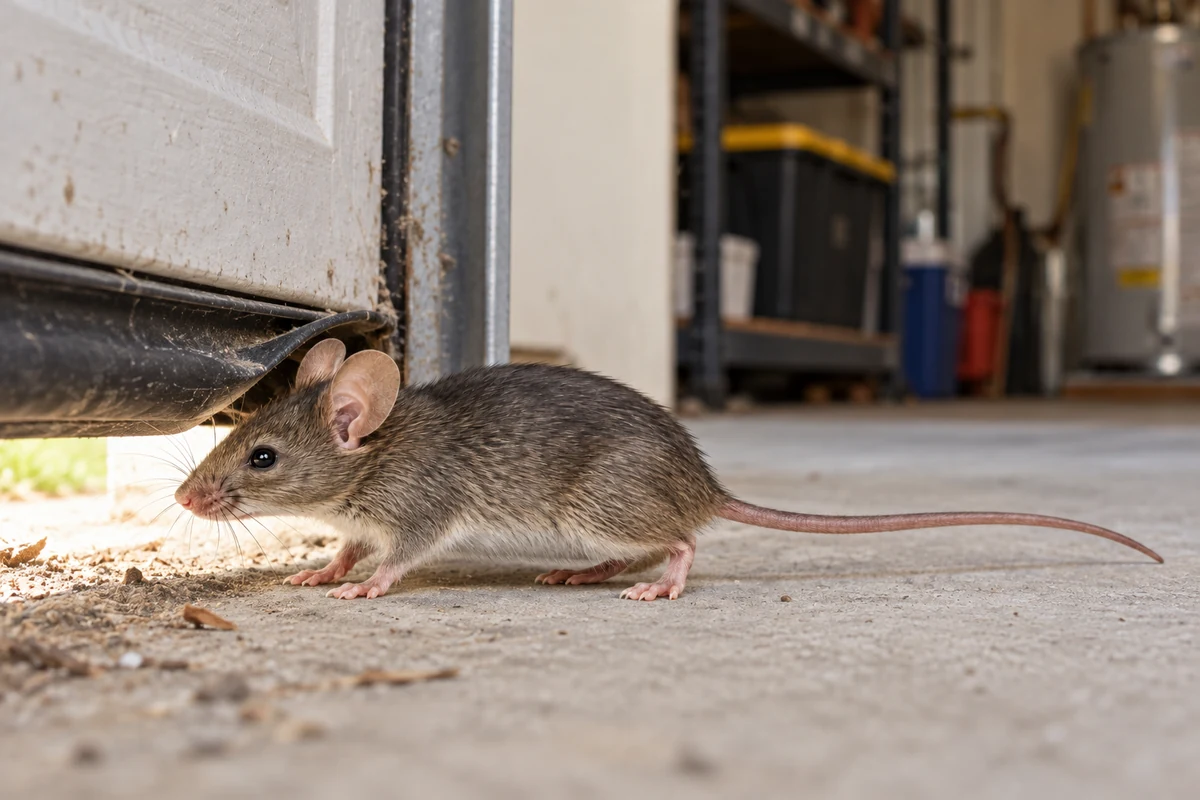
Droppings in the garage or kitchen drawers? Our office sits where McKinney, Plano, Frisco and Allen meet, 5 to 10 minutes from most homes in those four cities. Call and we will find how the mice get in and seal it.
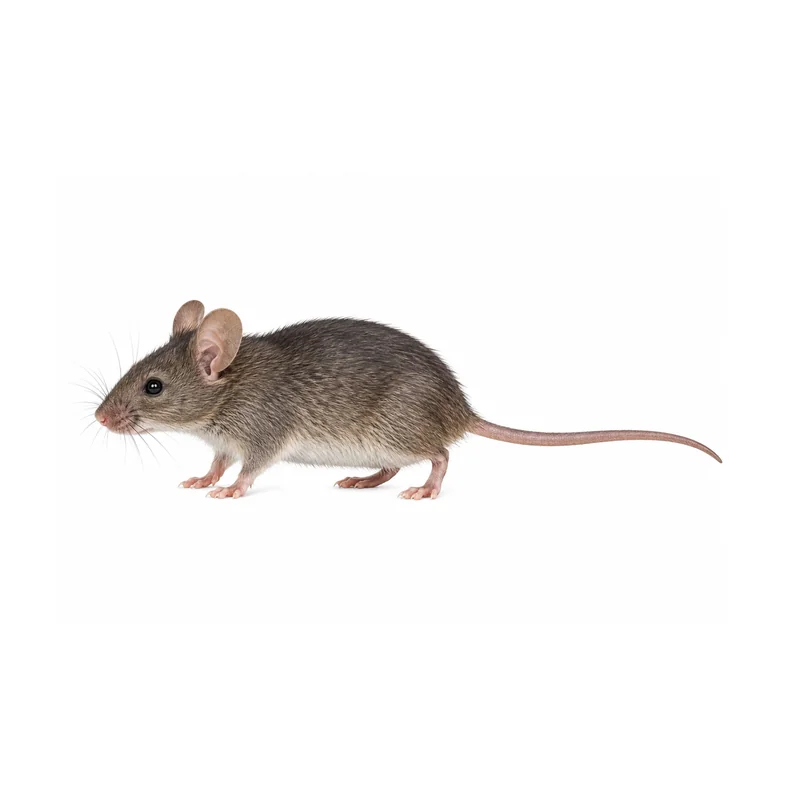
House Mouse
The house mouse is a small rodent that lives alongside people, nesting in garages, walls, attics and cabinets close to food and warmth. The national wildlife damage management reference says mice are more common in homes and businesses than rats.
Risk Assessment
Choose a row for the full detail- Color
- Gray brown above, with a gray or buff belly
- Diet
- Seeds and grain first, plus sweet, fatty foods and pet food
- Threat level
- Moderate
- Nesting site
- Garages, attics, walls and cabinets, near warmth
- Active season
- All year, moving indoors as the nights cool in fall
- Young to adult
- Weaned at about 3 weeks, breeding at 6 to 10 weeks
- Size
- 3 to 4 inches plus a 2 to 4 inch tail, under an ounce
What Does a House Mouse Look Like?
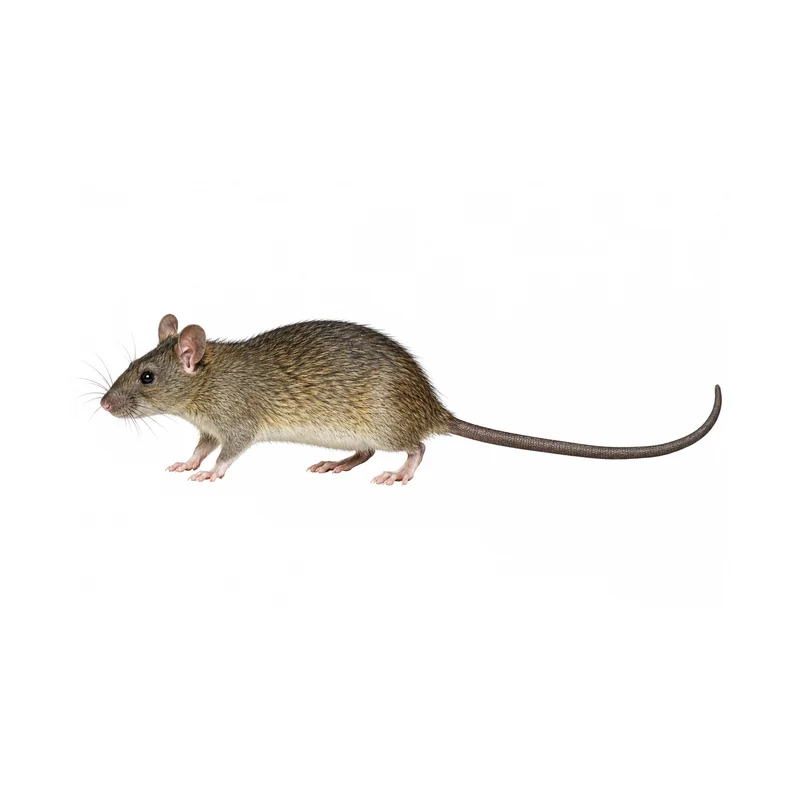
A small, slender gray brown mouse with big ears, a pointed nose and a long, nearly bare tail
An adult house mouse is small and slender, gray brown on top with a gray or buff belly. It has a slightly pointed nose, small black eyes, large thin ears and a nearly hairless tail with visible scale rings. The national wildlife damage management reference on house mice gives a body length of 3 to 4 inches, a tail of 2 to 4 inches and a weight of 0.4 to 0.9 ounces.
Most people find the signs first. The same reference describes droppings averaging a quarter inch long, gnaw marks far finer than a rat’s, entry holes an inch and a half wide or less, and a musky smell that sets mice apart from rats. Nests are balls of finely shredded paper, fabric or insulation about 4 to 6 inches across, often beside something warm such as a water heater or a refrigerator’s motor.
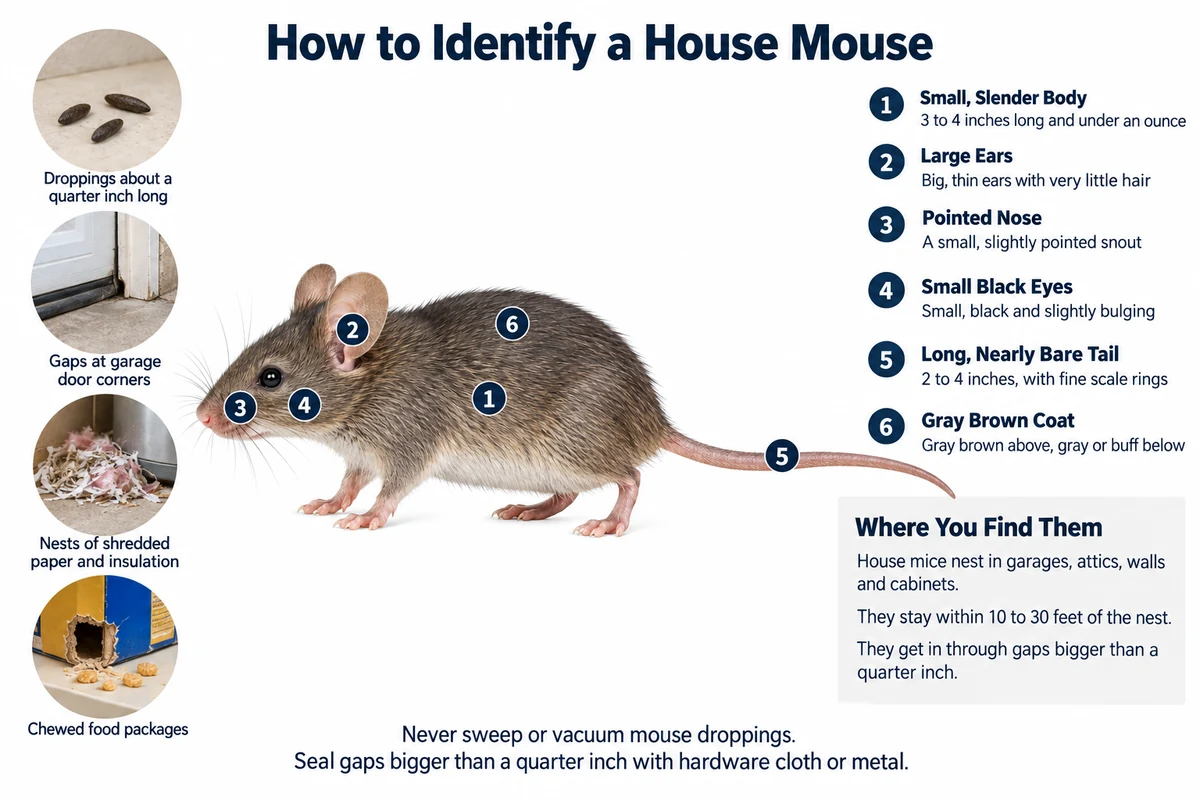
How to identify a house mouse by its small size, large ears and long, nearly bare tail, with the droppings, gnaw holes and nests it leaves behind
- Droppings about a quarter inch long, the size of a grain of rice, in drawers, cabinets or the garage
- Small gnawed holes at garage door corners, baseboards or around pipes
- A musky smell in a cabinet, closet or garage
- Nests of finely shredded paper, fabric or insulation near warmth
- Chewed food packages and pet food bags
- Light scratching in walls or ceilings, and squeaks at night
Other Names for the House Mouse
The house mouse is native to central Asia and reached North America with settlers from Europe, according to the wildlife damage reference. Its scientific name, Mus musculus, simply means little mouse. In Spanish it is the ratón, and many people call any small mouse in the yard a field mouse.
That last name causes confusion. Deer mice and white-footed mice, the true field mice, have bright white bellies that contrast sharply with their brown backs, while the house mouse’s belly is gray or buff. A young rat is the other mix-up: it has a bigger head and feet for its body, and its droppings are already larger than a mouse’s.
| Name | What it means |
|---|---|
| Mouse | Around Collin County homes, almost always the house mouse. |
| Ratón | The Spanish name for a mouse. |
| Field mouse | A loose name, often meaning deer or white-footed mice, which have white bellies. |
| Little mouse | What Mus musculus means in Latin. |
| Baby rat | A young rat, not a mouse, with a bigger head and feet for its size. |
How to Tell a House Mouse from a Young Norway Rat or Roof Rat
A mouse and a young rat can look alike at a glance, and the fix is different. Mice live inside, close to food, and slip through quarter-inch gaps, while rats need bigger openings and travel farther. The size of the droppings, the head and feet, and where you find the signs tell them apart.
| Species | Size and Color | Key Feature | Where Found |
|---|---|---|---|
|
House Mouse
AKA: Mouse, Ratón
Mus musculus
This species
|
Under an ounce, 3 to 4 inches plus the tail. Gray brown with a gray or buff belly. | Small head and feet, large ears, pointed nose. Droppings about a quarter inch long. | Inside garages, walls, cabinets and attics, near food and warmth, rarely more than 30 feet from the nest. |
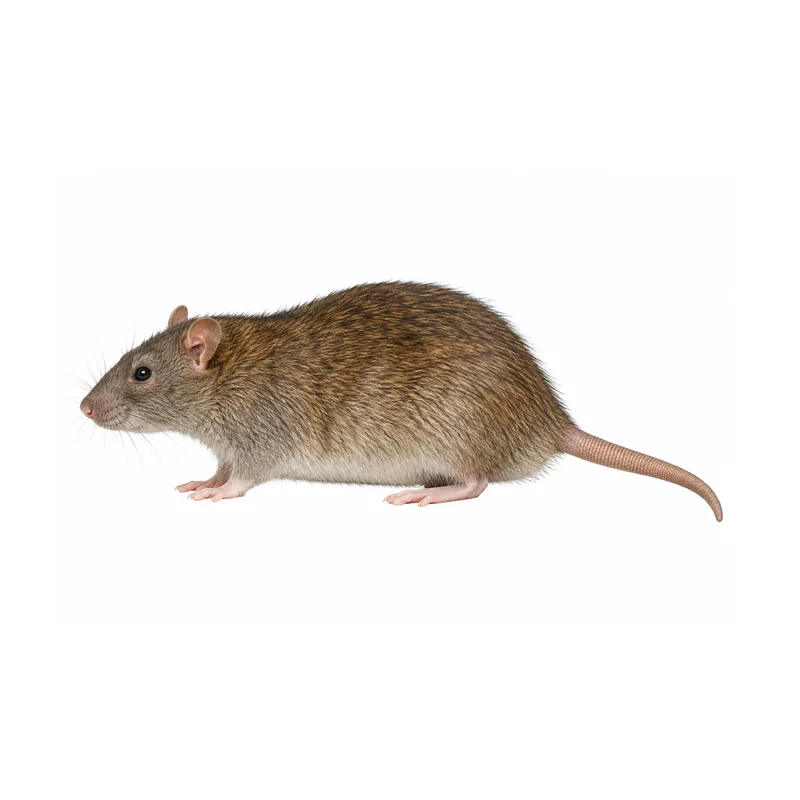
Norway Rat
AKA: Brown Rat, Sewer Rat
Rattus norvegicus
|
About a pound as an adult. Brown or reddish gray. Young rats are mouse-sized at first. | Even young ones have a big head, big feet and a thick tail. Blunt droppings up to three quarters of an inch. | On the ground, in burrows along foundations, under porches, sheds and walkways. |
Roof Rat
AKA: Black Rat, Ship Rat
Rattus rattus
|
Up to about 7 ounces. Brown mixed with black, or blackish. | Slim, with large ears and a thin tail usually longer than its body. Pointed droppings about half an inch. | Up high, in attics, rafters and trees, reached along limbs, fences and power lines. |
House Mouse vs Young Rat
The House Mouse in Three Numbers
1/4 inch
The national wildlife damage management reference advises sealing every opening larger than 1/4 inch wide to keep house mice out.
Internet Center for Wildlife Damage Management
5 to 10
The same reference reports that a female house mouse may have 5 to 10 litters a year, of 5 or 6 young each, so a few mice become many within months.
Internet Center for Wildlife Damage Management
10 to 30 feet
The same reference says one house mouse covers an area only 10 to 30 feet across each day, so mice you see are nesting close by.
Internet Center for Wildlife Damage Management
Are House Mice Dangerous?
They are more a health nuisance than a danger. The wildlife damage reference on house mouse damage says mice and their parasites spread salmonella food poisoning, rickettsialpox and lymphocytic choriomeningitis, may carry leptospirosis, rat-bite fever, tapeworms and ringworm, and that mouse urine can trigger asthma in some people. Mice bite when handled or caught on a glue board, so wear gloves.
Is It Safe to Clean Up Mouse Droppings?
Yes, if it is done wet. The CDC’s rodent cleanup guide says not to sweep or vacuum droppings, urine or nests, because that puts germs into the air. Wear gloves, soak the droppings with a bleach solution of 1 part bleach to 9 parts water or a disinfectant for 5 minutes, wipe them up with paper towels and throw them away.
When Mouse Activity Needs Fast Action
Droppings Near Food
Droppings in the pantry, drawers or on counters mean mice are reaching food. Throw out anything they could have touched.
Chewed Wiring
Mice chew appliance wiring and insulation, which can cause short circuits and fire hazards. Have chewed wires checked.
Asthma or Allergies at Home
Mouse urine can trigger asthma in some people. A home with mice and someone with asthma should have them dealt with quickly.
A Musky Smell in a Cabinet
A strong musky odor usually means a nest close by, often behind a drawer, inside a wall or under an appliance.
Why You Have Mice in Your House
Mice come in for warmth, shelter and food, and the wildlife damage reference on house mouse biology says they are most likely to move into buildings as temperatures cool in fall. They prefer to nest beside a source of heat, such as a water heater, a refrigerator’s motor or a furnace, and they get most of the water they need from their food.
A gap a little over a quarter inch is enough: the corner of a garage door with a worn seal, a weep hole in brick, the space around a pipe or AC line, a gap under a door. Once inside they stay close, covering only 10 to 30 feet a day and leaving and returning to the nest up to 40 times. Spilled bird seed, pet food and stored grain bring them closer. It is not a sign of a dirty house.
Where Mice Nest Around Collin County Homes
House mice nest in any sheltered spot, in garages, closets, attics, wall voids and behind cabinets, and will burrow outside when nothing better is near. The wildlife damage reference says they often damage large appliances by chewing the wiring and insulation, and that heirlooms, books and papers stored in attics and garages are often ruined beyond replacing.
Mouse Pressure Across Collin County
Our mouse calls come most often from McKinney, then Frisco, Princeton and Allen. Most of those calls start in the garage or the attic.
From Plano to Melissa and Anna, worn garage door seals, weep holes in brick and gaps around utility lines are where they get in, and backyard retaining walls give them a place to live right next to the house.
House mice are active all year. The wildlife damage reference says they are most likely to move into buildings as temperatures cool in fall, and our mouse calls climb from November through January, with a second rise in the heat of July and August.
Pattern from published house mouse biology (the Internet Center for Wildlife Damage Management) and Pest Me Off mouse calls, which climb from November through January.
Why Mice Keep Coming Back
How Pest Me Off Gets Rid of House Mice
Mouse control is four steps, every job. Catching the mice inside is the quick part, and sealing the house is what keeps the next ones out.
Inspect and Identify
A free inspection of the garage, kitchen, laundry and water heater areas, attic and outside walls. We confirm it is mice and not young rats, find the nests and map every way in.
Trap Inside, Bait Outside
Snap traps along the walls and runways inside, and locked, tamper-resistant bait stations outside along the foundation, away from children and pets.
Seal Every Gap
Every opening bigger than a quarter inch is closed with materials mice cannot chew: garage door corners with steel, weep holes with mesh, gaps around pipes and AC lines. This is our rodent proofing and exclusion work.
Clean Up and Check
We remove what the traps catch, clean droppings from the areas we treat, and come back to check traps and stations until no new activity shows.
& Other Companies
How to Get Rid of Mice Yourself
Mice are the one rodent most homeowners can handle themselves, if the gaps are found. The wildlife damage reference on mouse control puts sealing and sanitation first, then trapping.
Why Some DIY Responses Fail for Mice
Most DIY mouse trouble comes from trusting gadgets, using poison indoors, or trapping without sealing.
Sound Devices and Repellents
The wildlife damage reference does not recommend ultrasonic devices and says mice soon get used to new sounds. It calls chemical repellents seldom practical.
Poison Inside the House
A poisoned mouse often dies inside a wall or under a cabinet where it cannot be reached, and the smell can last for weeks. Traps let you remove the mouse.
Trapping Without Sealing
Catching the mice inside while the garage door corners and weep holes stay open means a new group moves in the next time the weather turns.
Common House Mouse Questions
What does a house mouse look like, and how big is it?
What do mouse droppings look like?
Is it a mouse or a rat?
How do mice get into the house?
Why do I have mice in winter?
Are house mice dangerous?
How fast do mice multiply?
Do ultrasonic mouse repellers work?
What is the best bait for a mouse trap?
Can mice chew through walls and wiring?
How do I get rid of mice?
Mice in the Garage or Kitchen? We Get Them Out and Seal Them Out.
We find every gap bigger than a quarter inch, trap the mice along their routes, seal the house with steel and mesh, and check back until it is quiet. Rodent control across McKinney, Allen, Frisco, Plano, and all of Collin County.