
Roof Rats in Collin County, TX | Identification and Control
The roof rat (Rattus rattus) is the slim, climbing rat that moves into Collin County attics. It runs along tree limbs, fences and power lines to reach the roof, slips in through gaps at soffits and vents, and nests in attic insulation, chewing wiring and leaving droppings behind. The Internet Center for Wildlife Damage Management reports that roof rats travel 100 to 300 feet for food, so the rat in your attic may be feeding several yards away. Texas Tech’s Mammals of Texas notes it is by far the more common of the two house rats in the southern United States.

Scratching in the attic once the house goes quiet? Our office sits where McKinney, Plano, Frisco and Allen meet, 5 to 10 minutes from most homes in those four cities. Call and we will find how they get in and close it for good.
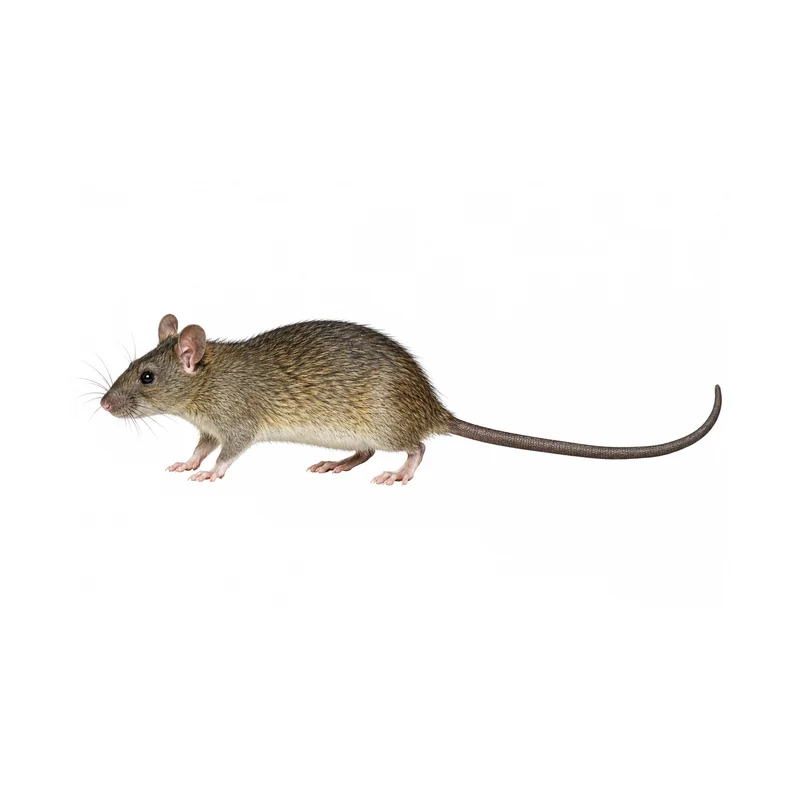
Roof Rat
The roof rat is a climbing rat that nests off the ground, in attics, rafters, trees and thick vines, and comes down at night to feed. Texas Tech’s Mammals of Texas calls it common over most of Texas, especially in towns.
Risk Assessment
Choose a row for the full detail- Color
- Brown mixed with black, or blackish, with a white, gray or black belly
- Diet
- Almost anything, with a taste for fruit, nuts, snails, grain and pet food
- Threat level
- High
- Nesting site
- Attics, rafters, trees and thick vines, off the ground
- Active season
- All year in Texas, breeding busiest in late winter and early summer
- Young to adult
- Weaned at about 3 weeks, breeding at about 3 months
- Size
- About 14.5 inches long with the tail, up to 200 g (about 7 oz)
What Does a Roof Rat Look Like?
A slim, dark rat with a pointed nose, big ears and a thin tail usually longer than its body
An adult roof rat is sleek and slender, with soft, smooth fur that is brown mixed with black, or nearly black, over a white, gray or black belly. Its nose is pointed, its ears are large and thin, and its scaly tail is usually longer than its head and body together. Texas Tech University’s species account in The Mammals of Texas gives an average total length of 370 mm, about 14.5 inches, with a tail of about 7.5 inches, and a weight of up to 200 grams.
Most homeowners hear a roof rat long before they see one. The national wildlife damage management reference on roof rat damage says sounds in the attic are often the first sign, heard at night when the house is quiet. The same reference’s roof rat page gives their droppings as about half an inch long with pointed ends, and they leave dark, greasy smudges along the beams, pipes and wires they travel.
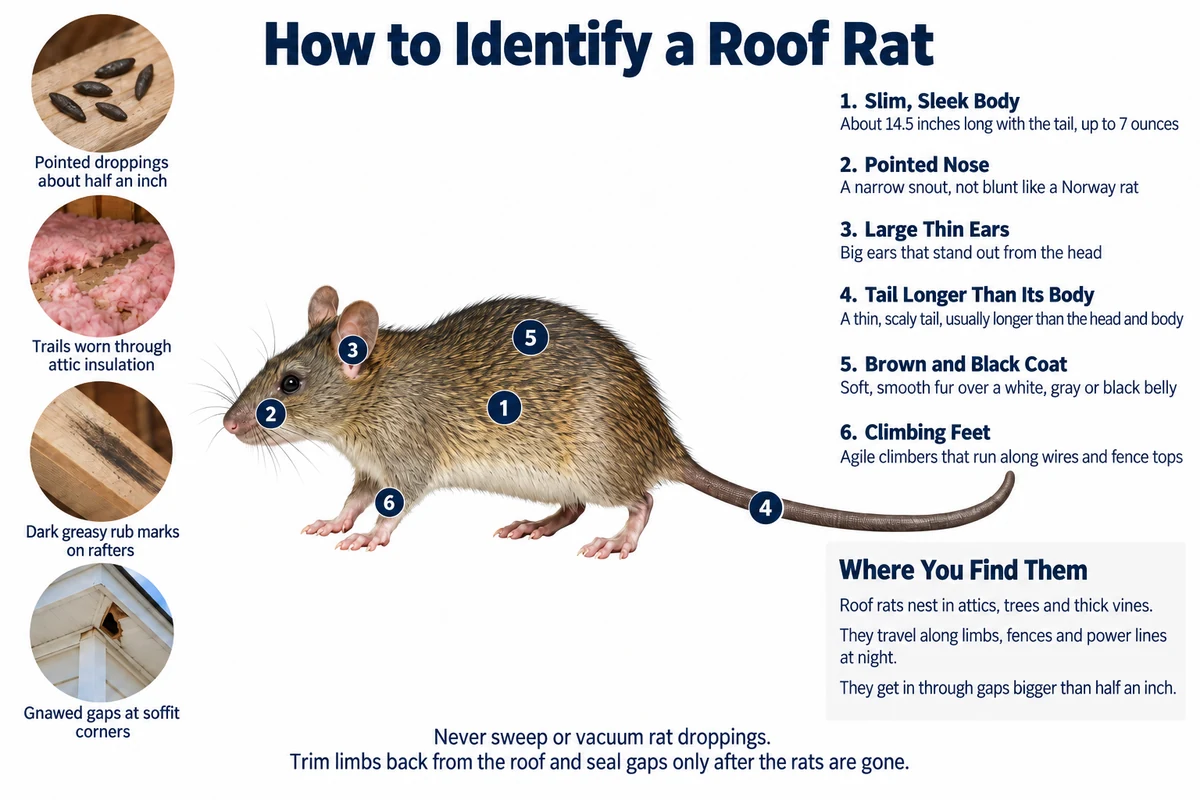
How to identify a roof rat by its slim body, large ears and long, thin tail, with the droppings, attic trails and rub marks it leaves behind
- Scratching and scurrying overhead at night, once the house goes quiet
- Pointed droppings about half an inch long in the attic or on top of cabinets
- Trails and tunnels worn through the attic insulation
- Dark, greasy smudges on rafters, pipes and the edges of openings
- Gnawed holes at soffit corners, garage door corners, vents or around AC lines
- Rats seen running along a fence top, tree limb or power line after dark
Other Names for the Roof Rat
The wildlife damage reference says the roof rat is also known as the black rat and the ship rat, and that it reached North America on early sailing ships. It names three color forms that interbreed freely: the black rat, the Alexandrine rat with a brownish streaked back, and the fruit rat with a brownish back and white belly. In Spanish it is the rata negra or rata de techo.
The names cause one common mix-up. Despite being called the black rat, many roof rats are brown, so color alone does not tell a roof rat from a Norway rat. The tail, the ears and where the signs are do. A roof rat also cannot interbreed with a Norway rat, so there are no in-between rats.
| Name | What it means |
|---|---|
| Black rat | The most common other name, even though many roof rats are brown. |
| Ship rat | For the sailing ships it arrived on. |
| Fruit rat | A brownish color form with a white belly, named for its taste for fruit. |
| Rata negra | The Spanish name, meaning the black rat. |
| Norway rat | A different, heavier rat that burrows at ground level. |
How to Tell a Roof Rat from a Norway Rat, House Mouse or Squirrel
Four animals are blamed for the same noises and droppings in Collin County homes. The fix is different for each, so it is worth knowing which one is up there. The tail, the size of the droppings and the time of day you hear it tell them apart.
| Species | Size and Color | Key Feature | Where Found |
|---|---|---|---|
|
Roof Rat
AKA: Black Rat, Ship Rat, Fruit Rat
Rattus rattus
This species
|
About 14.5 inches long with the tail, up to 7 ounces. Brown mixed with black, or blackish. | Slim body, pointed nose, large ears and a thin tail usually longer than its body. Pointed droppings about half an inch long. | Up high. Attics, rafters, trees and vine-covered fences, reached along limbs, fences and power lines. |
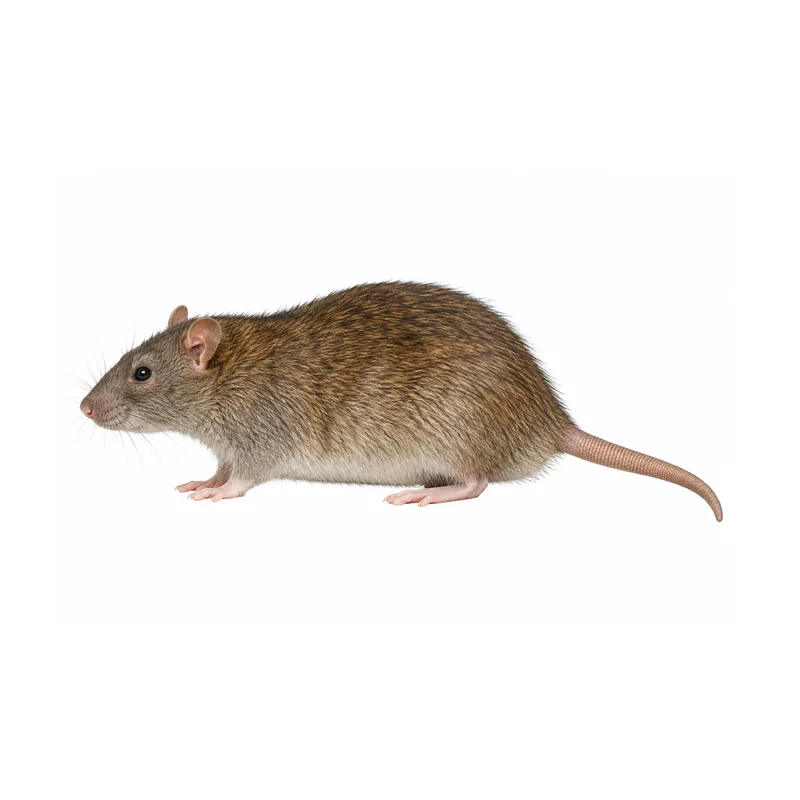
Norway Rat
AKA: Brown Rat, Sewer Rat
Rattus norvegicus
|
Heavier, about a pound. Brown or reddish gray with a gray to white belly. | Blunt nose, small ears and a thick tail shorter than its body. Blunt droppings up to three quarters of an inch. | On the ground. Burrows along foundations, under porches, sheds and walkways, and in mulch beds. |
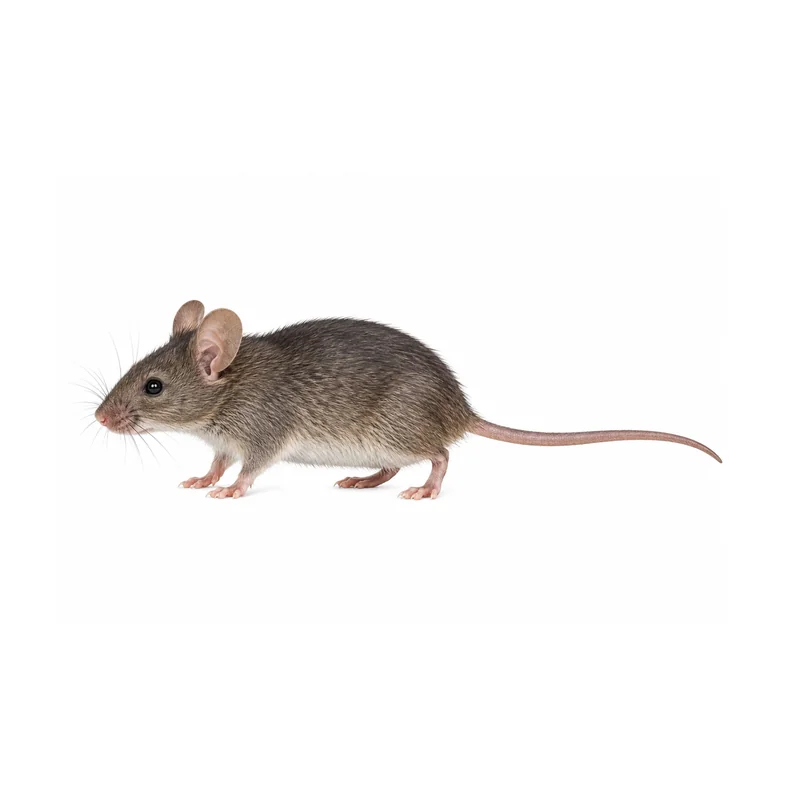
House Mouse
AKA: Mouse
Mus musculus
|
Far smaller, under an ounce. Gray brown with a gray or buff belly. | Small pointed head with large ears, and droppings only about a quarter inch long. | Inside walls, cabinets, garages and behind appliances, and in the attic too. |

Squirrel
AKA: Fox Squirrel, Gray Squirrel
Sciurus species
|
About 1 to 2 pounds. Gray or rusty orange with a long, bushy tail. | A furry tail, not a bare scaly one. Busy at dawn and through the day, quiet at night. | Attics reached from overhanging trees, gable vents and fascia gaps, and leaf nests in trees. |
Roof Rat vs Norway Rat
The Roof Rat in Three Numbers
1/2 inch
The national wildlife damage management reference advises sealing every opening larger than 1/2 inch across to keep roof rats out of a building.
Internet Center for Wildlife Damage Management
100 to 300 feet
The same reference reports that roof rats travel 100 to 300 feet for food, so they may live in the trees of one yard and feed at the house next door.
Internet Center for Wildlife Damage Management
7
Texas Tech University’s Mammals of Texas gives the average roof rat litter as almost 7 young, born after a pregnancy of about 21 days.
Texas Tech University, The Mammals of Texas
Are Roof Rats Dangerous?
Yes, for what they carry. The wildlife damage reference on roof rat damage lists murine typhus, leptospirosis, salmonella food poisoning, rat-bite fever and plague among the diseases roof rats spread to people, and Texas Tech’s species account names typhus, rat-bite fever and plague. Murine typhus is carried by fleas, so the fleas that leave a dead or trapped rat matter as much as the rat. A roof rat avoids people, but one that is cornered or caught will bite.
Can Rats in the Attic Make You Sick?
They can, mostly through their urine and droppings. According to the CDC’s page on leptospirosis, the bacteria spread through the urine of infected animals and infect people through contaminated water, soil or food, and it takes 2 to 30 days to get sick. The CDC’s rodent cleanup guide warns that sweeping or vacuuming droppings can put germs into the air you breathe, so an attic full of droppings is cleaned wet, never swept.
What If a Roof Rat Bites?
Wash the bite with soap and running water and call your doctor the same day. The CDC’s page on rat-bite fever says it is rare in the United States, that fever, vomiting, headache and muscle pain usually start 3 to 10 days after contact, and that it must be treated quickly with the right antibiotics.
When Roof Rat Activity Needs Fast Action
A Rat Bite or Scratch
Wash it at once with soap and running water and call your doctor the same day. Rat-bite fever needs the right antibiotics quickly.
Chewed Wiring
Roof rats gnaw electrical wires in attics and behind appliances. A chewed wire can knock out a circuit or an appliance, so have it looked at.
Droppings in the Kitchen
Droppings in cabinets, the pantry or on counters mean rats are coming down to food. Throw out anything they could have touched.
Noises That Have Gone Quiet
Sudden silence after weeks of scratching often means rats moved to another part of the house, not that they left. Check before sealing anything.
Why You Have Roof Rats in Your Attic
Roof rats nest off the ground whenever they can, so an attic is exactly what they look for. The wildlife damage reference on roof rat biology says they travel at night along overhead utility lines and fences, live in trees, thick shrubs and vine-covered fences, and climb down to food. A tree limb touching the roof, ivy on a wall or a power line to the house is a highway to the roofline.
Once there, a rat needs only a gap a little over half an inch: a soffit return that never closed, a loose vent screen, a corner of the garage door, the gap where an AC line enters the wall. Food draws them in the first place. Pet food left out, bird seed, fallen fruit and nuts, snails in the garden and open trash all feed them, and the same reference notes they may live in the landscaping of one home and feed at another. It is not a sign of a dirty house.
Where Roof Rats Live Around Collin County Homes
Texas Tech’s species account says roof rats usually live in attics, rafters and crossbeams, running along pipes, beams and wires and marking their routes with a dark layer of grease and dirt. Outside, the wildlife damage reference adds trees, thick shrubs, vine-covered fences and the plants along creeks and ponds. In a home, the reference notes the damage may be limited to torn-up insulation and gnawed wiring while the rats feed outdoors.
Roof Rat Pressure Across Collin County
Our technicians are called to rats in attics every month of the year, most often in McKinney, then Frisco, Plano and Allen. Neighborhoods with mature trees over the roofs, fences joining yard to yard and greenbelts behind the houses give roof rats the overhead routes they travel.
Newer neighborhoods in Prosper, Celina, Melissa and Princeton are not immune. Gaps at soffit returns, garage doors and utility lines let rats in even where the trees are still small.
Roof rats are in Collin County attics all year, and our attic rat calls come in every month. Texas Tech’s species account says Texas roof rats breed all year with two peaks, February and March and again May and June, and are least active in July and August.
Pattern from published Texas roof rat breeding biology (The Mammals of Texas) and Pest Me Off attic rat calls, which come in all year.
Why Roof Rats Keep Coming Back
How Pest Me Off Gets Rid of Roof Rats
Roof rat control is four steps, every job. Trapping the rats in the attic is only half of it, because the gaps they used bring in the next ones.
Inspect and Identify
A free inspection of the attic, the roofline, the garage and the trees and fences around the house. We confirm it is a roof rat and not a squirrel or mice, and find every way in.
Trap Where They Travel
Snap traps set on the rafters and runways in the attic, where roof rats actually move, and one-way doors on the active openings so rats can leave but not come back.
Seal Every Opening
Once activity stops, every gap over half an inch is closed with materials a rat cannot chew, 28-gauge steel at soffit returns and corners, metal mesh on vents, and sealed garage door corners. This is our rodent proofing and exclusion work.
Clean the Attic
We remove droppings and nesting from the attic’s landing areas, sanitize them, and restore disturbed insulation, then check the traps until no new activity shows.
& Other Companies
How to Get Rid of Roof Rats Yourself
The best DIY work makes the house hard to reach and hard to enter. The wildlife damage reference on roof rat control puts sealing, cutting back cover and removing food ahead of any trap.
Why Some DIY Responses Fail for Roof Rats
Most DIY roof rat trouble comes from trapping in the wrong place, using poison overhead, or closing gaps while rats are still inside.
Sealing Rats In
Closing the gaps while rats are still in the attic traps them. They chew a new way out, often into the living space, or die in the walls.
Poison in the Attic
A poisoned rat often dies inside a wall or ceiling where it cannot be reached, and the smell and flies can last for weeks.
Traps on the Floor
The wildlife damage reference says traps and bait on the ground or floor catch few roof rats unless they sit exactly where rats come down. Traps belong on rafters and runways.
Common Roof Rat Questions
What does a roof rat look like, and how big do they get?
How do I know if I have rats in my attic?
What is the difference between a roof rat and a Norway rat?
What do roof rat droppings look like?
Is it a rat or a squirrel in my attic?
How do roof rats get into the attic?
Are roof rats dangerous?
Do roof rats chew electrical wires?
Why won’t the rats go near my traps?
When are roof rats most active?
How do I get rid of roof rats?
Rats in the Attic? We Get Them Out and Seal Them Out.
We find every way in from the roofline to the garage door, trap the rats where they travel, seal every gap with steel and mesh, and clean the attic so nothing draws them back. Rodent control across McKinney, Allen, Frisco, Plano, and all of Collin County.