Fruit Flies in Collin County, TX | Identification and Control
The fruit fly (Drosophila melanogaster) is the tiny, red-eyed fly that hovers over the fruit bowl, the trash can and the kitchen sink. It breeds in anything moist and fermenting, from a soft potato to the film inside a drain, so throwing out the fruit is often not enough. Texas A&M AgriLife Extension says a fruit fly can go from egg to adult in as few as 8 days.
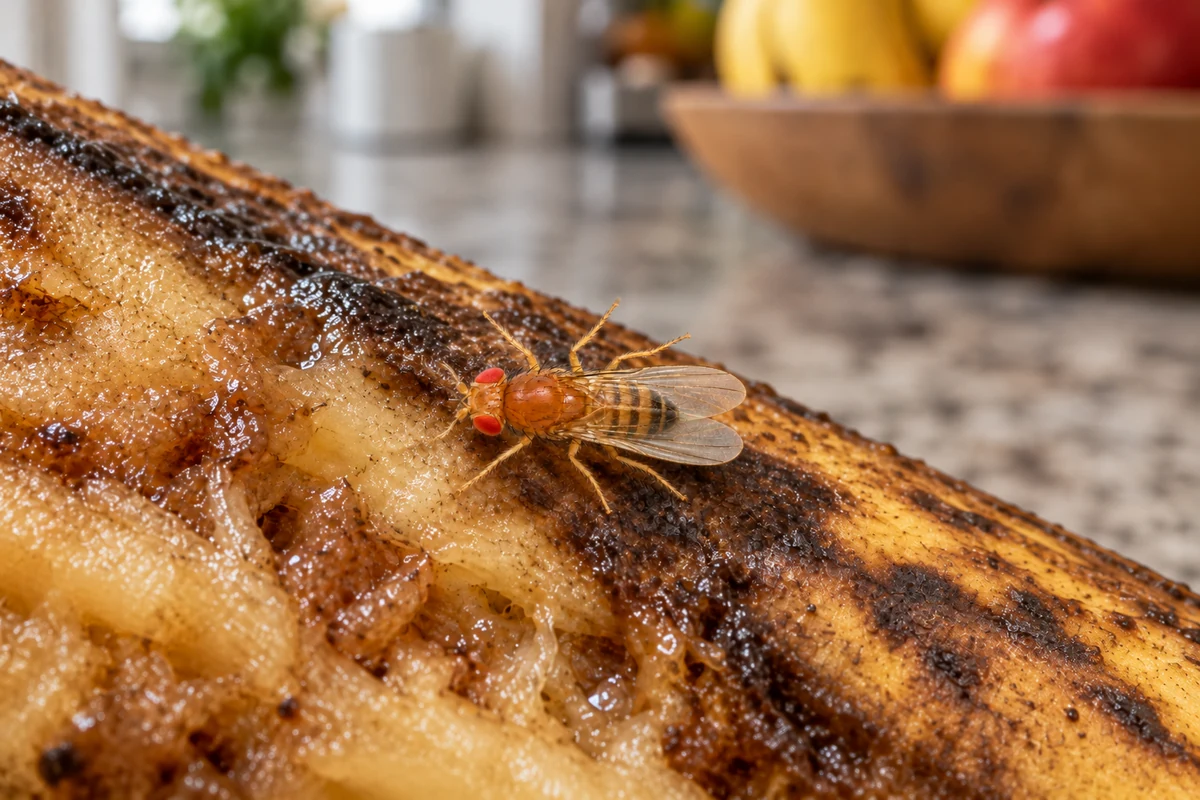
Fruit flies still there after the fruit is gone? Our office sits where McKinney, Plano, Frisco and Allen meet, 5 to 10 minutes from most homes in those four cities. Call and we will find where they are breeding.
Fruit Fly
The fruit fly is a tiny fly that breeds in fermenting fruit, vegetables, spilled drinks and the film inside drains, and follows the smell of that food anywhere in the house. Texas A&M AgriLife Extension lists it among the few flies that can breed and live entirely indoors.
Risk Assessment
Choose a row for the full detail- Color
- Tan at the front, darker bands at the back end
- Diet
- Yeast on fermenting fruit, vegetables, spilled drinks and drain film
- Threat level
- Low
- Eyes
- Usually bright red, dark in some kinds
- Primary habitat
- Kitchens, drains, trash cans and recycling bins
- Egg to adult
- As few as 8 days in warm conditions
- Size
- About 1/8 inch (2 to 4 mm)
What Does a Fruit Fly Look Like?
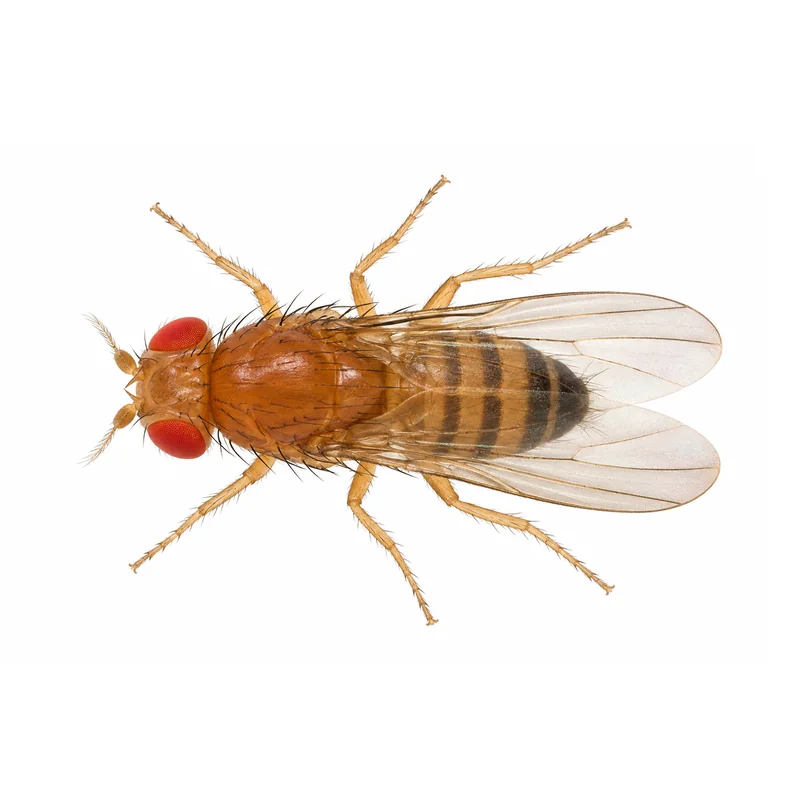
A tiny tan fly with red eyes and a dark-banded back end, hovering around food
An adult fruit fly is about 1/8 inch long, 2 to 4 mm, with a stout, rounded body and two clear wings. Most have bright red eyes. Texas A&M AgriLife Extension’s guide to indoor flies gives that size and adds that a fruit fly can be told from other small indoor flies by the feathery bristle at the tip of each antenna. The front of the body is tan and the back end is darker, crossed with black bands.
How it flies is the easier clue. The University of Kentucky Entomology fact sheet on small flies describes fruit flies hovering in quick, darting loops around overripe fruit and trash cans. They stay near food rather than resting on walls. Some fruit flies have dark eyes instead of red, and Texas A&M notes those dark-eyed kinds breed more often in drains and around bathrooms.
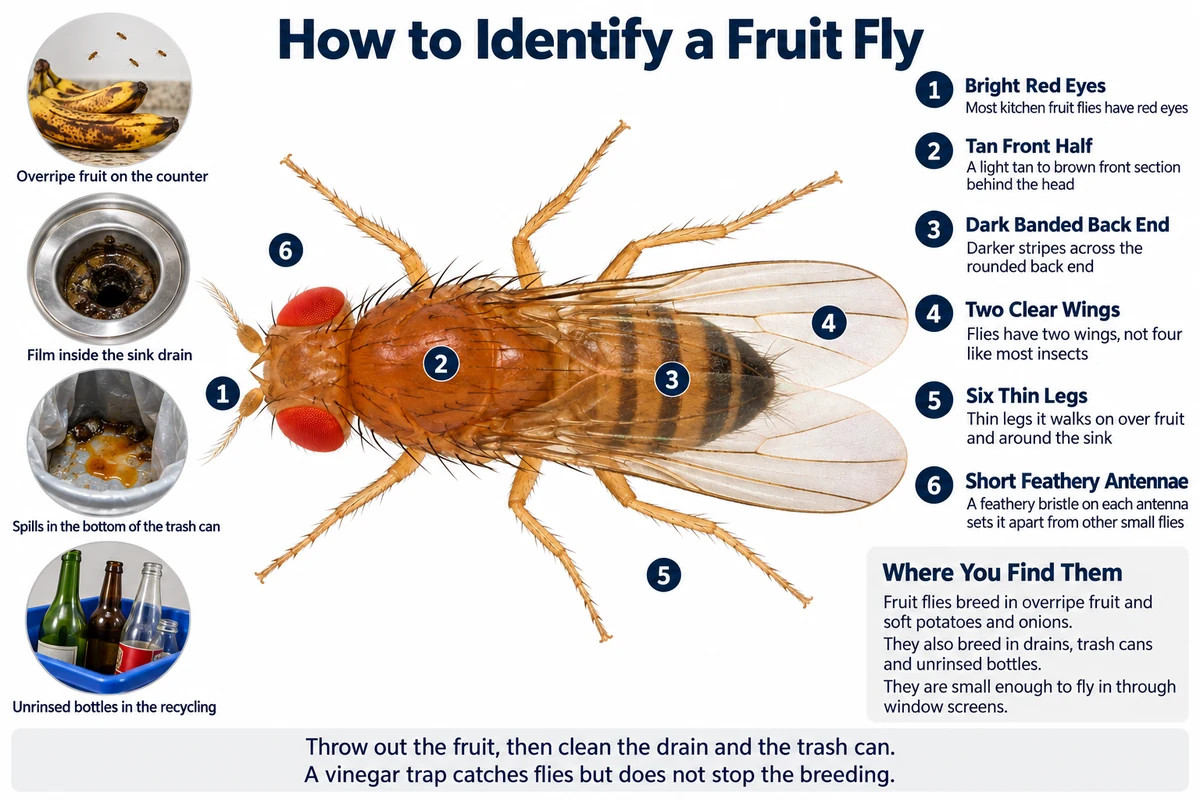
How to identify a fruit fly by its red eyes, tan body and dark-banded back end, with the kitchen spots where it breeds
- Tiny tan flies hovering over the fruit bowl, the trash can or the sink
- Red eyes, seen up close or in a zoomed phone photo
- Flies gathering at the recycling bin or an open bottle of wine, vinegar or juice
- Flies still flying days after the fruit is thrown out
- A soft potato or onion at the back of the pantry
- Flies landing on food and fruit, not resting on the bathroom wall
Other Names for the Fruit Fly
Fruit flies go by several names, most of them after what draws them. Texas A&M AgriLife Extension says they are sometimes called vinegar flies or pomace flies, because they come to vinegar and almost any decaying fruit, and the University of Kentucky adds banana fly. There are more than 170 kinds of fruit flies in the United States and Canada, according to Texas A&M, but the one in most kitchens is Drosophila melanogaster, the same fly scientists use to study genetics.
Many people simply call them gnats. The University of Kentucky’s fruit fly fact sheet says small flies or gnats seen in the kitchen are probably fruit flies, but a true fungus gnat is a different fly that breeds in houseplant soil. The look-alike section below shows how to tell them apart.
| Name | What it means |
|---|---|
| Vinegar fly | For the vinegar and fermenting food it is drawn to. |
| Pomace fly | Pomace is the crushed fruit left after making juice or wine. |
| Banana fly | For the overripe bananas it so often breeds in. |
| Mosca de la fruta | The Spanish name, meaning the fruit fly. |
| Gnat | A loose name for any tiny fly, often a fungus gnat instead. |
How to Tell a Fruit Fly from a Drain Fly, Gnat or House Fly
Several small flies turn up in Collin County kitchens, and each one breeds somewhere different, so the fix depends on which fly it is. Texas A&M AgriLife Extension names fruit flies, drain flies, phorid flies and fungus gnats as the small flies that breed indoors. The table compares the fruit fly with the house fly, and the field test below covers the small ones.
| Species | Size and Color | Key Feature | Where Found |
|---|---|---|---|
|
Fruit Fly
AKA: Vinegar Fly, Pomace Fly
Drosophila melanogaster
This species
|
About 1/8 inch. Tan at the front with a darker, banded back end. | Red eyes and a hovering, darting flight close to food. | Indoors, around fruit bowls, sinks, drains, trash cans and recycling bins. |
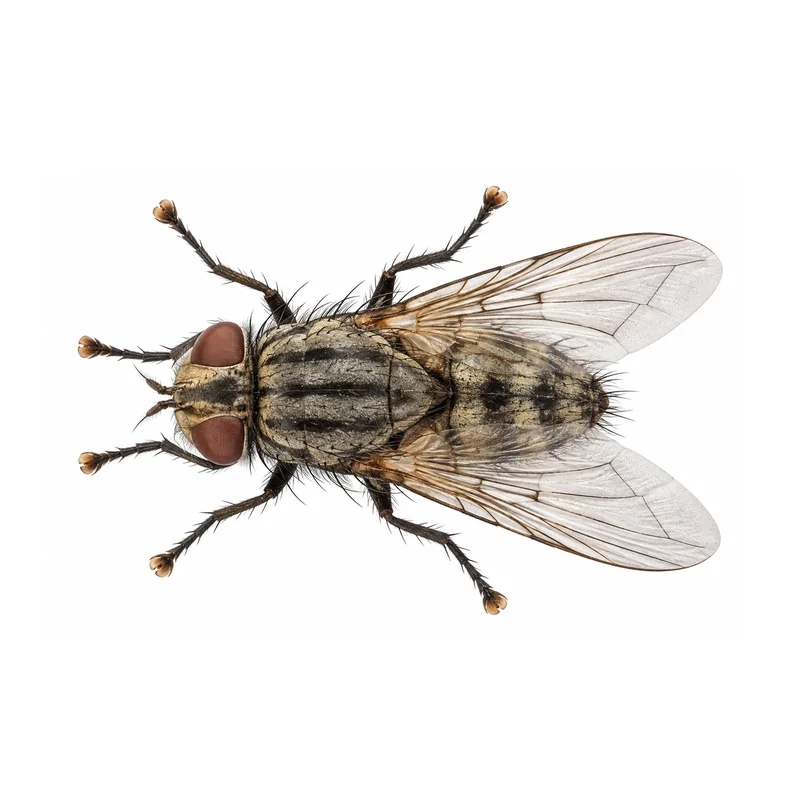
House Fly
Musca domestica
|
About 3/16 to 1/4 inch, twice the size or more. Gray. | Four dark stripes down its back, and a loud, buzzing flight. | Mostly outdoors around garbage and animal waste, flying in through open doors. |
Fruit Fly vs Drain Fly and Fungus Gnat
The Fruit Fly in Three Numbers
500
The University of Kentucky’s fruit fly fact sheet says a single female fruit fly can lay about 500 eggs on fermenting food.
University of Kentucky Entomology
8 days
Texas A&M AgriLife Extension says a fruit fly can go from egg to adult in as few as 8 days under the best conditions.
Texas A&M AgriLife Extension
1/8 inch
Texas A&M AgriLife Extension puts an adult fruit fly at about 1/8 inch long, small enough to pass through window screens.
Texas A&M AgriLife Extension
Do Fruit Flies Bite?
No. Texas A&M AgriLife Extension states plainly that fruit flies do not bite, and they have no sting. Texas A&M urban entomologist Mike Merchant, based in Dallas, put it this way in AgriLife Today’s article on fruit flies, saying they really bother people but are not really hurting anything. A fly that does bite in the kitchen is something else, and is worth catching to identify.
Can Fruit Flies Make You Sick?
They can carry germs. The University of Kentucky’s fruit fly fact sheet says they can contaminate food with bacteria and other organisms that cause disease. Texas A&M AgriLife Extension adds that hospitals treat them as a public health risk because they can contaminate sterile surfaces, and that eating food infested with them has been reported to cause intestinal upset and diarrhea. At home the rule is simple. Throw out food they have been breeding in, and cut away the soft or damaged part of fruit, since the young feed near the surface.
When Fruit Fly Activity Needs Fast Action
Flies in a Restaurant or Food Business
Texas A&M says health departments consider fruit flies in a food business unsanitary. Find the source before the next inspection.
Tiny Flies Running Across the Counter
A small fly that runs instead of flying off is likely a phorid fly. Texas A&M warns these can come from a leaking sewer line under the slab.
Flies That Outlast the Fruit
Flies still flying a week after the fruit is gone mean a drain, a trash can or a forgotten potato is still breeding them.
A Few Around the Fruit Bowl
A handful near ripe fruit in summer is common. Eat or refrigerate the ripe fruit and they soon fade.
Why You Have Fruit Flies in Your House
Fruit flies come in from outdoors and stay where they find something moist and fermenting to lay eggs in. In AgriLife Today, Mike Merchant called them almost impossible to keep out of homes. They fly in through doors as people come and go, ride home on ripe fruit from the store or the garden, and are small enough to get through window screens. Once inside, they are very good at smelling out food anywhere in the house.
The breeding spot is often not the fruit bowl. Texas A&M lists the wet bottom of a trash can where a liner has leaked, bags of potatoes or onions in the pantry, recycling bins with unrinsed wine, beer or soda containers, and open bottles of vinegar, wine or cider. The University of Kentucky adds drains, garbage disposals, mops and cleaning rags, and notes that a single rotting potato or onion forgotten at the back of a closet can breed thousands of fruit flies. It is not a sign of a dirty home. One soft onion is enough.
Where Fruit Flies Live Around Collin County Homes
Fruit flies live wherever food ferments and stays damp. In homes that means the kitchen first, around the fruit bowl, the sink and disposal, the trash can and the recycling bin, then the pantry. Texas A&M adds the moist spots under commercial kitchen equipment and bars, soft drink dispensers and cracked floor tile, which is why restaurants and bars see them all year.
Fruit Fly Pressure Across Collin County
Fruit flies show up in our service notes most often in McKinney, Prosper, Allen, Frisco and Plano, nearly always in the kitchen, around the sink, the drains and the fruit on the counter. We also find them behind bars and in bakeries and coffee shops, where spilled drinks and floor drains keep them breeding all year.
In Little Elm and Princeton we see the same kitchen pattern, and often find the small flies a homeowner called fruit flies are drain flies at a sink or gnats in a houseplant.
Fruit flies can breed indoors in any month in Collin County. Texas A&M AgriLife Extension says infestations are most frequent in summer, when fruit flies are active outdoors, and our own fruit fly calls run highest from April through August.
Pattern from Texas A&M AgriLife Extension’s guide to indoor flies and Pest Me Off fruit fly calls in 2025 and 2026, which run all year and climb from April through August.
Why Fruit Flies Keep Coming Back
How Pest Me Off Gets Rid of Fruit Flies
Fruit fly control is four steps, every job. Killing the flies you can see is the easy part. The job is finding every place they are breeding and cleaning it out.
Inspect and Identify
We check the kitchen, every sink and floor drain, the disposal, the trash and recycling bins, the pantry and under the fridge, and confirm the flies are fruit flies and not drain flies, phorid flies or gnats.
Clean Out the Breeding Spots
We treat the drains with a foaming drain product that breaks down the organic film the young feed in, and point out the produce, trash and spills that need to go.
Catch the Adults
Fruit fly traps go on the counter near the sink and wherever the flies gather, with fly bait where they land.
Keep the Sources Gone
We show you the breeding spots we found and the cleaning that keeps them from coming back, from the disposal to the bottom of the trash can.
& Other Companies
How to Get Rid of Fruit Flies Yourself
Most DIY fruit fly work is finding where they breed. Texas A&M AgriLife Extension puts finding and removing the breeding site first, ahead of any trap or spray.
Why Some DIY Responses Fail for Fruit Flies
Most DIY fruit fly trouble comes from killing the adults while the breeding spot keeps going, or from treating the wrong small fly.
Pouring Bleach Down the Drain
Texas A&M calls bleach and drain cleaner largely ineffective at removing the film flies breed in. The drain smells clean and keeps breeding.
A Spray Can or a Bug Bomb
It kills the flies in the air today, while eggs in the drain, trash and pantry hatch tomorrow.
Treating the Wrong Fly
Gnats in a houseplant and drain flies at the shower need different fixes. Throwing out the fruit will not touch either one.
Common Fruit Fly Questions
What is a fruit fly, and what does it look like?
Why do I have fruit flies in my house?
Where do fruit flies come from if there is no fruit out?
Do fruit flies bite?
Are fruit flies dangerous, and can they make you sick?
What is the difference between fruit flies, drain flies and gnats?
Can fruit flies breed in drains?
How long do fruit flies live, and how fast do they multiply?
Will a vinegar trap get rid of fruit flies?
How do I get rid of fruit flies?
Fruit Flies That Will Not Quit? We Find Where They Breed.
We find the drain, the trash can or the forgotten bag of potatoes they are breeding in, clean it out and trap the flies that are left. Pest control across McKinney, Allen, Frisco, Plano, and all of Collin County.