
House Centipedes in Collin County, TX | Identification and Control
The house centipede (Scutigera coleoptrata) is the fast, many-legged bug that races across a bathroom wall or turns up stuck in the tub. Penn State Extension puts its body at only 1 to 1.5 inches, but with its legs and antennae it measures 3 to 4 inches overall. It rarely bites and carries no disease, but seeing them often means it is finding plenty of silverfish, roaches or spiders to eat.
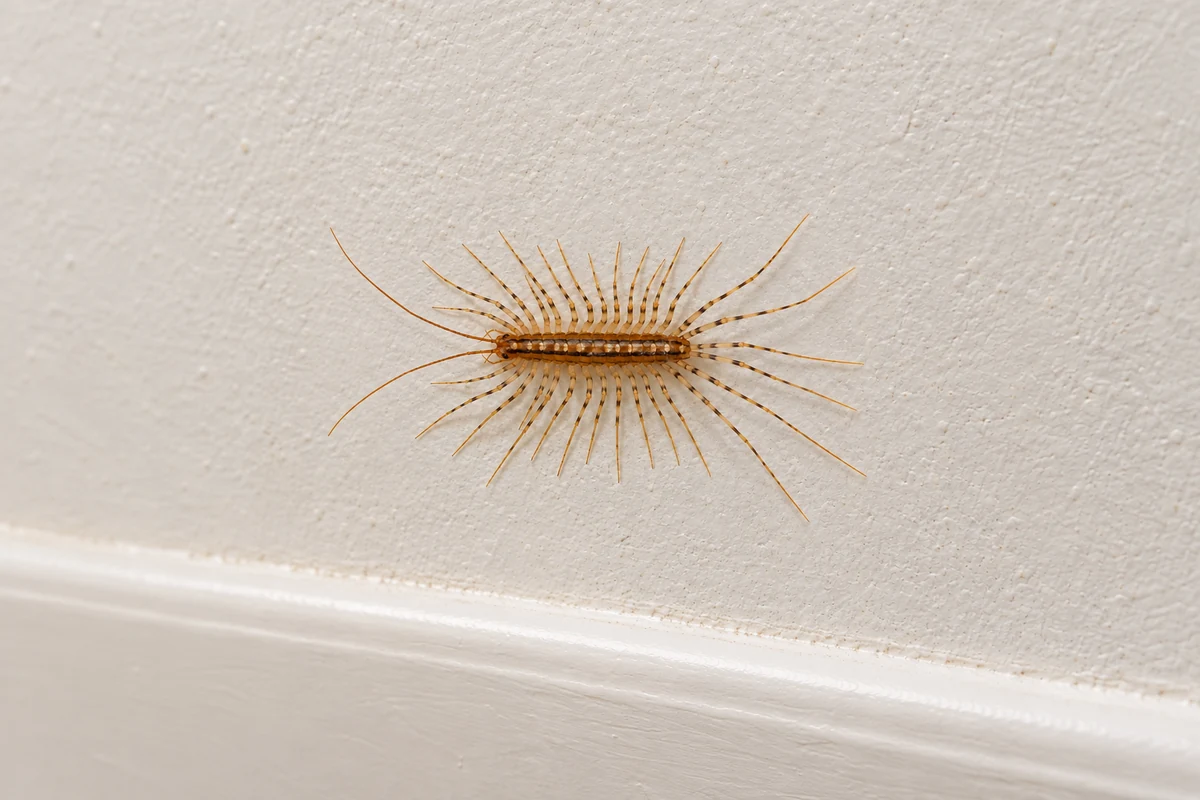
Centipedes in the bathroom or laundry room? Our office sits where McKinney, Plano, Frisco and Allen meet, 5 to 10 minutes from most homes in those four cities. Call and we will find what they are eating and where they hide.
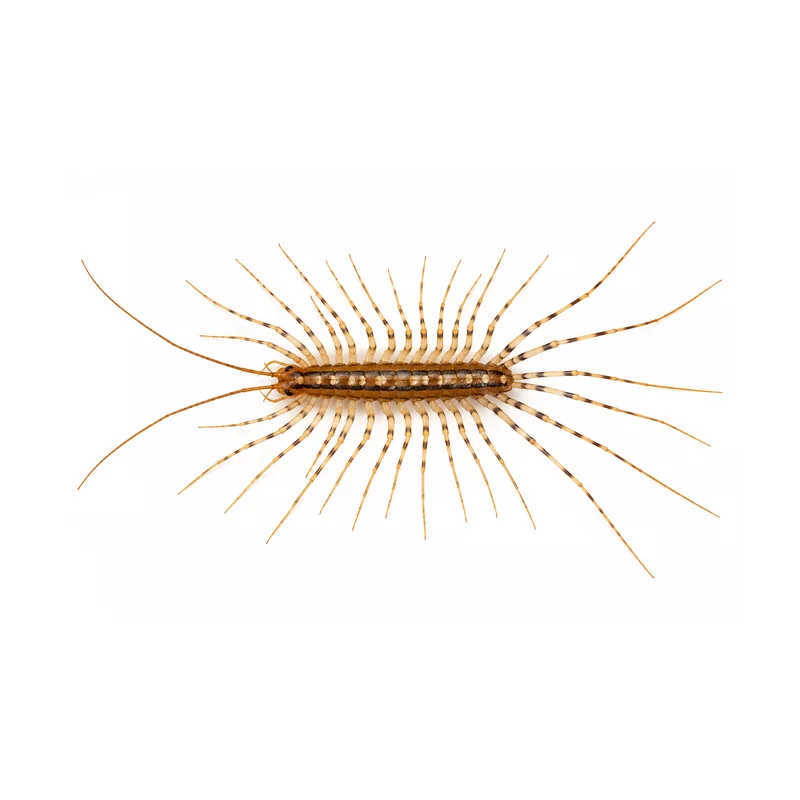
House Centipede
The house centipede is a hunter that lives in the damp, dark corners of a house and comes out at night to catch other bugs. Penn State Extension calls it harmless, though its speed and long legs frighten a lot of people.
Risk Assessment
Choose a row for the full detail- Color
- Dirty yellow with three dark stripes, legs banded light and dark
- Prey
- Silverfish, cockroaches, spiders, young carpet beetles and other small bugs
- Threat level
- Low
- Movement pattern
- Runs very fast along walls and floors, mostly at night
- Where it hides
- Damp, dark spots such as bathrooms, laundry rooms, closets and under boxes
- Lifespan
- Several years for females
- Eggs
- 63 on average in lab studies, up to 151
- Size
- Body 1 to 1.5 inches, 3 to 4 inches with legs and antennae
What Does a House Centipede Look Like?
A short, striped body with 15 pairs of long, banded legs and very long antennae
An adult house centipede has a short, flat body colored a dirty yellow, with three dark stripes running down its back. Penn State Extension describes 15 pairs of legs banded light and dark, with the last pair on adult females nearly twice the length of the body, which is only 1 to 1.5 inches long. Counting its legs and very long antennae, it looks 3 to 4 inches long.
Most people see one for a second as it races across a wall or floor. Animal Diversity Web, the University of Michigan’s animal encyclopedia, explains that its legs get longer toward the back, so the rear legs step over the front ones without tangling as it runs. Oklahoma State University Extension adds that, unlike other centipedes, it has a rounded head with a pair of large eyes.
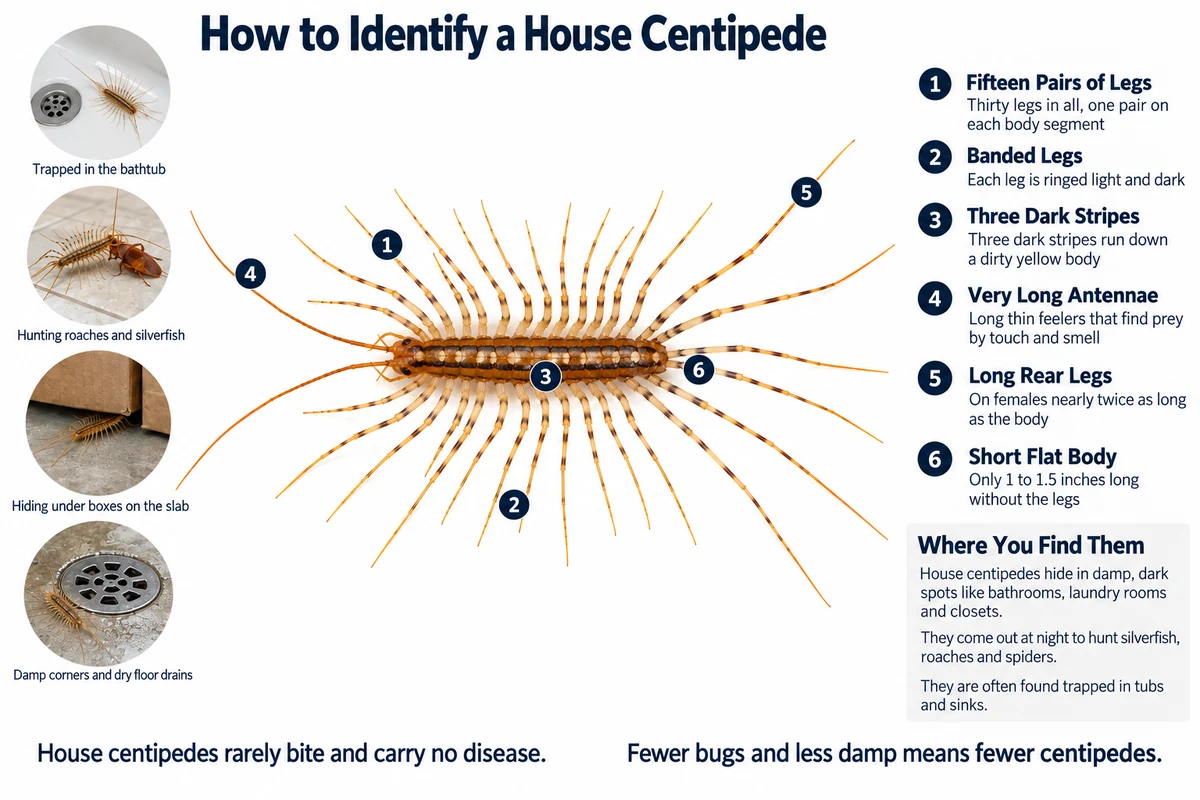
How to identify a house centipede by its striped body, 15 pairs of banded legs and long antennae, with the places it turns up and the bugs it hunts
- A flat, yellowish bug with long legs all around it that races across a wall or floor
- Three dark stripes down the back and legs ringed light and dark
- One stuck in the bathtub, the sink or a dry floor drain
- Sightings at night in bathrooms, laundry rooms, closets and the garage
- One darting out from under boxes stored on the floor
- Other bugs close by, such as silverfish, roaches or spiders, for it to eat
Other Names for the House Centipede
Its scientific name is Scutigera coleoptrata. Penn State Extension notes that the house centipede is native to the Mediterranean region, was accidentally brought into the southern United States, and was first recorded in Pennsylvania in 1849. It now lives across the country. In Spanish any centipede is a ciempiés, meaning a hundred feet.
The name that causes the most confusion is thousand-legger. Oklahoma State University Extension gives that name to millipedes, slow, round-bodied animals with two pairs of legs on each body segment, but many people use it for the house centipede too. The look-alike table below shows how to tell them apart.
| Name | What it means |
|---|---|
| Hundred-legger | An old name for any centipede. This one has 30 legs. |
| Bathroom centipede | For the room most people find one in. |
| Ciempiés | The Spanish word, meaning a hundred feet. |
| Thousand-legger | A millipede name that people use for it too. |
How to Tell a House Centipede from a Millipede or Silverfish
All three turn up in damp bathrooms, laundry rooms and garages around Collin County, and the fix depends on which one it is. A house centipede is a hunter that follows its food, a millipede wanders in from damp soil and mulch outside, and silverfish feed on paper, glue and dry food indoors. The legs, the speed and the tail end tell them apart.
| Species | Size and Color | Key Feature | Where Found |
|---|---|---|---|
|
House Centipede
AKA: Hundred-Legger, Bathroom Centipede
Scutigera coleoptrata
This species
|
Body 1 to 1.5 inches, 3 to 4 inches with legs. Dirty yellow with three dark stripes. | 15 pairs of long legs banded light and dark, one pair on each segment, and very long antennae. Runs very fast. | Bathrooms, laundry rooms, closets and garages, often trapped in tubs and sinks. |
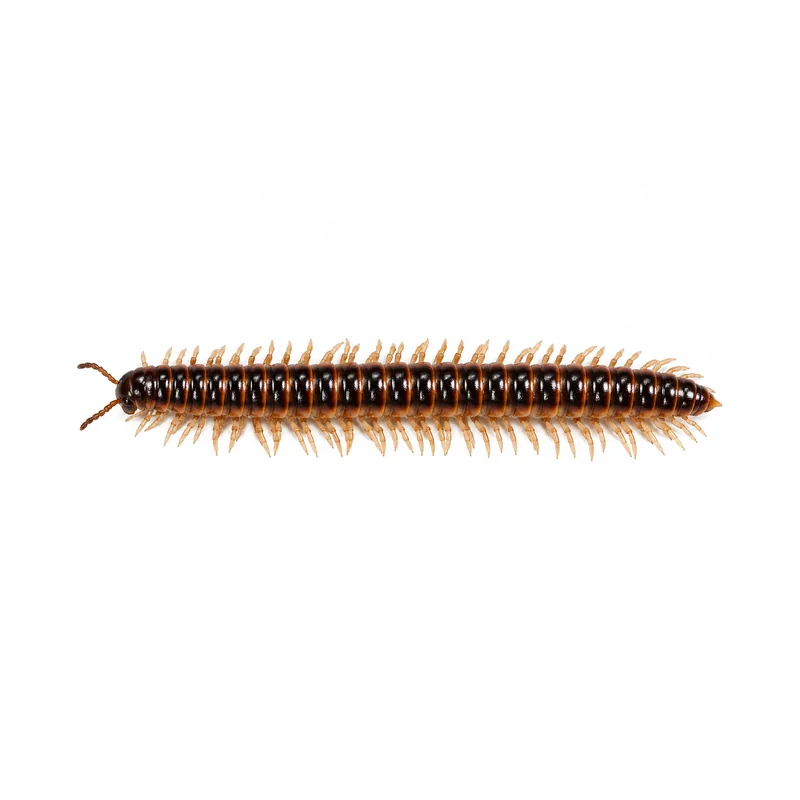
Millipede
AKA: Thousand-Legger
Class Diplopoda
|
One to two inches or more. Reddish brown to black. | Round, hard body with two pairs of short legs on each segment and short antennae. Slow, and curls into a coil. | Damp soil, leaves and mulch outside. Wanders indoors and usually dies there. |
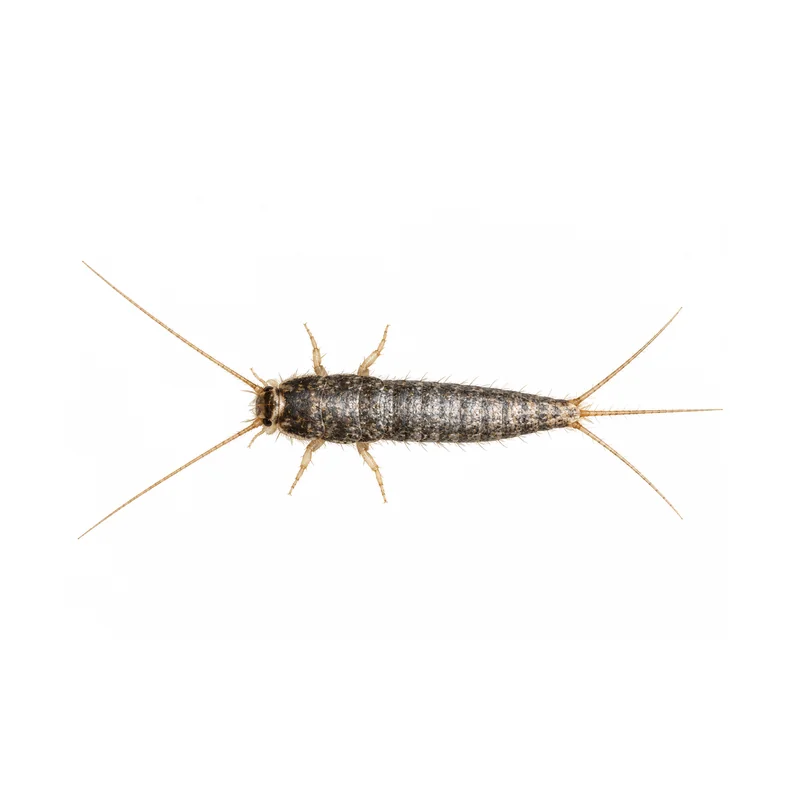
Silverfish
Lepisma saccharina
|
About 1/2 to 3/4 inch. Silver or gray scales. | Six legs, a flat, carrot-shaped body, two long antennae and three long bristles at the tail. | Bathrooms, basements, bookshelves and stored papers, hiding in cracks by day. |
House Centipede vs Millipede
The House Centipede in Three Numbers
3 to 4 inches
Penn State Extension says a house centipede’s body is only 1 to 1.5 inches long, but with its legs and antennae it measures 3 to 4 inches overall.
Penn State Extension
15 pairs
Penn State Extension counts 15 pairs of legs on an adult house centipede, with the last pair on females nearly twice the length of the body.
Penn State Extension
63 eggs
Animal Diversity Web reports that house centipede females laid an average of 63 eggs, and as many as 151, in laboratory observations.
Animal Diversity Web, University of Michigan, 2001
Do House Centipedes Bite?
They can, but rarely. Animal Diversity Web says house centipedes are not aggressive and bite people only in self-defense, that their fangs are often not strong enough to break the skin, and that a bite which does get through is painful, comparable to a honeybee sting. Most bites happen when someone grabs one or traps it against the skin, so scoop it into a cup or sweep it up instead. Wash a bite with soap and water.
Are House Centipedes Poisonous or Dangerous?
Not to people. They carry venom, which they use on the insects they catch, but Oklahoma State University Extension says centipedes carry no disease to people, other animals or plants, and that a bite from the smaller kinds produces at worst a reaction like a bee sting. Penn State Extension calls the house centipede harmless. Swelling that keeps spreading, or any trouble breathing, still needs a doctor.
Are House Centipedes Dangerous to Dogs and Cats?
Rarely. A cat or dog that paws at one can get the same self-defense bite a person can, painful but comparable to a bee sting by the accounts above. Call your vet if a pet’s face or paw keeps swelling or the pet seems unwell.
When House Centipede Activity Needs Action
A Bite That Keeps Swelling
Most bites feel like a bee sting and settle. Swelling that spreads, a fever or trouble breathing needs a doctor the same day.
Centipedes Seen Every Week
Seeing them often means something they eat is plentiful in the house. Find the silverfish, roaches or spiders feeding them.
One in the Tub or Sink
It fell in while hunting and is trapped by the smooth sides. Scoop it out with a cup and keep watch for more.
One in the Garage or Closet
A single centipede near stored boxes is common. Lift the boxes off the floor and see whether more turn up.
Why You Have House Centipedes in Your House
House centipedes stay where it is damp and where there is food. Penn State Extension says they spend the day in dark, damp places in the home and come out at night to hunt silverfish, firebrats, young carpet beetles, cockroaches and spiders, and that seeing them often means some prey is plentiful, which may be a bigger problem than the centipedes. Animal Diversity Web adds that indoors they are found most in bathrooms and basements, probably because of the higher humidity there.
Penn State’s list of hiding places fits a Collin County slab home closely: under the slab, coming in through expansion cracks, floor drains with no water in the trap, and cardboard boxes stored on the slab. Oklahoma State University Extension says house centipedes, unlike most centipedes, can breed indoors, laying eggs in damp closets and bathrooms, behind baseboards and in firewood brought inside, and that people often find them trapped in bathtubs, sinks and toilets. It is not a sign of a dirty house, only of damp corners and other bugs to eat.
Where House Centipedes Live Around Collin County Homes
Indoors, house centipedes live in damp, dark places such as bathrooms, laundry rooms, closets, garages and the cracks under and around a slab. Penn State Extension notes they can also be found outdoors near buildings in summer, and Animal Diversity Web says they hide under rocks and logs by day, spend the winter in sheltered spots and become active in spring.
House Centipede Pressure Across Collin County
House centipedes come up in our service notes most often in McKinney and Frisco, usually in a master bathroom, or inside a home where spiders, roaches or millipedes are getting in as well. Those are the damp rooms and the steady food that Penn State Extension describes.
In Plano, Allen and Prosper the same conditions draw them, bathrooms and laundry rooms that stay damp, boxes stored on a garage slab, and other bugs already finding their way inside.
House centipedes live indoors all year in Collin County, so one can turn up in any month. Our calls about them climb in late spring and stay steady through summer, the warmer months when they court and breed, and drop off in the coldest weeks.
Pattern from published house centipede biology (Animal Diversity Web) and Pest Me Off centipede calls, which run heaviest from May through September.
Why House Centipedes Keep Coming Back
How Pest Me Off Gets Rid of House Centipedes
House centipede control is four steps, every job. Penn State Extension puts cutting their food supply first, so the centipedes you see are only part of the work.
Inspect and Identify
A free inspection of the bathrooms, laundry room, garage, closets and the outside of the foundation. We confirm it is a house centipede and not a millipede or silverfish, and look for what it is eating.
Treat What They Eat
We treat for the silverfish, roaches, spiders or other bugs feeding them, wherever those live in the house.
Treat Where They Hide
Treatment along the foundation and into the cracks, gaps and weep holes where centipedes and their prey get in and hide, inside and out.
Point Out Damp and Gaps
We show you the leaks, damp corners and cracks that keep drawing them, from a dripping pipe under a sink to boxes stored on a garage floor.
& Other Companies
How to Get Rid of House Centipedes Yourself
Most DIY centipede work is taking away what draws them. Penn State Extension puts cutting their food supply first, then sealing their hiding places and lowering the humidity.
Why Some DIY Responses Fail for House Centipedes
Most DIY centipede trouble comes from killing the centipede and nothing else, spraying where they are not hiding, or grabbing one with bare hands.
Killing Them and Stopping There
A centipede you kill is replaced while its food is still around. Leave the silverfish, roaches and damp in place and the next one moves in.
Spraying Only Open Floors
They spend the day in cracks, under the slab and under boxes. Penn State Extension advises treating the cracks and crevices where they are suspected.
Picking One Up
Almost every bite happens when someone grabs one or traps it against the skin. Scoop it into a cup or sweep it up instead.
Common House Centipede Questions
What is a house centipede?
Do house centipedes bite?
Are house centipedes poisonous?
Are house centipedes dangerous to dogs and cats?
Why do I have centipedes in my bathroom?
What do house centipedes eat?
How many legs does a house centipede have?
What is the difference between a house centipede and a millipede?
Are house centipedes good to have in the house?
Do house centipedes lay eggs in the house?
How do I get rid of house centipedes?
Centipedes in the Bathroom? We Find What They Are Eating.
We confirm it is a house centipede, treat the bugs feeding it and the cracks where it hides, and show you the damp spots that keep drawing it. Pest control across McKinney, Allen, Frisco, Plano, and all of Collin County.