Orb Weaver Spiders Around Your Home
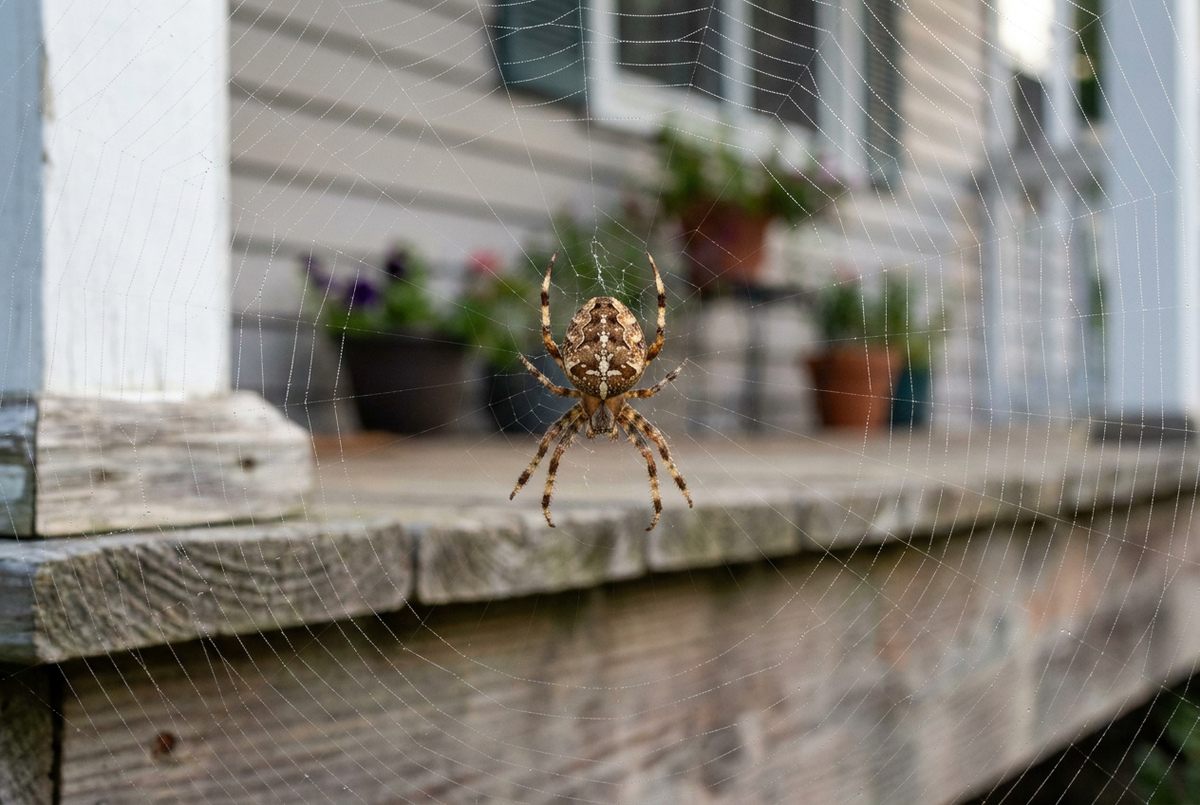
Orb weavers are the spiders behind the large, wheel-shaped webs that show up in Collin County yards, garden beds and porch overhangs from midsummer into fall. They live outdoors, they do not build up into anything close to an infestation, and the ones you are most likely to see, the black and yellow garden spider, the spotted orb weaver and smaller relatives, spend their whole lives outside catching insects rather than looking for a way in. This page covers what they are, whether they are actually dangerous, why their webs multiply on porches in late summer, and what to do about one that keeps showing up where you walk in McKinney, Allen and the rest of Collin County.

- Beneficial and largely harmless. Orb weavers are outdoor spiders that catch mosquitoes, moths and other flying insects near the house.
- They rebuild their web nightly, often eating the old silk and spinning a fresh one before dawn.
- Late summer is peak season. Spiders that hatched in spring reach full adult size by August and September.
- Bites are rare and mild. Orb weavers avoid contact, and a bite compares to a bee sting at most.
- Porch lights are the draw. Lights pull in flying insects, and orb weavers position webs nearby to catch them.





What Are Orb Weavers?
Orb weavers are a large spider family, Araneidae, named for the wheel-shaped web people picture when they think of a spider web. Of about 200 species, a handful account for almost everything homeowners in McKinney, Allen and Frisco actually see, and every one of them is native to Texas and common across Collin County, not an unusual find.
The black and yellow garden spider (Argiope aurantia) is the one people notice first: a large, patterned abdomen and a zigzag band of extra silk running down the center of the web. It is also the species behind most of the search traffic to this page, and it has its own detailed guide on our yellow garden spider page, including sizing and identification photos.
Smaller relatives fill in the rest of the season, and they are told apart by markings and by where they sit rather than by size alone.
| Which orb weaver | How you know it | Where it sits |
|---|---|---|
| Black and yellow garden spider | Large, boldly patterned abdomen, with a zigzag band of extra silk running down the middle of the web | At head height across a gap, in gardens and between porch posts. The one people notice first |
| Spotted orb weaver, or barn spider | Neoscona crucifera. About 1/2 inch, plainer than the garden spider, with gray legs ringed in brown | Under eaves and near porch lights, building the web at dusk and hiding in a corner by morning |
| Marbled orb weaver | Araneus marmoreus. A large, mostly orange abdomen with brown to purple markings and pale yellow spots | Shrubs and trees, with adults seen from midsummer until the first hard freeze |
| Spiny orb weaver | Tiny, white with black spots and short red spines. More like a crab than a spider at a glance | Low in shrubs, rather than at head height, so it is walked past more than walked into |
| Furrow orb weaver | Gray brown with a rippled pattern down the abdomen | Fences, railings and mulch beds near damp ground |
| European cross orb weaver | A pale cross-shaped mark on the back. Recognized by people who moved here from farther north | Anywhere the others are. A close relative now common across much of the country |
Every one of them belongs to the same non-aggressive family, so identifying which is curiosity rather than caution.
If you are asking what kind of spider is this about a round web by the porch light, the spotted orbweaver is the likeliest answer. The Missouri Department of Conservation lists Neoscona crucifera under the names barn spider and Hentz orbweaver, says it often builds near dusk-to-dawn lights, hunts at night and shelters in corners and crevices by morning, and that orbweavers do not bite unless molested. An orange spider with a swollen abdomen in late summer is more likely the marbled orb weaver. Penn State Extension says its range runs south to Texas, that adults are seen from midsummer until the first hard freeze, and that a bite is unlikely unless someone handles a female guarding her egg sac.
Building the web itself is a nightly project. A mature orb weaver often eats the old, dust-caught silk at night and spins an entirely fresh wheel from the recycled protein before dawn, anchoring spokes to 2 or 3 fixed points, a porch rail, a shrub, a light fixture, then filling in the sticky spiral that actually catches prey. That nightly rebuild is why a web that seems to vanish by midday is not gone for good. A new one is likely on the same anchor points by evening.
 Source:
Are Orb Weavers Dangerous, Aggressive or Likely to Bite?
No on all three. An orb weaver spider is not harmful to people or pets, and it is not poisonous either. Like every spider it carries venom to subdue insects, but the dose and the chemistry do nothing to a person and the fangs rarely break skin at all.
Worth knowing, though: orb weavers are aware of your presence well before you notice them, because the web carries vibration. A spider that looks like it is sitting still has usually already backed to the edge as you approached.
No, on all three counts, and this is the most searched question about them for good reason. Orb weavers are not aggressive. They do not chase, they do not defend a web the way a wasp defends a nest, and their first response to a disturbance is almost always to drop off the web and hold still rather than bite. Some, especially the black and yellow garden spider, add a visible bluff instead: shaking the whole web rapidly when something large approaches, which blurs its outline and can look alarming up close but is meant to make the spider harder to grab, not to warn off a person.
Bites happen only when a spider is trapped against skin, pressed in a glove or squeezed by accident, and even then the reaction compares to a bee sting at most: brief redness and a small welt that fades on its own. Orb weaver venom is not medically significant to a healthy adult, and there is no record of a serious reaction from one in this part of Texas. That puts them in a different category from the two spiders that do warrant caution here, the black widow and the brown recluse, neither of which builds a wheel-shaped web.
The honest summary is the one worth repeating: an orb weaver in the yard is doing useful work, not creating a hazard.
Will You Find an Orb Weaver Living Inside Your House?
Rarely, and when one does wander in, it does not stay. Orb weavers are built for the outdoors: their webs need open space, airflow and insects flying between two anchor points, none of which a hallway or a bedroom provides.
A search for an orb weaver infestation is understandable given how many webs can appear on one porch, but infestation is the wrong word for what is happening. These spiders are not colonizing the structure the way ants or roaches do. Each web belongs to one spider, rebuilt nightly in the same spot because that spot has proven insects, not because the population is spreading room to room.
If you do spot one indoors, it likely came in through an open door near a lit porch, following the same insects it was hunting outside. Escort it back out or vacuum it up. There is nothing to treat inside the house itself, because there is nothing established there to treat.
Why Do Orb Weaver Webs Take Over Porches in Late Summer?
Three things line up at once. Spiders that hatched in spring have spent the summer growing and reach full adult size by August and September, right when they build their largest webs. At the same time, late-summer insect activity peaks, mosquitoes, moths and beetles are at their highest numbers of the year, so a bigger web pays off.
And exterior lighting concentrates all of it in one place: porch lights and walkway fixtures pull flying insects in after dark, and orb weavers position themselves to intercept that traffic.
A porch light left on every night through August and September will draw new webs every few days even after you clear the old ones, because the light is still doing the advertising. Cutting exterior lighting back during peak season, or switching to a warmer bulb that draws fewer insects, reduces the pull without any treatment at all. Homes in Plano and Frisco with heavier landscape lighting tend to see the most webs each September for exactly this reason.
Are Orb Weavers Aware When You Walk Near Their Web?
Yes. Orb weavers see poorly, but a leg resting on a strand of silk reads every vibration across the web, which tells the spider whether an insect has landed, the wind is moving the strands, or something larger, such as a person walking through, has touched it.
That sensitivity is why an orb weaver drops or retreats the instant a web is disturbed rather than staying put. It is not deciding to confront you. It is reading the vibration as something too large to be prey and getting out of the way.
How Long Do Orb Weavers Live?
About one season outdoors. Orb weavers hatch in spring, grow through summer, reach full size in late summer, and die with the first hard frost, which is also why the largest webs and the most visible spiders both show up at the same time of year.
Egg sacs left in a sheltered spot survive the winter and hatch the following spring, starting the cycle again. An orb weaver you see in October is near the end of its life, not the start of a population that is moving in.
The Missouri Department of Conservation guide to the black and yellow garden spider describes the same year. Spiderlings leave the egg sacs in spring, and as autumn cools the female slows and dies in the first frosts. It also explains the web shaking: the bounce and blur make the spider harder for a predator to fix on.
How Do You Get Rid of Orb Weaver Webs Without Losing a Beneficial Spider?
Manual removal is enough unless webs come back faster than you can clear them. Knock a web down with a broom or a hose in the morning before the spider rebuilds, and cut back exterior lighting through late August and September so fewer insects, and fewer spiders, gather at the door.
Moving a spider to a fence line or a garden bed rather than killing it keeps the mosquito and moth control working somewhere it will not be underfoot.
Call for spider control when webs keep reappearing across a doorway or walkway faster than you can clear them, when the porch has enough insect activity to support a web every night no matter what you do, or when a spider is sitting somewhere a child reaches without noticing. Professional treatment for a heavy case focuses on the eave line, window frames and the foundation perimeter, the same corners that hold the insects orb weavers are chasing, rather than trying to remove every web one at a time. Treating that food source is what keeps new webs from rebuilding in the same spots week after week.
Webs taking over your porch or entryway? Same-day spider control in McKinney and the surrounding cities when you call before noon.
Call and we treat the eave line, window frames and foundation perimeter so webs stop rebuilding by morning.

Ryan has spent more than 16 years in pest control and wildlife management across McKinney and Collin County, from inspecting homes and treating infestations to sealing the entry points pests use to get in. He built Pest Me Off on that field experience, and every technician on the team is trained against it.
More about the Pest Me Off team