
Signs of Scorpion Infestation in Your Texas Home
A scorpion infestation is easy to miss. Scorpions live across Collin County and turn up in neighborhoods far more than homeowners tend to realize, because they are almost entirely nocturnal and very good at staying out of sight. The one you have here is the striped bark scorpion. Knowing what counts as a real problem, and what simply counts as Texas, is the main thing you need to know.

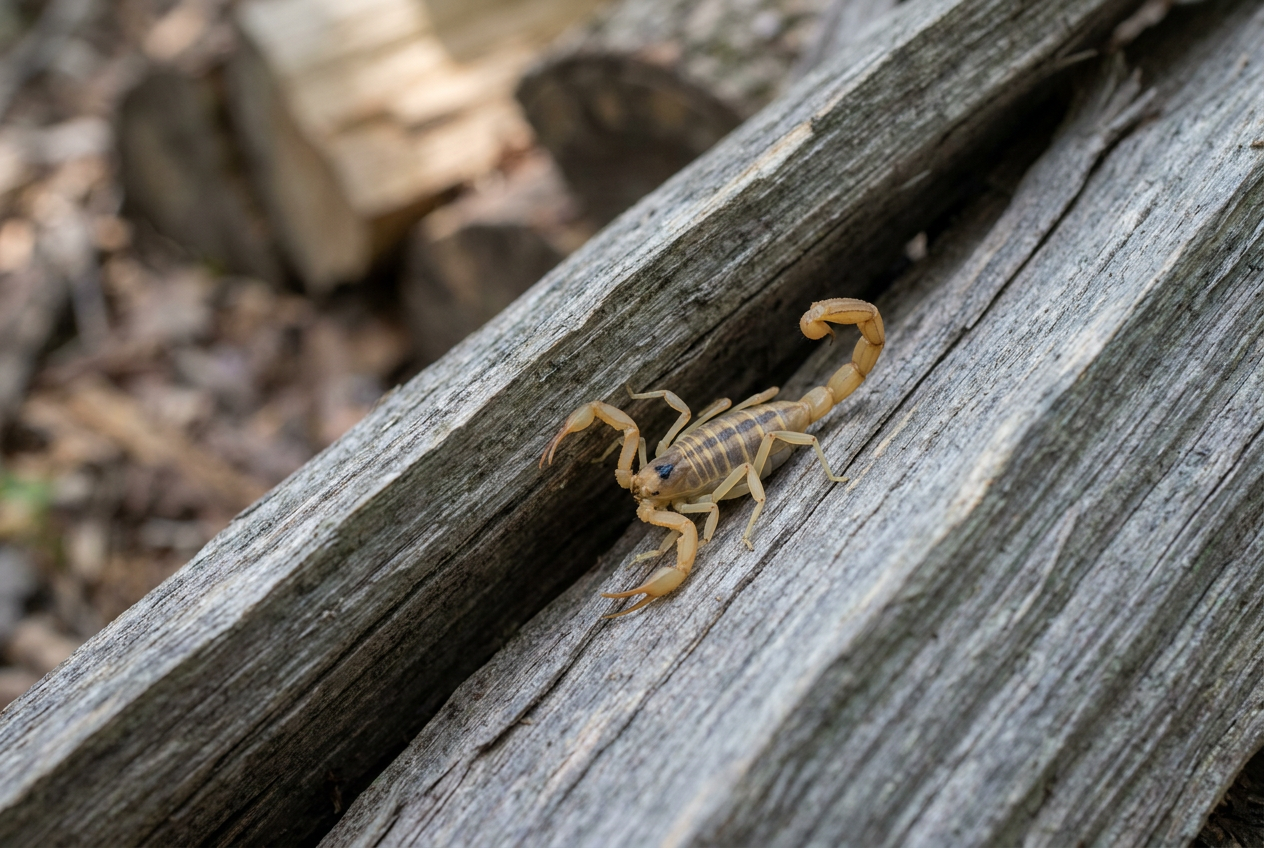
- A light brown or tan scorpion with two dark stripes is the striped bark scorpion, the most common and widespread one in Texas.
- The sting hurts and the swelling and itching can last for days, but it is not usually dangerous to a healthy adult.
- They glow blue-green under a blacklight. A UV flashlight after dark is the only reliable way to survey a yard.
- They are hunting your other pests. Cricket pressure in late summer is the single biggest thing that pulls them to a house.
- Attics matter. Texas A&M notes this species is often found in the attics of homes, not just at ground level.





How Many Scorpions Is an Infestation?
There is no official number, so here is the working one we use. One scorpion outdoors in summer is not an infestation. It is Texas. Two or three in the same part of the yard over a couple of weeks is a local population, which is normal and worth managing rather than worrying about.
Indoors changes the arithmetic. One scorpion inside means there is a way in. Two or more inside, or any repeat sightings in the same room, means they have both a route and somewhere to spend the day within the structure. That is the point where it is a problem to solve rather than a thing to sweep up.
Is a Light Brown or Tan Scorpion in Texas Dangerous?
That is the striped bark scorpion, and no, not usually. Texas A&M AgriLife Extension describes it as yellowish tan with two broad, dark stripes running the length of the back, and calls it the most common scorpion in Texas, the only one of the state’s 18 species found throughout the state.
If you are looking at a pale brown scorpion in Collin County, that is almost certainly what it is.
Are brown scorpions in Texas poisonous, then? Their sting carries venom and it hurts, but Texas A&M notes that stings from Texas scorpions produce only moderate reactions in most people. It does not typically cause serious effects in a healthy adult. A sting on a small child, an older adult, or anyone with a known venom allergy is a different matter and warrants a call to poison control or urgent care. For everyone else it is a bad afternoon rather than an emergency.
Does One Scorpion Under a Blacklight Mean Hundreds?
No. A scorpion’s outer shell fluoresces under ultraviolet light, so a UV flashlight after dark makes them glow blue-green and reveals what was always there. Two or three in a Collin County yard on a warm night is an ordinary result. Numbers climbing week on week, or scorpions along the foundation, is the signal that matters.
So finding one scorpion in your yard with a black light does not mean hundreds are lurking everywhere. It means the light is doing its job on the few that were already out hunting.
This is standard university advice, not a trick. The University of California page on scorpions says a portable black light can be used to survey for scorpions in and around the home, because scorpions glow brightly under it and are easy to find and remove.
What it does is reveal what was always there. Finding two or three in a yard on a warm night in Collin County is an ordinary result and does not mean hundreds are hiding just out of the beam. Sweep the same yard on more than one night and count. A steady one or two is background. Numbers climbing week on week, or scorpions showing up along the foundation and at the garage door rather than out in the landscaping, is the signal that matters.
Are Arizona Bark Scorpions Found in Texas?
Not in Collin County. The Arizona bark scorpion is a different species, more medically significant, and it belongs to the desert southwest. People search for it in a Texas context constantly, usually because they have found a pale scorpion and read something alarming.
The tell is the stripes. Our striped bark scorpion is tan to yellowish with two broad dark stripes running down its back and a darker triangular mark on the head, and an adult is about 2 1/2 inches long. If you are in the McKinney area, that is what you have.
How Do Scorpions Get in the House?
Through gaps, and they climb better than people expect. Scorpions can go up vertical surfaces including walls and window frames, so an entry point is not necessarily at ground level. The common routes are the gap around a garage door frame, weep holes and slab cracks, gaps around exterior utility lines, torn door sweeps, and attic vents.
They also arrive as passengers. Firewood, potted plants, cardboard boxes stored against an exterior wall and outdoor furniture cushions all carry them indoors without anybody noticing.
Signs of Scorpions in and Around Your Home
They are hard to spot by day because they spend it wedged into something tight and dark. These are the signs that they are around.
| What you notice | What it means |
|---|---|
| Indoors after dark | They have a route in and somewhere inside to spend the day |
| Two or three in two weeks | A local population rather than one that wandered in by chance |
| Shed skins, animal-shaped | Scorpions are growing and living in that spot, not passing through |
| Repeat sightings, one spot | An entry point or a daytime hiding place is close by |
| A cluster glowing under UV | That part of the yard is holding them, usually food or moisture |
Where they spend the day is a short list. Under rocks, boards, landscape timbers, bark mulch and debris near the foundation. Inside woodpiles. In the gap around a garage door frame. Behind stored items in the garage and in the seams of cardboard boxes. Inside shoes and folded clothing left on a closet floor. And in attics, where Texas A&M notes this species is often found.
What Draws Scorpions to a Structure
Food, first. The striped bark scorpion hunts crickets, roaches, silverfish and other ground-level insects. A house with steady insect activity draws them to the exterior and eventually inside, and in Collin County the late summer cricket surge is the biggest single driver. Deal with the crickets and the scorpion pressure usually falls with them.
Moisture comes second. Scorpions need some water, so they gather near irrigation that keeps soil damp, leaking outdoor spigots, and mulch beds against the foundation that hold moisture through the summer. Pulling moisture back from the foundation removes one of the reasons they stage close to the house.
Exterior lighting is the third, indirectly. Lights pull in moths and other flying insects near your doors, and that concentration of food pulls in the things that eat them.
When Scorpion Activity Warrants Professional Treatment
An occasional scorpion outdoors in summer in McKinney, Allen or Plano is part of living here and needs nothing. Repeated indoor sightings are different, particularly in bedrooms and bathrooms or on clothing, and they need both the entry points and the prey population dealt with rather than one or the other.
Treating the scorpions alone rarely holds, for the same reason it rarely holds with any predator, so our scorpion control treats the crickets and roaches that draw them in as well. Get a free estimate or call us if you are finding them inside more than once, and check the yard with a UV light first so you can say what you are actually seeing.
Are Scorpions the Hardest Pest to Get Rid Of?
They are one of the harder ones, because spraying alone does not control them. Texas A&M AgriLife Extension says scorpions are difficult to control with insecticides alone, and the University of California says adults are harder to kill because of their larger body size and thicker outer shell. Both say to change the area around the house first.
Scorpions turning up indoors? Same-day treatment in McKinney and the surrounding cities when you call before noon.
We treat the entry zone and the prey population that is keeping them close to the house. Call before noon for a same-day visit.

Ryan has spent more than 16 years in pest control and wildlife management across McKinney and Collin County, from inspecting homes and treating infestations to sealing the entry points pests use to get in. He built Pest Me Off on that field experience, and every technician on the team is trained against it.
More about the Pest Me Off team