
Signs of Fruit Fly Infestation and What They Mean for Your Home
Fruit flies do not appear randomly. Every infestation has an active breeding source somewhere in the kitchen, bathroom, or pantry. Understanding the signs tells you how bad the problem is and where to look – which is the difference between eliminating them in two days versus fighting them for two weeks.
What You Are Actually Seeing
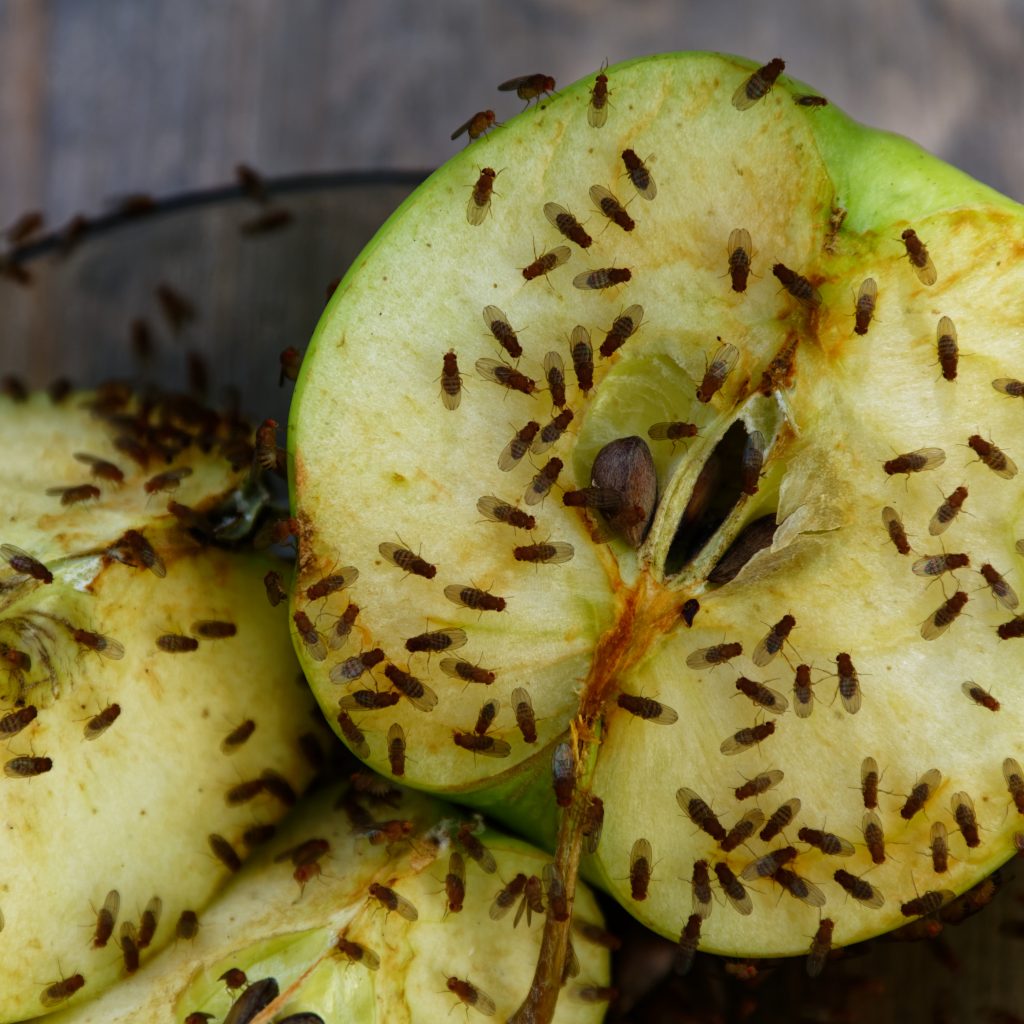
Fruit flies are tiny – 3 to 4mm – with distinctive red or orange eyes and a tan or yellowish-brown body. The most common species in Collin County homes is Drosophila melanogaster, though several related species show up as well. They are not gnats (which are longer and thinner) and not drain flies (which are moth-like and fuzzier). If you see small flies hovering near fruit, wine glasses, drains, or trash, you are looking at fruit flies.
Signs of an Active Fruit Fly Infestation
- Clusters hovering near produce. Fruit flies congregate near the fermenting sugars they breed in. A group of small flies near a fruit bowl, the recycling bin, or an open wine bottle is the most obvious sign. One or two flies near produce may be random; a cluster of 10 or more means there is a breeding source nearby.
- Flies emerging from drains. If you see small flies coming up from a kitchen or bathroom drain, especially in the morning, the drain biofilm is actively hosting larvae. Drain infestations are harder to see because the breeding happens inside the pipe.
- Persistent activity after removing all visible produce. This is the clearest sign of a drain or hidden source infestation. If you cleaned off the counter and put all fruit in the refrigerator but fruit flies are still present 24 hours later, the breeding source is not the produce bowl – it is in a drain, a forgotten piece of organic material, or a recycling bin with residue.
- Visible adults on wine glasses or open bottles. Fermenting alcohol is as attractive to fruit flies as rotting fruit. A wine glass left on the counter overnight with residue in the bottom will have flies on it by morning if there is a population in the kitchen.
Risks to Your Home and Family
Fruit flies are not a serious health threat in the same category as cockroaches or rodents, but they are not completely harmless either:
- Food contamination. Fruit flies land on both rotting material and food that is safe to eat – carrying bacteria and yeast between surfaces. Studies have documented fruit flies transferring E. coli and Salmonella from contaminated surfaces to fresh produce. The risk is low but real, particularly in homes with young children or immunocompromised individuals.
- Cross-contamination in food prep areas. A population breeding in a drain can carry material from drain biofilm onto counters and cutting boards. This is not hypothetical – it is the documented biology of how drain-breeding species forage.
- Indication of a larger sanitation issue. A persistent fruit fly infestation that will not clear up is telling you something about your home – usually either a plumbing issue (a slow drain or dry p-trap allowing sewer access), a moisture problem in the pantry, or a forgotten organic material source. The fruit flies are the visible symptom of an underlying condition.
How to Eliminate the Infestation
Traps slow the adult population but do not eliminate the infestation. The breeding source has to be removed.
- All produce off the counter, in the refrigerator or the sealed trash
- Every drain in the kitchen and bathrooms treated – boiling water or a drain-cleaning gel that breaks down biofilm
- Recycling bin emptied, rinsed, and moved outside or to an unattached garage until the infestation resolves
- Garbage disposal cleaned (the splash guard collects residue that supports breeding)
- Check the pantry for forgotten soft produce – a potato or onion going soft in a back corner feeds a large population
If fruit flies persist more than two weeks after thorough source elimination, there is a hidden source – often a slow drain or a p-trap that has dried out. At that point the problem warrants a professional look. Contact us if you are dealing with a persistent fruit fly infestation in McKinney, Allen, or anywhere in Collin County.
Pest problem that won’t go away? Same-day service in Collin County.
We identify the source and treat the infestation at its origin – not just the visible adults.