
How and Why Oriental Cockroaches Enter Your Home
People who find an oriental cockroach usually call it something else first: a water bug, or a shiny black beetle that turned up near a drain. That mix-up is common, and it points at the real story, because oriental cockroaches want something different from what pulls American cockroaches inside. They are chasing moisture, not heat, and that one difference changes where they show up and how you stop them.

- Their dark, shiny, almost black body is why people call an oriental cockroach a water bug or a black beetle rather than a roach.
- Adults reach about one inch long, smaller than American cockroaches and larger than German cockroaches.
- They can survive only 14 days without a water source, which pulls them toward floor drains, sewer lines, and damp crawl spaces instead of dry cabinets.
- Activity peaks in spring and fall in Collin County, not the triple-digit stretch of summer that pulls in American cockroaches.
- Unlike German and American cockroaches, they cannot climb smooth vertical surfaces, so sightings stay at floor level near drains.





Oriental cockroach identification and habits
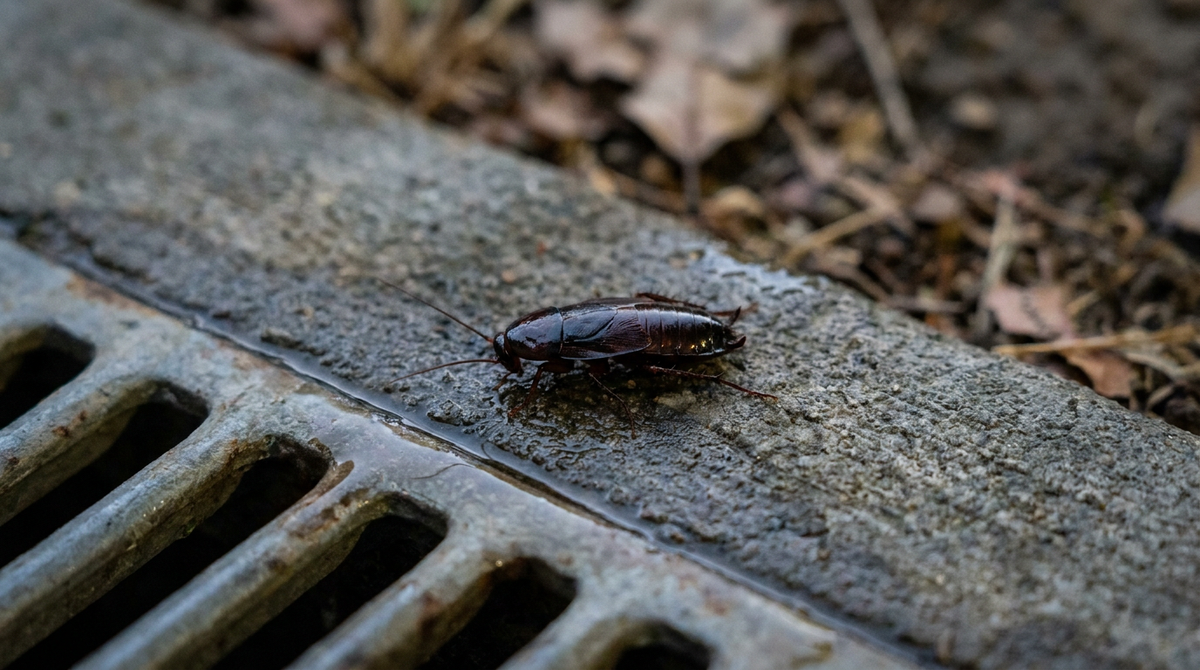
Oriental cockroaches are dark brown to almost black, with a smooth surface that carries a slight greasy sheen. Adults run about one inch long, smaller than the reddish-brown American cockroach and bigger than the tan German cockroach found in kitchens. That dark, shiny body is why people call an oriental cockroach a water bug or mistake it for a beetle the first time they see one.
Males have short wings that cover about three-quarters of the body and cannot fly. Females carry only small, useless wing pads and have a heavier, broader shape than males. Both move slower than German or American cockroaches, and both stay close to the ground. This species is common across Texas, including here in Collin County, wherever a home has a floor drain, a damp crawl space, or a leak that never got fixed.
Unlike German and American cockroaches, an oriental cockroach cannot climb a smooth vertical surface. You will not find one on a wall, a countertop, or inside an upper cabinet. If you are seeing them, they are on the floor, near a drain, along a baseboard, or under an appliance, because that is the only place their body lets them be.
The name black beetle comes up almost as often as water bug, and it fits at first glance: the rounded back, the dark color, and the slower, ground-hugging walk all read as beetle rather than roach to someone who has not looked closely. A quick check of the antennae settles it. Beetles have short, stiff antennae, while an oriental cockroach carries long, thread-like antennae close to the length of its own body.
How oriental cockroaches get into McKinney and Frisco homes
Oriental cockroaches are closely tied to sewer systems, more than any other roach species found in Collin County. In McKinney and Frisco, they travel through municipal sewer lines and use floor drains as the most direct route inside. A floor drain connected to the sewer, in a laundry room, a utility closet, or a garage, is an open corridor with almost nothing stopping a cockroach from walking straight through.
Garage floor drains deserve their own mention, because homeowners often check the kitchen and bathroom for a source of an oriental cockroach and skip the garage. Garages sit at slab level, hold a floor drain more often than any other room, and stay damp and dark, which is exactly what this species wants. If you found an oriental cockroach in a garage, the drain is the first place to check.
Beyond drains, oriental cockroaches also enter through utility penetrations at ground level, the openings where a gas line, a water pipe, or an electrical conduit passes through the slab or the foundation wall from a crawl space below. Unlike German and American cockroaches, which can enter from almost any direction, oriental cockroaches stay concentrated near the foundation and near anything tied to the drain system.
What draws oriental cockroaches indoors
Oriental cockroaches live in the sewer system and in damp ground cover year round, but drought, heavy rain and the season push them into a structure. Drought is the biggest one. When the ground outside dries out, the steady moisture inside a pipe, a drain, or a crawl space becomes the closest reliable water source, and that is what attracts oriental cockroaches more than food ever does.
Heavy rain after a dry stretch has the opposite effect and moves them just as fast. Water flowing hard through a sewer line dislodges cockroaches that were staging there, and they follow the easiest path out, which is often a floor drain into a home in Allen or Plano. A well-established population living in the sewer under a neighborhood keeps that pressure going for every house connected to it.
Season matters too. Oriental cockroaches are least active in the hottest weeks of a Texas summer, the opposite of the American cockroach, and most active in spring and fall when temperatures sit in the range they prefer. If you are asking why oriental cockroaches showed up in October or April and not in August, the answer is usually that simple.
Signs of an oriental cockroach problem
A musty, oily odor with no obvious source, especially in a utility room, garage, or water heater closet, is often the first sign of oriental cockroaches in a house, arriving before anyone actually sees a roach. The smell comes from the insects themselves and tends to get stronger as the population grows.
Beyond the smell, look for activity concentrated at floor level near drains, dark egg capsules tucked into corners near baseboards or under appliances, and any sighting that happens only on the ground and never on a wall or countertop. Young roaches look like smaller, wingless versions of the adult and share the same ground-level habits, so a mix of sizes near one drain usually means an established population rather than a single stray.
Seeing oriental cockroaches in more than one room, or seeing them during the day rather than only at night, points toward a real infestation rather than one insect that wandered in.
Can oriental cockroaches climb walls?
No. Oriental cockroaches cannot climb smooth vertical surfaces the way German and American cockroaches can. Their legs and body are built for ground-level movement, not for gripping glass, tile, or painted drywall. Any sighting on a wall, a countertop, or an upper cabinet is almost certainly a different species.
If you are only ever finding them on the floor, near a drain, or under an appliance, that pattern by itself is one of the clearest signs you are dealing with oriental cockroaches rather than American or German roaches. It also answers how roaches get upstairs: an oriental cockroach rarely does, so a roach on an upper floor is usually one of the climbing species.
The University of California guide to cockroaches says the same. Oriental cockroaches cannot fly or climb smooth vertical surfaces, so they sometimes end up trapped in a sink or tub after falling in.
Is one oriental cockroach a sign of an infestation?
Not always. One oriental cockroach near a drain at night may have come in through that drain on its own, following moisture during a dry spell, without a colony behind it. Roaches seen repeatedly in the same spot, or seen during the day, point to a bigger population near a water source.
If you found one oriental cockroach in your house and have not seen another in 7 days, keep an eye on drains and damp areas rather than assuming the worst. If you find a second one, or find one in more than one room, treat it as a reason to check the floor drains and any water heater closet for the source.
Are oriental cockroaches the same as American cockroaches?
No, they are two different species with different builds, different seasons, and different reasons for coming inside. American cockroaches are reddish-brown, close to 2 inches long, and come inside chasing cooler air during Texas summer heat. Oriental cockroaches are smaller, dark brown to nearly black, and come inside chasing moisture, most often in spring and fall rather than midsummer.
The confusion is understandable, since both are large roaches that show up in the same Collin County homes, sometimes in the same season.
| What differs | Oriental cockroach | American cockroach |
|---|---|---|
| Color and surface | Dark brown to nearly black, with a noticeably shiny body | Reddish-brown, with a pale margin behind the head and a duller finish |
| Size | Smaller, around an inch | Close to 2 inches, and among the largest roaches found in homes here |
| Where you meet it | Floor level, near drains, and it rarely ranges far from water | Ranges widely through the structure, including up walls and into upper rooms |
| What brings it in | Moisture. A dry building is a poor home for it whatever else is on offer | Heat. It comes inside chasing cooler air during a Texas summer |
| When it turns up | Spring and fall more than midsummer | Peak summer, when the outdoor temperature is what is driving it |
| What actually fixes it | Sealing the entry path and dealing with the water, since the population is outside or under the slab | Perimeter work and closing the ways in, since the ones indoors are usually visitors |
Color and floor level settle it in a second. Everything below that row follows from the moisture difference.
The fastest way to tell them apart is color and surface, since oriental cockroaches are darker with a shinier body, and location, since oriental cockroaches stay at floor level near drains while American cockroaches range more widely. For a closer look at the other species, see the American cockroach article.
What to do about oriental cockroaches
Oriental cockroaches coming through a floor drain are not the same problem as German cockroaches nesting inside kitchen cabinets, and they do not respond to the same fix. Bait placed inside cabinets targets German cockroaches. Oriental cockroaches need the entry point sealed and the population outside the structure addressed, not just the roaches you can see indoors.
Start with floor drain covers, a check of the utility room and garage for standing moisture, and a look at any crawl space vent for damage. A technician can tell whether the source is the sewer connection itself or a population building in a crawl space or under the slab, which need different approaches to actually stop the cycle.
If you are finding oriental cockroaches near a drain in McKinney, Allen, Frisco, or Plano and the pattern keeps repeating, the population will keep coming back until the entry path and the water source are both addressed. Professional cockroach control built around sewer-originating species works better here than general spraying inside the house. Call us and a technician will find the entry path.
A follow-up visit matters more with this species than with other roaches, since a drain connection that looked sealed can open back up after a hard freeze or a plumbing repair. Checking the same floor drains a season later, especially heading into the next spring or fall peak, catches a new entry point before it turns into another odor complaint or another late-night sighting.
 Source:
Oriental roaches near your drains? Same-day cockroach control in McKinney and the surrounding cities when you call before noon.
We identify the entry point, treat the source, and stop the cycle from the sewer system up.

Ryan has spent more than 16 years in pest control and wildlife management across McKinney and Collin County, from inspecting homes and treating infestations to sealing the entry points pests use to get in. He built Pest Me Off on that field experience, and every technician on the team is trained against it.
More about the Pest Me Off team