Why Wasps Love Fruit Trees
Wasps love fruit trees for one reason: sugar. When fruit splits, bruises, or falls to the ground, its juice is exposed, and the juice of ripening and overripe fruit is exactly what adult wasps feed on. Once you know what pulls them in, you can take the attractant away instead of chasing every wasp that lands, and that logic holds in yards across McKinney, Allen and the rest of Collin County.

- Sugar is the draw, not the fruit itself. Ripening and fallen fruit split open fast in Texas heat, and that exposed juice is what actually pulls wasps in.
- Apple, pear, peach and cherry trees draw the most wasps in Collin County yards, because all four hold fruit that splits and bruises easily as it ripens.
- Wasp activity around fruit trees peaks in August and September, when colonies are at their largest and natural food is scarcest.
- A colony that starts with one queen in April or May can hold thousands of workers by late summer, and every one of them is out foraging.
- A wasp working a branch for food is not the same as a wasp defending a nest. Mixing up the two is how people get stung.




Do Fruit Trees Attract Wasps?
Yes, and the reason is entirely about sugar. Adult wasps feed on the juice of ripening and overripe fruit, and yellowjackets typically forage about a quarter mile from the nest, so a nest you never see can still find your tree. A tree carrying nothing but healthy, intact fruit draws very few wasps.
A tree with cracked, bruised or fallen fruit anywhere near it, on the branches or on the ground beneath, is a different story.
That is also why wasps in trees is such a common sight in late summer specifically, and not a year-round problem. Spring blossoms offer nectar, which wasps use too, but nectar is a thin, low sugar source compared to fermenting fruit. Once fruit starts dropping, it becomes the strongest food signal in the yard, and wasps in a tree at that point are there for the fruit, not for anything else the tree offers.
Which Fruit Trees Attract the Most Wasps?
Apple, pear, peach, cherry and plum trees draw the most wasps in Collin County yards, because each one holds fruit that splits, bruises or drops easily as it ripens. Palm trees carry no soft ripening fruit to ferment, so they rarely pull wasps in the same way.
| Tree | Why it draws wasps |
|---|---|
| Apple | The skin splits as it ripens, and a fallen apple ferments within a day in Texas summer heat |
| Pear | Thin skin bruises on contact and holds sugar close to the surface, so a light bump is enough to open it |
| Peach | Soft flesh cracks under its own weight once fully ripe, exposing juice directly while still on the branch |
| Cherry | Small and thin skinned, so a whole cluster can split and ferment together in one afternoon |
| Plum | Drops early and often, and the ground beneath a plum tree stays wasp worked longer than under any of the other four |
Palm trees are a different case, worth answering directly since it comes up: they carry no soft, ripening fruit to ferment, so they rarely pull wasps the way the five above do. A wasp resting on a palm frond is usually passing through, not feeding.
Do Wasps Eat Fruit?
Wasps eat fruit by drinking it, not biting it. They cannot chew through intact, healthy fruit skin, so they need a crack, a soft spot or fruit already broken open on the ground. Once in, they lap up the juice and soft flesh rather than eating solid pulp.
That distinction explains a pattern homeowners notice every year. A single overripe peach on the ground can hold a working group of wasps for hours, while the same peach still hanging on the branch, unbroken, draws almost none. Do wasps like fruit, then, really means do wasps like sugar they can reach, and the fruit is only the container.
Do wasps eat apples? Yes, in exactly that way. Wasps eating apples on the tree are working a split or a bruise in the skin, and a fallen apple draws far more of them than a sound one still on the branch, because in Texas summer heat it starts to ferment within a day. Wasps like apples for that exposed juice, so the apple tree with the most wasps is usually the one with the most broken fruit under it.
Why Late Summer Is the Worst
By August, wasp colonies in McKinney, Allen and Frisco have been growing for five months. University of Minnesota Extension puts a yellowjacket nest at up to about 5,000 wasps at its late summer peak, and every one of those workers is actively foraging all day.
At the same time, their natural food sources thin out. Other insects become harder to catch, flower nectar turns sparse, and wasps shift hard toward scavenging carbohydrates instead. A fruit tree full of cracking, overripe fruit is exactly what they are looking for at exactly the wrong time of year for you.
University of Minnesota Extension, Wasps and bees describes the same shift. Adult wasps feed on sugar such as the juice of ripening and overripe fruit, and in late summer and fall some yellow jackets turn into aggressive scavengers wherever food is out.
 Source:
 How Do You Get Rid of Wasps in a Fruit Tree?
How to stop wasps attacking fruit trees, including wasps eating apples on trees, comes down to one thing: take away what they came for. Pick fruit before it fully ripens, clear fallen fruit every day, and keep compost and trash away from the tree. Traps cut the foraging wasps but miss the nest.
- Pick fruit before it fully ripens if your yard has consistent wasp pressure
- Remove fallen fruit from the ground every day, since it ferments fast once it sits in the heat
- Keep a clear space around fruit trees away from compost piles, trash bins and standing water
- Cover or store sugary drinks, pet food and open trash while fruit is ripening nearby
- Trim branches that touch a roof, fence or structure, since those contact points are common nest sites
Traps reduce the number of wasps foraging around a tree, but they do nothing to a nest close by. A nest produces new workers every day, so trapping the ones already out just clears space for the next batch. Getting rid of wasps from an apple tree, or any fruit tree, means finding and removing that nest, not just the wasps you can see on the fruit.
What Kills Wasps Instantly?
A direct hit from a wasp rated spray drops a single wasp in seconds, and that is the honest answer for the one wasp on a plate at a cookout. It is a different question entirely when a nest is involved.
Spraying into a nest opening does not kill it instantly, it disturbs it, and a disturbed nest answers back with every worker it has. If you are looking at one wasp, spray it. If you are looking at a nest anywhere near your fruit trees, that same instinct is what sends people to the emergency room.
When a Nest Is a Bigger Problem Than Foraging Wasps
An active nest near a fruit tree is a different problem than foraging wasps passing through. Foraging wasps are looking for food and will move on once it is gone. Nesting wasps are defending territory, and a nest disturbed by a lawnmower, a hand reaching into the tree, or anything that reads as a threat answers immediately, with every worker it has.
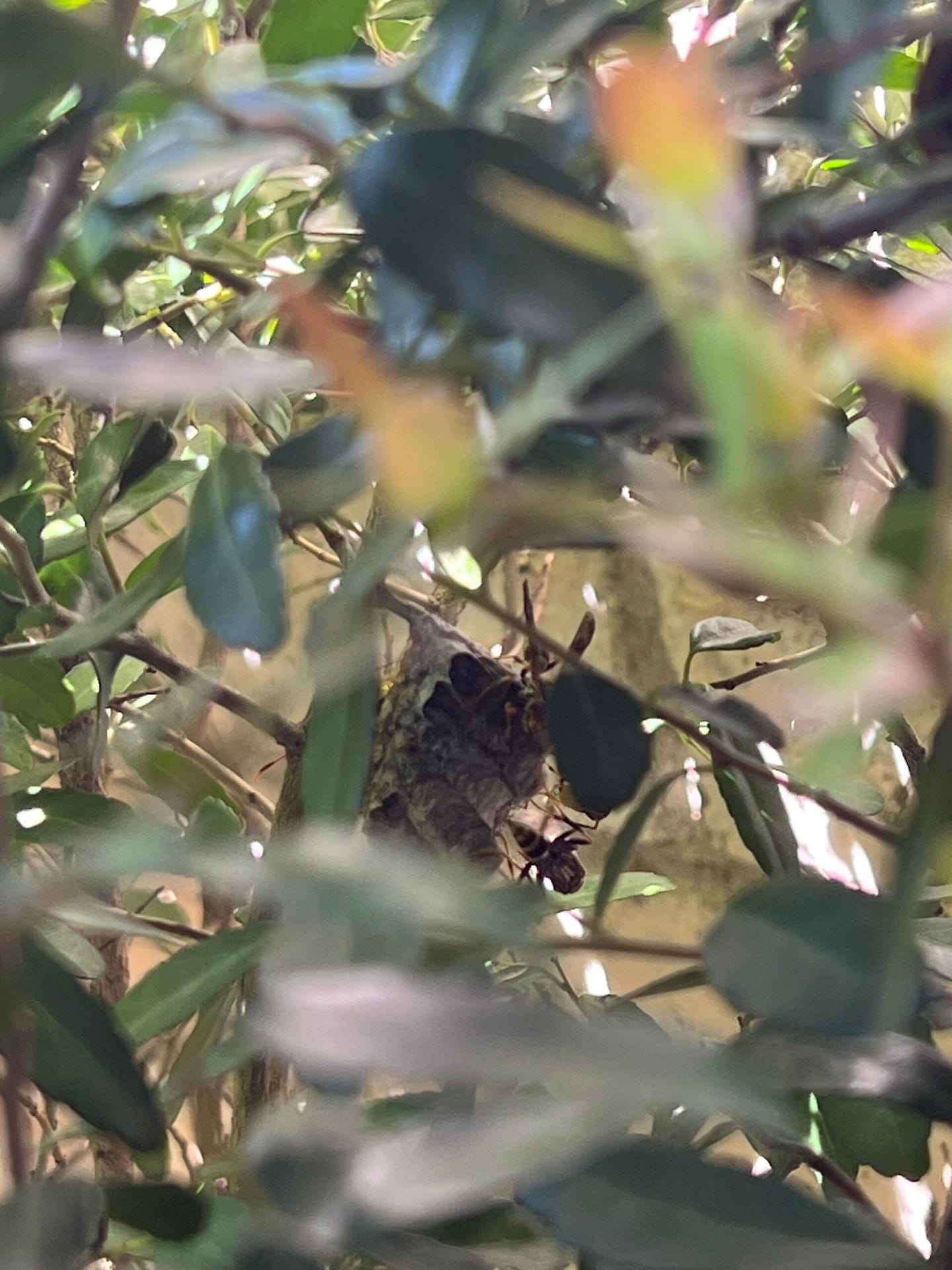
Yellow jackets nest underground, in wall voids and in raised garden beds. Paper wasps build open, umbrella shaped nests under eaves, on fence posts and in tree branches themselves, sometimes inside the same canopy that is drawing them in. Both are common across McKinney, Allen, Frisco and Plano, and neither is easy to spot from a distance.
If you have found a nest within 20 feet of where people or pets spend time, do not treat it yourself. Disturbing a yellow jacket nest means facing a colony that University of Minnesota Extension puts at up to about 5,000 wasps by late summer. A trained technician finds the full extent of the nest, treats the colony, and removes the structure so the same spot does not get reused next season. Professional wasp control is the only way to fully clear the problem.
Wasp nest near your fruit trees? Same-day removal in McKinney and the surrounding cities when you call before noon.
We find the nest, treat the colony, and remove it so the same spot does not get reused next season.
Ryan has spent more than 16 years in pest control and wildlife management across McKinney and Collin County, from inspecting homes and treating infestations to sealing the entry points pests use to get in. He built Pest Me Off on that field experience, and every technician on the team is trained against it.
More about the Pest Me Off team