Fire Ant Treatment in McKinney, What Works and What It Costs
Fire ant treatment works only if it reaches the queen, and everything else is detail. She lives down in a nest that NC State Extension says may run three feet deep, and a spray on the mound rarely reaches her. That is why a yard in McKinney can be treated on Saturday and have fresh mounds by the next weekend. Pest Me Off treats fire ant yards across Collin County every spring and summer, and this is what works, how long it takes and what it costs.

- The queen lives deep in the nest. Kill every ant you can see and the colony rebuilds from her within weeks.
- Fire ants are covered on our Stinger plan, from $45 a month for a typical McKinney home, billed once a quarter.
- In the yards we treat, visible change comes in 7 to 10 days and full collapse in 2 to 4 weeks. Faster is a warning sign, not a win.
- Without a treated perimeter, scouts from the neighbors’ untreated yards are testing yours again inside six weeks.
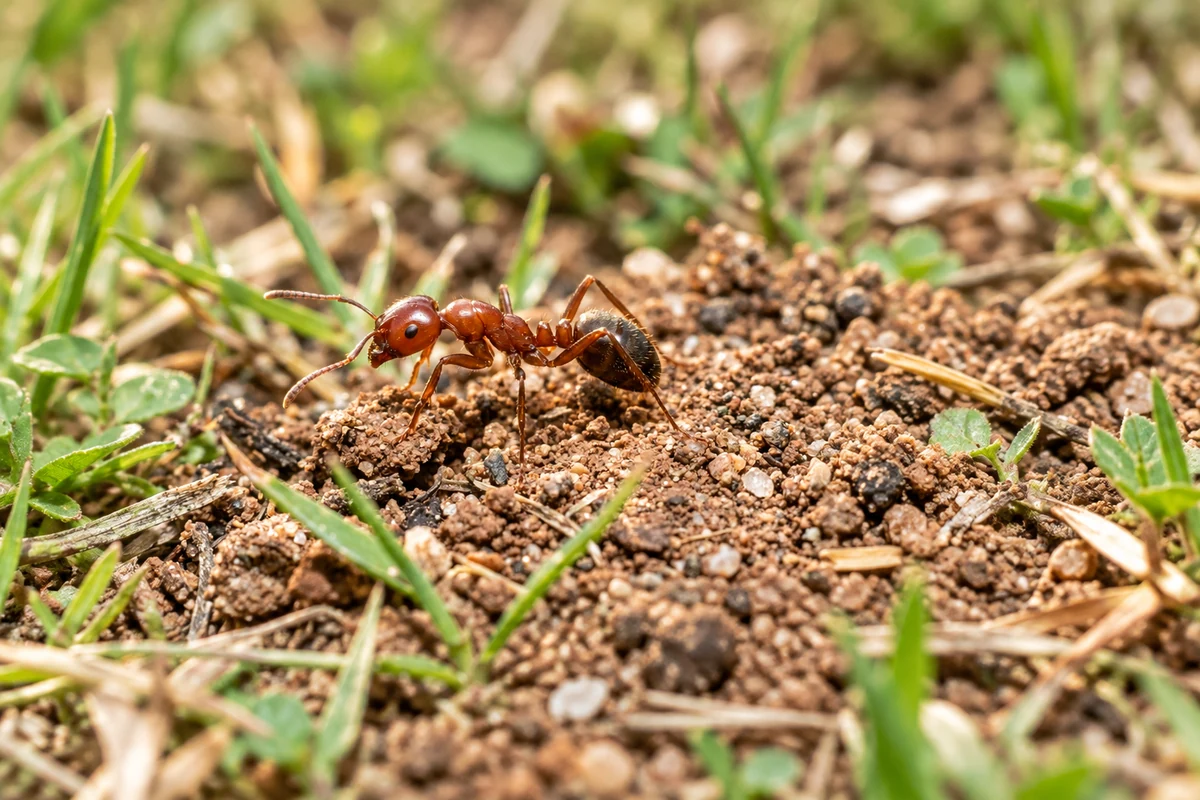
- NC State Extension says the mound is rarely wider than 18 inches, while the nest under it may run three feet deep.
- Never drench a mound and bait it at the same time. NC State says doing both at once wastes the bait.





Why do fire ants come back after you treat the mound?
Fire ants come back after a mound treatment because the mound was never the colony. NC State Extension says a fire ant mound is rarely over 18 inches across and is only a small part of a nest that may be three feet deep. The queen lives down in that nest.
A spray kills only the ants it touches, and the colony moves.
Workers are replaceable, and the queen is the only ant in the colony that matters. So a contact spray does exactly what it says. The colony reads it as an attack on one side of the yard and shifts away from it. Within days there are two or three smaller mounds a short distance from the first one.
It is easy to read that as the treatment spreading them. It did not spread them. It pushed them, and the queen came along. Collin County clay also holds moisture well into the warm months, which gives a queen more of the year to keep raising young than she would get on sandy ground.
What does professional fire ant treatment actually do?
Professional fire ant treatment from Pest Me Off starts with the technician walking the yard to map every live mound. The technician then chooses bait or direct mound treatment by how severe the problem is, never both on the same visit, and lays a perimeter barrier against scouts from next door.
Bait is the treatment that reaches the queen, because the workers carry it home and feed it to her themselves. Direct mound treatment knocks down the ants on top faster. We never do both on the same visit, and NC State says doing both at once wastes the bait. If a yard later needs the other one, it goes down on a different visit.
NC State Extension says that when there are too many mounds, baiting may be the best solution, and that bait goes around a mound rather than on top of it, because the ants do not forage on top of the mound.
| Step | What it does | What you see |
|---|---|---|
| Walking the property first | Maps every live mound, checks foundation edges, irrigation zones and equipment housings, and works out whether the yard has single-queen or multi-queen colonies, which changes the timeline | Nothing yet. This is the twenty minutes that decides whether the rest works |
| Bait or mound treatment | One or the other, chosen by how severe the problem is, and never both on the same visit. The bait is an indoxacarb product that does not repel, so the ants carry it home and feed it to the queen. Direct treatment goes on each live mound | With bait, trail traffic thins and mounds start to flatten inside 7 to 10 days. With mound treatment, an immediate drop in surface activity |
| A treated perimeter | A bifenthrin barrier around the foundation and the property edge, aimed at scouts arriving from untreated yards rather than at the colonies already here | Nothing, and that is the point. It is what stops the yard filling back in within six weeks |
The middle row is a choice, made on the day by how severe the problem is. If the yard later needs the other treatment, it is a separate visit.
The difference between a bait and a spray is the whole reason this works and a hardware store product often does not. A spray is something the ants can detect, so they avoid it and seal off the treated side. A bait that does not repel goes unnoticed, and they carry it down and share it before anything senses a problem.
How long does fire ant treatment take to work?
Fire ant treatment shows its first results in 7 to 10 days, when trail traffic thins and the mounds start to slump. An established yard with multi-queen colonies takes 2 to 4 weeks to collapse fully. Those are the timelines Pest Me Off sees in Collin County yards.
A yard treated in early spring, before the mating flights, usually clears faster than one treated in July.
That is not slow work being excused. Bait has to be carried down, shared around and fed to a queen, and that takes as long as it takes. A treatment that empties a yard in 48 hours did it by killing the ants on top, which is the result that does not last.
NC State Extension gives a free check you can run while you wait. Drop a potato chip lightly on the mound. If the colony is still active, workers should come out within a few minutes.
What does fire ant treatment cost in McKinney?
Fire ants are covered on Pest Me Off’s Stinger plan, from $45 a month, billed as $135 after each quarterly visit. That price is for a home of about 2,250 square feet and can vary with property size and pest pressure.
Every yard-wide service starts with mapping the live mounds and ends with a perimeter barrier against scouts from next door. In between, the technician uses bait or direct mound treatment, chosen by how severe the problem is, and never both on the same visit.
A quarterly plan that includes the perimeter costs less per visit than repeat one-off calls. That is arithmetic rather than a sales line. A yard next to untreated yards gets scouted again within about six weeks, so a one-off treatment there is bought again and again. If your neighbors have mounds, you are buying a barrier as much as a treatment.
A bag of hardware store bait is cheap and will work, slowly, if it goes down at the right time of year and nothing is sprayed on top of it. Spraying on top of it is the common mistake, and avoiding it is a large part of what a service is paid for.
When is the best time to treat fire ants?
The best time to treat fire ants is late spring, and again from late September to early October before the soil cools, according to NC State Extension. A mound in an inconvenient spot can be treated on any warm day without waiting for a season.
In McKinney, spring pays the most, because the mating flights follow the first warm rains from about mid-March.
Those flights are when new queens land and start colonies across a whole neighborhood at once. Treating before them means fewer colonies to deal with all summer.
Bait only works while the workers are out collecting food. Texas A&M’s Insects in the City, writing from Dallas, puts their favorite foraging range at soil between 70 and 95 degrees about an inch down. In July the ground runs well past that by day, so in the hot months the bait goes out late in the evening.
Why do store-bought fire ant treatments fail?
Store-bought fire ant treatments usually fail for one of three reasons, and none of them is a fake product. The queen is out of reach of anything sprayed on the surface. Bait and spray get used together, so the workers carrying the bait die before it reaches her.
And nothing protects the edge of the yard from the colonies next door.
- The queen is out of reach. A contact product kills what it touches, and she is deep in the nest.
- Bait and spray are used together. This is the big one. Spraying a mound that has just been baited kills the workers carrying the bait home, so the bait never arrives. NC State says not to do both at once, because doing so wastes the bait.
- Nothing protects the edge. Even a treatment that works leaves the yard open, and neighboring colonies send scouts across within weeks.

How long do children and pets stay off after fire ant treatment?
Children and pets stay off the treated area until the wait is up, and the wait depends on the treatment. A mound treatment and the perimeter product need a dry-down period, and the product label sets how long. After bait goes down, NC State Extension says to keep pets off the treated area for 12 to 24 hours.
Pest Me Off gives you the window on the day, and works around play areas and dog runs.
If there are play areas or a dog run, we say exactly what was done around them, so nobody has to guess.
How Pest Me Off handles fire ants
If you have fire ants in Allen, Frisco, Plano or anywhere else in Collin County, Ant-Nihilation, our residential fire ant control service, maps the yard, chooses bait or mound treatment by how severe the problem is, never both on the same visit, and puts a barrier around the edge. Get a free estimate and we will tell you what your yard needs before you commit to anything.
For stings rather than mounds, our article on what happens after fire ant bites covers what helps and when to worry.
Mounds near your sidewalk or play areas? Same-day pest control in McKinney and the surrounding cities when you call before noon.
We map the yard, choose bait or mound treatment by how severe the problem is, then put a barrier around the edge so the yard stays clear. Free estimate. No-contract options.