
Carpenter Bee Control in McKinney TX
Serving McKinney, Plano, Frisco, Allen and across Collin County.



Why McKinney Homeowners Choose Pest Me Off for Carpenter Bee Control
Pest Me Off is a family-owned, Texas-licensed pest control company that has been protecting fences, decks, and pergolas from carpenter bees in McKinney, Plano, Frisco and Allen since 2014.
Every home is treated by a licensed applicator, never a subcontractor. Spray-and-pray chains swat at the bees hovering around your deck and skip the tunnels in the wood where the damage actually happens. We treat every active hole at full depth, seal the holes once the wood goes quiet, and show you which bare boards to paint or seal so next spring’s bees move on. One distinction worth knowing: honey bees get relocated alive through our bee removal service; carpenter bees are a wood-damage problem and get treated at the wood.
How our carpenter bee treatment works
Swatting at the big bee hovering around your deck does nothing, because that bee is a male with no stinger and he is not the one drilling. The female is inside the wood, at the far end of a tunnel a surface spray never reaches, and plugging her hole just traps bees that chew new exits. The RID Method goes after the real problem: the bees inside the wood, the holes the next generation comes back to, and the bare boards that invited the drilling. Remove and Install both happen on the initial visit. That is our one-time Carpenter Bee Annihilation service. Defend is the ongoing step, available on a recurring plan, for homes with cedar fences and pergolas that draw new bees every spring.
Remove the Bees in the Wood
Carpenter bees do not live in a hive. Each female drills her own perfectly round hole into bare or weathered wood and raises her young at the far end of the tunnel. We Remove the problem where it lives: a treatment placed directly into every active hole, reaching the full depth of the tunnel, after a top-to-bottom inspection of the fence line, deck, pergola, eaves, and porch ceilings. We also confirm it is a carpenter bee and not a bumble bee or honey bee first, because each one calls for a different plan.
- Treatment placed inside every active hole at full tunnel depth, not sprayed at the surface
- Full-exterior wood inspection: fence posts and rails, deck boards, pergola beams, eaves, swing sets
- Species confirmed first: carpenter bee, bumble bee, or honey bee, three different plans
- EPA-registered, pet-safe once the treatment dries (1 to 2 hours)
Install Scorched Earth Barrier
On the same visit, we Install the Scorched Earth Barrier along the exterior and treat the wood surfaces where the bees keep landing and drilling. Treated holes stay open for a few days so returning bees contact the treatment, then get sealed once the wood is confirmed quiet, because sealing an active hole just traps bees that chew new exits. Before we leave, we point out the bare and weathered boards drawing the drilling, since painted or sealed wood is the one thing carpenter bees consistently avoid.
- Scorched Earth Barrier installed along the exterior where the bees stage and land
- Treated holes sealed after activity stops, with filler bees cannot chew back through
- We flag the bare fence rails, trim, and beams to paint or seal before next spring
- Pets and kids back in the yard in 1 to 2 hours
Defend Year-Round
Remove and Install clear the bees drilling your wood today. Defend keeps it that way. Quarterly visits keep the Scorched Earth Barrier live and re-check the fence, deck, and eaves each spring, when the new generation comes looking for last year’s tunnels. The one-time Carpenter Bee Annihilation service handles R and I. Defend is the step you add when you want your wood held through every spring.
- Spring re-check catches new holes before drilling peaks in April and May
- Guaranteed re-service whenever our tech confirms it is warranted
- Contract plans and no-contract options both available
- Quarterly plans start at $40/mo, billed monthly
The Texas A&M Apiary Inspection Service documents that carpenter bees drill into bare and weathered wood, that the hovering males cannot sting, and that painted or sealed wood is far less likely to be attacked, so lasting control means treating the tunnels and protecting the wood, not swatting the bees in the air. We do both on one visit.
Pricing for Carpenter Bee Control
Three options, all built around the same treatment that reaches the bees inside the wood and protects the boards they keep coming back to, not just the ones you see hovering. Pricing scales with home size and how many active holes the inspection finds. The free inspection confirms your number before anything gets scheduled.
Our one-time knockout for a fence, deck, or pergola you want cleared right now.
No return visits included; recurring plans add re-service.
- Every active hole treated at full depth, plus the Scorched Earth Barrier, in one visit
- Pay once, no annual contract
- We flag the bare wood to paint or seal so next spring’s bees move on
The plan most McKinney homeowners choose.
- The full treatment repeated every quarter
- A Scorched Earth Barrier kept active around your home year-round
- A spring re-check of the fence, deck, and eaves when carpenter bees return to old tunnels
- Guaranteed re-service whenever our tech confirms it is warranted
The flexible middle ground.
- The same full treatment and year-round barrier
- Billed at $50/mo with no annual commitment
- One guaranteed re-service every six months if covered carpenter bees return
- Cancel any time without penalty
Want pricing detail for other pest services? See the full Pricing page.
Why DIY Carpenter Bee Killer Fails in McKinney TX
Every spring the same scene plays out: a homeowner with a can of spray, swinging at a big bee that will not back off. That bee is a male carpenter bee. He cannot sting, and he is not the one drilling. The female doing the damage is inside the wood, at the far end of a tunnel the spray never touches, and the holes she leaves behind get reused by the next generation every year. Here is what homeowners try, why it does not work, and what our team does differently.
| What homeowners try | Why it fails | What actually works |
|---|---|---|
|
Spray the bee hovering at the deckRaid, wasp & hornet spray class
|
|
Treat the tunnel, not the air
A treatment placed inside every active hole at full tunnel depth, applied by a licensed applicator who inspects every wood surface, not just the one you saw. |
|
Caulk or putty the holes shutcaulk gun, wood filler, dowel plugs
|
|
Treat first, seal after the wood goes quiet
Every hole gets treated, stays open a few days so returning bees contact the treatment, then gets sealed with filler bees cannot chew back through. |
|
Wait it out, they look harmlessthey are just big bumble bees, right?
|
|
Species ID first, then a matched plan
|
The Carpenter Bee in McKinney, Plano, Frisco & Allen
Carpenter bees are the big black-and-yellow bees hovering around fence rails, pergolas, and porch ceilings across Collin County every spring. The giveaway is the rear end: shiny and bare on a carpenter bee, fuzzy on a bumble bee. The female chews a perfectly round half-inch hole into bare or weathered wood and raises her young inside, the male guards the entrance and dive-bombs anything that comes close, and neither one is a real threat to your family. The threat is to the wood, and it grows every year the holes go untreated.
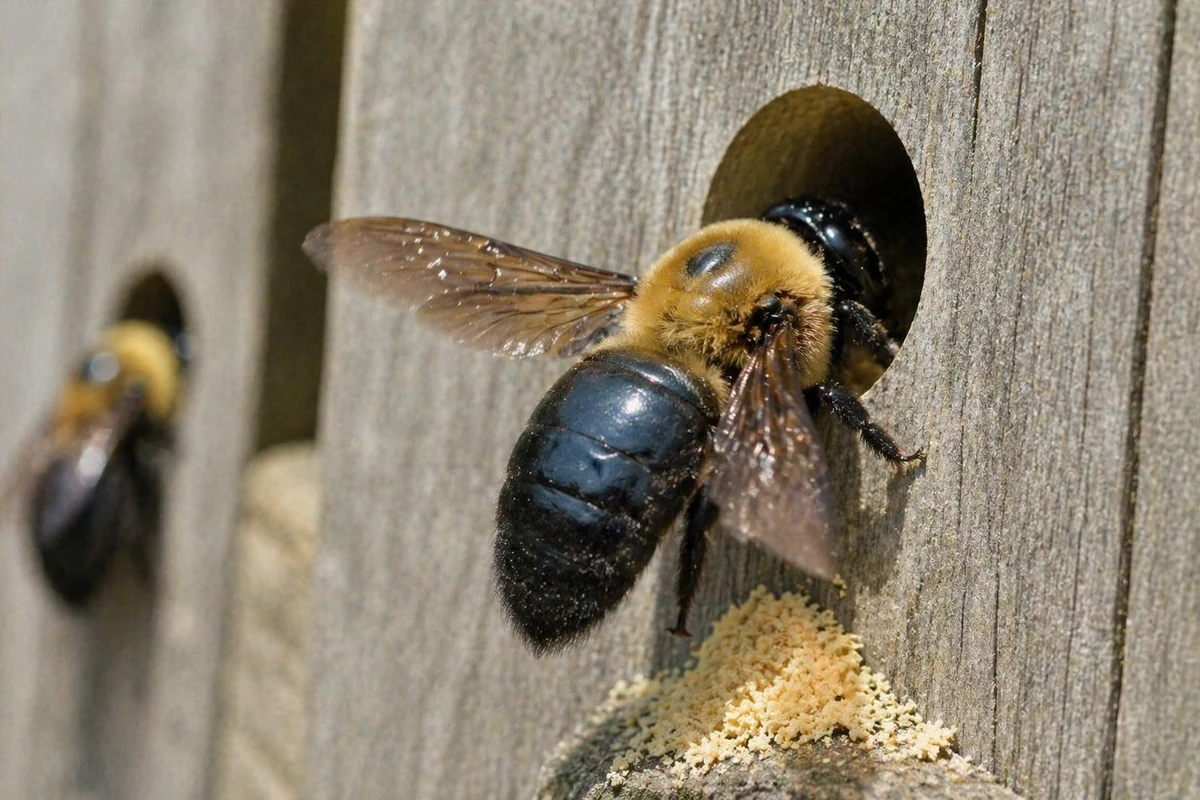 Wood-damage pest · drills fences, decks, and eaves
Big and loud, with a shiny, hairless rear end, that is the field test. Bumble bees are fuzzy all over and nest low to the ground. Males hover at face height near the holes; females do the drilling.
Bare or weathered wood. Cedar fence posts and rails are the number-one target in Collin County, then deck rails and trim, pergola beams, porch ceilings, eaves, and swing sets. Painted wood mostly gets skipped.
The first warm spells of late February and March wake them, drilling peaks April through May, and a second round runs into July and August. New adults spend the winter inside the old tunnels.
Each tunnel starts small, but the same tunnels get reused and extended every year, and a multi-season tunnel can run feet through a board. Woodpeckers tear the wood open hunting the young and often do worse damage than the bees.
Low. The dive-bombing bee at your face is a male, and males cannot sting. Females can but almost never do unless grabbed. The real risk is to fences, decks, and trim, not to your family.
Species confirmed first. We treat every active hole at full tunnel depth, Install the Scorched Earth Barrier, seal the holes once the wood is quiet, and flag the bare boards to paint or seal.
Carpenter Bee Prevention in McKinney TX Homes
Carpenter bees are a yearly spring reality in Collin County, not a one-time problem. Our one-visit treatment clears the bees drilling your wood today. Keeping next spring’s generation out takes sealed holes, protected wood, and an active barrier when the drilling season peaks.
Carpenter bees wake with the first warm spells of late February, and drilling peaks April through May. The best window to treat is late winter into early spring, before the females settle back into last year’s tunnels. New adults emerge in late summer and spend the winter inside the wood, which is why open, untreated holes in fall mean a fresh round of drilling next year.
Painted wood is the single best deterrent. Carpenter bees target bare and weathered boards and mostly skip a sealed, painted surface. The fences that get hammered hardest across McKinney, Plano, Frisco, and Allen are usually cedar that was stained but never sealed with a film finish. Prioritize the wood they hit first: fence posts and rails, pergola beams, deck rails and trim, eaves, and porch ceilings.
Never plug an active hole. A sealed-in bee chews a new exit, and the young already inside emerge the following season, so plugging before treating doubles the holes instead of ending them. The order matters: treat first, wait until the wood goes quiet, then seal every hole with filler bees cannot chew back through. Sealed, treated holes also shut out next spring’s females, who go looking for last year’s tunnels first.
The honest math: a single Carpenter Bee Annihilation visit clears the bees drilling your wood today. A quarterly plan clears that and adds a spring re-check of the fence, deck, and eaves, right when the new generation comes back looking for old tunnels. For homes with a cedar fence or a pergola near a greenbelt, recurring is the only model that actually holds the line.
Ongoing service keeps the barrier live and the wood checked through every drilling season. Quarterly plans start at $40/mo with guaranteed re-service when our tech confirms it is warranted. No-contract options are available too.
See plan optionsCarpenter Bee Control in McKinney, Allen, Frisco, and Plano
Carpenter bee pressure runs hardest where cedar fences, pergolas, and bare wood trim meet greenbelts and mature trees, exactly what Collin County subdivisions are built around. We dispatch daily across all 14 service cities.

Allen, TX
High pressureMiles of cedar privacy fence run through Twin Creeks and Cypress Meadows, and weathered fence rails are the number-one carpenter bee target in Collin County. Patio covers and pergolas around Watters Creek add more bare wood every season. We treat every active hole at full depth and flag the boards to paint or seal, not just the bees you see hovering.
Allen pest control
Frisco, TX
High pressureMaster-planned neighborhoods like Stonebriar and Phillips Creek Ranch pair newer cedar fences with pergolas, arbors, and backyard play sets, a steady supply of the bare wood carpenter bees drill. In Hollyhock, fence lines backing onto open space see fresh round holes every April. We treat the holes, seal them once quiet, and protect the wood.
Frisco pest control
McKinney, TX
High pressureEstablished cedar fences across Stonebridge Ranch and Craig Ranch have had years to weather, exactly the gray, bare wood carpenter bees pick first. Painted Tree adds new pergolas and swing sets every season. Spring drilling shows up as perfectly round holes with sawdust-like shavings below, and the same holes refill every year until they are treated and sealed.
McKinney pest control
Plano, TX
High pressurePlano’s mature neighborhoods carry decades-old fences, arbors, and wood trim. Homes through Gleneagles and Willow Bend pair older cedar fencing with pergolas and patio covers, prime drilling territory. Properties near Spring Creek back onto wooded corridors that keep a steady population of carpenter bees nearby every spring.
Plano pest controlGet a free carpenter bee control estimate · response in 1 hour during business hours
Tell us where you are seeing the holes or the hovering bees, the fence, deck, pergola, or eaves. We confirm your free same-day visit within 1 hour during business hours (Mon-Fri 8am-5:30pm).
- Every active hole treated at full tunnel depth
- Pet-safe products, family back in the yard in 1-2 hours
- No-contract options alongside quarterly plans
- Same-day service when you call before noon
- Guaranteed re-service on recurring plans, when we confirm it is warranted
Thanks! We got your request.
A Pest Me Off team member will confirm within 1 hour during business hours.
For immediate same-day help: (972) 866-4720
Carpenter Bee Control FAQ
Why are there perfectly round holes in my fence and deck wood?+
Can carpenter bees sting me or my kids?+
Should I just plug the carpenter bee holes myself?+
Why do carpenter bees come back to the same holes every year?+
Are your carpenter bee treatments safe for my dog and kids?+
Do carpenter bees really damage my house?+
Is the big bee at my deck a carpenter bee or a bumble bee?+
When is the best time for carpenter bee treatment in Collin County?+
Ready to stop the drilling in McKinney?
What’s bugging you? Our team has protected fences, decks, and pergolas across McKinney, Plano, Frisco, and Allen since 2014. 260+ five-star reviews. Best Pest Control McKinney 2025 and 2026. Same-day service when you call before noon. Texas TPCL #0937184. Open Mon-Fri 8am-5:30pm.