
When Spider Season Is in Texas and Where They Go in Winter
Spider season in Texas is really separate seasons stacked on top of each other, and the one everybody notices is not the one that matters most. Autumn is when the webs get big and obvious across a porch in McKinney, so that is what people call spider season. The species most worth knowing about peaks months earlier. And winter does not clear any of them out, because the ones that concern you were never relying on the weather in the first place.

- There is no single spider season. The outdoor web builders peak in late summer and fall. The indoor species have no season at all.
- Adult brown recluses are seen most in spring, not fall, which is the opposite of the usual assumption.
- Spiders do not migrate indoors for the winter as a group. The ones inside in January were mostly inside in July too.
- Spiders follow food. A spider count is really a report on how many insects the building is holding.
- Garages, attics, storage closets and crawl spaces carry them through winter. Stillness matters more than warmth.
- The riskiest moment of the whole year is a spring garage cleanout, not a cold night.






When Is Spider Season in Texas?
It depends which spider, and the answer is genuinely different for each. Orb weavers peak in late summer into fall, brown recluses in spring, and black widows through the warm months, while cellar spiders live indoors with no season at all. All of them spike briefly the week it first turns cold.
| Which spider | When you notice it | Why then |
|---|---|---|
| Orb weavers | Late summer into fall, and this is what people mean by spider season | The females have reached full size, so the webs are at their largest and hardest to walk past without noticing |
| Brown recluse | Spring, with adults seen most in the spring months | Mating runs April to early July in Texas, so they are moving rather than sitting still, and moving spiders get found |
| Black widow | Through the warm months, peaking in summer | Ground level activity around garages, meter boxes and stored items, which is also when people are out in those spaces |
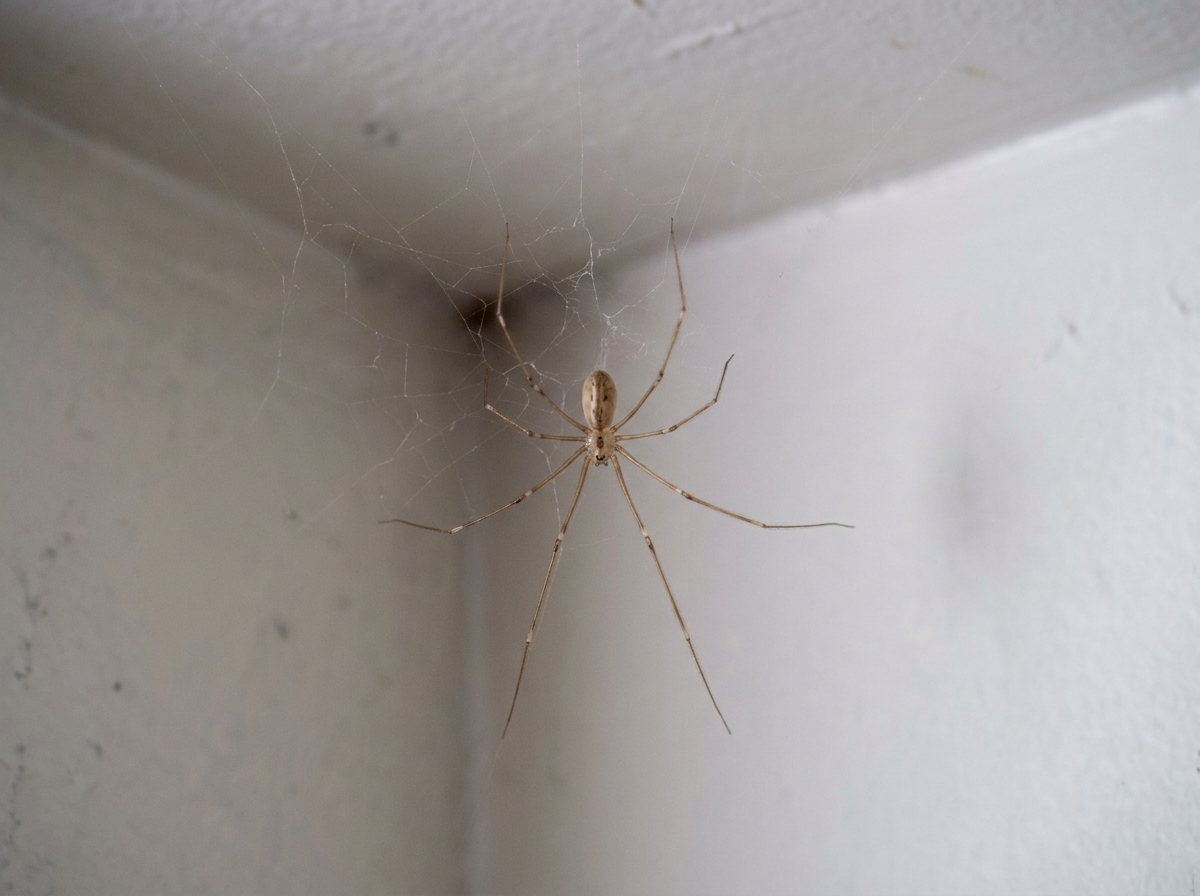
| Cellar spiders | Any month at all, indoors | They live inside permanently in garages, utility rooms and closets. Nothing about the calendar reaches them |
| All of them | A short spike the week it first turns cold | Outdoor spiders shifting to sheltered ground, plus people going into garages and attics they have not opened since summer |
Rows one and two disagree by six months, which is why one spider season does not exist.
Do Spiders Go Away in Winter?
No, and they do not all pour indoors either, which is the other half of the myth. Most outdoor spiders in Collin County simply become inactive and hard to find. They move under bark, into leaf litter, beneath stones and into the gaps around a foundation, slow right down, and wait.
Their egg sacs sit out the cold in the same places.
What actually happens indoors is less dramatic than a migration. Stray individuals wander in through the gaps that were always there, and they are noticed more than usual because the house is quieter and people are inside looking at their own walls. Meanwhile the species that genuinely live indoors carry on exactly as they were.
 Source:
 Which Spiders Stay Indoors Through Winter?
The ones that were never really outdoor spiders. Cellar spiders hold ceiling corners in garages, utility rooms and closets all year. Brown recluses sit in stored cardboard, in closets and in attic storage, and a cold month outside makes no difference to a spider living in a box.
Black widows carry on in garages, meter boxes and the undersides of stored furniture.
All three have the same requirement and it is not warmth. It is stillness, plus something to eat. A garage that is quiet from November to March is a better home than a heated kitchen that gets used every day.
Why Do More Spiders Appear in Fall?
More spiders appear in fall for three reasons. The webs are bigger, because spiders that hatched in spring are full grown by September. Males wander looking for females. And the insects they eat peak first, with cricket pressure here heaviest in August and September.
The webs are simply bigger. An orb weaver that hatched in spring is at full size by September, and a large web across a doorway is impossible to miss where the same spider’s smaller web in July was invisible. Second, males wander at that time of year looking for females, and a wandering spider crosses open floor where a settled one never does. Third, and most usefully, the insects peak first. Cricket pressure here is heaviest in August and September, and spiders follow their food, so a heavy cricket year is followed by a heavy spider autumn.
That last point is the practical one. If the spider count is climbing, the thing to look at is what they are eating, because dealing with the insects lowers the spider numbers in a way that killing spiders one at a time never does.
How Do You Keep Spiders Out of the House?
Keep spiders out by treating it as a food and access problem rather than a spider problem. Seal cracks in the foundation and gaps around windows and doors, check that screens seal well, and keep clutter off the floor indoors and around the foundation outside, as UC Agriculture and Natural Resources, Spiders advises.
- Cut the insect supply. Exterior lighting pulls in what spiders eat, so yellow bulbs or moving a light away from a doorway does more than any spray.
- Seal the ordinary gaps. Door sweeps, garage weather stripping, window screens and the gaps around utility lines. These are the routes, and none of them is exotic.
- Take the clutter out of storage. Cardboard is the single best spider habitat in a home. Taping boxes shut and clearing genuine junk removes more spiders than anything applied from a can.
- Clear webs and keep clearing them. A cleared corner that is rebuilt within 7 days still has its spider, which tells you where to treat.
- Treat the perimeter before the season, not during it. A treated perimeter in midsummer is what keeps the fall quiet, so schedule it then.
If the count is rising through the fall, or you are finding spiders in stored boxes in Allen, Frisco or Plano, professional spider control deals with the perimeter, the storage areas and whatever the spiders are feeding on. Get a free estimate or call us and we will tell you which species you have and whether the count is actually a problem.
More spiders than last year? Same-day spider control in McKinney and the surrounding cities when you call before noon.
We treat the perimeter and the storage areas, and deal with what the spiders are eating.

Ryan has spent more than 16 years in pest control and wildlife management across McKinney and Collin County, from inspecting homes and treating infestations to sealing the entry points pests use to get in. He built Pest Me Off on that field experience, and every technician on the team is trained against it.
More about the Pest Me Off team