Home Pest Library Spiders Southern House Spider
Southern House Spider (Crevice Weaver, Woolly Web Spider)

Southern House Spiders in Collin County, TX | Identification and Control

Last updated 2026

The Southern House Spider is the most common brown recluse look-alike in Texas. The males send more homeowners to the ER with a misidentified “recluse bite” than any other spider in Collin County. They are harmless. Three visual tests separate them from brown recluse in under ten seconds without handling the spider.
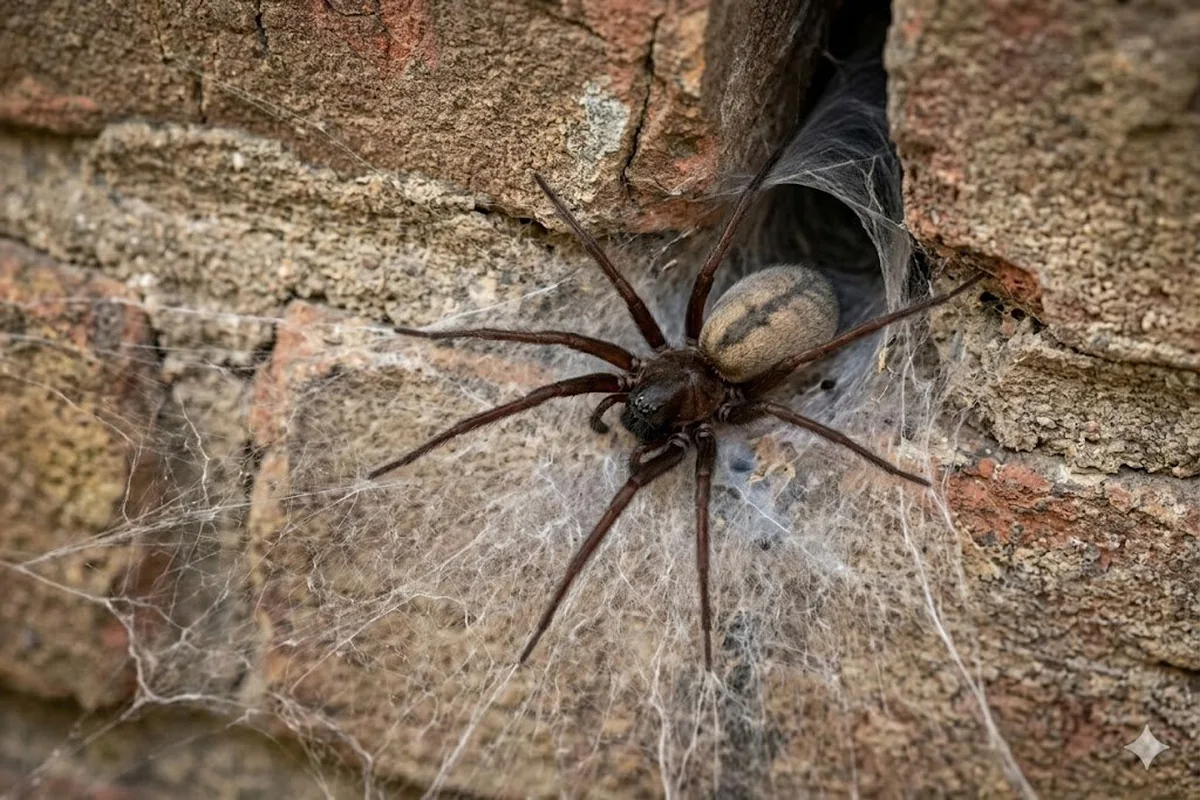
Southern house spider in woolly crevice web on garage wall showing dark charcoal female body
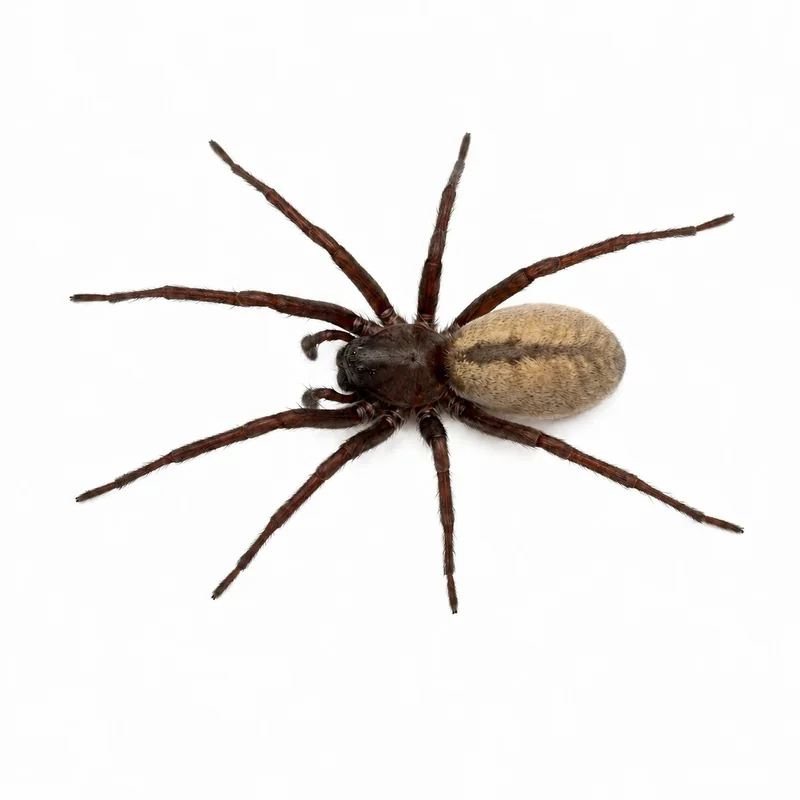
Southern house spider specimen showing dark charcoal body and 8 eyes clustered on raised bump
Southern House Spider
Kukulcania hibernalis
AKA Crevice Weaver · Woolly Web Spider · Brown Recluse Impostor
Body lengthFemale 0.51 to 0.75 in (13-19 mm); male 0.35 to 0.5 in (9-13 mm)
Leg spanUp to 2 in (50 mm) when extended
Adult lifespanFemale up to 8 years; male 1 to 2 years
Active seasonYear-round; peak male wandering May through August
PreyHouse flies, cockroaches, beetles, wasps, mud daubers
Hunting styleSit-and-wait ambush from tubular retreat at crevice center
Sexual dimorphismExtreme; female dark charcoal-gray; male khaki with very long pedipalps
Threat levelLOW

A large, harmless crevice-weaving spider whose wandering males are the most common brown recluse misidentification in Texas. The woolly flat web spreading from a wall crack and the 8-eye cluster on a raised bump are the two fastest diagnostic traits. Females live up to 8 years in the same retreat.

PEST ME OFF | PEST LIBRARY | SOUTHERN HOUSE SPIDER pestmeoff.com
North Texas Pest Calendar
Southern House Spider Activity in Collin County by Month

Southern house spider females remain active year-round in established retreats. The seasonal pattern reflects male wandering behavior: males leave their retreats in late spring and summer to find mates, which is when homeowners encounter them in open areas and mistake them for brown recluse. Females are visible in webs year-round but peak complaints track male wandering from May through August.

Jan
Low
Feb
Low
Mar
Emerge
Apr
Active
May
Peak
Jun
Peak
Jul
Peak
Aug
Peak
Sep
Slow
Oct
Slow
Nov
Low
Dec
Low
Dormant / Low
Emerging
Active
Peak
Slowing

Pattern from iNaturalist observation records and Pest Me Off service call data across Collin County, 2023 to 2026.

Identification

What a Southern House Spider Looks Like

Males look enough like brown recluse to send homeowners to the ER. Three field tests rule them out in under ten seconds without touching the spider.

The Southern House Spider is a large crevice weaver with dramatic differences between the sexes. Females are dark charcoal-gray to near-black with a round, velvety abdomen and a heavy build. A large female is sometimes mistaken for a small tarantula or a trapdoor spider at first glance. She lives in a tubular retreat built into a wall crevice, windowsill gap, or brick weep hole, and she rarely leaves. The woolly flat web spreading from that crevice is her calling card.

Males are the spider most frequently mistaken for brown recluse in Texas. They are smaller than females (0.35 to 0.5 inches body length), khaki to amber in color, and they wander actively in late spring and summer looking for females. The visual that drives misidentification: their pedipalps – the small leg-like appendages near the mouth – are extremely long and thin, projecting forward in a way that makes the spider appear to have ten legs instead of eight. Combined with a plain tan-brown body, wandering behavior, and similar overall size, male Southern House Spiders pass the initial brown recluse visual check for most homeowners. Texas southern house spider identification and biology confirm their non-threatening status.
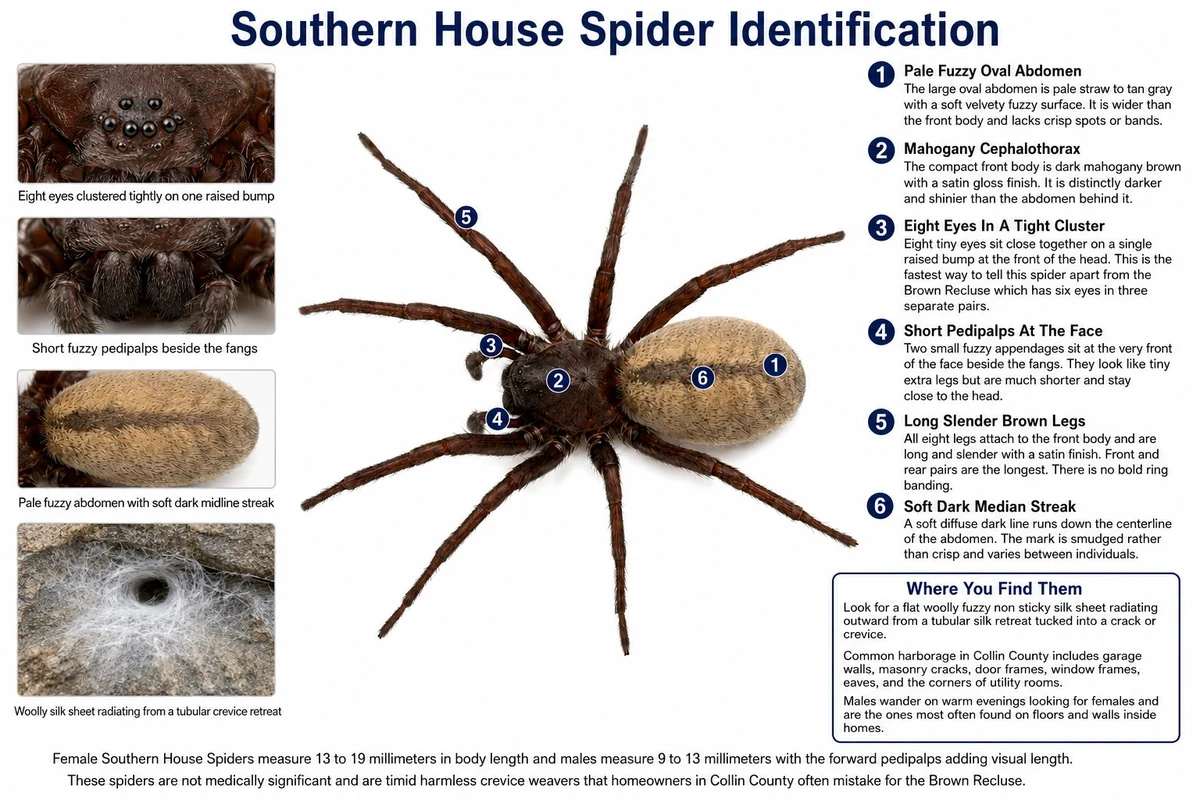
Southern house spider identification diagram showing male and female differences with anatomical callouts

Southern house spider identification diagram showing male and female differences with anatomical callouts

Dead GiveawaysThree tests that rule out brown recluse in under ten seconds
  • 8 eyes clustered tightly on a single raised bump at the front of the cephalothorax; brown recluse has 6 eyes in 3 separate pairs
  • Male has extremely long, thin pedipalps projecting forward that look like an extra pair of legs; brown recluse does not have this
  • Flat woolly web spreading from a wall crevice or window frame; brown recluse builds small irregular retreat silk in clutter, not a flat fan web
  • Female is dark charcoal-gray to near-black; brown recluse is matte tan to medium brown
  • Spider curls up and plays dead (thanatosis) when disturbed; brown recluse retreats quickly
  • Web silk has a fuzzy, woolly texture; brown recluse retreat silk is fine and irregular, not woolly
  • Female rarely leaves the retreat; brown recluse wanders more actively at night
The Name

Why the Southern House Spider Is Texas’s Most Misidentified Spider

The Southern House Spider is in the family Filistatidae, known as crevice weavers. The genus name Kukulcania refers to Kukulkan, the Mayan feathered serpent deity. The species was first described in 1842 by Nicholas Marcellus Hentz, a French-American arachnologist who named several of the most commonly encountered spiders in the American South.

The misidentification problem is structural. Males actively wander in warm months, appearing in open areas of garages and on exterior walls where homeowners see them directly. They are the right size (0.35 to 0.5 inches), the right color (tan to amber), and they are found in the right general locations for a recluse concern. The visual that should rule them out – the 8-eye cluster and the extreme pedipalps – requires a close look that most panicked homeowners do not take before calling for treatment. Pest Me Off technicians estimate that the majority of McKinney “brown recluse emergency” calls involve Southern House Spider males on inspection.

Look-Alikes

How to Tell Southern House Spiders from Other Collin County Spiders

Male Southern House Spiders are the primary brown recluse look-alike in Texas. Eye count, pedipalp length, and web type separate them from every species they are confused with. Use your phone camera to zoom in on the eye arrangement before making any treatment decision.

Species Size Key Feature Where Found
Southern House Spider
Southern House Spider AKA: Crevice Weaver, Woolly Web Spider Kukulcania hibernalis This species
Female 0.51-0.75 in body, charcoal-gray, heavy-bodied. Male 0.35-0.5 in, khaki-amber. Both sexes up to 2 in leg span. 8 eyes tightly clustered on a raised bump. Male has extremely long pedipalps resembling an extra pair of legs. Flat woolly web spreading from a crevice. Female plays dead when disturbed. Silk is fuzzy and non-sticky (cribellate). Wall crevices, window frames, door frames, brick weep holes. Female stationary in retreat year-round. Male wanders May through August seeking mates.
Brown Recluse
Brown Recluse AKA: Violin Spider, Fiddleback Loxosceles reclusa
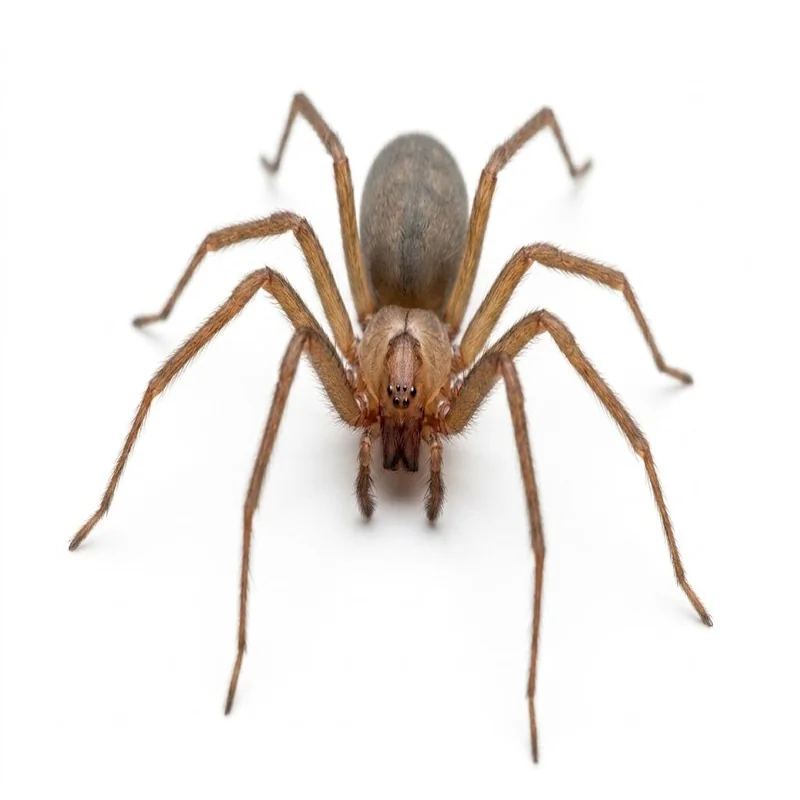
0.25 to 0.5 in body; leg span 1 to 1.5 in. Slender, lightly built. Uniformly colored, unbanded legs. Matte tan to medium brown. 6 eyes in 3 separate pairs arranged in a semicircle (diagnostic). No pedipalp exaggeration. Violin-shaped mark on cephalothorax. Small irregular retreat silk in clutter, not a woolly fan web. Retreats quickly rather than playing dead. Dark undisturbed storage: closets, shoe boxes, stacked boxes, garage shelving. Not in fan webs at wall crevices. Nocturnal wanderer found in storage areas, not on open garage walls.
Wolf Spider
Wolf Spider AKA: Hairy Spider, Ground Spider Hogna carolinensis, Rabidosa spp.
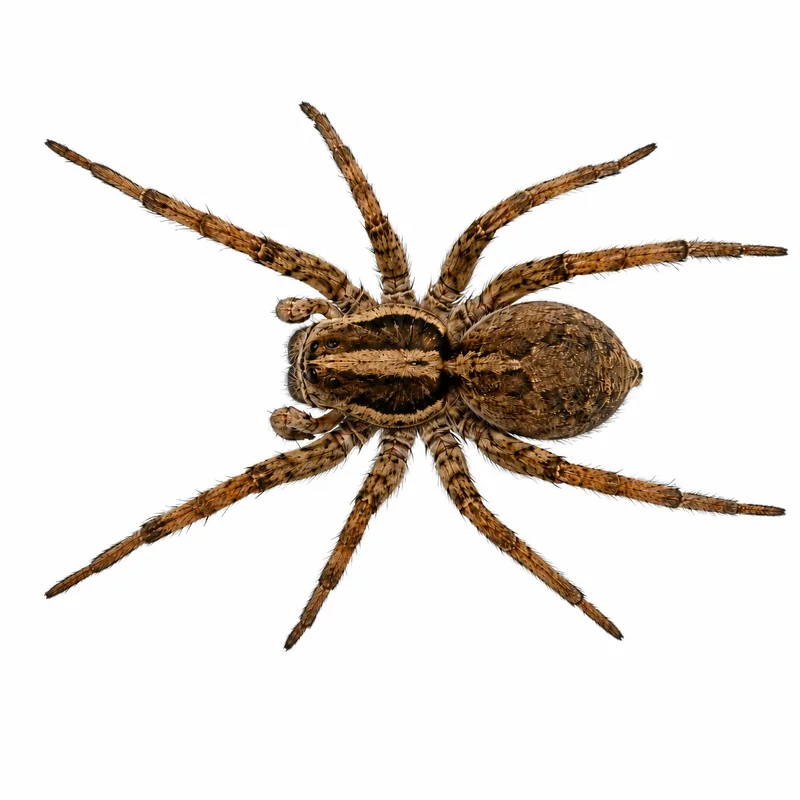
0.5 to 1.5 in body; leg span up to 4 in. Stocky, heavily built, densely hairy. Much bulkier than Southern House Spider male. 8 eyes in 3 rows; large middle pair glows bright green under flashlight at night. Distinct longitudinal stripes on cephalothorax. Runs actively on floors. No crevice retreat or fan web. Pedipalps normal length, not exaggerated. Open garage floors, under exterior doors. Ground hunter; not associated with wall crevice webs. Enters during fall temperature drops; peaks September and October.
Cellar Spider
Cellar Spider AKA: Daddy Long Legs, Vibrating Spider Pholcus phalangioides
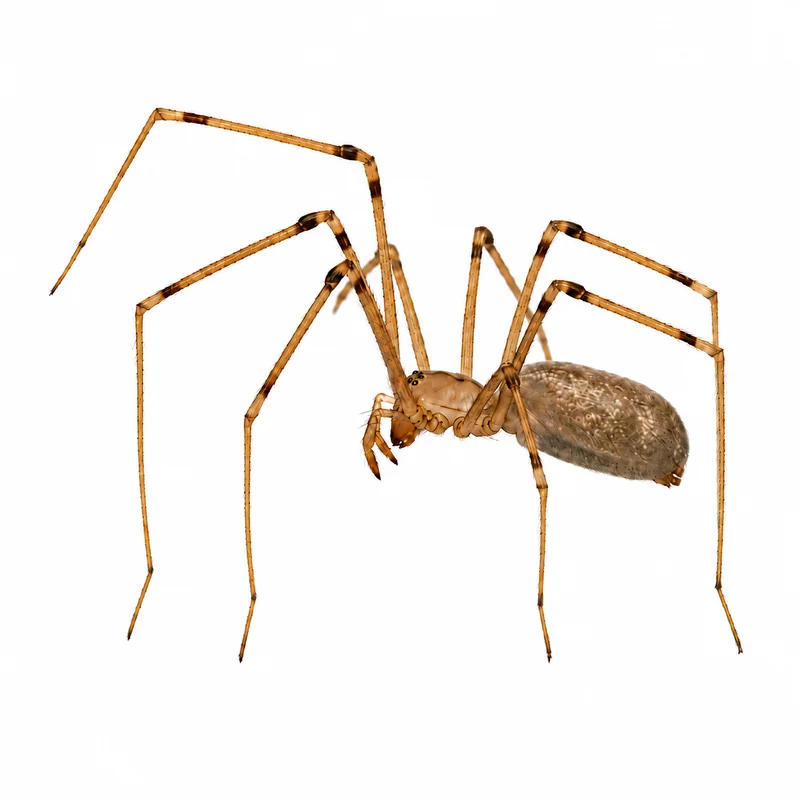
0.25 in body; leg span up to 2 in. Tiny body dwarfed by thread-like legs. Pale tan to nearly translucent. Much lighter-built than any Southern House Spider. Hangs upside down in loose irregular ceiling cobweb. Pale or translucent; not dark. Vibrates body rapidly when disturbed. Female holds egg sac in jaws. Not associated with wall crevices or woolly flat webs. Ceiling corners, garage rafters, bathroom walls. Indoors year-round in low-traffic spots. Not found in wall crevice retreats or flat fan webs at wall level.
The fastest field test for Southern House Spider vs brown recluse: zoom in on the eyes with your phone camera. Eight eyes clustered on a raised bump equals Southern House Spider, harmless. Six eyes in three separate pairs arranged in a semicircle equals brown recluse, medically significant. If the spider has extremely long appendages projecting forward from the face area, those are pedipalps – Southern House Spider diagnostic. If it is playing dead and curled up in a ball, that is Southern House Spider thanatosis behavior; brown recluse runs away rather than curling.
Why Southern House Spider Scores 1 of 3 on People Risk

People Risk for Southern House Spider

The Southern House Spider is harmless. It rarely bites, and when it does the effect is minor localized pain and redness that resolves within two days without medical treatment. The actual risk from this species is misidentification: homeowners who believe they have brown recluse call emergency exterminators, apply unnecessary pesticides, and in some cases seek ER treatment for a spider bite that never happened. Correct identification eliminates this cost entirely.

People Risk
1/ 3
Low
Medical Risk

Southern House Spider Bites: What Actually Happens

Southern House Spiders are reluctant biters. Their mouthparts often cannot penetrate adult human skin. In the rare case where a bite occurs – almost always from a female confined against skin – the result is minor localized pain similar to a bee sting, possible minor swelling, and redness that resolves within 24 to 48 hours without any medical treatment. There is no medically significant venom effect documented for this species. No necrosis, no systemic cramping, no medical emergency. Southern house spider range and confirmed Texas sightings document how widespread this species is across Collin County neighborhoods.

What Southern House Spider bites do cause that is dangerous is panic. A homeowner who sees a male Southern House Spider, believes it is a brown recluse, and then notices a pre-existing skin lesion or insect bite may attribute that lesion to a recluse bite. The subsequent ER visit, aggressive wound care, and anxiety around every tan spider in the house are all costs of a misidentification, not of an actual Southern House Spider bite.

Critical ID Tip
Eye Count Is the Fastest and Most Reliable Test

Hold your phone camera near the spider (or take a photo and zoom in). Eight eyes clustered tightly on a raised bump at the front of the cephalothorax: Southern House Spider, harmless. Six eyes in three separate pairs arranged in a semicircle: brown recluse, medically significant. This one check resolves the most dangerous misidentification error in North Texas spider encounters. Every homeowner in Collin County who has a “recluse concern” should know it before they call anyone or start any treatment.

Context

When Southern House Spider Presence Is Worth Addressing

Southern House Spiders become worth addressing when they become a nuisance from repeated web presence in visible areas, or when populations are large enough that wandering males appear frequently indoors:

Worth Addressing

Repeated Woolly Webs in Visible Areas

A flat woolly web spreading from a window frame or door frame in a visible living area that rebuilds within days of removal indicates an established retreat that needs treatment at the crevice, not just surface web removal. The female is in the crack; cleaning the web without addressing the retreat produces a permanent cycle of removal and rebuild.

Worth Addressing

Wandering Males Appearing Indoors Frequently

Finding a wandering male Southern House Spider once or twice a year is a non-event. Finding them weekly during May through August suggests the outdoor population around the structure is high enough to produce consistent interior entry. Exterior perimeter treatment and weep hole sealing reduces the source population.

Worth Addressing

Home With Confirmed Brown Recluse Concern

In a home where brown recluse are a confirmed concern, it is worthwhile to eliminate Southern House Spider populations in garage and storage areas simply to confirm that future spider sightings are correctly attributed. A home with both species present is harder to monitor accurately.

Low Priority

Female in Crevice Retreat in Garage or Exterior Wall

A Southern House Spider female in a weep hole or exterior wall crevice is in her natural habitat and poses no risk to occupants. Unless her webs are appearing in living areas or the crevice is at a door or window regularly used by the household, no treatment is warranted.

Low Priority

Single Male Found Indoors Once

A single wandering male found inside once is not a treatment event. Capture and release outdoors or simply let him go. Males are searching for females and will exit through the same gap they used to enter. No action beyond correct identification is needed.

Low Priority

Exterior Webs on Brick Veneer or Fence

Southern House Spider webs on the exterior brick veneer, in fence crevices, or under porch overhangs are in their expected outdoor habitat. They eat house flies, beetles, and wasps. Unless webs are accumulating in entry areas or you are seeing large numbers of them, exterior webs are a cosmetic observation, not a treatment target.

Why Southern House Spider Scores 1 of 3 on Property Risk

Property Risk for Southern House Spider

Southern House Spiders cause no structural damage. They do not chew wood, damage masonry, contaminate food, or harm surfaces. The woolly webs they build in crevices are cosmetically unpleasant and may accumulate insect debris, but they require no more than vacuuming to remove. The spider may return and rebuild; the retreat needs to be treated, not just the web surface.

Property Risk
1/ 3
Low
Habitat

Where Southern House Spiders Come From in Collin County

Southern House Spiders are highly synanthropic – they are built for life in and around human structures. Their preferred habitat is any narrow crevice with a stable temperature, protection from direct light, and access to prey insects: weep holes in brick veneer, gaps around window and door frames, spaces under exterior siding, expansion joints in slab foundations, and interior crevices in garage walls and utility areas. The flat woolly web extends from the crevice mouth and intercepts prey insects that contact it physically rather than through sticky silk.

The cribellate silk (woolly-looking, non-sticky nanofiber produced by a comb-like structure called the calamistrum) is distinctively different from the sticky globules on orb weaver and cobweb webs. Prey is entangled by the looped nanofibers mechanically rather than chemically. Fly wings, beetle parts, and insect debris accumulate in the web over time, making established webs visually distinctive to a trained eye even when the spider is not visible. Crevice weaver spider identification and biology covers the fiber structure and retreat behavior in detail.

Local Pressure

Southern House Spider Pressure Across Collin County

Southern House Spiders are found throughout Collin County but are most dense in areas with mature masonry construction: older sections of McKinney, historic Allen, Adriatica in McKinney (stone architecture), and Stonebridge Ranch. Brick veneer weep holes in these neighborhoods provide abundant permanent shelter. New construction in Prosper, Celina, and Frisco also sees rapid establishment as spiders displaced from cleared land move into fresh weep holes in new brick veneer.

The peak service call pattern follows male wandering: May through August, homeowners find a tan or khaki spider in an open area of the garage or on an exterior wall and call immediately with a recluse concern. The identification conversation resolves the emergency in most cases. A smaller percentage of calls involve genuine removal requests for females whose webs are rebuilding in visible areas despite repeated cleaning.

Perspective

The Cost of Misidentification Is Higher Than the Spider

Worth Knowing

Southern House Spider females live up to 8 years in the same retreat. An untreated crevice retreat produces a continuous cycle of web presence and male wandering for the life of the female, which can be nearly a decade. If the webs are in a visible location or males are appearing indoors frequently, treating the retreat (not just the web) is the right call. But the treatment is worthwhile because of aesthetic nuisance, not because of any safety risk from the spider itself. The misidentification cost – an unnecessary ER visit, an emergency pesticide application for a harmless spider – is almost always higher than the treatment cost for the actual problem.

Why Southern House Spider Scores 2 of 3 on Persistence Risk

Why Southern House Spiders Keep Coming Back

The persistence challenge is the 8-year female lifespan combined with crevice retreats that surface sprays and web removal cannot reach. Remove the web and the female rebuilds from the same crevice within days. Spray the web surface and the female retreats deeper into the wall void. The retreat itself must be treated for lasting control, and the crevice must be sealed afterward to prevent re-establishment.

Persistence Risk
2/ 3
Moderate
Behavior and Biology

Southern House Spider Biology That Explains Persistent Presence

Female Lifespan Up to 8 years – one of the longest-lived common house spiders in Texas An 8-year female lifespan in the same crevice retreat means that once a Southern House Spider establishes in a weep hole or window frame gap, you are dealing with that individual for potentially a decade. Each year she produces egg sacs. Each year males from her offspring and from the surrounding population wander. The retreat is not just a temporary occupation; it is a long-term fixture that regenerates the local population continuously.
Thanatosis Both sexes play dead when threatened – curling up motionless rather than running When disturbed, Southern House Spiders curl all legs beneath their body and become completely motionless. This death-feigning behavior is called thanatosis. Males wandering on a surface will drop and curl up if you approach quickly. The frozen, curled spider is often described by homeowners as “already dead” or “sick.” It is not. Give it a minute undisturbed and it will uncurl and move on. Aerosol sprays that freeze the spider visibly do not necessarily kill it through the cribellate silk web.
Cribellate Silk Woolly non-sticky silk made by a comb structure on the rear leg The calamistrum (a row of bristles on the fourth leg) combs silk out of the cribellum (a sieve-like structure near the spinnerets), producing the distinctive woolly texture of the Southern House Spider web. This silk can stretch over 26 times its original length without breaking. The non-sticky entanglement mechanism means standard contact sprays applied to the web surface do not flow into the retreat where the female is waiting. Treatment must reach the crevice interior.
Male Wandering Males nearly blind; wander across open surfaces without recognizing obstacles including humans Male Southern House Spiders have reduced eyesight and will walk directly across a human hand without recognizing it as a threat. The wandering behavior that produces misidentification emergencies is mate-seeking, not prey-hunting or aggression. A male found indoors is lost or in transit; he entered through a gap looking for females, not looking to establish a retreat. Catch and release outdoors is the right response to an indoor wandering male.
Retreat Depth Female retreats deeper into the crevice when disturbed; can move into wall voids Disturbing the web or applying aerosol spray at the crevice mouth drives the female deeper into the wall void, not out. OTC foggers produce the same result at a larger scale: the spider moves deeper into voids rather than dying. A female driven deeper into a wall void is now inaccessible and still producing eggs. Professional treatment uses residual dust formulations in wall voids and liquid residual at crevice mouths to reach the spider where she retreats.
Spiderling Communal Phase Spiderlings feed communally in the natal web before dispersing Unlike most spider species where spiderlings immediately disperse after hatching, Southern House Spider spiderlings remain in the mother’s retreat web for a communal feeding period, sharing prey she captures. This extended maternal association means an established retreat web produces a small dispersing cohort rather than a single large hatch event. Young spiders establish new retreats nearby, maintaining local population pressure even if individual females are removed.
Pest Me Off Translation
Cribellate silk Woolly-looking silk made by a comb structure on the fourth leg; gives Southern House Spider webs their fuzzy texture and tangling power without using sticky glue droplets.
Pedipalps The two small arm-like appendages near a spider’s mouth. In male Southern House Spiders they are extremely long and thin, making the spider look like it has ten legs. This is the fastest visual separator from brown recluse.
Thanatosis Death-feigning behavior: the spider curls up and plays completely motionless when threatened. Not dead, not sick. It will uncurl and move normally after the threat passes.
Reality Check

Things You Should Know About Southern House Spiders

Facts that resolve the most common emergency call in Collin County

1
The spider with the extra-long “front legs” projecting forward is not a brown recluse – those are pedipalps, not legs.Why this matters. Male Southern House Spiders have extremely elongated pedipalps that look like an additional pair of legs. This 10-legged appearance confuses homeowners who know brown recluse have 8 legs. Count actual legs on the body segments: if you count 8 walking legs plus two extra appendages projecting from the face area, it is a Southern House Spider male. Brown recluse pedipalps are short and unremarkable.
2
The curled-up, motionless spider is playing dead, not actually dead.Why this matters. Homeowners often spray a Southern House Spider with aerosol and observe it curl up and stop moving. They conclude the treatment worked and the spider is dead. Five minutes later the spider uncurls and walks away. Thanatosis is a survival strategy that makes the spider appear dead to both predators and humans. A spider that is playing dead is not dead; it needs to be physically removed or treated with a residual that remains effective after the spider uncurls.
3
The fuzzy web in your crevice rebuilds because the female is still in the crack and you did not treat the retreat.Why this matters. Removing the visible web portion without treating the crevice interior leaves the female alive and at the same location. She rebuilds the web within days because the retreat – where she lives – was never disturbed. Effective removal requires treating the crevice with an appropriate dust or residual formulation, then sealing the crack after the treatment has time to work.
4
A brown recluse has 6 eyes in 3 pairs; every other spider in this area has 8.Why this matters. This single fact resolves the most dangerous misidentification error in North Texas. Every spider you encounter in Collin County has 8 eyes except the brown recluse, which has 6. Use your phone camera zoomed in: 8 eyes means not a recluse. 6 eyes means look more carefully. The 8-eye cluster on a raised bump is Southern House Spider. Six eyes in three separate pairs arranged in a semicircle is brown recluse.
5
Male Southern House Spiders are nearly blind and will walk across your hand without recognizing you.Why this matters. The wandering male that appears to be “stalking” you in the garage is not tracking you at all. He cannot see you. He is following chemical signals toward females and moving in a direction that happens to put him near a human. He is not aggressive, not hunting, and not threatening. Cup, card, outside. Done.
Why Southern House Spider Scores 2 of 3 on Difficulty to Treat

Controlling Southern House Spiders

Southern House Spiders are moderately difficult to control because the female lives in a crevice retreat that most OTC products cannot reach, and she retreats deeper when disturbed. Surface web removal and aerosol sprays produce temporary results that miss the source entirely. Effective treatment requires a dust or residual formulation applied into the crevice itself, followed by sealing to prevent re-establishment.

Difficulty to Treat
2/ 3
Moderate
SPIDER CONTROL
Treatment

How Pest Me Off Controls Southern House Spider

Southern House Spider control is a retreat problem, not a surface problem. The web is the symptom; the crevice is the cause. Our approach treats the retreat where the spider lives, not just the web she produces. Sealing the crevice after treatment prevents re-establishment from the surrounding population.

Step 1

Locate All Active Retreats

Walk the exterior and inspect every weep hole, window frame gap, door frame crack, and expansion joint in the slab for flat woolly webs spreading from a crevice. Note whether the web is fresh (white, fuzzy) or old (gray, debris-laden). Fresh web means an active female. Also inspect interior garage walls, utility closets, and attic access areas for interior retreat webs.

Why this step: Treating retreats you know about while missing others produces partial results. A complete retreat map before treatment so you address the full population, not just the webs that are visible from the driveway.
Step 2

Treat Retreats With Appropriate Residual

Apply silica gel or diatomaceous earth dust into the crevice interior using a bellows duster to reach the spider in her retreat. For exterior crevices at weep holes and window frames, apply residual pyrethroid (a synthetic insecticide chemical family) or pyrethroid-combination liquid into and around the crevice mouth. These formulations need to reach the spider at the retreat depth, not just the web at the surface.

Why this step: The female retreats deeper into the crevice when disturbed or when she detects treatment at the surface. Dust formulations in wall voids move through the air space and contact the spider regardless of where she retreats within the structure. Surface-only sprays that do not reach retreat depth have limited effectiveness.
Step 3

Allow Residual to Work Before Sealing

Give the treatment 5 to 7 days before sealing the crevice. If the crevice is sealed immediately after treatment, a surviving female can remain in the wall void indefinitely. Waiting allows the residual to produce confirmed control before closing the retreat. After treatment and waiting period, seal all treated crevices with appropriate caulk or mortar, and install weep hole covers on brick veneer weep holes.

Why this step: A female sealed into a wall void with a small prey insect population can survive for months or years. Sealing the crevice before confirming control traps the spider inside rather than eliminating her. Wait, confirm, then seal.
Step 4

Perimeter Residual for Wandering Male Reduction

Apply exterior perimeter residual pyrethroid (insecticide chemical family) along the foundation band and across threshold areas during May and June, before peak male wandering begins. This reduces the number of wandering males that reach entry points and enter the structure. Timed application in late April covers the approach window for the heaviest male wandering period from May through July in Collin County.

Why this step: Interior finds of wandering males are a symptom of a high exterior population near the structure. Perimeter treatment reduces the source population approaching the home rather than catching individual males after they have already entered.
Pest Me Off
Identify the species correctly so you know you are treating a harmless spider rather than a recluse. Map all active retreat webs on the exterior and interior. Treat the retreat interior with dust and residual liquid, not just the web surface. Wait for treatment to work, then seal the crevices. Apply perimeter residual before peak male wandering season. Return for follow-up if new webs appear within 30 days.
Store Products
& Other Companies
Spray the visible web with aerosol. Spider plays dead, looks controlled. Web rebuilds in 4 days. Spray again. Spider retreats deeper into wall void. Fogger treatment drives her deeper still. Schedule next quarterly visit. Web is back in a week. The retreat was never treated. The female is still there. The cycle continues for years, possibly the full 8-year lifespan of the female if nothing changes.
Do It Yourself
Southern House Spider: What Works and What Drives Her Deeper Into the Wall
The retreat is the target, not the web – everything else is cosmetic
DIY Prevention

DIY Southern House Spider Prevention

Prevention targets the crevices and entry points the spider needs to establish a retreat. Seal them and the spider cannot establish; leave them open and the surrounding population fills them continuously.

1
Install weep hole covers on all brick veneer weep holes. Weep holes are the primary exterior entry and shelter site for Southern House Spiders in Collin County brick-veneer homes. Stainless steel mesh or commercially available weep hole covers allow drainage while blocking pest access. They are inexpensive and take minutes to install.
2
Caulk gaps around window and door frames. Gaps at the junction of window frames with brick or siding are the second most common retreat site. Use an appropriate exterior caulk to seal any gap larger than 1/8 inch. Focus on corners and where frame meets masonry, as these are the widest and most protected crevices.
3
Identify males correctly before treating. The fastest DIY action for a wandering male Southern House Spider is a cup and a card. Capture, release outside. No chemicals, no emergency call. Use your phone to zoom in on the eyes and pedipalps to confirm the identification. The five seconds this takes prevents unnecessary panic and unnecessary treatment.
4
Remove webs early before retreats become established. A fresh woolly web appearing in a window frame crack that is removed immediately, with the spider captured and released, prevents that location from becoming a long-term retreat. A web that has been present for a season and repeatedly rebuilt indicates an established female; that situation requires retreat-level treatment.
DIY Pitfalls

Why Some DIY Approaches Fail for Southern House Spiders

Wrong Target

Removing the Web Without Treating the Retreat

Knocking down the visible web portion without addressing the crevice retreat leaves the female in place. She rebuilds the web within 3 to 5 days because her home – the crevice – was never disturbed. This cycle can repeat indefinitely if the retreat is not treated. Web removal is cosmetic; retreat treatment is control.

Drives Deeper

Aerosol Spray at the Crevice Mouth

Spraying aerosol pyrethroid (insecticide chemical family) at the crevice opening drives the female deeper into the wall void rather than killing her. She retreats from the chemical at the entrance and may be inaccessible for weeks. When the residual breaks down, she returns to the crevice mouth and rebuilds. Aerosols at surface level are not the right tool for retreat spiders.

Amplifies Problem

Bug Bombs and Foggers

Foggers are particularly counterproductive for Southern House Spiders. The fog penetrates open air space but not the crevice retreats where females live. The fog drives wandering males deeper into wall voids. The net effect is a temporarily reduced indoor sighting rate followed by the same or higher population as treatment breaks down – with the added problem that spiders are now deeper in the structure.

False Completion

Thanatosis Fooling You Into Thinking the Treatment Worked

Spray a Southern House Spider with aerosol. She curls up motionless. You conclude the treatment worked. Five minutes later she uncurls and walks away. This plays out in McKinney garages constantly. The death-feigning behavior looks like treatment success when it is just a survival response. Confirm treatment success by absence of web rebuild over 10 to 14 days, not by the spider curling up at first contact.

Overreaction

Emergency Recluse Treatment for a Southern House Spider

The most expensive mistake for this species. A wandering male Southern House Spider triggers a recluse emergency call. Emergency treatment is scheduled. Broad application of residual products occurs throughout the home. The actual spider – harmless – is gone. The actual concern – whether recluse are present – was never answered. Correct identification before any treatment decision prevents this entirely.

Timing Error

Sealing Crevices Before Treatment

Sealing weep holes and window frame cracks before treating the female inside traps her in the wall void with access to whatever prey insects are present. She can survive for years in a sealed void. Seal crevices only after treatment has had 5 to 7 days to produce confirmed control. Treat first, wait, confirm, then seal.

Operational Questions

Common Southern House Spider Questions

No. Brown recluse do not build flat fan-shaped webs spreading from wall crevices. They build small, irregular retreat silk in dark undisturbed storage areas like closets, shoe boxes, and stacked boxes. A flat, woolly-textured web spreading from a crack in a window frame, door frame, weep hole, or garage wall is a Southern House Spider. The woolly texture – it looks fuzzy rather than gossamer – is the distinctive characteristic of cribellate silk made by a comb structure on the spider’s fourth leg. No other common Collin County spider builds this type of web in this type of location.
Three tests, any one of which is sufficient: First, eye count. Use your phone camera zoomed in. Eight eyes tightly clustered on a raised bump at the front of the head half: Southern House Spider. Six eyes in three separate pairs arranged in a semicircle: brown recluse. Second, male pedipalps. If the spider has extremely long, thin appendages projecting forward from the face area that look like extra legs, it is a Southern House Spider male; brown recluse pedipalps are short and unremarkable. Third, web type. A flat woolly web spreading from a wall crevice is Southern House Spider. Small irregular retreat silk in a dark storage location is brown recluse.
No. The Southern House Spider is harmless. It rarely bites; when it does the effect is minor localized redness and pain that resolves within two days without medical treatment. There is no medically significant venom effect. The danger from this species is not the spider itself but the misidentification: homeowners who mistake it for brown recluse incur unnecessary treatment costs, unnecessary pesticide exposure, and unnecessary medical anxiety. Correct identification makes the spider a non-event.
Southern House Spiders use thanatosis – death-feigning – as a defensive behavior. When threatened, they curl all legs beneath the body and remain completely motionless. Predators that expect a struggling prey response are confused by stillness and often move on. Importantly, a spider that curls up when you spray it with aerosol is not dead; it is surviving. It will uncurl and walk away once the immediate threat passes and the aerosol dissipates. Do not consider a curled Southern House Spider to be dead or controlled until it is physically removed from the structure and fails to uncurl after several minutes.
A male Southern House Spider. The extremely long, thin appendages projecting forward from the face area are pedipalps, not legs. All spiders have pedipalps, but in male Southern House Spiders they are elongated far beyond normal proportions, creating the impression of an extra pair of legs. The spider has 8 walking legs like every other spider; the two additional appendages are sensory structures. This is the fastest and most distinctive visual separator from brown recluse, whose pedipalps are short and unremarkable. If you see ten apparent legs on a tan wandering spider in your garage in June, it is a Southern House Spider male.
The female is surviving and returning to rebuild because the spray is not reaching her in the crevice retreat. Surface-level aerosol spray either does not penetrate the crevice or the spider simply waits out the contact treatment and then returns. What works: dust formulation (silica gel or diatomaceous earth) applied into the crevice interior with a bellows duster, combined with residual liquid pyrethroid (insecticide chemical family) at the crevice mouth. Give it 5 to 7 days, confirm no web rebuild, then seal the crevice with caulk or mortar. If the web returns within 30 days of a proper treatment, the retreat is deeper than the treatment reached and professional follow-up is warranted.
Females live up to 8 years, one of the longest lifespans of any common house spider in Texas. Males live 1 to 2 years. The female’s extraordinary longevity means that an untreated crevice retreat hosts the same individual for nearly a decade, producing egg sacs annually and sustaining the local population throughout. This is why surface web removal alone never resolves a Southern House Spider problem: you can clean the web every week for years and the female in the crack is still there, still producing offspring, still sending males wandering into your garage every summer.
Because the female in the crevice behind the web is still there. You removed the web but not the spider. She rebuilt it because her retreat – the crack she lives in – was not disturbed. For the web to stop coming back, the female must be removed or killed at the retreat level, not just at the visible web surface. Treat the crevice interior with dust or residual liquid, give the treatment time to work, confirm the spider is gone (no web rebuild in 10 to 14 days), then seal the crevice to prevent re-establishment from the surrounding population.
If it is dark charcoal-gray, heavy-bodied, and associated with a flat woolly web spreading from a wall crack or garage door frame gap, it is almost certainly a Southern House Spider female. She is harmless. Her size is startling – large females are sometimes mistaken for small tarantulas – but she does not bite unless physically confined against skin, and even then the effect is minor. You can capture her with a cup and card for outdoor release, or vacuum the web and spider together. She does not need chemical treatment on the basis of medical risk alone.
Rarely and with minimal effect. The mouthparts of Southern House Spiders are often not strong enough to penetrate adult human skin. In the uncommon case where a bite occurs – almost always from a spider confined against skin – the result is minor localized pain and redness that resolves within 24 to 48 hours without any treatment. There is no necrosis, no systemic effect, and no medical emergency. If you find a Southern House Spider and are concerned about being bitten, use gloves and a container to capture it rather than handling it bare-handed.
Yes, easily. Females are large, dark charcoal-gray to near-black, with a rounded velvety abdomen and a heavy build. They are typically found in or near their crevice retreat web. Males are smaller, khaki to amber in color, leaner, and have the dramatically elongated pedipalps projecting forward from the face. Males are found wandering in open areas rather than in retreats. Once you have seen both sexes side by side, the difference is immediately obvious. The male’s extreme pedipalps are distinctive enough that no other common Collin County spider is easily confused with him once you know what you are looking at.
The primary difference is that we treat the crevice retreat rather than the web surface. OTC aerosols applied at the crevice mouth drive the female deeper into the wall void and produce no lasting control. We use dust formulations applied into the retreat interior with a bellows duster, combined with residual liquid at the crevice mouth. We wait for confirmed control before sealing the crevice. We also apply perimeter residual before peak male wandering season rather than reactively treating after males are already entering. And we correctly identify the species first, so you know whether you are dealing with a harmless Southern House Spider or a brown recluse that genuinely warrants aggressive treatment.
What's Bugging You?

Woolly Webs Rebuilding in Your Crevices. We Treat the Retreat, Not Just the Web.

Most companies spray the surface and leave the female in the crack. We treat the retreat interior, wait for confirmed control, and seal the entry. Plus we tell you accurately whether that tan wandering spider is a harmless Southern House Spider male or an actual brown recluse – because those two answers lead to very different treatment responses across McKinney, Allen, Frisco, Plano, and all of Collin County.
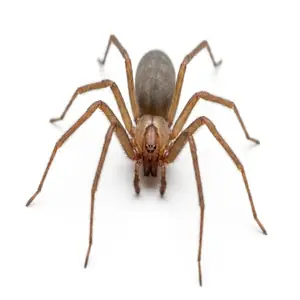
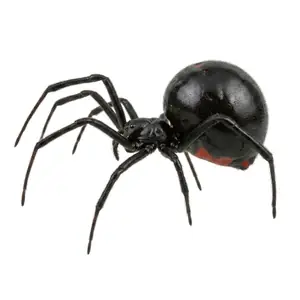
12Stops Per Day
Other companies run 20+ stops a day. We cap at 12. That extra time is what it takes to actually dust the crevice interior, wait for it to work, confirm control before sealing, and correctly identify the spider so you know whether you have a Southern House Spider or something that actually needs emergency treatment.