Home Pest Library Spiders Jumping Spider
Jumping Spider (Bold Jumping Spider, Daring Jumper)

Jumping Spiders in Collin County, TX | Identification and Control

Last updated 2026

Jumping spiders are the small, compact, big-eyed spiders that look directly back at you from your fence railing or windowsill. They are completely harmless, they hunt during the day, and they eat the mosquitoes, flies, and moths that are actually bothering you. Treatment for jumping spiders is almost never justified. Knowing what they are and why they are there is the full resolution for most encounters.
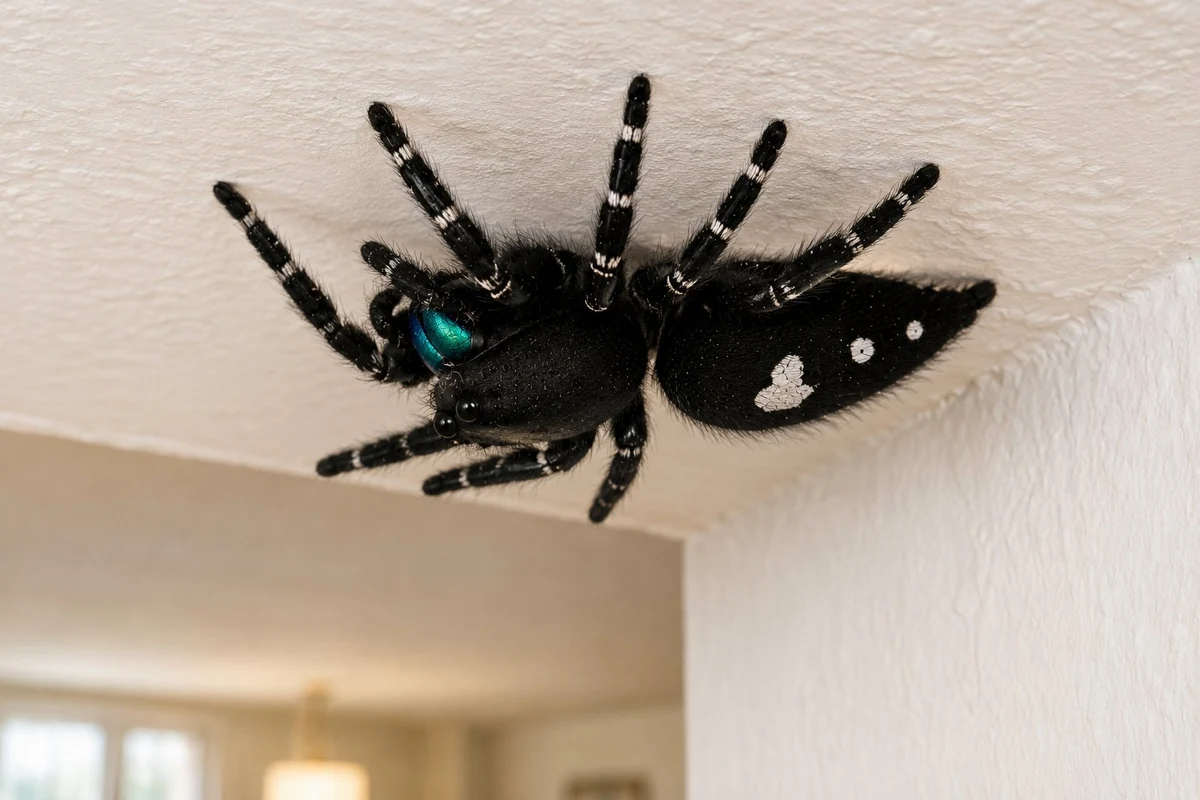
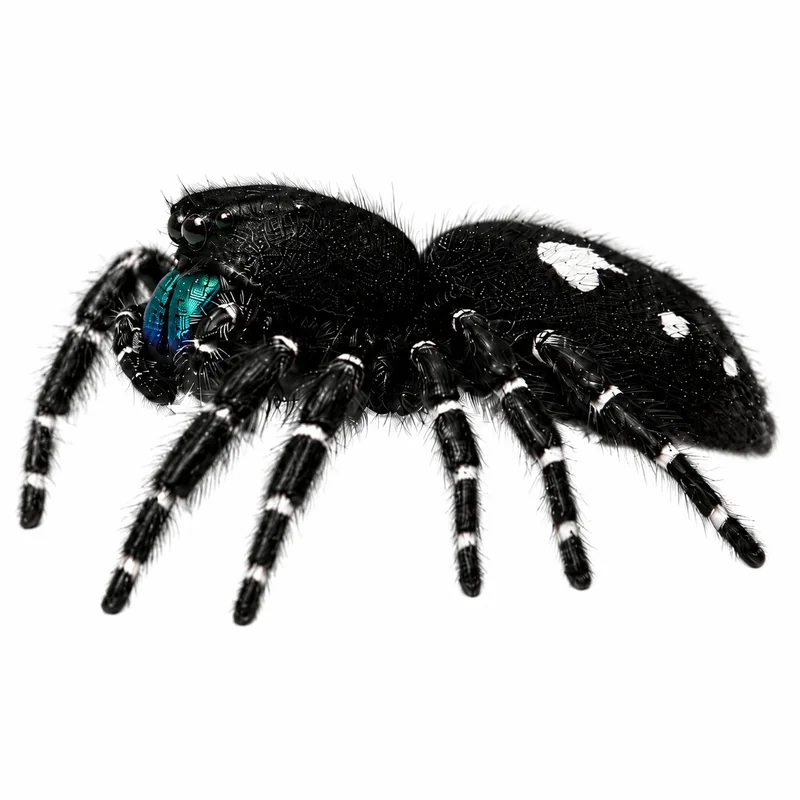
Bold jumping spider on fence railing showing large forward-facing eyes, black body with white spot, and iridescent chelicerae
Bold jumping spider specimen showing large anterior median eyes, black body with white spots, and metallic green chelicerae
Jumping Spider
Phidippus audax
AKA Bold Jumping Spider · Daring Jumper · White-Spotted Jumper
Body lengthFemale 0.31 to 0.59 in (8-15 mm); male 0.24 to 0.51 in (6-13 mm)
Leg span0.6 to 1 in (15-25 mm)
Adult lifespanAbout 1 year; females slightly longer
Active seasonApril through September peak; overwinters as immature in sheltered locations
PreyFlies, mosquitoes, moths, caterpillars, small insects
Hunting styleActive daytime visual hunter; stalks and pounces with silk safety line
Eye featureTwo enormous forward-facing eyes; iridescent green or blue chelicerae
Threat levelLOW

A compact, daytime-hunting spider with two enormous forward-facing eyes and iridescent green chelicerae. Harmless, highly beneficial, and one of the few spiders that will look directly back at you with apparent curiosity. Jumping spider identification and facts confirm their low-risk, high-benefit status.

PEST ME OFF | PEST LIBRARY | JUMPING SPIDER pestmeoff.com
North Texas Pest Calendar
Jumping Spider Activity in Collin County by Month

Jumping spiders are predominantly warm-season spiders in Collin County. Adults peak from April through September. Immatures overwinter in sheltered locations such as leaf litter, bark crevices, and garage corners. Texas’s mild winters allow survival through most of the cold season, and spring emergence begins earlier here than in northern states. Indoor encounters are most common in late spring and summer when adults are actively hunting near windows and doors.

Jan
Low
Feb
Low
Mar
Emerge
Apr
Peak
May
Peak
Jun
Peak
Jul
Peak
Aug
Peak
Sep
Peak
Oct
Slow
Nov
Low
Dec
Low
Dormant / Low
Emerging
Peak
Slowing

Pattern from iNaturalist observation records and Pest Me Off service call data across Collin County, 2023 to 2026.

Identification

What a Jumping Spider Looks Like

Two enormous forward-facing eyes, iridescent green chelicerae, black body with a white spot, and a tendency to look directly back at you – nothing in Collin County looks like this

The bold jumping spider (Phidippus audax) is the most distinctive spider in Collin County and one of the most visually recognizable in North America. The body is compact and stocky: 0.3 to 0.6 inches in length for adults, predominantly black or very dark brown, with a conspicuous white, orange, or red spot on the dorsal abdomen and smaller white spots ringing the abdomen perimeter. Juveniles may show orange spots that darken to white with successive molts.

The defining feature is the eye arrangement. Eight eyes are distributed in three rows, but the anterior median pair – the two enormous front-facing eyes – dominate the face and give the spider an almost vertebrate-like gaze. These eyes are true-imaging eyes with four layers of light receptors, providing resolution better than many mammals at close range. The spider can see you from several feet away and will track your movement by rotating its cephalothorax rather than moving its eyes. When you lean in for a closer look, the spider is already looking at you. The metallic green or blue chelicerae (the fang-bearing mouthparts at the center of the face) are iridescent and visible even at a short distance. No other common Collin County spider has this combination of features.
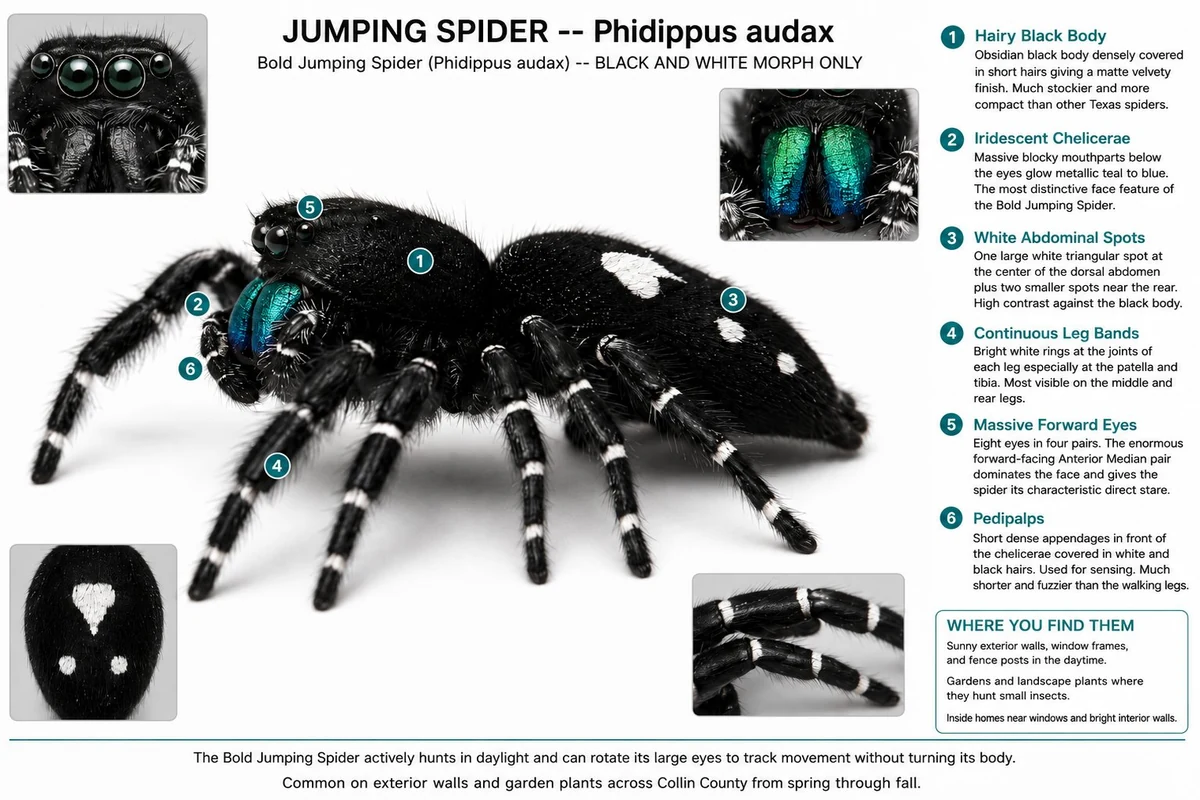
Jumping spider identification diagram with eye arrangement, chelicerae, and body marking callouts

Jumping spider identification diagram with eye arrangement, chelicerae, and body marking callouts

Dead GiveawaysWhat makes the bold jumping spider unmistakable
  • Two enormous forward-facing anterior median eyes visible from several feet away
  • Iridescent metallic green or blue chelicerae at the center of the face
  • Black or dark brown body with a bold white, orange, or red spot on the abdomen
  • Compact, stocky build; much shorter and stubbier than wolf spider or brown recluse
  • Moves in confident short jumps rather than sustained running
  • Active in full daylight; almost never seen at night (unlike most spider species)
  • Turns body to face and track your movement when approached
  • No capture web; small silken retreat used only for resting and egg laying
The Name

Why They Are Called Bold Jumping Spiders

The species name audax is Latin for “bold” or “daring,” which refers to the spider’s fearless behavior around humans. While most spider species retreat immediately when a large animal approaches, bold jumping spiders frequently hold their ground, turn to face the approach, and investigate with apparent curiosity. This behavior is what makes them a favorite with naturalists and wildlife photographers: they are the rare spider that will sit still while you photograph them from a foot away rather than running immediately.

The jumping behavior uses hydraulic leg pressure rather than muscular spring. The spider contracts muscles in the cephalothorax to increase blood pressure in the legs, causing a rapid extension that launches it up to 50 times its own body length. A silk dragline is always attached before a jump, functioning as a safety rope: if the spider misses or lands badly, it can climb back up the line. The family Salticidae is the most diverse spider family in the world, with over 6,000 described species. In Collin County, Phidippus audax is the most commonly encountered salticid. Texas bold jumping spider identification and behavior covers the hydraulic jump and dragline mechanics in detail.

Look-Alikes

How to Tell Jumping Spiders from Other Collin County Spiders

Jumping spiders are rarely confused with dangerous species by anyone who sees them clearly. The enormous forward-facing eyes and iridescent chelicerae are unmistakable. Confusion occurs primarily when the spider is seen briefly from a distance or in poor lighting, when only the black body with white markings is registered without the diagnostic eye and chelicerae features.

Species Size Key Feature Where Found
Jumping Spider
Jumping Spider AKA: Bold Jumping Spider, Daring Jumper Phidippus audax This species
0.31 to 0.59 in body; leg span 0.6 to 1 in. Compact, stocky, dense build. Much shorter and stubbier than wolf spider or southern house spider. Two enormous forward-facing eyes immediately visible. Iridescent metallic green or blue chelicerae. Black body with bold white, orange, or red abdomen spot. Moves in short confident jumps. Active in full daylight. Turns to face and track approaching observer. Fences, exterior walls, windowsills, garden plants, mulch beds. Daytime hunter in bright, open locations. Enters homes through open doors and windows. Primarily outdoor; does not establish indoor populations.
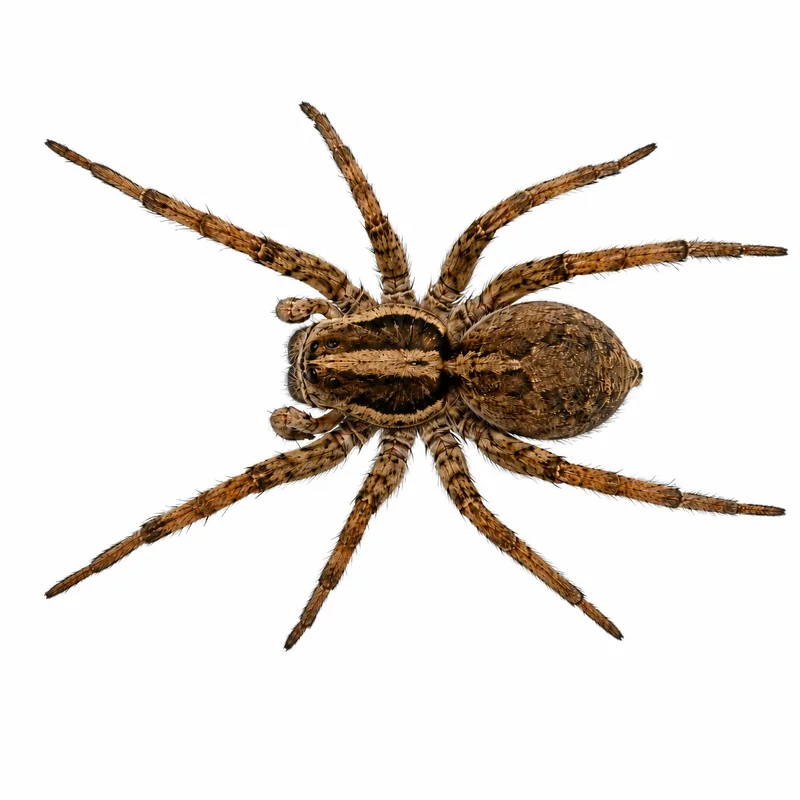
Wolf Spider
Wolf Spider AKA: Hairy Spider, Ground Spider Hogna carolinensis, Rabidosa spp.
0.5 to 1.5 in body; leg span up to 4 in. Much larger, stockier, and hairier. Three to five times the mass of a jumping spider. 8 eyes in 3 rows; large middle pair glows bright green under flashlight at night. Distinct stripes on cephalothorax; no iridescent chelicerae. Runs in sustained sprints on floors rather than jumping. Nocturnal. Does not turn to face observer. Open garage floors, under exterior doors. Ground hunter. Active at night, not in daylight. Enters in fall through gaps; peaks September and October.
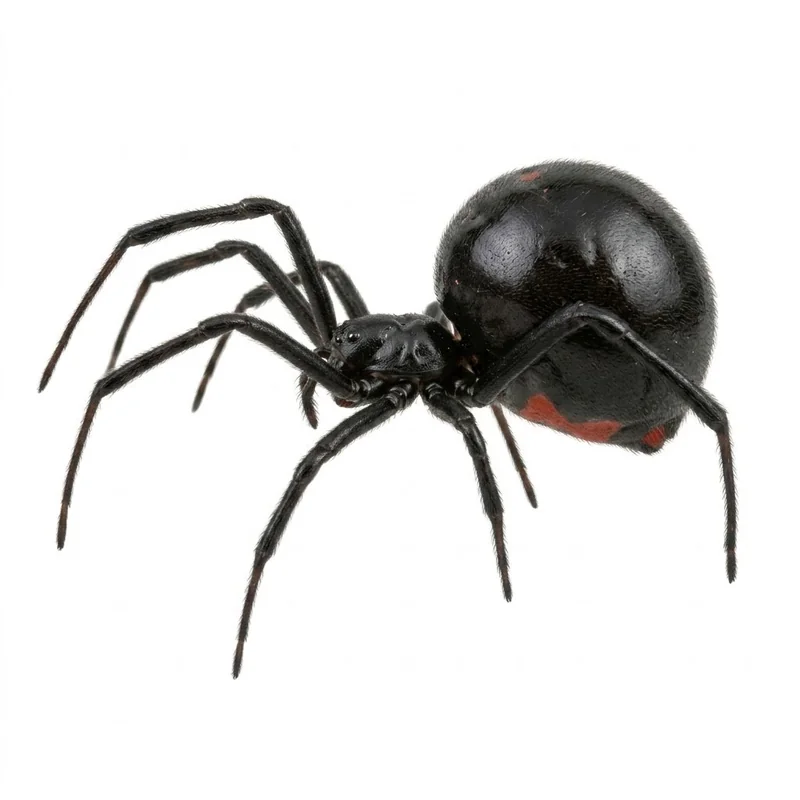
Black Widow
Black Widow AKA: Southern Black Widow, Hourglass Spider Latrodectus mactans
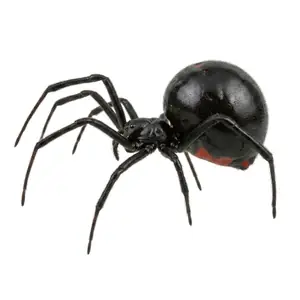
Female 0.5 in body; leg span 1.5 to 2 in. More elongated and lighter-built than jumping spider. Glossy jet black with no body hair visible at distance. Shiny jet-black body; bright red or orange hourglass on underside of abdomen. No large forward-facing eyes visible from the front. Hangs upside down in messy tangle web at ground level in corners. Does not jump. Nocturnal. MEDICALLY SIGNIFICANT. Garage corners near floor, water meter boxes, woodpiles, utility boxes, outdoor furniture interiors. Always associated with a messy low-level tangle web. Not on fences or plant surfaces in daylight.
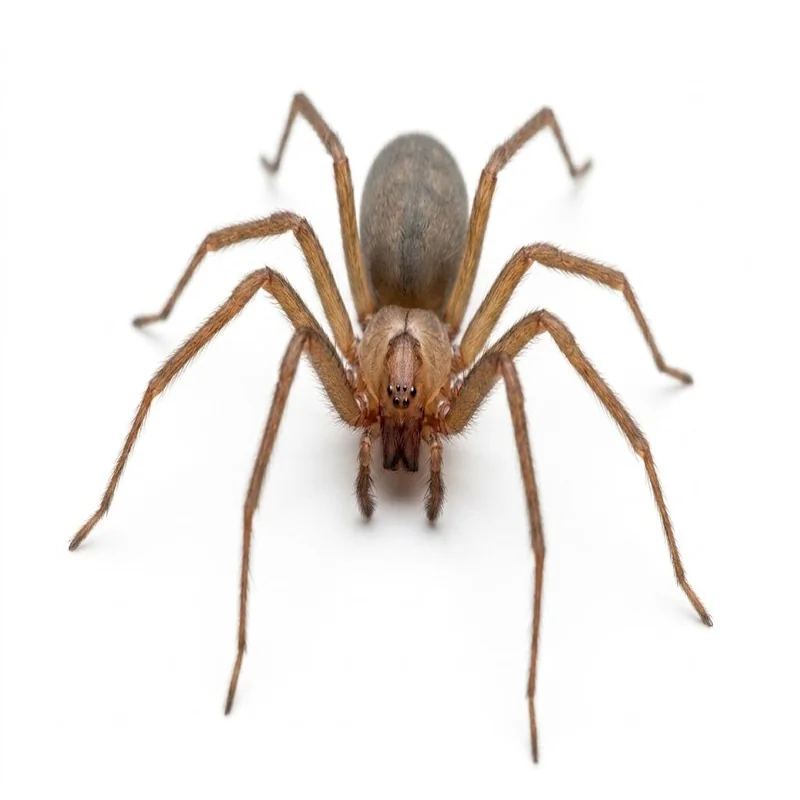
Brown Recluse
Brown Recluse AKA: Violin Spider, Fiddleback Loxosceles reclusa
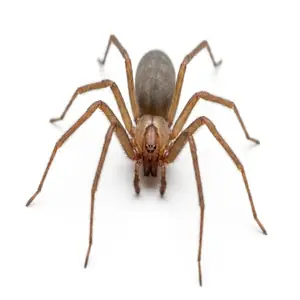
0.25 to 0.5 in body; leg span 1 to 1.5 in. Slender, lightly built. Matte tan to medium brown; no bold markings, no white spots. 6 eyes in 3 pairs (not 8). Violin-shaped mark on cephalothorax. No iridescent chelicerae. No bold body spots. Retreats quickly rather than turning to face observer. Nocturnal; found in dark storage, not on fences in daylight. MEDICALLY SIGNIFICANT. Dark undisturbed storage: closets, shoe boxes, garage shelving. Not on exterior walls, fences, or garden plants in daylight. Hides in clutter retreats.
The fastest field test for jumping spider identity: look for the two enormous forward-facing eyes and the metallic green or blue chelicerae. No other common Collin County spider has both. If you see a compact black spider on a fence in full daylight that turns to look directly at you, it is a jumping spider. Black widows hang in ground-level webs in corners and do not exhibit this behavior. Brown recluse are nocturnal and tan, not black with white spots. The daytime location and the two giant eyes close the identification completely.
Why Jumping Spider Scores 1 of 3 on People Risk

People Risk for Jumping Spider

Jumping spiders are functionally harmless to humans. Bites are extremely rare and require physically confining the spider against skin. The venom produces minor localized redness similar to a mosquito bite that resolves without treatment. The spider’s daytime hunting behavior, open habitat preference, and tendency to retreat or simply look at you rather than attack means accidental contact that produces a bite is genuinely uncommon. The question for most homeowners is not whether to treat them but whether to enjoy watching them hunt.

People Risk
1/ 3
Low
Medical Risk

Jumping Spider Bites: What Actually Happens

Jumping spider bites are among the least medically significant spider bites in North America. The venom is designed for subduing small insects and has no clinically relevant effect on humans. A bite produces minor localized redness, possibly a small welt similar to a mosquito bite, and mild itching that resolves within 24 hours without any treatment. No necrosis, no systemic effect, no medical concern.

Bites occur only when the spider is physically pinned against skin and cannot escape. A jumping spider on your arm, fence post, or windowsill is not attempting to bite you; it is watching you with its exceptional forward-facing vision and deciding whether to jump away or stay put. The bold behavior that makes them seem threatening – facing you directly, bobbing their front legs, moving toward you – is courtship and territorial display behavior, not aggression toward humans. These displays are directed at other jumping spiders, not at people. The spider is aware of you but not hunting you.

Good to Know
Jumping Spiders Eat Mosquitoes and Flies

A jumping spider on your garden plants or exterior wall is actively hunting mosquitoes, flies, moths, caterpillars, and other small insects. Studies have shown Phidippus audax selectively targets mosquitoes when given a choice of prey. In a McKinney backyard during peak mosquito season, a jumping spider population on the fence line and garden plants is providing measurable pest suppression for two of the most annoying insects in Collin County. Treating jumping spiders removes a natural mosquito and fly control layer that required no chemical application and no cost.

Context

When Jumping Spider Presence Is Worth Addressing

Jumping spiders almost never warrant treatment. The few scenarios where action makes sense are about homeowner comfort, not spider risk:

Worth Addressing

Repeated Indoor Encounters Through One Entry Point

Finding jumping spiders inside repeatedly through the same door or window suggests a consistent entry gap that is worth sealing. The spiders themselves need no treatment; sealing the gap stops indoor encounters without affecting the beneficial outdoor population.

Worth Addressing

Severe Arachnophobia in the Household

Jumping spiders’ tendency to face and approach observers can be deeply unsettling to people with arachnophobia even though the spider is harmless. In a home with a household member with severe arachnophobia, reducing interior encounters through gap sealing rather than chemical treatment is the appropriate response.

Low Priority

Single Spider on Porch Railing

A jumping spider on your porch rail is hunting the flying insects attracted to your exterior lights. It poses no risk and is providing a small benefit. Watch it hunt if you have a moment; catch and release indoors if it enters a space you do not want it in.

Low Priority

Jumping Spiders in the Garden

Garden populations of jumping spiders actively reduce fly, moth, and caterpillar pressure on plants. A jumping spider hunting on your tomato plants or rose bushes is performing natural pest suppression. No intervention is warranted or beneficial.

Low Priority

Jumping Spider Bobbing Its Front Legs at You

Leg waving and bobbing is courtship and territorial display behavior performed by jumping spiders toward other jumping spiders. When a jumping spider does this in your direction, it has misidentified you as a potential mate or competitor. It is not threatening. It is confused. The display is harmless and typically lasts a few seconds before the spider moves on.

Low Priority

Children Encountering Jumping Spiders

Jumping spiders are among the most child-safe spiders in North Texas. They are visible in daylight, they do not hide in clothing or bedding, their bite (in the extreme scenario where it occurs) is minor, and many children find their eye-contact behavior fascinating. This species is one of the reasons many children become interested in spiders and natural history. No safety concern exists for household contact.

Why Jumping Spider Scores 1 of 3 on Property Risk

Property Risk for Jumping Spider

Jumping spiders cause no property damage. They do not build capture webs, do not damage surfaces, do not infest stored goods, and do not establish indoor colonies. Their only indoor presence is opportunistic: individual spiders entering through open doors and windows in search of prey. They do not establish and will exit when the opportunity arises.

Property Risk
1/ 3
Low
Habitat

Where Jumping Spiders Come From in Collin County

Jumping spiders are primarily outdoor, open-habitat hunters. Their preferred environment is any surface with good sunlight exposure and access to flying insects: garden plants, exterior walls, fences, mailbox posts, rock walls, mulch beds, and landscape plantings. They are diurnal, meaning they are active in full daylight and retire to small silken retreats under bark, leaves, or crevices at night. The combination of daytime activity and open habitat preference makes them frequently visible but rarely problematic.

Interior encounters occur when jumping spiders follow insects through open doors or windows, or enter through gaps in window frames or door seals during hunting. Once inside, they typically move toward windows and bright light sources, hunting any flies or small insects in the space. They do not attempt to establish retreats indoors and will exit through any available opening when the opportunity arises. An indoor jumping spider is temporarily lost or hunting; it is not trying to live in your home. Bold jumping spider sightings and range data confirm how common they are across North Texas yards and gardens.

Local Presence

Jumping Spider Presence Across Collin County

Jumping spiders are present across all of Collin County during the warm season, with the highest observable populations in established neighborhoods with mature landscaping: Stonebridge Ranch, Tucker Hill, and El Dorado sections of McKinney; established Allen and Plano neighborhoods with mature trees and garden plantings; and greenbelt-adjacent properties in Frisco and Prosper. New construction areas in Celina and Melissa see lower populations until landscape vegetation establishes.

Service calls specifically for jumping spiders are uncommon because most homeowners recognize them as harmless on inspection or after a quick phone consultation. The more common scenario is a jumping spider identified during a broader spider service, where the recommendation is uniformly the same: leave it, or catch and release if found indoors. Chemical treatment for jumping spiders alone is not a service we have ever provided.

Perspective

Jumping Spiders Are Beneficial and Need No Management

Worth Knowing

Jumping spiders are natural mosquito and fly predators. Studies of Phidippus audax prey selection show active preference for mosquitoes when available. A garden population of jumping spiders during peak mosquito season is performing measurable pest suppression without any chemical application or cost. Treating jumping spiders removes a beneficial predator and replaces it with nothing. The correct response to finding jumping spiders in your yard is to observe them, appreciate them, and let them work. The correct response to finding one indoors is a cup, a card, and the nearest door.

Why Jumping Spider Scores 1 of 3 on Persistence Risk

Jumping Spider Biology and Seasonal Presence

Jumping spiders do not establish indoor populations, which means the persistence challenge that drives treatment decisions for recluse, widow, and southern house spider does not apply. Outdoor populations are naturally maintained by the surrounding landscape and are not a problem to be solved. Indoor encounters are individual events that resolve themselves when the spider finds an exit or is caught and released.

Persistence Risk
1/ 3
Low
Behavior and Biology

Jumping Spider Biology Worth Knowing

Vision Four-layer retina in anterior median eyes; resolution better than most mammals at close range The two large forward-facing eyes of a jumping spider are principal eyes with four types of photoreceptor cells, including one sensitive to ultraviolet light. Their resolution at close distances (within 8 inches) approaches that of humans. The secondary eyes arranged around the head provide near-360-degree motion detection. This visual system is what allows the spider to stalk prey at close range with precision and to track your movement when you approach.
Jumping Mechanics Hydraulic leg pressure launches jumps up to 50 times body length; silk dragline attached before every jump Jumping spiders jump by rapidly increasing hemolymph (blood) pressure in their legs through muscular contraction in the cephalothorax, causing explosive leg extension. The jump is precise enough to land on a moving fly. Before every jump, the spider attaches a silk dragline to the surface as a safety line. If it misses the target or lands badly, it can climb back up the line. This is why you occasionally see a jumping spider dangling from a silk thread at a window: it jumped, the landing was unsuccessful, and it is ascending the dragline back up.
Diurnal Activity Active in full daylight; retires to silk retreat at night and during cold or overcast periods Jumping spiders are one of the few primarily daytime spiders in North Texas. Their exceptional vision is designed for bright-light conditions. They hunt from mid-morning through mid-afternoon in full sun and are rarely active at night. This makes them highly visible and identifiable compared to nocturnal spiders. If you find a small black spider actively hunting on an exterior wall at noon in July, it is a jumping spider. A spider of similar size found in dark storage or running on a garage floor at night is something else.
Courtship Display Males wave front legs and display colored body patches in elaborate pre-mating dances Male jumping spiders perform some of the most complex courtship displays of any spider: leg waving, body bobbing, lateral movements, and flashing of iridescent chelicerae. These displays are performed toward females and other males. When a jumping spider performs this display in your direction, it has likely triggered on your movement and is running through its display behavior before it processes that you are not another spider. The display is harmless and fascinating to watch. No aggression toward humans is involved.
Prey Selection Actively hunts flies, mosquitoes, moths, caterpillars; documented preference for mosquitoes Jumping spiders are generalist visual predators but show active preference for mosquitoes in prey selection studies. A jumping spider hunting on your exterior wall or garden plants is systematically reducing the flying insect population in that zone. This benefit is real, measurable, and occurs continuously during the warm season without any intervention or cost. It makes jumping spiders one of the most pragmatically beneficial spiders in Collin County for homeowners dealing with mosquito pressure.
Overwintering Immatures overwinter in silken retreats under bark, leaves, and in sheltered crevices Unlike some Texas spider species that die at first freeze, jumping spider immatures overwinter in sheltered silken retreats and emerge in spring as the temperature rises. Texas’s mild winters allow most immatures to survive through the cold season and begin hunting earlier in spring than in northern states. This year-over-year continuity is what produces consistent jumping spider populations in Collin County gardens without requiring annual re-establishment from the south.
Pest Me Off Translation
Anterior median eyes The two huge front-facing eyes that give jumping spiders their distinctive direct gaze and near-vertebrate-quality vision at close range.
Dragline silk The safety rope of silk a jumping spider attaches to a surface before every jump, allowing it to climb back if the jump misses or lands badly.
Salticidae The jumping spider family; over 6,000 described species worldwide, all sharing the enlarged front eyes and hydraulic jumping mechanism. The most species-rich spider family on Earth.
Reality Check

Things You Should Know About Jumping Spiders

Facts that make encounters more interesting and responses more appropriate

1
When a jumping spider turns to look directly at you, it is genuinely looking at you with near-human visual resolution at close range.Why this matters. The eye-contact behavior that many people find unsettling is real visual tracking, not a reflexive posture. The spider can see your eyes, your hands, and your movements with resolution comparable to humans at close range. It is deciding whether you are a predator, a potential mate, or a competitor. This is why they seem unusually aware and interactive compared to other spiders; they actually are.
2
The leg-waving and bobbing display directed at you is courtship or territorial behavior toward another spider, not aggression.Why this matters. A jumping spider waving its front legs at you has triggered on your movement and is running its display program. It processes you as a potential competitor or mate. The display will stop when the spider realizes you are not another jumping spider, which takes a few seconds. It is not preparing to attack. If you hold still, the spider will reassess and move on.
3
A jumping spider hanging from a silk thread at your window jumped and missed, not fell from the ceiling.Why this matters. Before every jump, the spider attaches a dragline. When a jump does not stick or the surface is unsuitable, the spider dangles from the thread and climbs back up. If you see one dangling at eye level indoors, it jumped from a nearby surface toward an insect or another surface and is now ascending the thread. It is doing exactly what it is supposed to do. You can capture it easily at this moment if you want to relocate it.
4
Jumping spiders eat mosquitoes with documented prey preference for them over other available insects.Why this matters. In a Collin County summer, mosquitoes are a real quality-of-life issue. A jumping spider population on your fence and garden plants is actively reducing the mosquito population in that zone. This is a service that requires no application, no cost, and no scheduling. Treating jumping spiders removes this service. The cost-benefit analysis for treating jumping spiders is never favorable when mosquito reduction is factored in.
5
Jumping spiders can leap up to 50 times their body length using hydraulic pressure, not muscle spring.Why this matters. The jump is powered by a sudden increase in blood pressure in the legs, not by a mechanical spring mechanism. This makes the jump both powerful and extremely precise – the spider controls direction, speed, and landing with high accuracy even targeting moving flies. Attempts to swat a jumping spider usually fail because the spider has already seen your hand moving and jumped before contact. A glass and card are more reliable than a swat.
Why Jumping Spider Scores 1 of 3 on Difficulty to Treat

Managing Jumping Spider Encounters

Jumping spiders do not require treatment. The management response for an indoor jumping spider is catch and release. The management response for an outdoor population is none at all, or if indoor entry is frequent, gap sealing at the specific entry point. Chemical treatment for jumping spiders introduces pesticide exposure for a spider that is actively beneficial and poses no risk. No pest professional who has assessed the situation accurately recommends chemical treatment for jumping spiders as a primary target.

Difficulty to Treat
1/ 3
Low
SPIDER CONTROL
Management

How Pest Me Off Handles Jumping Spider Encounters

When we encounter jumping spiders during a broader spider service, our response is identification and education. We confirm the species, explain why it is beneficial, and recommend against treatment. If a homeowner wants interior encounters reduced, we find the entry gaps and seal them rather than applying pesticide. We have never recommended chemical treatment for jumping spiders as a primary pest target.

Step 1

Confirm the Identification

Visually confirm the two large forward-facing eyes, iridescent chelicerae, and compact black body with white spots. If all three features are present, the identification is certain. No other Collin County spider combines these traits. Correct identification takes ten seconds and eliminates any treatment urgency.

Why this step: No other step matters until the species is confirmed. A jumping spider that is misidentified as a black widow or brown recluse drives an unnecessary emergency response. The identification is so visually distinctive that it should always be the first and typically last step before any response decision.
Step 2

Catch and Release for Indoor Encounters

Place a clear cup over the spider. Slide a stiff card under the cup rim. The spider typically jumps onto the cup interior or card rather than running away. Carry cup and card to the nearest exterior door and release. The spider is gone, no chemicals were applied, and the beneficial outdoor population is unchanged. This takes approximately thirty seconds.

Why this step: The cup-and-card method works reliably for jumping spiders because their jump behavior is predictable: they jump toward the cup interior when they detect movement at the cup rim. They do not try to run under the card. The result is reliable indoor removal without any chemical application.
Step 3

Seal Entry Gaps If Indoor Encounters Are Frequent

If jumping spiders are entering through the same window, door gap, or utility penetration repeatedly, seal the gap. This resolves indoor encounters without affecting the outdoor population and without chemical treatment. Focus on gaps at window frames, door sweeps, and any utility penetration that was not caulked during construction.

Why this step: A jumping spider entering through a specific gap is following insects through that gap. Sealing it stops both the spiders and the prey insects they are following. The outdoor population continues to hunt the yard and exterior surfaces; the indoor encounters stop because the entry route is closed.
Step 4

No Chemical Treatment in Standard Scenarios

Residual pesticide application for jumping spiders is not recommended. The spider is harmless and beneficial. The pesticide exposure produces no net benefit and removes a natural mosquito control layer from the treated area. Any company recommending chemical treatment specifically for jumping spiders as a primary target is not providing accurate pest management advice.

Why this step: This is the outcome of the previous three steps. Identify: it is a jumping spider. Remove if indoors: cup and card. Reduce entry if frequent: seal the gap. No chemical treatment justified. The response is proportionate to the actual risk, which is negligible.
Pest Me Off
Correctly identify the spider in ten seconds. Tell you it is harmless and eating your mosquitoes. Suggest catch and release for the indoor individual. Find and seal the entry gap if you want indoor encounters to stop. Recommend you leave the outdoor population entirely alone. No chemicals. Done in one visit with no future billing for a spider that was never your problem.
Store Products
& Other Companies
Spray perimeter for spiders. Kill the jumping spider population on your fence line and garden. Schedule next quarterly visit. The mosquito and fly population that the jumping spiders were controlling is now slightly higher. You paid for treatment of a beneficial spider and received a slightly worse mosquito situation in exchange. The jumping spiders will be back by next season anyway because the outdoor population is not eliminated, it is suppressed temporarily.
Do It Yourself
Jumping Spider: What to Do and What Not to Treat
The spider is harmless and beneficial – the correct DIY response is almost always to leave it alone
DIY Management

DIY Jumping Spider Management

Management for jumping spiders is minimal. Outdoor populations need nothing. Indoor encounters need catch and release. Frequent indoor entry needs gap sealing.

1
Catch and release for indoor spiders. A clear cup placed over the spider and a stiff card slid underneath is the complete solution for an indoor jumping spider. They jump toward the cup rather than running from it; capture is usually quick. Take the cup to the nearest exterior door and release. No chemicals, no fuss, spider is back doing useful work in your yard within the hour.
2
Seal window and door frame gaps if entry is frequent. Jumping spiders enter through the same gaps that flies use. If you are finding one inside more than once or twice a week during peak season, there is a gap worth sealing. Caulking the gap resolves the entry without affecting the outdoor population.
3
Leave the outdoor population alone. Jumping spiders on your fence, exterior walls, and garden plants are eating mosquitoes and flies. This is a benefit with no associated cost. Treating them removes the benefit and requires re-application every season as the population naturally re-establishes from surrounding areas.
4
Use your phone camera to zoom in before making any treatment decision. If you are uncertain whether the small black spider on your porch is a jumping spider or a black widow, zoom in with your phone camera. Two enormous forward-facing eyes and metallic green chelicerae: jumping spider, no action needed. If you cannot see large front eyes or the spider is hanging upside down in a messy web at ground level: look more carefully before assuming harmless.
DIY Pitfalls

Why Some DIY Responses Are Wrong for Jumping Spiders

Speed Problem

Trying to Swat a Jumping Spider

Jumping spiders see your hand coming before your hand arrives. They have jumped before contact in most swat attempts. The spider is also fast enough to jump 50 times its body length per leap, meaning a missed swat sends it across the room. A cup is faster and more reliable than a swat for a spider with near-human visual acuity at close range.

Wrong Tool

Glue Traps for an Actively Jumping Spider

Glue traps work by contact when a spider walks across them. Jumping spiders routinely jump over surfaces rather than walking across them and avoid unfamiliar substrates with good eyesight before contact. Glue trap capture rates for jumping spiders are low. More importantly, there is no reason to trap a spider that can be cup-and-carded in thirty seconds.

Misidentification

Treating a Jumping Spider as a Black Widow

Both are black. Both appear on exterior surfaces. The differences are fundamental: jumping spiders are active in daylight on fences and garden plants; black widows hang upside down in ground-level tangle webs in dark corners. Jumping spiders have huge forward-facing eyes; black widows have a distinctive red hourglass on the abdomen underside. Treating a jumping spider population in a garden as if it were a widow infestation is a misidentification that costs money and removes a beneficial predator.

Removing Allies

Broad Perimeter Spray During Mosquito Season

Applying broad perimeter pyrethroid (insecticide chemical family) in the spring or summer when jumping spiders are active on the fence line and garden plants kills the jumping spider population along with the target pests. The mosquito and fly population that jumping spiders were suppressing is now uncontrolled. This outcome is worse than the pre-treatment state from a net insect-control standpoint. Targeted perimeter applications should avoid the garden and fence areas where beneficial jumping spiders are concentrated if outdoor insect activity is the actual concern.

Unnecessary Exposure

Indoor Fogger for a Single Jumping Spider

A fogger applied to a room where a single jumping spider was seen introduces significant chemical exposure for a completely harmless spider. Jumping spiders are mobile and often avoid fog by jumping to untreated surfaces. The result: unnecessary pesticide exposure in your living space, a spider that may or may not have died, and no lasting benefit. Cup-and-card takes thirty seconds with zero chemical exposure and produces a certain, observable result.

Windex or Hairspray

Spraying Household Products at the Spider

Homeowners occasionally spray Windex, hairspray, or other household liquids at jumping spiders. These products may irritate the spider or cause it to retreat into a crevice but rarely kill it outright. The result is a spider now hidden in a crack somewhere in the room rather than visible on the wall. A spider in a wall crack is harder to catch and release than one visible on an open surface. The cup approach works; the Windex approach makes the problem harder.

Operational Questions

Common Jumping Spider Questions

No. A compact black spider with a white or orange dot on its abdomen, active in full daylight on a fence or porch railing, is almost certainly a bold jumping spider (Phidippus audax). They are completely harmless. The two enormous forward-facing eyes and the metallic green or blue chelicerae at the center of the face confirm the identification if you can get a closer look with your phone camera. Jumping spiders are beneficial predators that eat the flies and mosquitoes on your property. No action is needed.
Because it is genuinely looking at you. The two large anterior median eyes have four-layer retinas and can resolve detail comparable to human vision at close range. When you approach a jumping spider, it registers your movement with its secondary side-facing eyes, then rotates its cephalothorax to bring you into the field of the large front eyes for a closer look. It is processing whether you are a threat, a competitor, or neither. The direct eye-contact behavior that many people find unsettling or almost cute is real visual attention, not a reflexive posture. It knows you are there.
They can, but bites are extremely rare and require physically confining the spider against skin. A jumping spider on your wall, fence, or arm is not attempting to bite you; it is watching you and deciding whether to stay or jump away. Bites occur almost exclusively when a spider is pinned accidentally, such as by sitting on one or pressing an arm against a surface where one is resting. Even then, the result is minor: brief localized pain and redness similar to a mosquito bite that resolves without treatment within 24 hours.
Yes, but the venom is not medically significant to humans. All spiders have venom; it is how they subdue prey insects. Jumping spider venom is effective for killing small insects and is completely harmless to humans and household pets. No jumping spider bite has been documented as medically significant in any US poison control center report. The spider’s venom system is simply not designed for animals larger than a fly.
A bold jumping spider. The two enormous forward-facing eyes, compact black body with a white or orange spot on the abdomen, and daytime activity on fences and exterior walls confirm the identification. The direct gaze is real: these spiders have exceptional vision and actively track movement. They are harmless, beneficial, and one of the most visually distinctive spiders in North Texas. No other spider in Collin County combines the large front-facing eyes, iridescent green chelicerae, and the tendency to turn and face you.
No. Catch and release is the recommended response. A cup placed over the spider and a card slid underneath takes thirty seconds and relocates the spider to your yard where it can continue hunting mosquitoes and flies. Killing a jumping spider indoors removes a beneficial predator for no benefit: the spider was not dangerous, not establishing a population, and not causing any problem. The cup-and-card approach is faster than finding a way to kill it and produces a better outcome.
No capture webs. Jumping spiders do not build the prey-trapping webs that most people associate with spiders. They are active visual hunters that stalk and pounce. They produce silk for two purposes only: a dragline (safety rope) attached before every jump, and small silken retreats used for resting, molting, and egg laying. These retreats are tiny and typically hidden under bark or leaf litter outdoors, or in a small crevice indoors. An indoor jumping spider is not building a web; it is hunting flies near your windows.
The large anterior median eyes are principal eyes with four types of photoreceptor cells and resolution comparable to human vision at close range. This exceptional vision is what allows jumping spiders to stalk moving fly prey with precision, judge distances accurately before a jump, and recognize other jumping spiders for courtship and territorial displays. The visual system is more sophisticated than that of most other spiders, which rely primarily on vibration and touch. The trade-off is that jumping spiders are heavily vision-dependent and significantly less effective in poor lighting conditions, which is why they are daytime hunters.
Up to 50 times their body length in a single leap. For a jumping spider with a 0.5-inch body, that is a jump of up to 25 inches. The jump uses hydraulic leg pressure rather than a spring mechanism: muscles in the cephalothorax contract to increase blood pressure in the legs, causing sudden extension that launches the spider. The jump is accurate enough to land on a moving fly at a distance. Before every jump, the spider attaches a silk dragline to the surface as a safety line, allowing it to climb back if the landing is unsuccessful.
Yes, and this is one of their most distinctive characteristics. Jumping spiders are primarily diurnal, meaning they are active in full daylight and hunt during the day. Most North Texas spiders are nocturnal or crepuscular. If you see a small, compact black spider actively hunting on an exterior wall, fence, or garden plant in full midday sun, it is almost certainly a jumping spider. Their exceptional vision is adapted for bright-light conditions and is significantly less effective at night, which is why they hunt in daylight and retire to silk retreats after dark.
Yes, measurably so. Jumping spiders are generalist visual predators that eat flies, mosquitoes, moths, and caterpillars. Studies of Phidippus audax prey selection show documented preference for mosquitoes when available. A jumping spider population on your fence line and garden plants during peak season is providing continuous mosquito and fly suppression without any chemical application or cost. Treating jumping spiders eliminates this benefit and requires the population to re-establish naturally over the following season before that suppression returns.
For an individual spider indoors: cup and card, thirty seconds, done. For repeated indoor encounters: find and seal the entry gap. Jumping spiders enter through the same gaps that flies use – window frame gaps, door sweep failures, utility penetrations. Caulk the gaps and indoor encounters stop without any effect on the outdoor population. Chemical treatment for jumping spiders indoors is not recommended and is not proportionate to any actual risk they pose. If a company is recommending pesticide application specifically for jumping spiders as the primary target, that recommendation is not accurate pest management.
What's Bugging You?

Jumping Spiders at Your Windows. Usually Good News. We Will Tell You If It Is Not.

We will tell you accurately when a spider is harmless and when it is not. Jumping spiders: harmless, beneficial, leave them alone. Black widow in the same garage corner: different story. We find what is actually there, identify it correctly, and treat what actually needs treatment – across McKinney, Allen, Frisco, Plano, and all of Collin County.
12Stops Per Day
Other companies run 20+ stops a day. We cap at 12. That extra time is what it takes to correctly identify a spider before recommending treatment, to tell you when treatment is not warranted, and to find the actual problem if something more serious is sharing the same garage with your jumping spiders.