Little Black Ants in Collin County, TX | Identification and Control
The Little Black Ant (Monomorium minimum), called the black ant or tiny black ant by most Collin County homeowners, is the smallest ant you are likely to find indoors. Workers run 1.5 to 2 mm, jet black, and nest outdoors in soil and ground debris before sending foraging trails inside through foundation cracks. No sting, no wood damage, no budding. Standard non-repellent perimeter treatment handles the colony in a single visit.
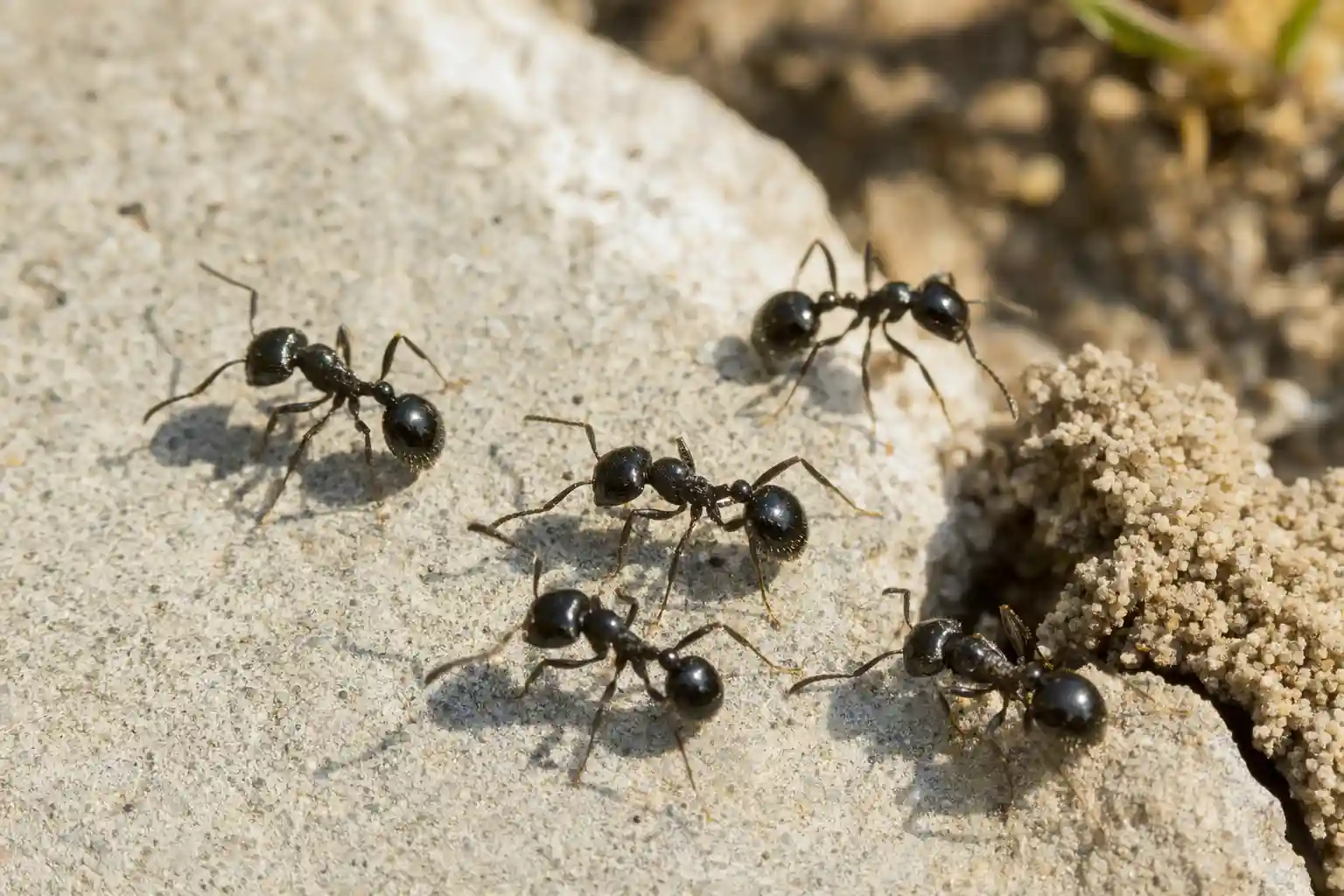
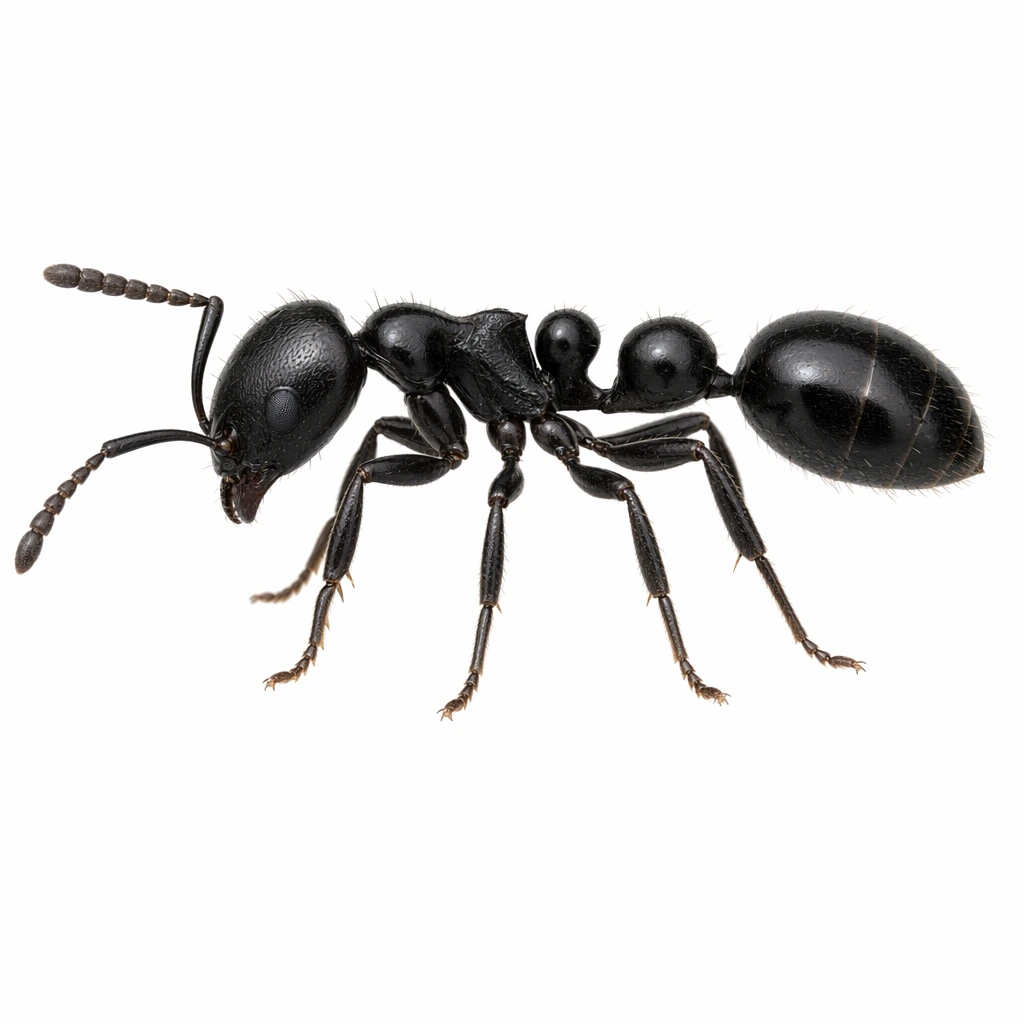
The smallest ant commonly encountered in Collin County homes. A purely outdoor nester that sends foraging workers inside through foundation gaps and expansion joints. No structural risk, no medical concern, and straightforward to eliminate with a single perimeter treatment visit.
Activity builds in spring and peaks through summer when workers range farthest from outdoor nests. Indoor kitchen trails are most common in June and July. Pressure drops sharply in late fall as outdoor colonies reduce foraging range.
Pattern from Pest Me Off service call records across Collin County, 2023 to 2026.
What Little Black Ants Look Like
Smallest ant in Collin County, with a diagnostic absence of odor that separates them from their nearest lookalike
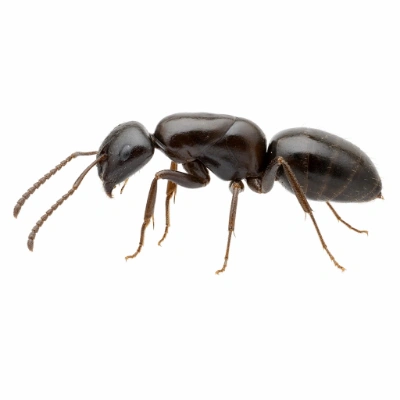
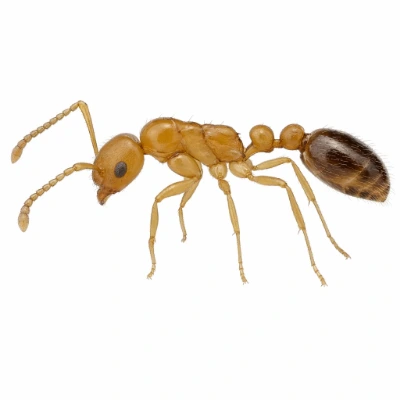
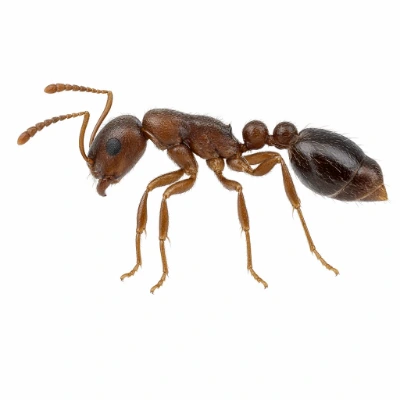
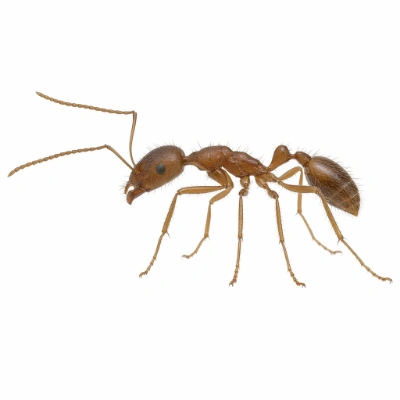
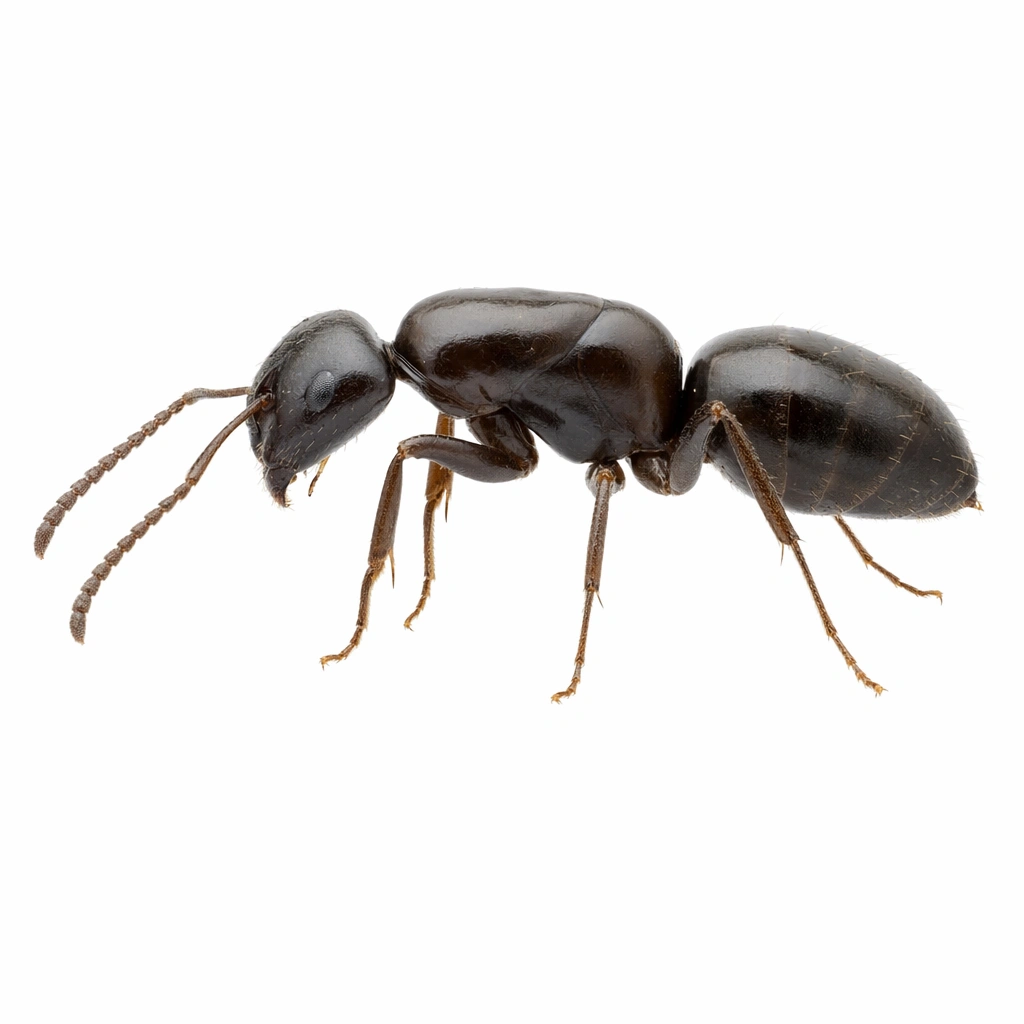
Little black ant workers are 1.5 to 2 mm, jet black, and shiny throughout. Every worker in the colony is the same size, making them monomorphic. There is no mixed-size lineup and no color variation. The body is a uniform, high-gloss black from head to abdomen, with no brown tones, no red segments, and no banding. At this size they are noticeably smaller than odorous house ants (2.4 to 3.3 mm) and substantially smaller than pavement ants (2.5 to 3 mm). Little black ant identification and behavior documentation consistently lists jet-black coloring and sub-2 mm size as the primary field markers.
The waist has two distinct nodes (bumps) between the midsection and the rear body segment. The body surface is smooth with no parallel grooves, which distinguishes them from pavement ants. No odor is produced when workers are crushed, which is the single most useful diagnostic: if the ant smells like rotten coconut when crushed, it is an odorous house ant. If there is no odor, and the ant is very small and jet black, it is almost certainly a little black ant. ant species identification and structural diagnostic guidance confirms the two-node waist and smooth body surface as primary field identifiers for this species.
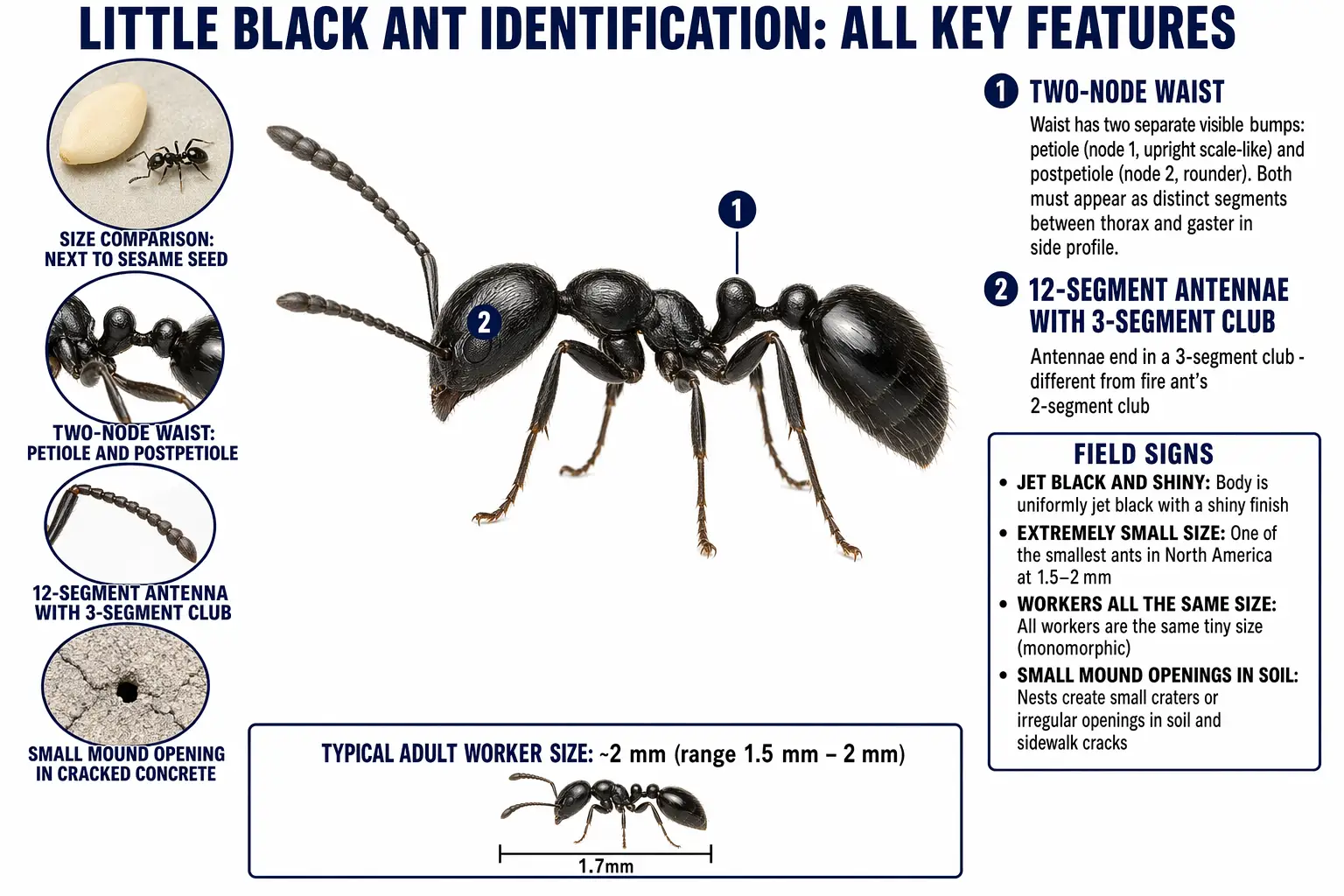
Little black ant identification diagram with anatomical callouts
- Called black ants or tiny black ants by most homeowners; the name comes from the jet-black color and visibly tiny size compared to every other ant found indoors
- Smallest ant in Collin County: 1.5 to 2 mm, noticeably smaller than any lookalike including odorous house ants and pavement ants
- Jet black and shiny throughout; no brown tones, no red segment, no color variation
- Two-node waist: two distinct bumps between midsection and rear body segment
- NO odor when crushed (unlike the odorous house ant, which smells strongly of rotten coconut)
- Smooth body surface with no parallel grooves (unlike the pavement ant, which has grooves on both head and midsection)
- Outdoor nest entrance at soil, debris, or rotting wood; small workers foraging in tight single-file lines indoors
Why Collin County Calls Them Black Ants
The name black ant is simply what the ant looks like: jet black, uniformly dark, with no color features to describe beyond the color itself. “Tiny black ant” is the extended version that adds size to the description. Both names stick because they are accurate and because there is nothing else memorable about this ant at a glance. It does not sting, does not smell when crushed, does not excavate wood, and does not build a visible outdoor mound. It is a small, black, unremarkable forager.
The scientific name takes a different approach. Monomorium minimum means “single-form, smallest.” Monomorphic means all workers are the same size (as opposed to fire ant size variation), and minimum refers directly to the size: the smallest commonly encountered Monomorium species in North America.
The most common identification confusion is with the Odorous House Ant (Tapinoma sessile). Both are small and dark. The crush test settles it in ten seconds: crush one worker between your fingers. Rotten coconut odor means odorous house ant. No odor means little black ant. The treatment implications are significant: odorous house ants maintain multi-queen satellite nests inside wall voids and bud when treated with repellent products. Little black ants nest purely outdoors and respond to a single standard perimeter visit.
How to Tell Little Black Ants from Other Ants in Collin County
Three ants are regularly mistaken for little black ants. Size and the crush test separate them without any equipment.
| Species | Size | Key Feature | Nesting Habit |
|---|---|---|---|
|
Little Black Ant
AKA: Black Ant, Tiny Black Ant
Monomorium minimum
This species
|
1.5 to 2 mm, jet black and uniform across all workers. The smallest ant routinely encountered indoors in Collin County, noticeably smaller than odorous house ants, pavement ants, and fire ants at a glance. | Jet black body with a smooth surface and no grooves on head or midsection. Two-node waist. No odor produced when workers are crushed, which is the fastest separation from odorous house ant. | Outdoor soil, rotting wood, and ground debris near the foundation. Foraging workers enter through foundation cracks and expansion joints. No permanent indoor satellite nests established in wall voids. |
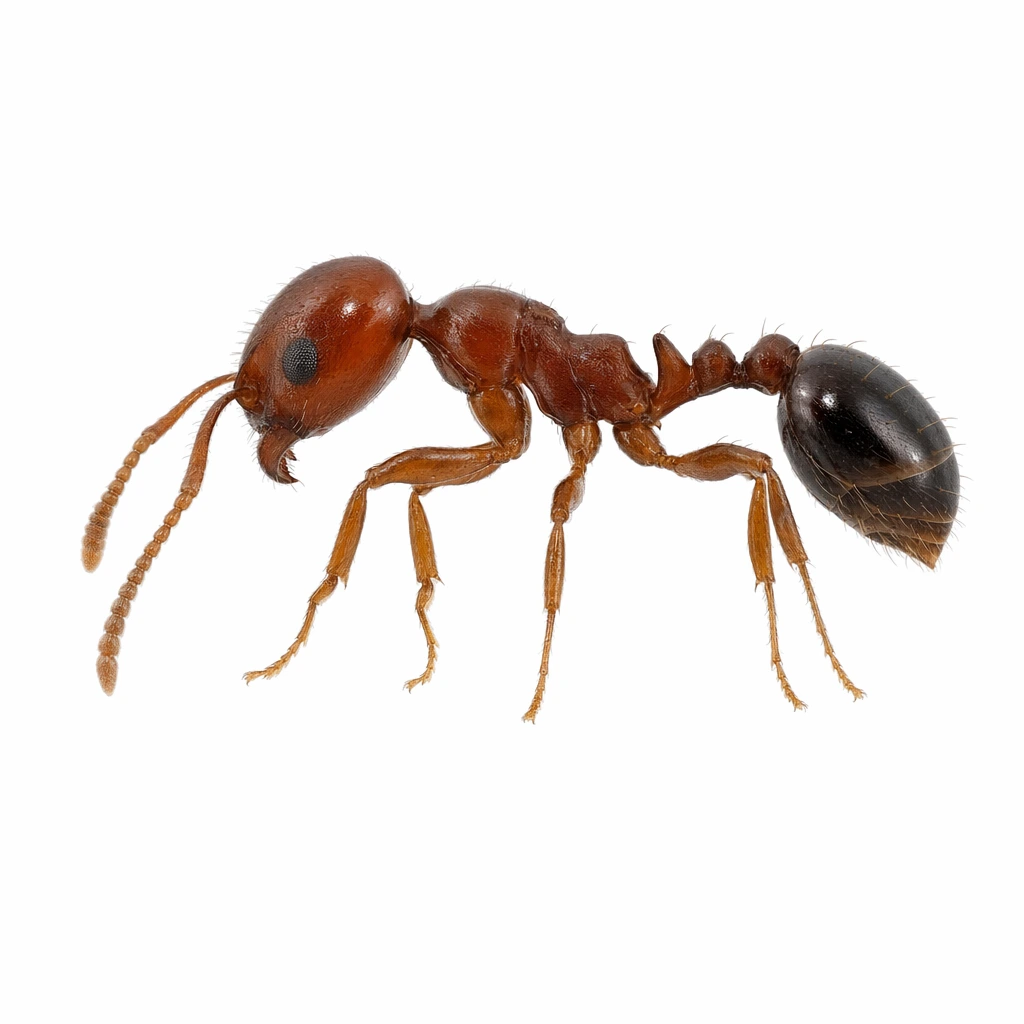
Fire Ant
AKA: Red Ant, Mound Ant
Solenopsis invicta
|
1.6 to 6 mm with clearly mixed worker sizes in the same colony. Reddish-brown body, which is immediately distinct from the jet-black little black ant even at small worker sizes. | Reddish-brown coloring on head and midsection. Aggressive swarming sting response within seconds of mound disturbance. Two-node waist, but no midsection grooves and no odor when crushed. | Dome mound with no central opening at the surface; entry tunnels exit through the mound sides. Mounds appear in lawns, foundation edges, and irrigation zones, not beneath concrete slabs. |
Odorous House Ant
AKA: Sugar Ant, Stink Ant
Tapinoma sessile
|
2.4 to 3.3 mm, dark brown to black and uniform across workers. Visibly larger than a little black ant when the two are side by side, though the difference is subtle enough that size alone is not a reliable field separator. | One-node waist, not two, though the node is nearly hidden under the rear body segment. Strong rotten coconut odor released when workers are crushed. Expands by satellite budding when repellent products are applied. | Wall voids, under insulation, and beneath flooring indoors; also outdoor soil and mulch beds. Maintains year-round indoor satellite nests, unlike the strictly outdoor little black ant. |
Pavement Ant
AKA: Sugar Ant, Sweet Ant
Tetramorium immigrans
|
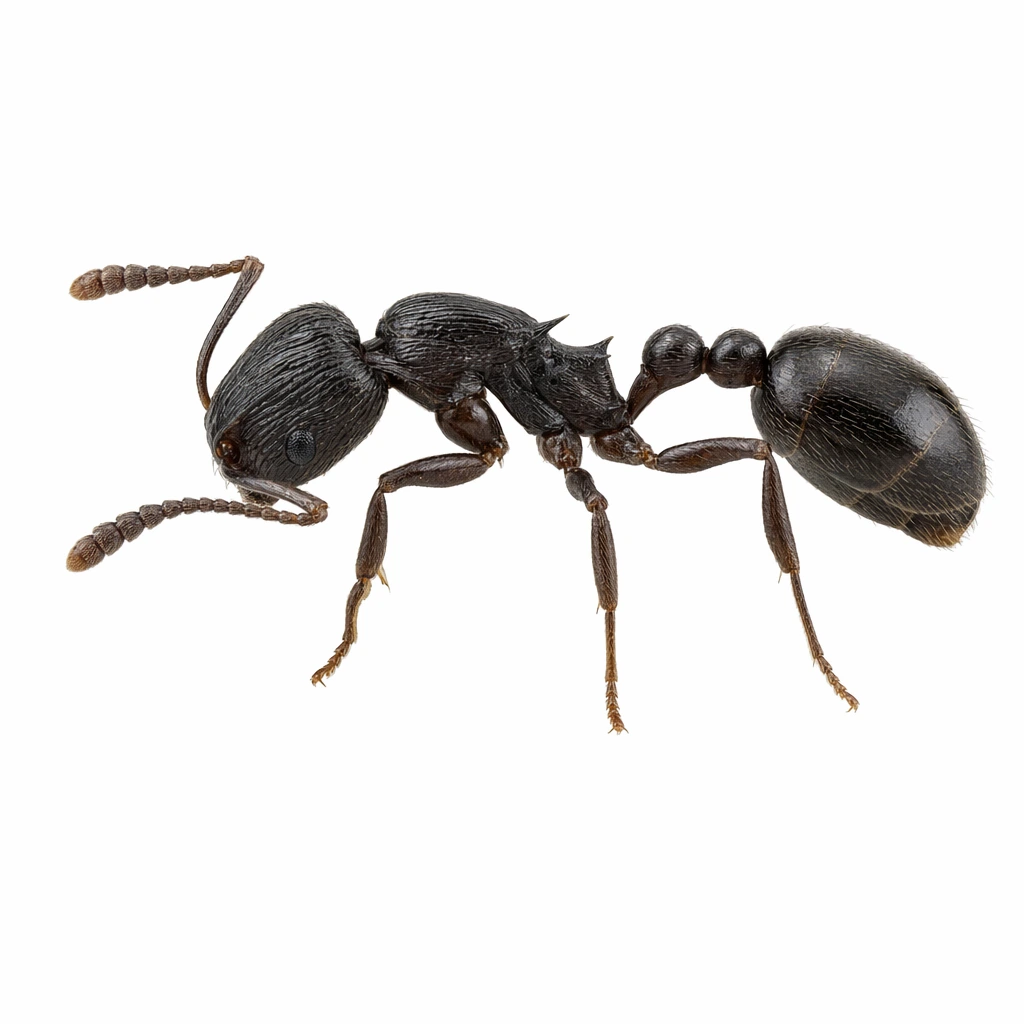
2.5 to 3 mm, dark brown rather than jet black, and slightly larger than a little black ant. The brown tone of the body is the fastest visual separator from the pure jet-black little black ant. | Parallel grooves (striae) run lengthwise on the head AND midsection, visible under magnification. Two-node waist. No odor when workers are crushed, same as little black ant. | Soil beneath driveways, sidewalks, and foundation slabs. Workers push sandy soil through surface cracks forming small cone-shaped piles. Nests under concrete rather than in loose outdoor soil or debris. |
Little Black Ants and Human Health
Little black ants possess a stinger but the venom apparatus is too small to deliver a meaningful sting through normal human skin. They are not medically significant, have no documented disease association, and are not known to trigger allergic reactions. If a trail has crossed food-prep surfaces or entered an open food container, discard the affected food and wash the surface with soap and water. No medical follow-up is needed for a standard little black ant encounter. The species is a nuisance pest only.
What Little Black Ants Actually Do to Your Property
Little black ants nest in outdoor soil, rotting wood, and ground debris. They do not excavate structural wood, do not nest in wall voids, and do not damage wiring or equipment. If you see coarse woody debris near a door frame or hear ticking sounds in walls at night, that is carpenter ant activity, not little black ant activity. Ant species identification and damage classification research places little black ants strictly in the food-contamination nuisance category with no structural damage potential. The only property issue is food contamination from foraging workers crossing kitchen surfaces and entering unsealed containers. Discard food the trail has reached, clean the surface, and close the entry point at the foundation or expansion joint. There is no structural concern with this species.
Little Black Ant Colony Behavior
Little black ant colonies nest in outdoor soil, rotting wood, and ground debris near the foundation. Workers forage indoors through foundation gaps and expansion joints to reach food sources, following scent trails with precision once a route is established. The colony itself never relocates inside the structure and does not produce satellite nests in wall voids. This is meaningfully different from odorous house ants, where repellent treatment triggers budding and expands the infestation. Ant foraging and nesting behavior guidance for homeowners draws this outdoor-only distinction clearly for little black ant. For little black ants, standard non-repellent bait placed along the active trail reaches the outdoor colony directly. Pressure is seasonal: activity slows significantly in Collin County winters, with active foraging typically running April through October.
How Pest Me Off Treats Little Black Ant Colonies
Ant-nihilation is our proprietary ant protocol that combines queen-targeted bait placement with a foundation barrier system called the Scorched Earth Barrier. For little black ants, non-repellent bait (a product workers carry back to the colony without detecting it as a threat) placed along active foraging trails reaches the outdoor colony through workers. Unlike odorous house ants, there is no wall-void satellite to address and no risk of budding when treatment is applied. The Scorched Earth Barrier applied along the full foundation perimeter closes the entry points that let foraging workers establish indoor trails and prevents new colonies from locating access points between service visits.
Inspect and Map Active Trails
Walk the kitchen and foundation perimeter to locate active foraging trails, trace each trail back to the foundation crack or expansion joint where workers are entering, and identify the outdoor nest entrance within 10 to 20 feet of the entry point in soil, debris, or rotting landscape material.
Trail-Targeted Non-Repellent Bait
Non-repellent bait is placed at the indoor pickup point along each active trail and at the foundation entry point where workers are concentrated. Workers carry the bait back to the outdoor colony. Trail activity collapses within 7 to 14 days. No yard-wide broadcasting is required for this species.
Scorched Earth Barrier at Foundation
The Scorched Earth Barrier is applied along the full foundation perimeter, expansion joints, and concrete seams where little black ant trails enter. This closes active entry points and prevents new trails from establishing from neighboring outdoor colonies between service visits.
Entry Point Closure and Seasonal Follow-Up
Foundation cracks and expansion joints identified at inspection are noted for caulking. Quarterly Scorched Earth Barrier maintenance is timed to spring (April through May in Collin County) to intercept early-season foraging scouts before they establish a trail route into the structure.
& Other Companies
DIY Little Black Ant Prevention
What Collin County homeowners can do between service visits
Why DIY Little Black Ant Control Keeps Failing
Little black ants look like an easy DIY target: small trail, simple entry point, nothing scary. The problem is that the standard homeowner response makes the situation worse or just moves it around without solving it.
Spraying the Trail With Repellent
Consumer ant spray kills the workers visible on the trail but leaves the outdoor colony and queen completely untouched. The surviving workers reroute around the treated area and re-establish a new trail through a different crack within hours to days. Repellent creates a barrier the ants walk around, not through. The trail moves. The problem does not go away. A product the workers cannot detect as a threat, carried home as food, is the only approach that reaches the source.
Placing Bait at the Wrong Location
Consumer bait stations placed in the kitchen near the food source are too far from the entry point and often in the wrong product form for little black ants. Workers need to pick up the bait and carry it back to the outdoor colony. Placing bait where the trail enters the structure, not where it ends at the food, is what makes workers pick it up on the way out rather than ignoring it on the way back. Wrong placement means the bait sits unused while the trail continues.
Treating Only Indoors
Little black ants nest outdoors in soil and rotting debris. The indoor trail is a foraging extension of an outdoor colony, not a colony living inside the structure. Spraying baseboards, caulking interior gaps, and placing traps at kitchen entry points all address the symptom. The outdoor colony keeps producing foragers. Until the colony is reached through a product workers carry home, indoor-only treatment is an indefinite holding action that never eliminates the source.
Using a Fogger or Aerosol Bomb
Indoor foggers disperse a fine insecticide mist that kills workers in the open air and coats surfaces. Little black ant workers that are inside wall voids, along foundation edges, or in trail lines beneath appliances avoid the treatment entirely. The product does not penetrate cracks, gaps, or the outdoor colony. Fogging drives surviving workers into less visible areas temporarily, which homeowners often interpret as the problem being solved. Activity resumes in the same locations within a week to two weeks as the outdoor colony continues sending foragers in.
Treating Once and Expecting It to Hold
Even correct bait placement takes 7 to 14 days to work through a little black ant colony. During that window the trail remains active, which most homeowners interpret as treatment failure. Wiping out the bait to try something else, or adding a repellent spray while waiting for bait to work, disrupts the transfer mechanism and resets the clock. One complete bait cycle, left undisturbed, is what produces lasting results. Impatience and layering products on top of each other is the most common reason a treatable ant problem drags on for months.
Little Black Ant FAQ
Black Ant Trails in Your Kitchen Start Outside. We Find the Colony and Bait It at the Entry Point.
We place non-repellent bait along every active little black ant trail, run the Scorched Earth Barrier along the full foundation perimeter, and close the entry points that let outdoor colonies reach your kitchen across McKinney, Allen, Frisco, Plano, and the rest of Collin County.