German Cockroaches in Collin County, TX | Identification and Control
German cockroaches (Blattella germanica), known to most Collin County homeowners as croton bugs or kitchen roaches, are the most common indoor cockroach in our service area. They breed continuously inside heated structures, and a single female can produce thousands of descendants in a year. They are also the most researched cockroach in pest control, which is why we treat them differently than every other roach we deal with. Field observations for German cockroach in Texas confirm year-round indoor presence across the Dallas-Fort Worth region.
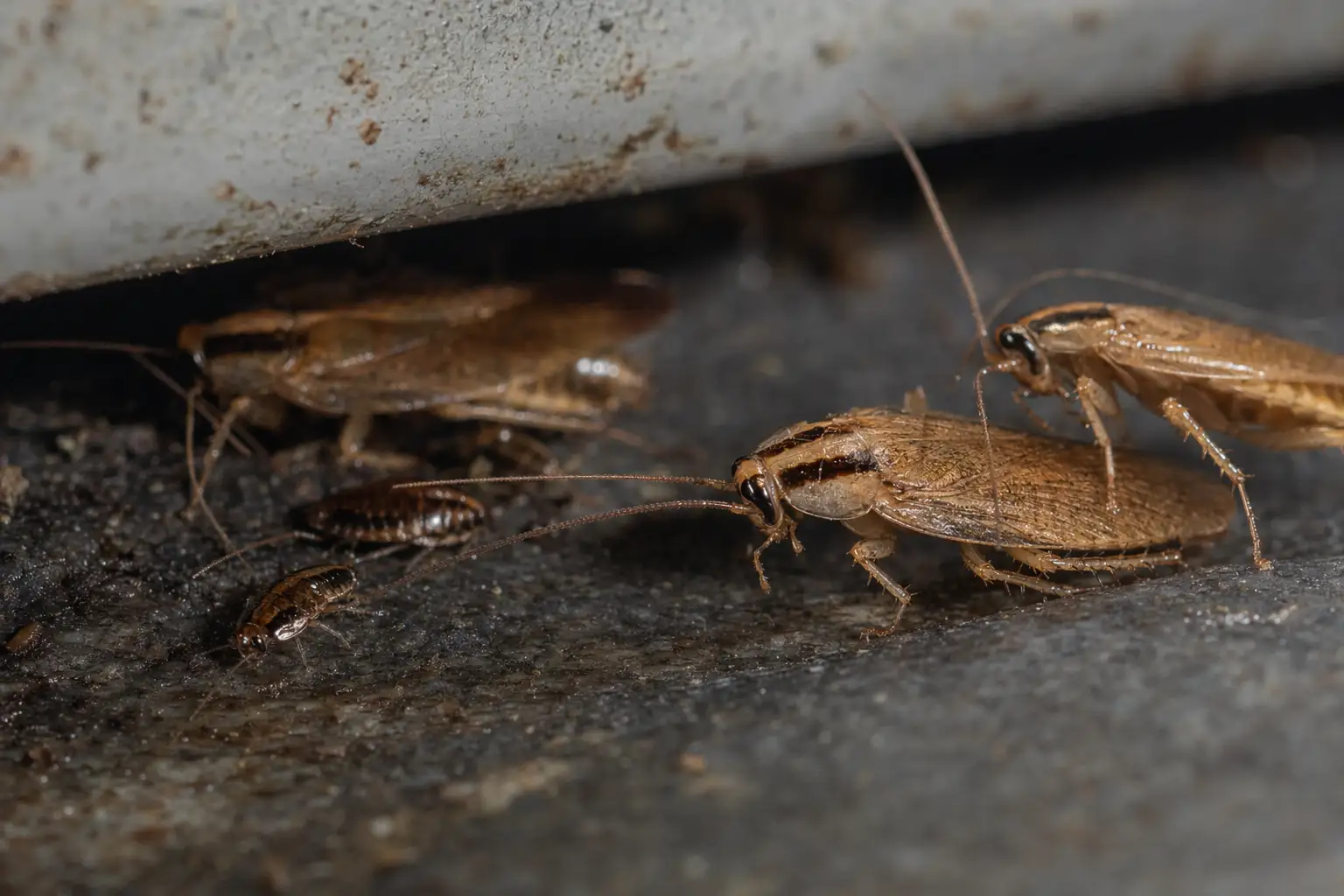
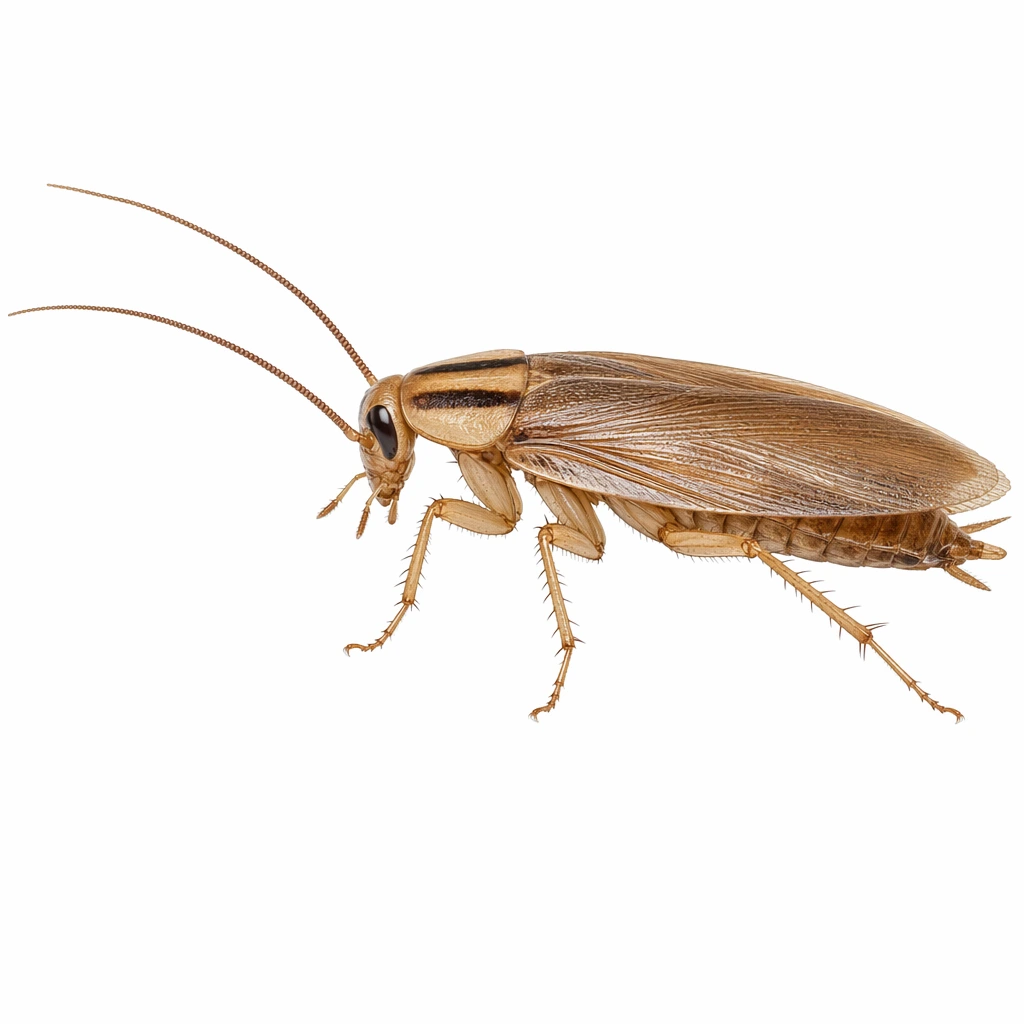
The most common indoor cockroach in Collin County. A strictly indoor species that arrived in North America via shipping commerce and now breeds continuously inside heated structures, with no winter slowdown.
German cockroaches breed year-round inside heated and cooled Collin County structures. Outdoor seasonal weather has no meaningful effect on this species because the population lives inside the building envelope. The minor winter slowdown reflects only the few homes that allow indoor temperatures to drop substantially overnight.
Confidence CONFIRMED. Pattern from Pest Me Off service call records across Collin County 2023 to 2026 cross-referenced with peer-reviewed German cockroach reproduction biology under indoor temperature conditions.
What German Cockroaches Look Like
Two parallel stripes on a pale brown shield, every time
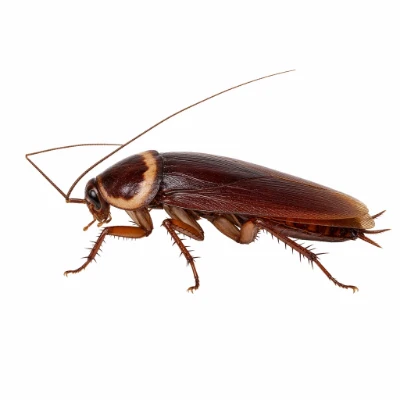
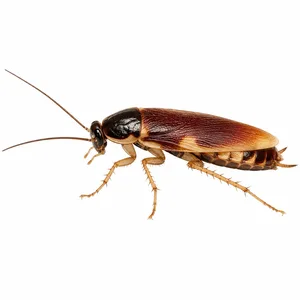
German cockroach adults run 13 to 16 mm long (about half an inch). The body color is light brown to tan. The single most reliable identifier is on the pronotum: the shield-shaped plate immediately behind the head carries two dark, nearly parallel longitudinal stripes that run from behind the head toward the wing base. No other indoor cockroach you will encounter in Collin County displays that pattern. If you see lengthwise stripes on a small pale-brown roach in your kitchen, the species ID is settled, and close-up reference photos at multiple life stages are available for cross-confirmation.
Adults have fully developed wings that reach the tip of the body, but neither sex flies in any meaningful way. Males may glide a short distance when falling. Females do not fly at all. Nymphs are darker than adults, often nearly black, with a single pale stripe down the back. The female carries her egg case (egg case) protruding from the tail end of her body for almost the entire incubation period, dropping it only 24 to 48 hours before the nymphs hatch. That maternal carrying behavior is unique among the cockroach species you will see in our service area.
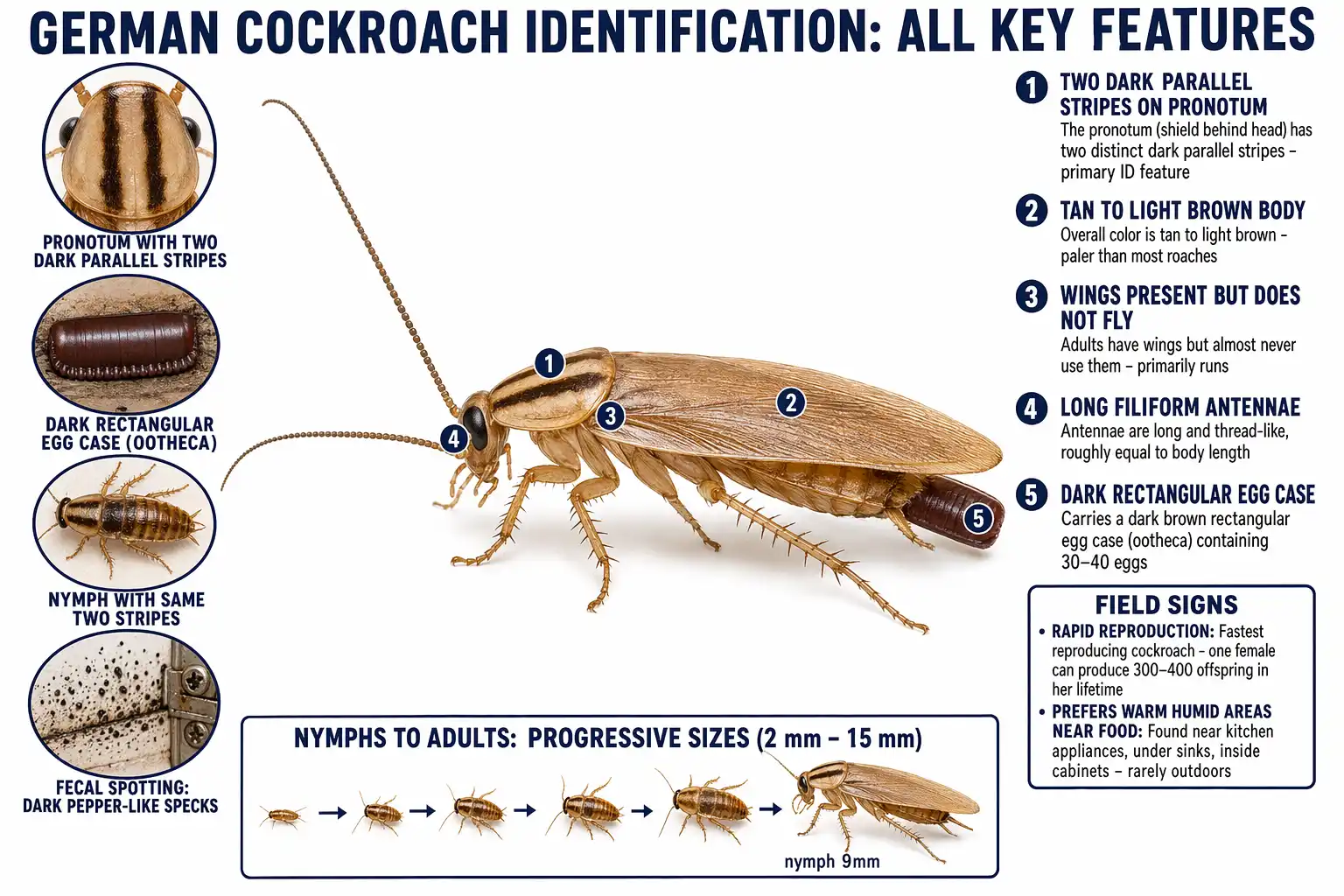
German cockroach identification diagram with pronotal stripes and egg case callouts
- Commonly called croton bugs or kitchen roaches for their small size and kitchen-centered activity
- Two dark parallel stripes running lengthwise on the pronotum (the shield behind the head)
- Light brown to tan body, 13 to 16 mm long
- Nymphs nearly black with a single pale dorsal stripe
- Female carries a brown bean-shaped egg case at the tail end of her body
- Active in kitchens and bathrooms after dark, scattering when lights come on
- Daytime sightings indicate a large, overcrowded population
Why Collin County Calls Them Croton Bugs
The “German” in German cockroach is a historical misnomer. The species originated in Southeast Asia and reached Europe through colonial-era shipping. Linnaeus named it Blattella germanica in 1767 based on European specimens, and the name stuck. In Germany the species was historically called the French cockroach. In Russia it was the Prussian cockroach. The pattern of every nation blaming a neighbor is consistent.
“Croton bug” is the older American name. It comes from the Croton Aqueduct in New York, the brick water-tunnel system completed in 1842 to supply Manhattan with drinking water. German cockroaches thrived in the moist underground brickwork and rode water service pipes into apartment buildings throughout the city. Through the late 19th and early 20th century, “Croton bug” was simply what New Yorkers called them. The name traveled south with shipping and migration and is still used by older homeowners across Texas. “Kitchen roach” or “kitchen cockroach” is the modern descriptive nickname, since this species is the one that actually establishes inside your kitchen rather than just visiting from outside.
All four names refer to the same insect: Blattella germanica, the small striped cockroach that breeds inside your home year-round.
How to Tell German Cockroaches from Other Cockroaches in Collin County
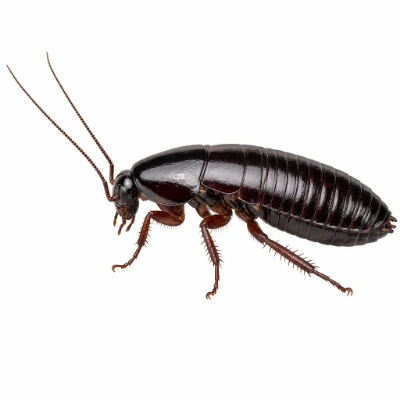
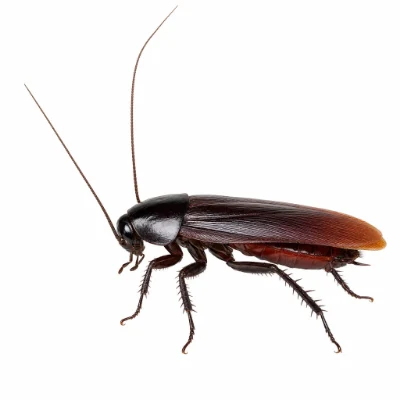
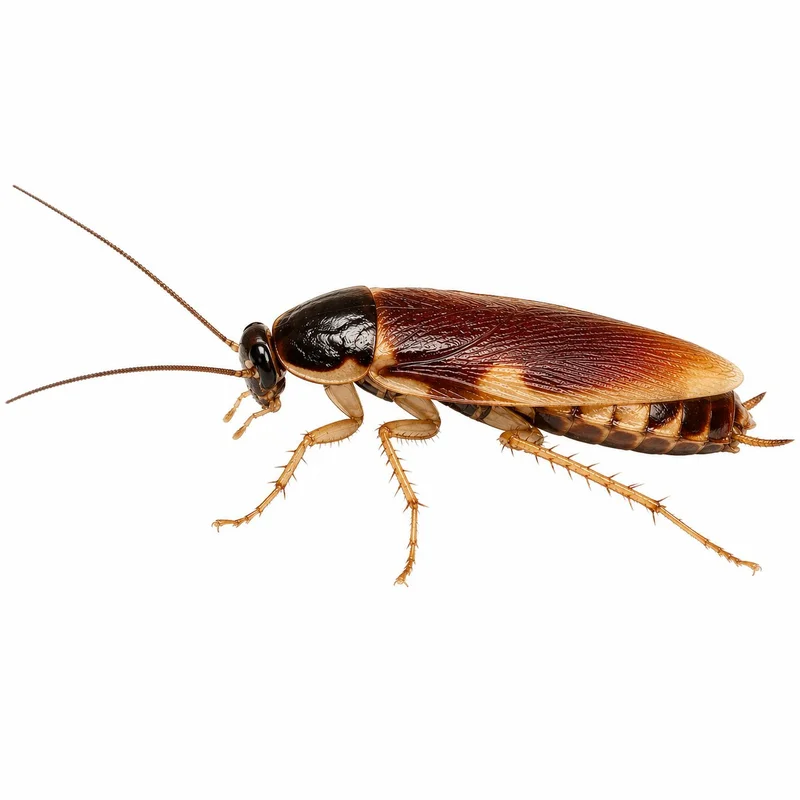
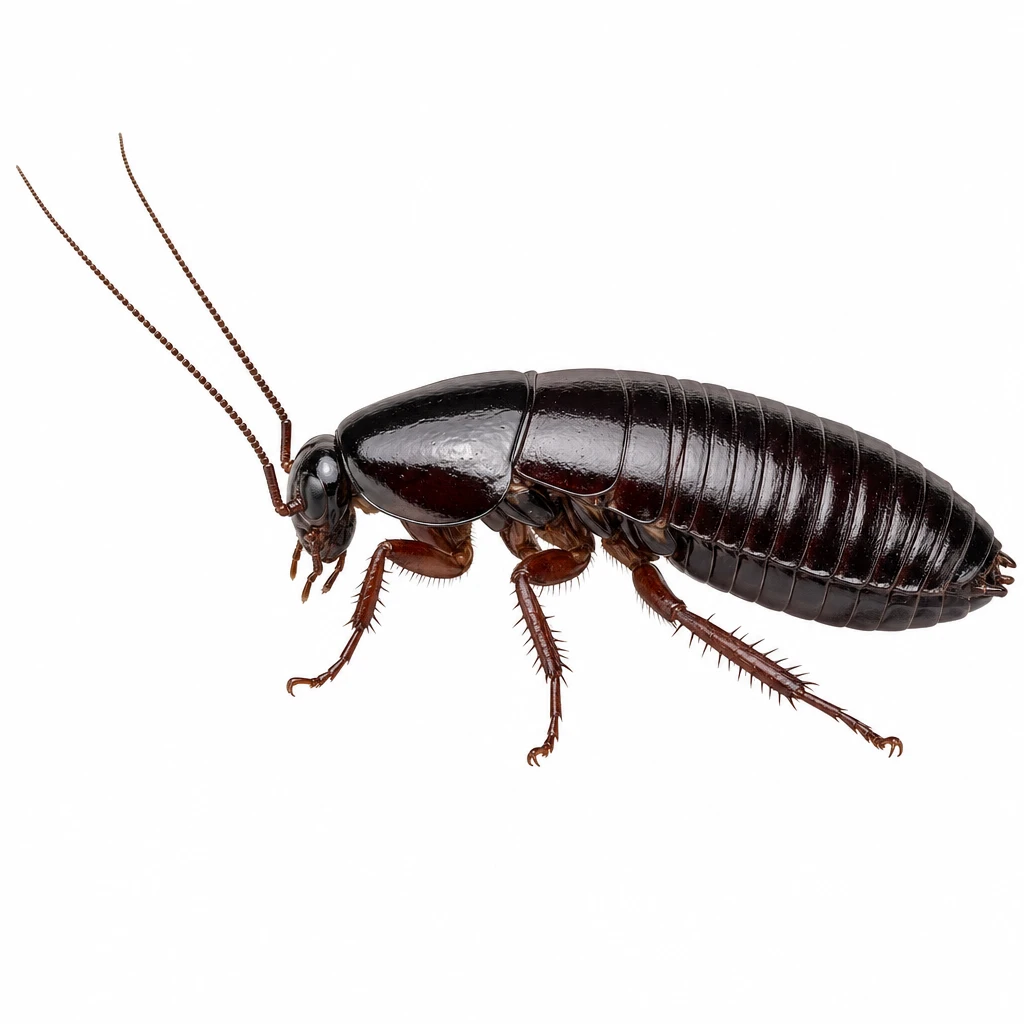
Three other cockroach species in our service area get mistaken for German cockroach. Size, color, stripe orientation, and habitat zone separate them quickly without a microscope.
| Species | Size & Color | Key Feature | Where You Find It |
|---|---|---|---|
|
German Cockroach
AKA: Croton Bug, Kitchen Cockroach
Blattella germanica
This species
|
13 to 16 mm (about half an inch). Light brown to tan body with a darker rear section. Nymphs are nearly black with a single pale stripe down the back. | Two dark parallel stripes running lengthwise on the pronotum (the shield behind the head). Females carry a brown bean-shaped egg case at the tail end of the abdomen until shortly before hatching. | Kitchens and bathrooms, behind refrigerator and dishwasher, under sinks, inside cabinet hinge pockets. Active year-round indoor in heated structures. Almost never found outdoors in Collin County. |
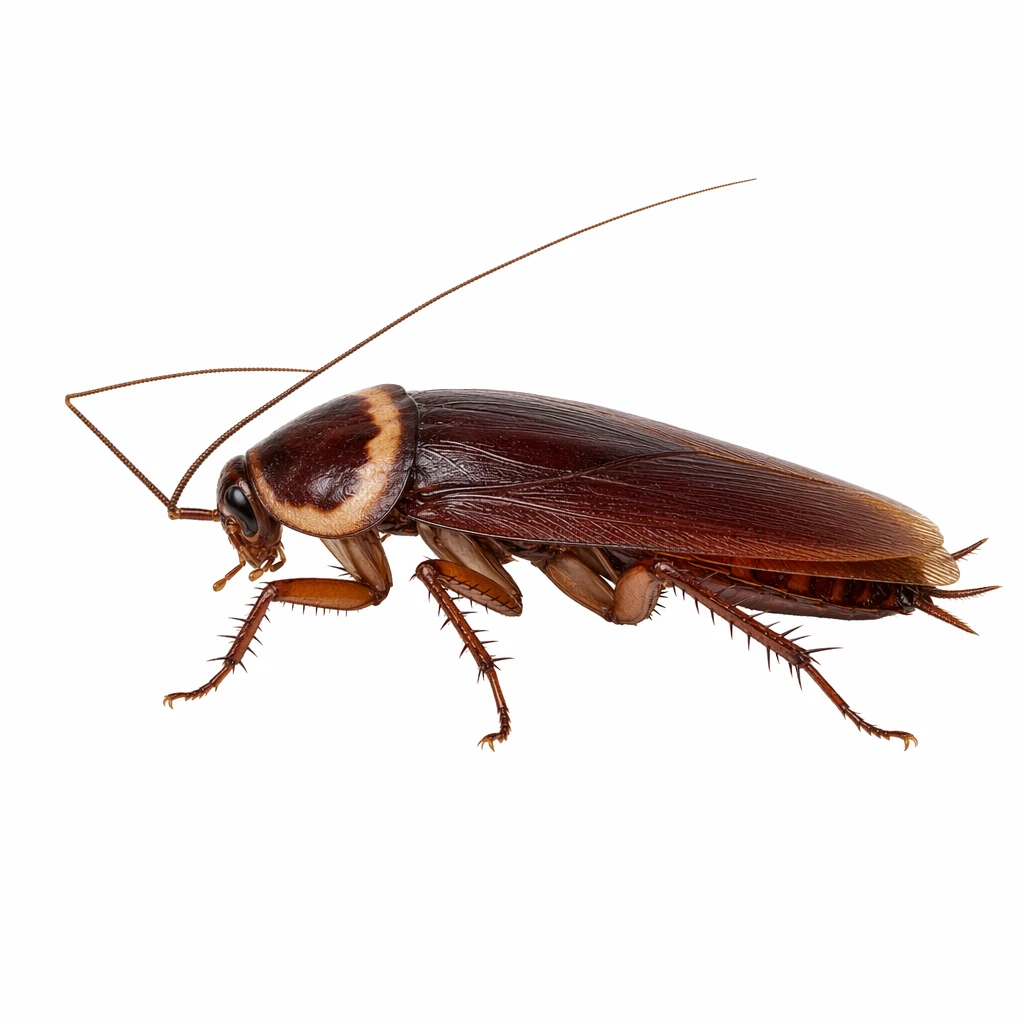
American Cockroach
AKA: Palmetto Bug, Water Bug, Sewer Roach
Periplaneta americana
|
35 to 50 mm (1.5 to 2 inches), the largest cockroach in our service area. Reddish-brown body with a yellow halo outlining the pronotum (the shield behind the head). Looks dramatic enough that homeowners often mistake first encounters for “giant water bugs.” | Capable of short gliding flight, especially in warm humid weather, which sets it apart from German and Oriental cockroaches that are functionally flightless. Strong runner. Antennae are longer than the body. | Garages, utility rooms, sewer drains, plumbing voids, and the slab perimeter. Outdoor in mulch and foundation perimeter through the warm months. Enters through floor drains, expansion joints, and weep holes after heavy rain. In Collin County slab construction, ground-level and below-slab entry points are the primary pathway. |
Brown-banded Cockroach
AKA: Furniture Cockroach, Furniture Roach
Supella longipalpa
|
11 to 14.5 mm, similar size to German cockroach. Light to medium brown body with two distinct light yellowish bands running across the wings (not lengthwise on the pronotum like German). Males are slightly slimmer than females. | The two light bands run across the wings, not lengthwise on the pronotum. Females glue their egg cases to hidden surfaces (under shelves, behind picture frames) instead of carrying them. Tolerates much drier conditions than German cockroach. | Bedrooms, living rooms, inside electronics (TVs, gaming consoles, microwave clocks), upper cabinets, behind picture frames, under furniture. Prefers warm and dry, away from the kitchen. Often found in homes with no plumbing-leak history. |
Oriental Cockroach
AKA: Black Beetle, Water Bug, Shiny Black Roach
Blatta orientalis
|
22 to 27 mm (about 1 inch). Uniformly shiny dark brown to jet black, the darkest cockroach you will encounter in Collin County. Males have wings that do not cover the full abdomen; females are essentially wingless. | Flightless in both sexes (cannot fly even short distances). Slow, heavy-bodied, ground-dwelling movement. Produces a distinctive musty odor that lingers in infested garages and crawl spaces. | Garages, utility rooms, foundation perimeter, under mulch and stones, near floor drains, along the slab edge where the foundation meets damp soil. Active mostly outdoors during cooler months and enters through slab-edge gaps and floor drains when populations build against the foundation. |
German Cockroach Allergens, Asthma, and Pathogen Transfer
German cockroaches do not bite under normal conditions. The medical concern is allergen exposure and mechanical pathogen transmission. Allergen proteins are present in the saliva, fecal particles, and shed exoskeletons accumulating in infested kitchens, bathrooms, and bedrooms. These particles become airborne with normal household activity, settle in dust, and persist on bedding, upholstery, and HVAC filters even after a population is fully eliminated.
Mechanical pathogen transfer happens because German cockroaches travel between sewer drains and food preparation surfaces. Real-world samples have tested positive for Salmonella typhimurium, Staphylococcus aureus, Pseudomonas aeruginosa, and Escherichia coli. Workers carry organisms on the cuticle and in the digestive tract and deposit them passively wherever they walk and feed.
Anyone in a confirmed infestation experiencing increased nighttime cough, wheezing, chest tightness, or higher-than-usual rescue inhaler use should contact a healthcare provider. Children with diagnosed asthma showing increased symptom frequency, sleep disruption, or school absenteeism in an infested home should be screened for cockroach-specific IgE sensitization. Primary care providers managing pediatric asthma in multi-family housing or homes with confirmed infestation should include environmental allergen assessment in the asthma action plan.
Acute reactions (sudden severe wheezing, difficulty breathing, lip or tongue swelling, hives) are uncommon from cockroach allergen exposure alone but require immediate emergency care if they occur.
How Bad Is Your German Cockroach Problem
A single sighting at night is one signal. The signals below are the ones that change the treatment plan, the urgency, and the medical priority. Read the property like a technician would.
Daytime Sightings
German cockroaches are nocturnal under normal conditions. Daytime activity in the open means the hiding spots are overcrowded and the visible population is being pushed out. Daytime sightings indicate a population well into the hundreds, not dozens.
Child with Asthma in the Home
Cockroach allergen exposure is documented as the strongest single predictor of asthma morbidity in inner-city pediatric cohorts. Any confirmed German cockroach activity in a home with an asthmatic child elevates priority immediately. Treatment becomes a medical timeline, not a scheduled service visit.
Activity in Multiple Rooms
If sightings are happening in the kitchen, bathroom, and laundry room (or any other secondary nesting area), the population has expanded beyond the initial introduction site. Multi-room activity requires whole-home inspection rather than spot treatment.
Multi-Family Housing or Shared Wall Voids
Apartments, townhomes, duplexes, and condos share plumbing chases and wall voids. Treatment that does not coordinate with adjacent units allows continuous reintroduction. Pressure remains elevated until the building treats as a unit.
Egg Cases on Live Females
Visible females carrying brown egg capsules at the tail confirm an active breeding population. The 30 to 40 nymphs inside each case will hatch in 24 to 48 hours after the female releases the case. A treatment plan that does not account for this hatch window will see a population rebound at week three.
Prior DIY Spray Application
Recent over-the-counter spray near the nesting area scatters the population deeper into wall voids and contaminates bait sites. Prior DIY treatment lengthens the timeline because we have to wait out the contaminated surfaces and rebuild bait coverage from a less optimal starting point.
German Cockroach Allergens and the Asthma Connection
German cockroaches produce a documented family of allergen proteins that show up in saliva, fecal particles, and shed exoskeletons. These accumulate as fine dust in kitchens, bedrooms, bedding, upholstery, and HVAC filters. The particles become airborne with normal activity and settle into surfaces children touch and breathe near every day.
The clinical evidence comes from a landmark inner-city asthma study that followed children with asthma across multiple major US cities. Kids living in homes with elevated cockroach allergen levels had measurably higher rates of unscheduled medical visits and asthma hospitalization than kids in lower-exposure homes. The Dallas site recorded cockroach allergen sensitization rates above 78 percent in asthmatic children living in infested housing. This is the strongest indoor environmental link to pediatric asthma morbidity in the medical literature.
Allergens stay in dust and fabric for months after the cockroach population is gone. That means treatment is only half the work. Deep cleaning of bedding, upholstery, and HVAC filters needs to happen alongside cockroach elimination. If your child’s asthma symptoms (nighttime cough, wheezing, increased rescue inhaler use, school absences) escalate after a confirmed infestation, ask your pediatrician about cockroach-specific IgE testing. Kids who test positive often see meaningful symptom improvement once the home is treated and cleaned.
Where German Cockroaches Live and How They Got There
German cockroaches almost never enter Collin County homes from outdoors. The species cannot establish or survive outdoors in our climate. Introduction is almost always through hitchhiking on cardboard moving boxes, grocery delivery bags from high-volume retailers, secondhand appliances, restaurant takeout containers, and items brought from infested storage facilities, a well-documented introduction pattern in indoor pest research. In multi-family construction (apartments, townhomes, duplexes), migration between units happens through shared plumbing chases where pipes penetrate the slab, shared wall voids between units, and unsealed gaps around electrical conduit.
Once inside, the population settles in tight, dark, warm, slightly damp hiding spots near food and water. The kitchen is the primary zone in nearly every case: behind the refrigerator compressor compartment (warmth and condensation), inside the void of the dishwasher, under and behind the range, under the kitchen sink at the drain and supply line penetrations, inside cabinet hinge pockets, and inside the refrigerator door gasket itself. The bathroom is the secondary zone: under the vanity, behind the toilet tank, around the tub or shower valve access. Severe infestations extend into the utility room around the washing machine drain and into the kitchen wall voids that connect to entertainment center electronics.
A flat adult German cockroach can fit through a gap as narrow as 1.6 millimeters, roughly the thickness of a credit card. There is almost no gap inside a cabinet, appliance, or wall void that excludes them mechanically.
German Cockroach Pressure Across Collin County
German cockroach pressure across our service area concentrates in three patterns. Multi-family housing density is the first: apartments, townhomes, and duplexes in McKinney, Plano, and Allen generate consistent call volume because shared wall voids allow continuous migration between units regardless of any single unit’s sanitation. Restaurant and food-service adjacency is the second: residential properties along the US-75 corridor in Allen and the Dallas North Tollway commercial zones in Frisco show elevated pressure from reservoir populations in adjacent commercial kitchens. Older construction with degraded slab penetration seals is the third: pre-1990 homes with original plumbing infrastructure and aging seal materials provide more internal movement pathways than newer construction.
New construction in Celina, Prosper, Anna, and Melissa typically shows low background pressure for this species, with introductions occurring through moves, deliveries, and secondhand items rather than structural pathways. The Colony and Carrollton sit closer to the Dallas commercial corridor and show pressure intermediate between the suburban core and the older McKinney and Plano housing stock.
Cost of Doing Nothing
One pair of German cockroaches and their offspring can theoretically produce over 30,000 individuals in a single year. The dollar exposure follows the population curve. Discarded contaminated pantry items run $200 to $600 in the average kitchen. Refrigerator gasket replacement runs $80 to $250 per door. Dishwasher seal and motor cleaning runs $150 to $400. Pediatric asthma management for a child sensitized to cockroach allergen averages $1,500 to $4,000 per year in additional medication, specialist visits, and missed school days. In multi-family housing, lease termination triggered by infestation can cost $1,500 to $3,500 in lost rent and turnover. In food service, a single visible roach during a Texas Department of State Health Services inspection can result in temporary closure costing $2,000 to $10,000 in lost revenue per day. Untreated infestations expand at population-doubling rates of roughly two to three weeks under typical indoor conditions.
German Cockroach Reproduction and Population Dynamics
Why a German Cockroach Population Comes Back After You “Got Them All”
You spray under the sink and the kitchen goes quiet
Visible workers in the immediate spray zone die within hours. You see no roaches for two to three days. The treatment looks like it worked.
Females with egg cases survived inside the wall void
Most spray products (a chemical family called pyrethroids) do not reach the hiding spots where 80 percent of the population hides during daylight. Females carrying egg cases are protected by the egg case itself. They wait out the application.
Three weeks later, 30 to 40 nymphs hatch from each surviving female
The next generation appears as small, dark, single-striped nymphs. By the time they are visible, they are already feeding and trailing back into the same hiding spots. The population rebuilds from a fraction of the original count.
Aggregation pheromones recruit any additional arrivals
The hiding spot still smells like an established colony to any cockroach that enters the building afterward, whether through a delivery box, a grocery bag, or an adjacent unit in multi-family housing. An empty hiding spot in a previously infested home is more attractive than a fresh location, not less.
How Pest Me Off Treats German Cockroach Infestations
German cockroach elimination is a structured 4-step protocol, not a single visit. Each step targets a different part of the population the previous step couldn’t reach. Skip a step and the population rebuilds at the egg-cycle interval (about three weeks).
Inspect & Confirm
Confirm the species before any product goes down. Audit the kitchen and bathroom for competing food and water sources. Place 12 to 18 sticky traps at floor level in the hiding spots we identified to map where the population is concentrated.
Bait the Population
20 to 30 small (pea-sized) gel bait points per kitchen, placed in cabinet hinge pockets, behind appliances, under cabinet ledges, along plumbing chases, and inside the refrigerator and dishwasher voids. Bait goes in the cracks, not on open counter.
Stop the Next Generation
Apply a growth regulator (a different kind of product, not a poison) to the cracks and crevices where roaches live. Treat wall voids with insecticidal dust through switch plates, outlet boxes, and pipe penetrations.
Rotate & Follow Through
Switch bait products every 60 to 90 days. 30-day reinspection. 90-day product rotation. Multi-family housing and food service accounts get weekly to bi-weekly visits through the elimination phase, then move to monthly maintenance.
& Other Companies
What Homeowners Can Do Before and Between Treatments
Prevention for German cockroach is mostly sanitation and source control. Eliminating competing food and moisture is the single highest-impact thing a homeowner can do, and it makes professional bait roughly five times more effective when treatment begins.
Why DIY Can Fail for German Cockroaches
German cockroaches fail DIY treatment in Collin County at higher rates than any other indoor pest. The reasons are biological and behavioral, not a homeowner skill problem. The species is built to survive single-product applications, and the most common over-the-counter products actively make the situation worse.
Total-Release Foggers (Bug Bombs)
Foggers release product into open air. German cockroaches live in cracks and voids that the fog never penetrates. The application drives the population deeper into wall voids and appliance motors and can spread it from the kitchen into rooms that had no prior activity. Independent university extension testing has consistently found foggers ineffective against this species. They feel like decisive action because of the dramatic visible discharge, but the active product never reaches where the roaches actually live, and the experience often pushes a kitchen-only problem into bedrooms and living rooms that were previously roach-free.
Store-Bought Roach Spray
The active ingredient in most over-the-counter spray cans (a chemical family called pyrethroids) stopped working on German cockroaches across the DFW metroplex decades ago. Local populations are now resistant to these chemicals. The spray kills a few roaches you see, but the chemistry signals threat to the rest of the population, which scatters deeper into wall voids and into adjacent rooms. Surviving females with egg cases produce the next 30 to 40 nymphs three weeks later. The visible population goes quiet, then rebuilds across more of the home than it occupied before treatment. This is why we use bait products that the roaches carry back to their hiding spots, not sprays.
Placing Bait on Open Countertops
German cockroaches feed only along surfaces in tight contact with their body. Bait placed on open counters, floors, or exposed surfaces rarely gets eaten because it is not in the tight cracks and crevices where the population lives and feeds. Hardware-store gel bait placed correctly (inside cabinet hinge pockets, behind appliances, along plumbing chases) can reduce populations. The same product placed in the wrong location fails entirely, and homeowners conclude the bait does not work rather than recognizing the placement issue.
Single-Visit Treatment Without Follow-Up
German cockroach females carry egg cases for almost the entire incubation period and release them only 24 to 48 hours before hatching. Any treatment that kills visible adults leaves intact egg cases behind. Three weeks later, 30 to 40 nymphs hatch from each surviving case and the population rebuilds. A single application, whether DIY or professional, almost never completes German cockroach elimination. Follow-up at the egg-cycle interval (roughly three weeks) is what closes the gap. This is why we build return visits into the protocol rather than treating it as a one-and-done call.
Hardware-Store Gel Bait Plus Cleaning
Hardware-store gel bait (the kind that comes in a small plastic syringe) can work if placed in cracks and crevices near where the roaches actually live, refreshed every two weeks, and paired with serious sanitation. Partial application without the cleaning cuts bait effectiveness by roughly five times. Even done correctly, DIY gel bait alone rarely matches the elimination rate of a professional treatment that combines bait with the additional product types covered in our 4-step protocol above. The DIY ceiling is reduction, not elimination, and reduction usually rebounds within two months.
German Cockroach FAQ
The Roach That Came Home in a Cardboard Box. Bait Rotation, Growth Regulators, Follow-Through.
We confirm the species, map every hiding spot, place gel bait across multiple chemical types, follow with an insect growth regulator and void dust, and return at the egg-cycle interval until the population stays gone. Cockroach Crackdown across McKinney, Allen, Frisco, Plano, and the rest of Collin County.