Paper Wasps in Collin County, TX | Identification and Control
Paper wasps (Polistes spp.), also called umbrella wasps for the shape of their open-celled paper nests, are the most frequent stinging insect call Pest Me Off receives every spring across McKinney, Allen, Frisco, and Plano. They nest directly on your home’s eaves, porch ceilings, door frames, and outdoor light fixtures, placing them in daily contact with everyone who enters or exits your house. Multiple Polistes species are active throughout North Texas, all receiving the same treatment approach, and all capable of multiple stings when their nest is disturbed.
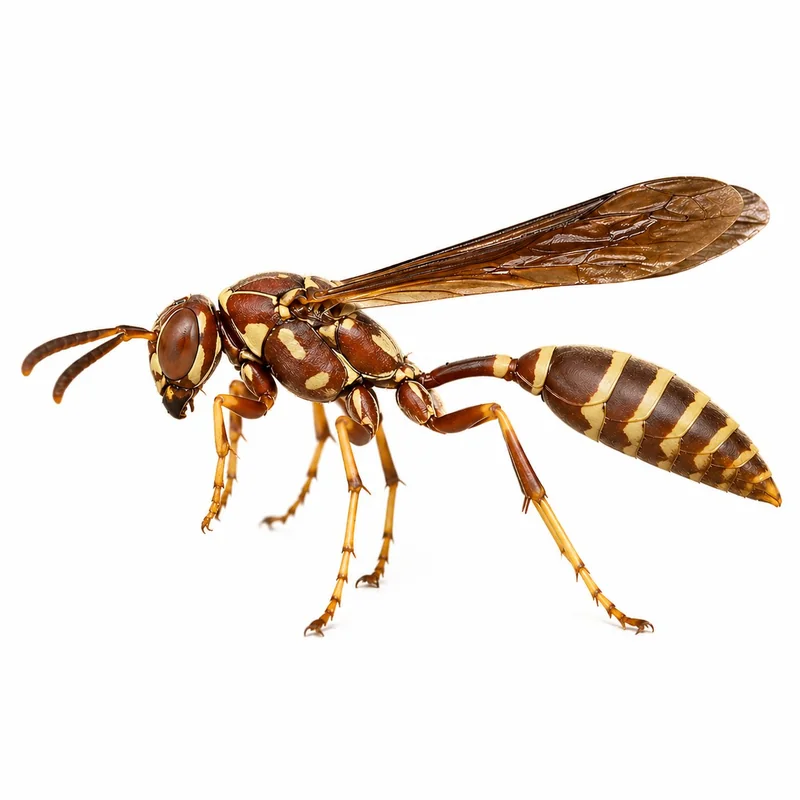
Queen activity begins in late February during warm stretches and escalates through spring. Worker population peaks in August and September. Colony die-off follows the first hard freeze in November.
What Paper Wasps Look Like
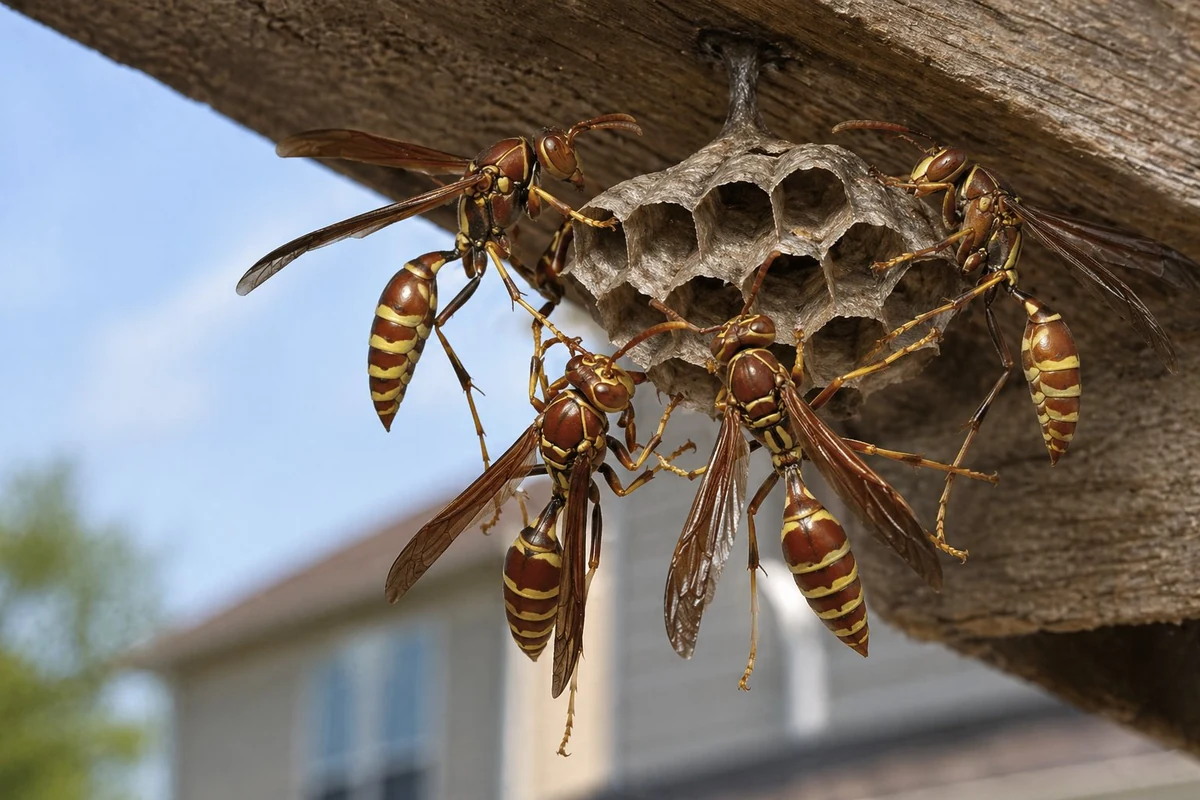
Slender body, dangling legs in flight, and an open umbrella-shaped nest with no paper envelope.
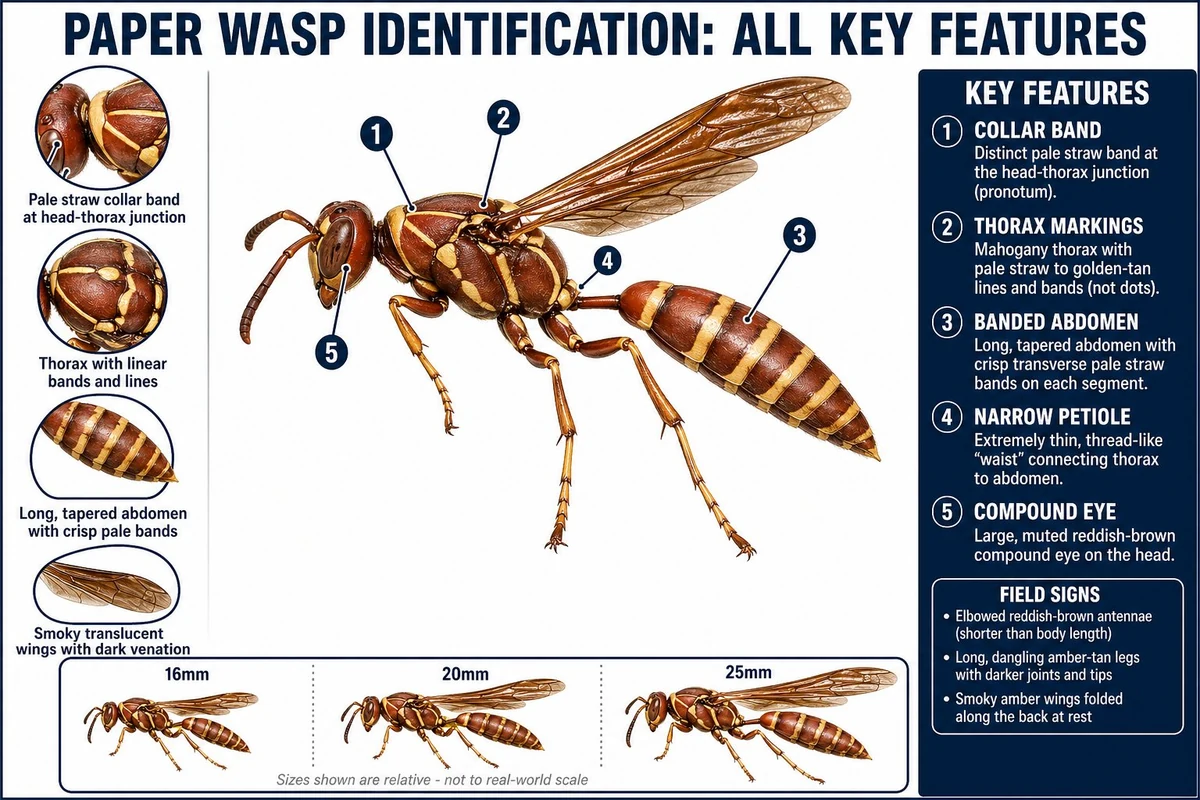
- Long hind legs dangle visibly below the body during flight (no other common North Texas wasp does this)
- Open hexagonal cells in the comb are fully visible from below with no paper envelope
- Nest hangs from a single thin central stalk attached to a horizontal surface
- Slender body with a very narrow “wasp waist” pinched between the middle and rear body sections
- Wings fold lengthwise along the body when at rest
- Nest is the size of a silver dollar to a dinner plate; never football-sized
AKA: Umbrella Wasp
The name “umbrella wasp” is the most accurate common name for this species group. Turn the nest upside down in your mind: the rounded comb profile with cells facing downward does look like an open umbrella suspended at the handle. Red wasp is the name most North Texas homeowners use for Polistes carolina, the reddish-brown species with purple-black wings common in our area. Guinea wasp applies to Polistes exclamans, the brownish-orange species with yellow markings that is equally common across Collin County.
Paper wasps range from 16 to 25 mm in length, roughly the size of a large paper clip to just under an inch. Body color varies by species but always includes some combination of brown, orange, red, and yellow. The slender profile, narrow waist, and the distinctive dangle of the hind legs during flight separate them from yellowjackets and bald-faced hornets at a glance, even without a close look at the markings. Species-level identification within Polistes requires expert examination and is not needed to confirm pest identity or begin treatment. iNaturalist observations of paper wasps across North America document the range and seasonal activity patterns of the primary Collin County species.
Paper Wasp vs Similar Species
The open umbrella comb is the field identification feature that eliminates all other stinging insect species. If the nest is enclosed in a paper envelope, it is not paper wasp.
| Species | Size | Key Feature | Nesting Habit |
|---|---|---|---|
|
Paper Wasp
This species
AKA: Umbrella Wasp, Red Wasp, Guinea Wasp
Polistes spp.
|
16 to 25 mm. Slender build with a very narrow waist. Brownish-orange, reddish-brown, or dark coloring depending on species. Larger and more slender than any yellowjacket worker. | Long hind legs dangle below the body during flight, visible at a distance. Nest is open-celled with no paper envelope. Smoky black wings fold flat along the body at rest. Generally ignores people unless the nest is directly approached or disturbed. | Nests exclusively on exposed structural surfaces: eaves, porch ceilings, door frames, window frames, shutters, outdoor furniture, and equipment housings. Never inside ground burrows or enclosed wall and soil cavities. Open comb is always attached by a single central stalk. |
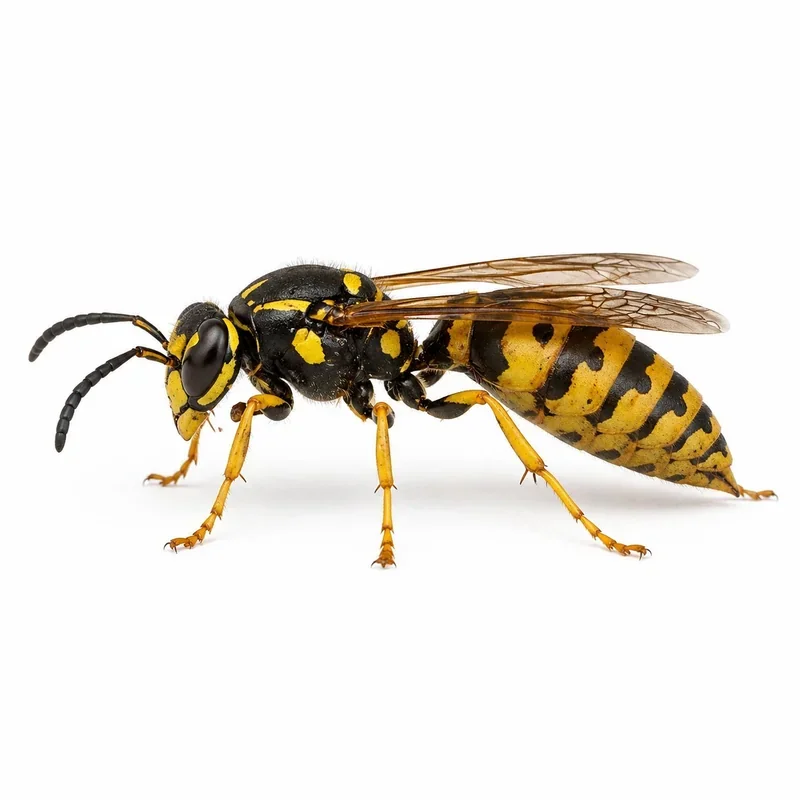
Yellowjacket
AKA: Ground Hornet
Vespula spp.
|
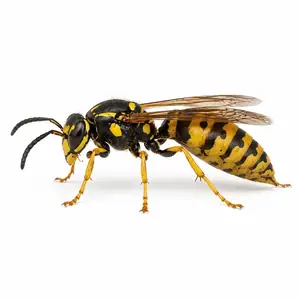
10 to 16 mm. Stocky, compact build. Bright yellow and black abdominal banding. Legs held close to the body in flight, not dangling. Noticeably shorter and heavier-built than paper wasp at the same viewing distance. | Bold yellow and black pattern is brighter and more contrasting than paper wasp’s brownish-orange coloring. Much more aggressive colony defense; workers pursue and sting at distances well beyond the nest. No visible nest structure on home surfaces: entry point is a hole or crack. | Most Collin County yellowjacket colonies nest underground in soil burrows or inside wall voids accessed through a crack, weep hole, or expansion joint. A ground hole with fast in-and-out worker traffic is the homeowner-visible sign. Never builds an open comb on an eave. |

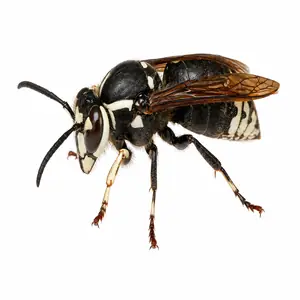
Bald-Faced Hornet
AKA: White-Faced Hornet
Dolichovespula maculata
|
15 to 20 mm. Solid, heavy build, noticeably larger than a yellowjacket. Black body with white markings on the face, abdomen tip, and upper body section. Much heavier-looking in flight than a paper wasp of the same length. | White markings on an otherwise black body are the definitive field ID at a glance (no other common North Texas wasp shares this pattern). Builds large enclosed football-shaped gray paper nests. Among the most aggressively defensive social wasps in the service area; can spray venom toward intruder eyes. | Enclosed gray paper ball hanging in a tree, shrub, or from a structural overhang. Single bottom entry hole in the paper envelope. Nest grows visibly from month to month and can exceed basketball size by September. Never an open comb. Never in the ground. |
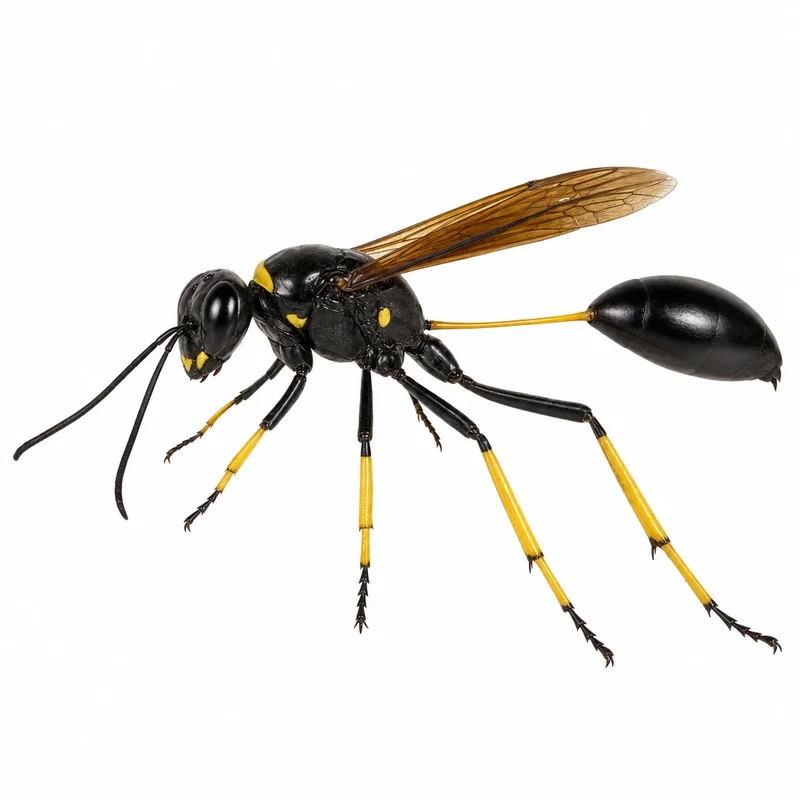
Mud Dauber
AKA: Dirt Dauber, Mud Wasp
Sceliphron caementarium
|
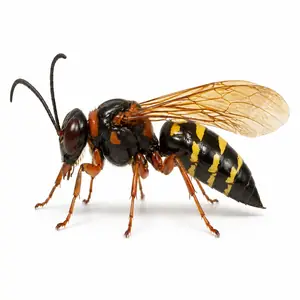
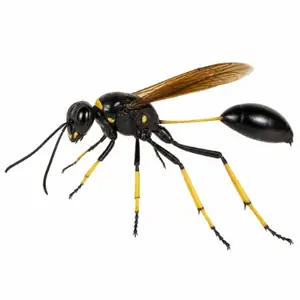
25 to 30 mm. Extremely slender with a greatly elongated, thread-like petiole between the mid-body and abdomen. Black body with yellow markings on the legs and mid-body. Longer and more angular-looking than paper wasp despite similar coloring. | The thread-thin waist connecting mid-body to abdomen is unlike any other common North Texas wasp. Solitary species: no colony, no workers, no colony defense. Rarely stings; will not defend a nest site. Sluggish, non-aggressive flight behavior. Constructs cylindrical mud cells, not paper combs. | Attaches clusters of cylindrical mud tubes to sheltered vertical and horizontal surfaces: garage walls, porch ceilings, under eaves, and inside sheds. Each mud cell is individually provisioned with paralyzed spiders, then sealed. No paper, no open comb, no colony living in the structure. |
Paper Wasp Sting: What to Expect
A paper wasp sting delivers venom through a smooth stinger that can be used repeatedly in a single encounter. The immediate response for non-sensitized individuals is sharp localized pain, redness, and swelling at the sting site. Symptoms typically resolve within a few hours for a single sting. Multiple stings from a disturbed colony produce more significant localized reactions and can cause systemic symptoms including nausea in some individuals.
The serious medical risk is anaphylaxis in individuals with known or undiagnosed sensitivity to wasp venom allergy reactions. Sensitivity is not predictable from prior sting history alone; a person who has been stung without serious reaction can still develop sensitization over subsequent exposures. Anyone who has experienced systemic symptoms from a prior sting (hives, throat tightening, dizziness, difficulty breathing) should carry an epinephrine auto-injector and treat a paper wasp nest call as a professional service, not a DIY project.
Call 911 or go to an emergency room immediately if a sting is followed by difficulty breathing, wheezing, or throat tightening. Other signs that require emergency care include hives or skin flushing spreading beyond the sting site, dizziness or a rapid pulse, and multiple stings on a child or elderly person. Anyone with a known venom allergy should not wait for symptoms to worsen. These are signs of anaphylaxis and do not resolve on their own.
The one indirect property concern worth noting: paper wasps scrape wood fiber from weathered, unpainted wood surfaces to make nest material. Fence posts, deck railings, pergola beams, and unfinished fascia boards are the primary sources. This scraping is not structural damage and does not weaken the wood, but it does accelerate surface weathering on raw wood over time. Painting or sealing bare wood surfaces removes the primary material source and reduces the likelihood of queens founding nests on or near that structure the following spring.
Paper Wasp Colony Cycle and Why the Same Spot Gets Recolonized
How Pest Me Off Treats Paper Wasps
Effective paper wasp control in Collin County requires a four-step sequence. Each step addresses a failure mode that a one-and-done spray approach leaves open. Texas A&M Extension treatment guidance for paper wasp treatment has aligned on nighttime application and surface residual treatment as the steps most commonly skipped in self-treatment attempts that fail.
Full Perimeter Survey
We walk the full perimeter of your home during daylight to locate every active nest before committing to treatment. Paper wasps commonly build satellite nests within 10 to 20 feet of the primary nest. Treating one while missing three is the most common reason paper wasps appear to return within a week. We mark every nest location before moving to nighttime treatment.
Nighttime Direct Application
We treat after dark when foraging workers have returned to the nest and the colony is at rest. Night treatment puts the full worker population in contact with product in a single application. Daytime treatment misses up to half the foraging force, which returns to a disrupted nest and remains defensive for hours.
Comb Removal
Once the colony is confirmed dead, we physically remove the comb from the attachment surface. Leaving the dead nest in place leaves an intact pheromone structure at the attachment site. New queens scouting in February and March can detect residue even from a dead, deteriorating comb and will initiate a fresh nest in the same location.
Surface Residual Treatment
We apply a residual insecticide to the attachment point and surrounding eave surface. This breaks the pheromone signal at the substrate level and provides an insecticidal barrier against early-spring queens that investigate the same surface.
& Other Companies
What You Can Do to Reduce Paper Wasp Pressure
Why DIY Paper Wasp Control Often Makes Things Worse
Paper wasps seem like an obvious DIY job. Can of spray, wait for night, done. In practice the failure rate is high and the most common mistakes either push the nest to a worse location or guarantee return in the same spot next spring.
Spraying During the Day
A significant portion of the foraging workers are away from the nest during daylight hours. Spraying at 2pm kills the workers present at the nest but misses every worker out foraging. Returning foragers arrive to a disturbed nest in a highly defensive state and will sting anyone near the entry point for hours afterward. Evening treatment after dark, when all workers are clustered on the comb, is the only timing that puts the full colony in contact with the product in a single application.
Spraying Without Removing the Nest Afterward
Consumer wasp spray kills the active colony but does not remove the pheromone-saturated attachment surface. A new queen scouting for nest sites in February or March detects the chemical signature of a prior successful nest and selects the same surface. The spray did its job. Leaving the nest comb in place undid it. Treatment and removal must happen together. Scrub the attachment point after removal to eliminate the pheromone signal that marks the spot as proven real estate.
Getting Too Close Without Protective Equipment
Consumer wasp spray advertises 20-foot jet range. Most homeowners get far closer than that, often within 6 to 8 feet when working on a ladder under an eave. Paper wasps defensively sting at 18 inches from the nest. On a ladder, there is nowhere to retreat quickly. A full-length face shield, gloves, and closed clothing are not overcaution on an active paper wasp nest on a ladder. The injury risk from a fall triggered by a sting is greater than the sting itself in many ladder removal scenarios.
Removing One Nest and Missing the Others
Properties with one visible nest under an eave almost always have additional nests in less visible locations: inside a soffit vent, behind a shutter, under a deck board, or on the underside of outdoor furniture. Treating only the nest that triggered the call leaves active colonies in secondary locations that homeowners discover the hard way over the following weeks. A full perimeter check of all covered exterior surfaces before treatment is the step that prevents callback situations.
Treating in August or September Without Expecting Aggression
A mature August paper wasp colony has 30 to 75 workers compared to the 5 to 10 on a spring starter nest. Late-season colonies are larger, more defensive, and produce a faster alarm response to disturbance. The same DIY approach that worked on a small March nest under an eave can trigger a mass defensive response on an August colony in the same location. Colony size changes the risk calculation completely. A nest the size of your palm in March and the same nest in August are not the same job.
Paper Wasp FAQ
All three names refer to the same group of wasps. Paper wasp is the standard term used in pest control. Umbrella wasp is the most descriptive informal name, referring to the shape of the open comb when viewed from below. Red wasp is what most North Texas homeowners call the reddish-brown species with dark wings that is one of the most common types in Collin County. Guinea wasp is another name you may hear for the brownish-orange and yellow species that is equally common here. All of them build the same style of open-celled paper comb and are treated the same way. The different names are just regional habits, not different insects requiring different approaches.
Paper wasps are defensive rather than aggressive. They will generally ignore people working near a nest at distances beyond three to four feet. The defensive zone around an active nest is roughly 18 inches; entering that zone or making sudden contact with the nest surface triggers immediate sting behavior. Foraging wasps away from the nest are essentially harmless and will not sting unless physically trapped against skin. The population is at its most defensive in August and September when colony size and new queen protection both peak. The practical homeowner rule: if the nest is within 18 inches of a door handle, porch light, or chair back, the contact zone makes professional removal the right call.
Pheromone residue on the attachment surface is the mechanism. When a colony nests successfully in a location, the queen and workers deposit chemical marks on the substrate over the course of the season. These pheromones persist on wood, vinyl, and painted surfaces long after the colony dies in the fall. New queens emerging in late winter can detect those chemical signals and are drawn to the same attachment surfaces as historically successful founding sites. Removing the old nest without cleaning and treating the surface leaves the chemical signal intact. Scrubbing the surface with detergent and applying a residual insecticide to the attachment point after removing the comb is what breaks this annual return cycle.
Knocking down an active nest without applying insecticide first is the approach most likely to get you stung and least likely to solve the problem. Physically disturbing the comb without killing the workers scatters the colony in a coordinated defensive response. Surviving workers and returning foragers continue to defend the attachment site for hours. The remaining workers typically rebuild in the same location within days because the pheromone signal at the attachment point is still intact. A safer DIY approach: a consumer wasp and hornet aerosol from 15 to 20 feet away, directed at the nest after dark when all workers are on the comb. Wait 24 hours, then knock down the dead nest and treat the surface. Nests near doors or at roofline height are better handled professionally.
Paper wasps are active predators of caterpillars, flies, and soft-bodied insects. Workers hunt and capture these insects to provision larvae, which makes them incidental natural pest controllers in gardens. They also serve as minor pollinators when foraging on flowering plants for nectar. These ecological roles are real. They do not change the calculus when a nest is within 18 inches of your front door or your child’s outdoor play area. The practical recommendation is to leave nests in locations genuinely away from human traffic and remove nests in contact zones.
New construction throughout Prosper, Celina, Anna, Melissa, and Fairview provides large areas of fresh, unweathered eave and soffit surface that founding queens find highly attractive. New homes also lack the established competition from existing colonies that tends to moderate density in older neighborhoods. The combination of clean unoccupied eave surface, available wood fiber from nearby raw lumber piles, and the absence of prior territorial pressure typically produces noticeably higher first-year paper wasp activity in new-construction neighborhoods than in established communities. The same home will usually see lower pressure in year three than in year one as established colonies claim territory and raw wood surfaces get painted or weathered.
The most likely explanation is that the attachment surface was not treated and cleaned after the nest was removed. Paper wasp queens locate historically successful founding spots by chemical markers left at the substrate. If those markers were not removed, a new queen founding in February will be drawn to the same eave corner or door frame and begin a fresh nest there. A second possibility is that a satellite nest was missed during the original treatment: paper wasps often build two, three, or more nests on a single home within 10 to 20 feet of each other. If only the most visible nest was treated, the others remained active and established continued territory on the same structure. The fix at this point is a full perimeter re-treatment with surface residual application at every attachment point found.
Paper wasps nest on external surfaces, not inside wall voids or attic spaces. The open-celled comb requires an attachment point on a horizontal or angled surface that is sheltered from rain but exposed to air. They do not chew through soffits, drill into wood, or establish inside enclosed voids the way yellowjackets and bald-faced hornets can. If you are seeing wasps entering and exiting a hole in your eave or wall, that is a yellowjacket or hornet indicator, not paper wasp. Paper wasp nests are always visible from the outside. If you can see the nest, you have confirmed paper wasp. If the only evidence is wasps going in and out of a hole, call us before approaching.
Paper Wasps on Your Eaves and Porch. We Find Every Nest and Keep Them From Coming Back.
Most wasp treatments spray the obvious nest and leave. We survey the full perimeter first, treat after dark when the whole colony is home, remove the comb, and treat the surface so the same spot does not get recolonized next March. One call covers all the nests you can see and the ones you cannot. Stinger Smackdown across McKinney, Allen, Frisco, Plano, and all of Collin County.
Rushing a wasp call means one nest gets treated at noon and three satellite nests get missed entirely. We take the time to walk the full perimeter, locate every active nest, treat at the right time of day, and come back if anything gets missed. That is what the 12-stop limit is for.