Yellowjackets in Collin County, TX | Identification and Control
Yellowjackets (Vespula spp.) are the most dangerous wasp in Collin County, nesting in hidden ground burrows and wall voids where they are routinely discovered by accident during mowing, landscaping, or routine home maintenance. southern yellowjackets dominate Collin County, with colonies reaching thousands of workers by late summer. This page covers identification, why hidden nests inside slab-on-grade homes are the highest-risk scenario, why sealing the entry hole before treatment is the most dangerous DIY mistake homeowners make, and how Pest Me Off treats both ground and wall-void colonies.
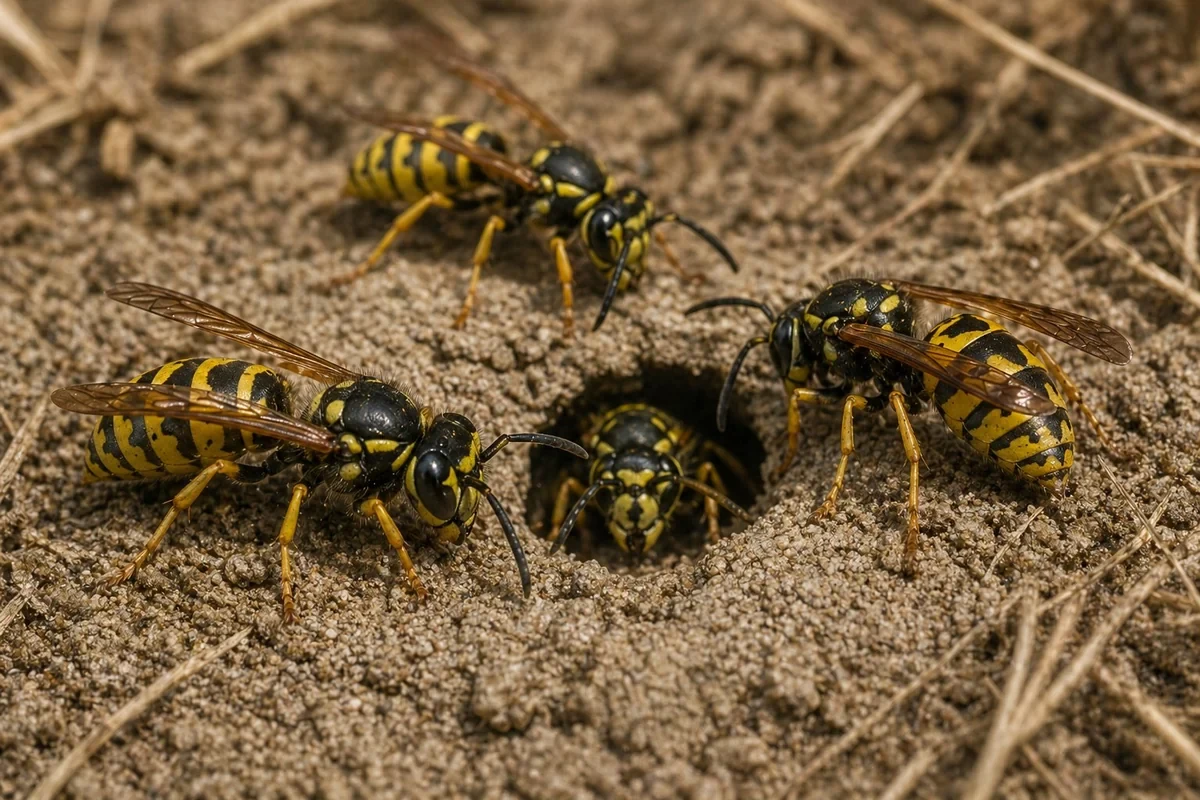
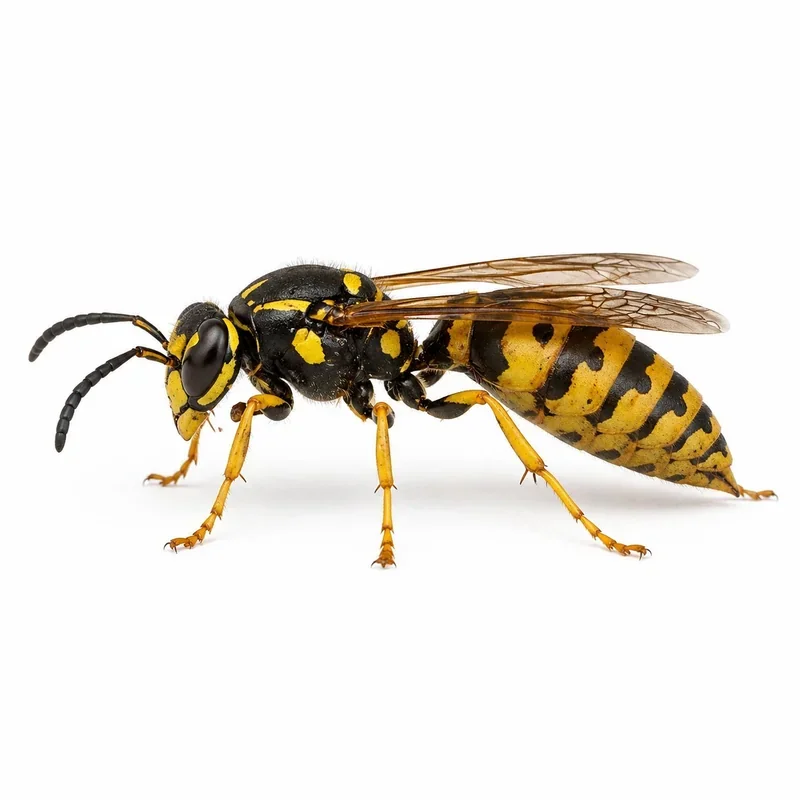
Queens emerge from overwintering in late March and April. Small starter nests go unnoticed through spring. Colony size builds through summer and peaks in August through October, which is also the highest-aggression period. Colony death follows the first hard freeze, though mild Texas winters can allow some colonies to overwinter and continue growing.
What Yellowjackets Look Like
Stocky yellow and black body, legs held close in flight, and no visible nest on any surface.
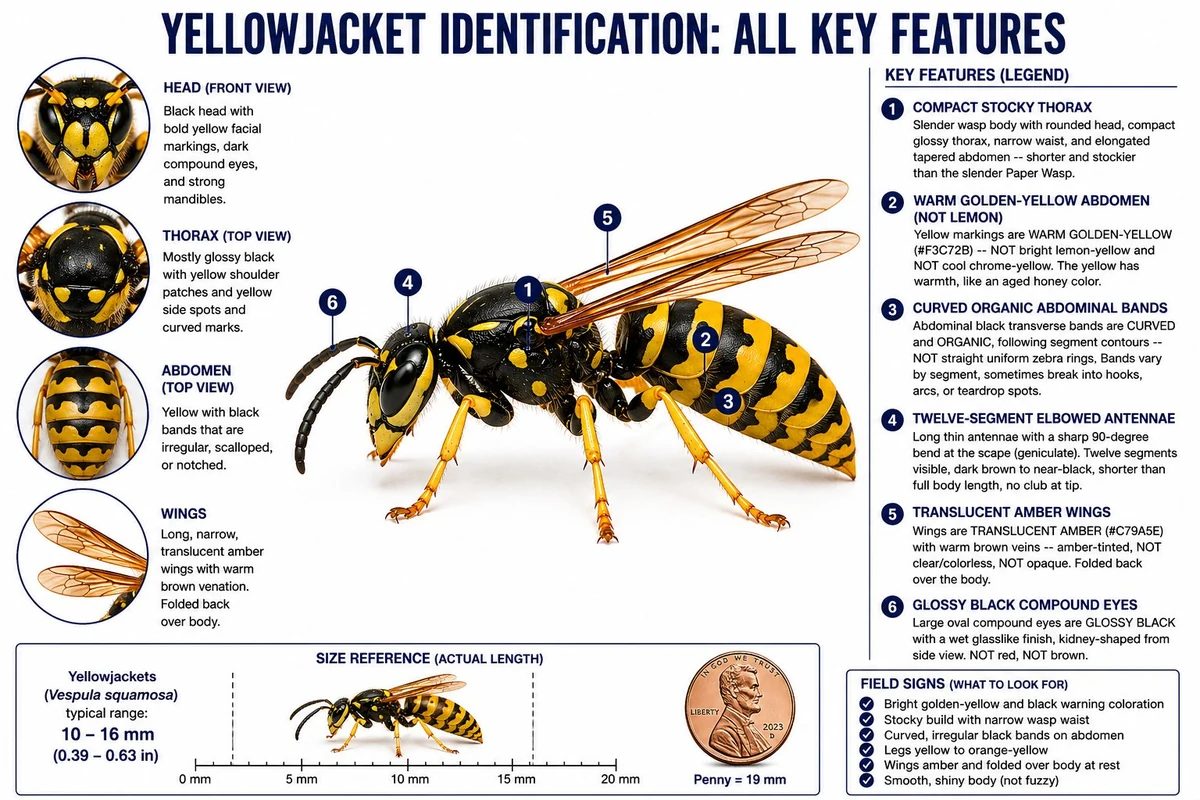
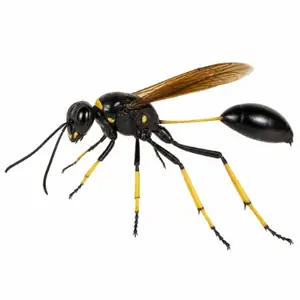
- Stocky, compact build with a blocky head; much shorter and wider-looking than paper wasps or mud daubers at the same distance
- Bright, high-contrast yellow and black abdominal banding; body is hairless and appears shiny
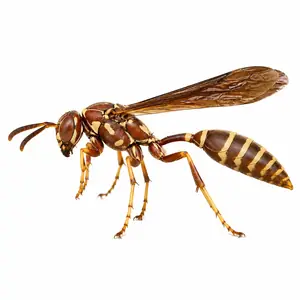
- Legs are short and held close to the body in flight; they do not dangle below the body the way paper wasp legs do
- No visible nest on any surface of the home; the only homeowner-visible sign is a hole or crack with fast-moving in-and-out worker traffic
- Flight is fast and direct with a characteristic hovering pattern near the entry hole
- In late summer, workers appear at outdoor food, drinks, trash, and pet food even far from the nest
AKA: Ground Hornet, Ground Wasp
Ground hornet is the name most Collin County homeowners use when describing a yellowjacket that erupted from a hole in the ground during mowing. The term is not taxonomically precise but is accurate enough: the dominant Collin County species, Vespula squamosa (southern yellowjacket), is primarily a ground-nesting species, and ground burrows near the foundation and in landscape beds are the most common nest locations in our area. The queen of this species is notably larger than workers and predominantly orange in color, which surprises homeowners who only know the yellow-and-black worker pattern.
Yellowjackets range from 10 to 16 mm, roughly the size of a large staple to half an inch. The stocky build and blocky head are the features that most reliably separate them from paper wasps at a glance. Multiple yellowjacket species present are present in Collin County, all receiving the same treatment approach. The absence of a visible nest on any home surface is the single most important identification point: if there is no paper structure visible but wasps are entering a hole, that is a yellowjacket indicator until proven otherwise. Vespula observations across North America document the range, seasonal activity, and nest-type variation of the genus.
Yellowjacket vs Similar Species
The hidden nest is the field identification feature that separates yellowjackets from every other common Collin County wasp. If workers are entering a hole with no visible paper structure anywhere on the exterior, treat it as yellowjacket until an inspection proves otherwise.
| Species | Size | Key Feature | Nesting Habit |
|---|---|---|---|
|
Yellowjacket
This species
AKA: Ground Hornet, Ground Wasp
Vespula spp.
|
10 to 16 mm. Stocky, compact build with a blocky head. Bright yellow and black banding. Hairless and shiny. Legs not dangling in flight. Noticeably shorter and heavier-bodied than paper wasps. | No visible nest on exterior surfaces; entry point is a hole or crack in soil, wall, or concrete. Workers enter and exit rapidly. Alarm pheromone recruitment means one sting summons more workers immediately. Colony defends a large radius around the entry. | Ground burrows in soil near the foundation, landscape beds, and lawn. Wall voids accessed through weep holes, cracks, and expansion joints. Occasionally aerial nests in dense shrubs. Never an open paper comb on an eave surface. |
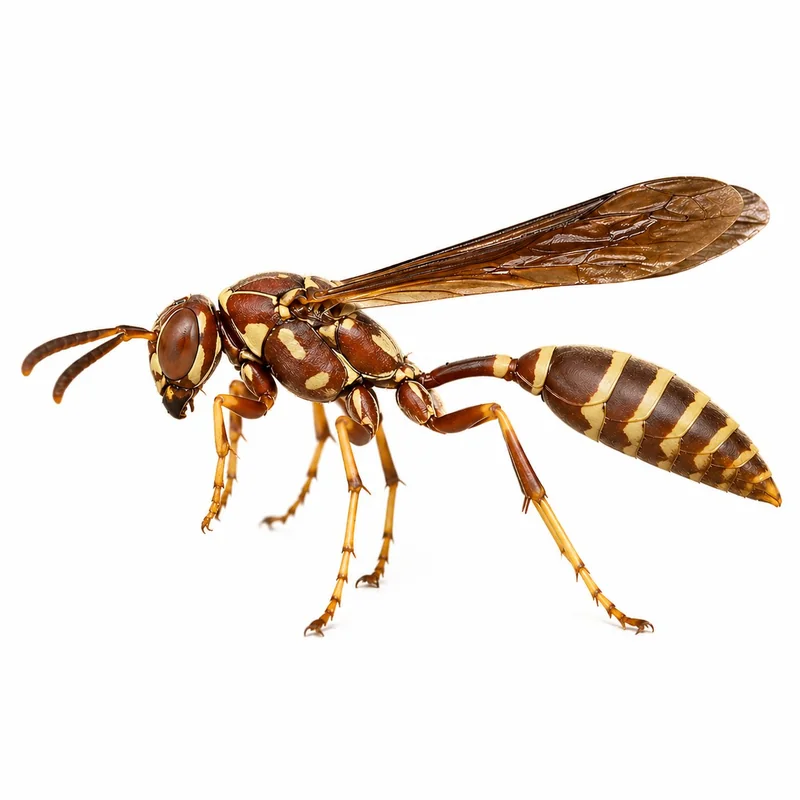
Paper Wasp
AKA: Umbrella Wasp, Red Wasp
Polistes spp.
|
16 to 25 mm. Slender build with a very narrow waist. Brownish-orange to reddish-brown coloring. Longer and more slender than any yellowjacket worker at the same distance. | Long hind legs dangle visibly below the body during flight. Open umbrella-shaped paper comb with visible hexagonal cells hanging from a single stalk. Nest is always visible from the exterior. Less aggressive colony defense than yellowjacket. | Nests exclusively on exposed structural surfaces under eaves, on porch ceilings, door frames, and window frames. Never inside ground burrows or enclosed wall voids. If there is a visible open-celled paper comb, this is paper wasp, not yellowjacket. |
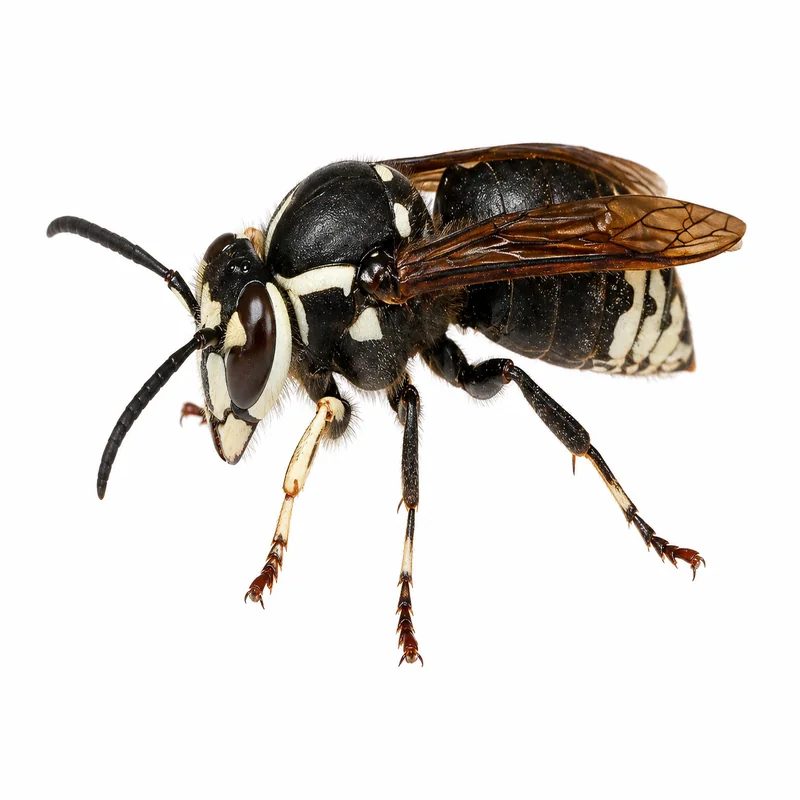
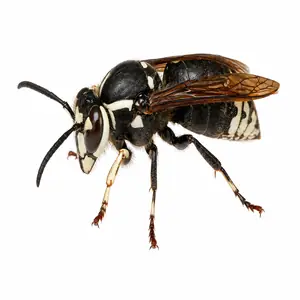
Bald-Faced Hornet
AKA: White-Faced Hornet
Dolichovespula maculata
|
15 to 20 mm. Larger and heavier-built than a yellowjacket. Black body with white markings on the face, abdomen tip, and upper body. Heavier-looking in flight. | White markings on black body are the definitive field ID. Builds large enclosed gray paper nests in trees and on structural overhangs. Among the most aggressively defensive wasps in the area. Can spray venom toward intruder eyes. Treatment approach for enclosed nests is similar to yellowjacket wall-void protocol. | Enclosed gray paper ball or football-shaped structure hanging in a tree, large shrub, or from a structural overhang. Single bottom entry hole. Never in the ground. Never an open comb. Treatment timing and dust protocol match yellowjacket wall-void treatment. |
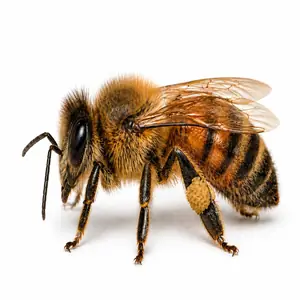
Honey Bee
AKA: European Honey Bee
Apis mellifera
|
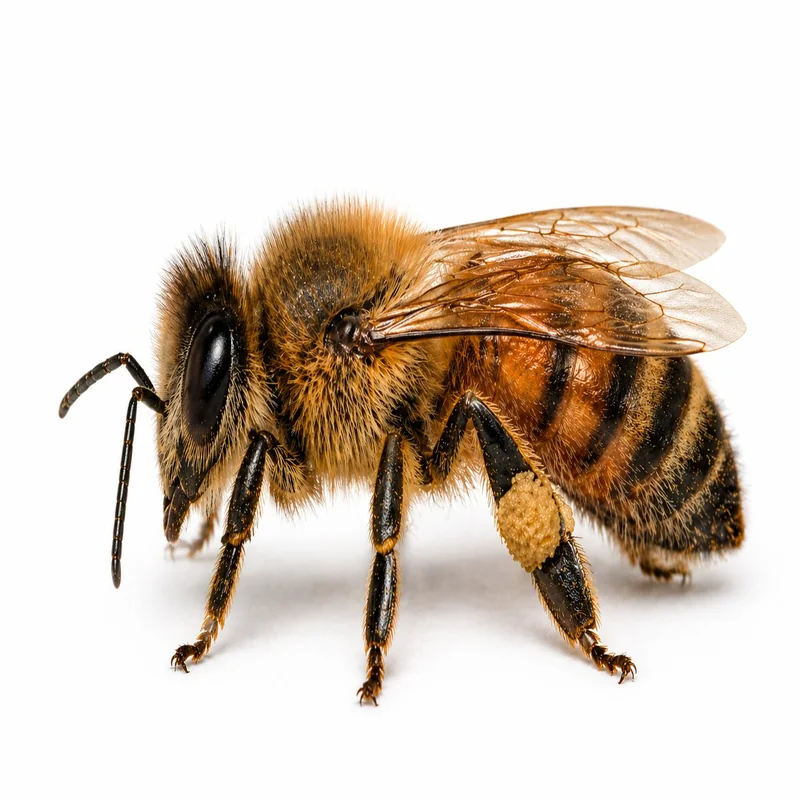
12 to 15 mm. Similar size range to yellowjacket. Golden-brown and black; body has visible hair and appears less shiny than yellowjacket. Abdomen is more tapered and rounded. | Fuzzy body with visible hair is the key visual separator from hairless yellowjacket. Honey bees carry orange or yellow pollen balls on their hind legs when foraging, which yellowjackets never do. Less aggressive foragers; do not typically approach outdoor food and drinks the way late-summer yellowjackets do. | Natural or structural cavity nests: tree hollows, wall voids, attic spaces. Workers enter through a small gap or crack. Swarms on tree branches or exterior surfaces are temporary staging, not permanent nests. Wall-void honey bee colonies require live removal, not standard pesticide treatment. |
Yellowjacket Sting: What to Expect
A yellowjacket sting delivers venom through a smooth, reusable stinger. Each worker can sting multiple times in a single encounter without losing the stinger. The immediate response for non-sensitized individuals is sharp localized pain, burning, redness, and swelling at the sting site. Multiple stings from a disturbed colony can produce more significant systemic reactions including nausea, vomiting, and extended swelling even in non-allergic individuals. The alarm pheromone effect means that disturbance of a hidden ground nest during mowing can result in mass stinging events with dozens or hundreds of stings in seconds before the person can retreat.
The serious medical risk is anaphylaxis in individuals with known or undiagnosed sensitivity to yellowjacket venom allergy reactions. Non-allergic individuals who receive a very large number of stings can also experience systemic toxic reactions even without prior sensitization. Anyone who has had a systemic response to a prior sting should carry an epinephrine auto-injector and treat any yellowjacket problem as a professional service.
Call 911 or go to an emergency room immediately if a sting is followed by difficulty breathing or wheezing. Other signs that require emergency care include hives or skin flushing spreading beyond the sting site, throat tightening, dizziness, or a rapid pulse. Multiple stings on a child, elderly person, or anyone with known venom sensitivity also warrant emergency evaluation. Any systemic response following a mass attack near a ground or wall-void nest should be treated as anaphylaxis. Do not wait to see if symptoms resolve.
The more practical property concern for Collin County homeowners is interior breakthrough: a wall-void colony whose entry is sealed before the colony is eliminated will send workers through electrical wiring chases, plumbing penetrations, and HVAC duct connections into living spaces. A Celina homeowner who sealed the crack where yellowjackets were entering the exterior wall found wasps coming out of an interior electrical outlet within 20 minutes. This scenario creates both a physical danger and a remediation cost that far exceeds the original treatment expense. Sealing the exterior entry is the last step, not the first.
Yellowjacket Colony Cycle and Why Hidden Nests Keep Coming Back
How Pest Me Off Treats Yellowjackets
Yellowjacket treatment in Collin County requires a strict sequence that differs depending on whether the nest is in the ground or inside a wall. The defining rule that applies to both: never seal entry points before colony elimination. That single rule prevents the most dangerous treatment failure mode homeowners encounter.
Entry Mapping and Inspection
We observe worker flight direction and entry behavior from a safe distance to locate the primary entry. For wall-void nests, we walk the full exterior to identify all cracks, weep holes, expansion joints, and utility penetrations where workers are entering. A wall colony may have multiple active entries. Treating one while leaving others open allows continued colony function and forager reentry.
After-Dark Dust Application
We apply commercial-grade insecticidal dust into every mapped entry point after dark when the full colony is inside the nest. Dust is applied with a wand extension to reach deep into the cavity without approaching the entry opening directly. We do not seal any entry at this stage. The entry stays open so treated workers can carry the product through the colony as they move in and out during the contact period.
48-to-72-Hour Contact Window
We leave all entries open and untouched for a minimum of 48 to 72 hours after dust application. This window allows returning foragers and nest workers to track the product through the colony and reach the queen and brood. Sealing the entry before this window closes cuts off the distribution mechanism and leaves the colony partially intact and sealed inside the wall or ground.
Confirmation and Entry Sealing
After the contact window, we confirm colony elimination by observing entry activity. When activity has ceased, we seal all entries with professional-grade masonry sealant or copper mesh. For ground nests, the entry hole is sealed and the surrounding soil surface is treated. A follow-up visit is scheduled for any colony that shows continued activity beyond the standard contact window.
& Other Companies
What You Can Do to Reduce Yellowjacket Pressure
Why Yellowjacket DIY Creates Bigger Problems Than It Solves
Yellowjackets are the wasp where DIY mistakes carry the highest consequence. The hidden nest and the alarm pheromone system mean small errors produce fast, dangerous outcomes. These are the failure modes PMO sees repeatedly on callback calls.
Sealing the Entry Before Treatment
Plugging the crack or hole where yellowjackets are entering is the most common and most dangerous DIY mistake. Sealing the exterior entry before the colony is eliminated traps thousands of workers inside with no way out. Those workers follow electrical wiring, plumbing chases, and HVAC ducts through interior walls and emerge from outlets, light fixtures, and ceiling vents inside living spaces. This creates both a physical emergency and a remediation cost that far exceeds the original treatment. If the entry is sealed right now, call us before doing anything else.
Using Aerosol Spray on a Hidden Nest
Consumer wasp aerosol is designed for visible nests with direct line-of-sight contact. Spraying it at a wall crack or ground entry hole kills workers near the surface but does not deliver product deep enough into the cavity to reach the queen and brood. The colony continues functioning with a reduced surface population and workers return through secondary entries within hours. The colony typically rebounds to full size within one to two weeks. Aerosol on a hidden nest is a temporary surface fix that agitates the colony without eliminating it.
Treating a Ground Nest in Daylight
A significant portion of the foraging force is outside the nest during daylight hours and not in contact with any product applied to the entry. Workers returning to a recently disturbed entry arrive in a defensive state and remain so for hours. A ground nest disturbed at noon produces a mass defensive response before any product can distribute through the colony. After-dark treatment with a dust formulation and a wand extension is the only approach that puts the full colony in contact with the product in a single application without requiring the applicator to be near the entry.
Missing a Secondary Entry Point
Wall-void yellowjacket colonies in Collin County slab construction regularly use more than one entry. A weep hole in the brick veneer plus a gap around a refrigerant line two feet away is a common two-entry pattern. Treating one and leaving the other open allows the colony to continue functioning and foragers to continue entering and exiting. Most homeowners treat the entry they can see and miss the secondary. Professional inspection walks the full exterior looking specifically for secondary entries before any product is applied.
Sealing Before Confirming Colony Elimination
The contact window after dust application is 48 to 72 hours minimum. Sealing the entry on the day of treatment, or the day after, cuts off the distribution mechanism before the product has reached the queen and brood through worker contact. The result is a partially treated colony sealed inside the wall with no exterior exit: the same interior breakthrough scenario as sealing before treatment, just delayed by one day. Confirmation that activity has ceased completely is the gate that must be cleared before any entry is sealed. No activity for 48 hours after the contact window closes is the minimum standard.
Yellowjacket FAQ
Ground hornet is the name most Collin County homeowners use when they describe a yellowjacket that erupted from a hole in the ground during mowing or landscaping. It is not a technically accurate common name: yellowjackets are wasps, not true hornets. But it is descriptive enough to stick: the dominant Collin County species nests primarily in ground burrows, and a cloud of wasps coming out of a hole in the yard reads as a hornet to most people regardless of the taxonomy. Ground wasp is a third common name used for the same reason. All three names, yellowjacket, ground hornet, and ground wasp, describe the same species on this page. The name distinction matters primarily for treatment: recognizing that the ground entry leads to a hidden cavity nest, not an aerial paper comb, is what drives the after-dark dust protocol rather than a daylight spray approach.
Colony size reaches its annual maximum in late summer, with thousands of workers defending the same hidden nest. At the same time, the larval population that workers were feeding through summer declines, and workers shift from hunting insects to scavenging carbohydrates. That combination puts a very large, defensive population in direct contact with outdoor human food and drink at exactly the point when people are most active outside. Hot, dry summers make it worse because reduced natural food sources drive more foragers to human-generated food. The aggression is not random; it is a function of colony size and resource competition both peaking at the same time.
No. Sealing the exterior entry before eliminating the colony is the most dangerous DIY mistake associated with yellowjackets. Blocking the only exterior exit traps thousands of workers inside the wall void with no path outward. Those workers do not simply stay in the wall; they follow electrical wiring chases, plumbing penetrations, and HVAC connections through interior walls and emerge from outlets, fixtures, and vents inside your living space. The entry gets sealed as the last step, after colony elimination is confirmed, not before treatment begins. If the entry is sealed right now, call us before anything else.
No. The annual colony dies with the first hard freeze, and the nest structure itself is not reused as a live colony the following spring. A new queen starts fresh each year. However, the same ground location or wall void that successfully supported a colony is attractive to new queens the following spring for the same physical reasons it worked the first time: protected cavity, appropriate size, suitable entrance. Sealing the entry after confirmed colony elimination is the step that prevents the same address from calling with yellowjackets again in May. Without sealing, expect the same location to be reoccupied.
Yes, and this is a risk unique to the South. Texas A&M documents that southern yellowjacket colonies can survive mild winters and continue growing into a second season without a colony reset. Documented perennial colonies in southern states have reached 6 feet across with hundreds of thousands of workers. Collin County does not experience reliably hard winters every year. A homeowner who sees renewed activity in March at a location that had yellowjackets the prior summer should not assume the colony is new or small. If activity resumed quickly after a mild winter, the existing colony may still be active and may be substantially larger than a typical first-year colony.
The fastest visual separator is body texture: yellowjackets are hairless and shiny with bright yellow and black banding, while honey bees have visible body hair and a golden-brown, less contrasting appearance. Honey bees also carry orange or yellow pollen baskets on their hind legs when foraging, which yellowjackets never do. Behaviorally, honey bee foragers are generally docile and do not approach outdoor food and drinks the way late-summer yellowjackets do. Treatment protocol differs significantly: yellowjacket nests receive insecticidal dust, while honey bee wall-void colonies require live removal to prevent the dead comb from attracting secondary pests and new swarms. If you are unsure which species you have entering a wall, call before treating.
This almost always means the exterior entry to a wall-void colony was blocked or disrupted before the colony was eliminated. Workers inside the void followed the path of least resistance to an alternative exit, which in slab-on-grade construction is typically an electrical chase or outlet box. The same scenario can produce wasps emerging from light fixtures, HVAC vent covers, and ceiling penetrations. If this is happening right now, do not attempt to seal the interior outlet. Leave interior exit points open and call us. The exterior entry needs to be located and treated with the colony still intact.
Yellowjackets are active predators of caterpillars, flies, and other pest insects through the summer foraging season, making them incidental garden pest controllers. They also serve as minor pollinators when visiting flowers for nectar. These ecological functions are real. They do not change the risk calculation when a colony of several thousand workers is located in a ground burrow directly underneath a lawn mowing path or inside the wall of a home with children. The practical recommendation is identical to paper wasp: leave nests in genuine no-traffic locations, call a professional for anything that creates regular human contact.
Do not seal anything and do not approach with aerosol. Interior buzzing from a wall without a visible exterior entry is a classic wall-void yellowjacket scenario. The entry is likely a weep hole in the brick veneer, a gap around a utility penetration, or a slab-edge crack that is not obvious from normal viewing height. Locating it requires walking the full exterior perimeter, sometimes including ground level along the foundation, and watching for the in-and-out worker traffic that marks the entry. Spraying into the wall through an interior outlet before the exterior entry is found is not a substitute for entry mapping and will not solve the problem. Call us; locating hidden entries is the part homeowners most consistently miss.
Yellowjackets in Your Ground or Wall. We Find Every Entry and Do Not Seal Anything Until the Colony Is Gone.
Most yellowjacket treatments spray the visible entry and hope for the best. We map every entry point first, treat after dark with professional-grade dust, leave the entries open for the full contact window, and confirm elimination before any sealing starts. That sequence is what separates a completed job from a callback with wasps coming out of an outlet. Stinger Smackdown across McKinney, Allen, Frisco, Plano, and all of Collin County.
A yellowjacket wall-void job done right takes time: locating every entry point, treating at the right time of day, waiting for the contact window, confirming elimination. Rushing it is how you create an interior breakthrough. The 12-stop limit is what gives us time to do it correctly the first time.