Bald-Faced Hornets in Collin County, TX | Identification and Nest Removal
The bald-faced hornet (Dolichovespula maculata) builds the largest and most visually alarming wasp nest in North Texas: a gray enclosed paper ball suspended in trees and shrubs that can exceed two feet long by late summer. Despite the common name, bald-faced hornets are not true hornets but large yellowjackets in the genus Dolichovespula, with a colony of 200 to 400 highly defensive workers at peak. This page covers identification, why an enclosed aerial nest requires a completely different treatment approach from open paper wasp combs, and when a distant tree nest can safely wait for winter versus when it needs professional treatment now.
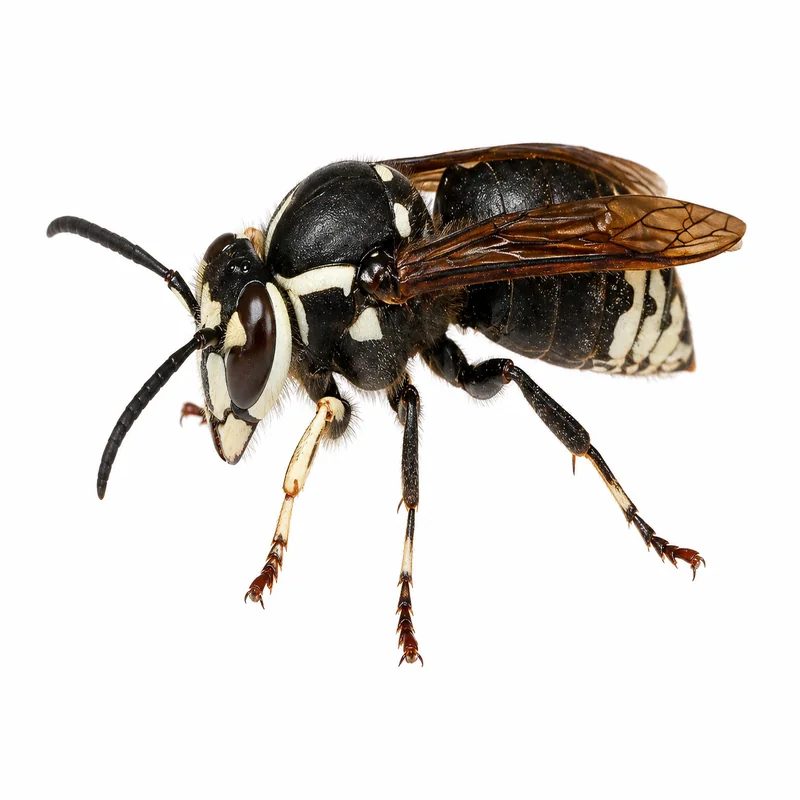
Overwintered queens emerge in April and May and begin building starter nests that go completely unnoticed at walnut size. Colony size builds through summer; nests become visible in late July or August once they have grown large enough to see through the canopy. Peak aggression runs August through September when the colony reaches full size. Colony dies with the first hard freeze in November; empty nests may remain visible in trees through winter after leaf drop.
What Bald-Faced Hornets Look Like
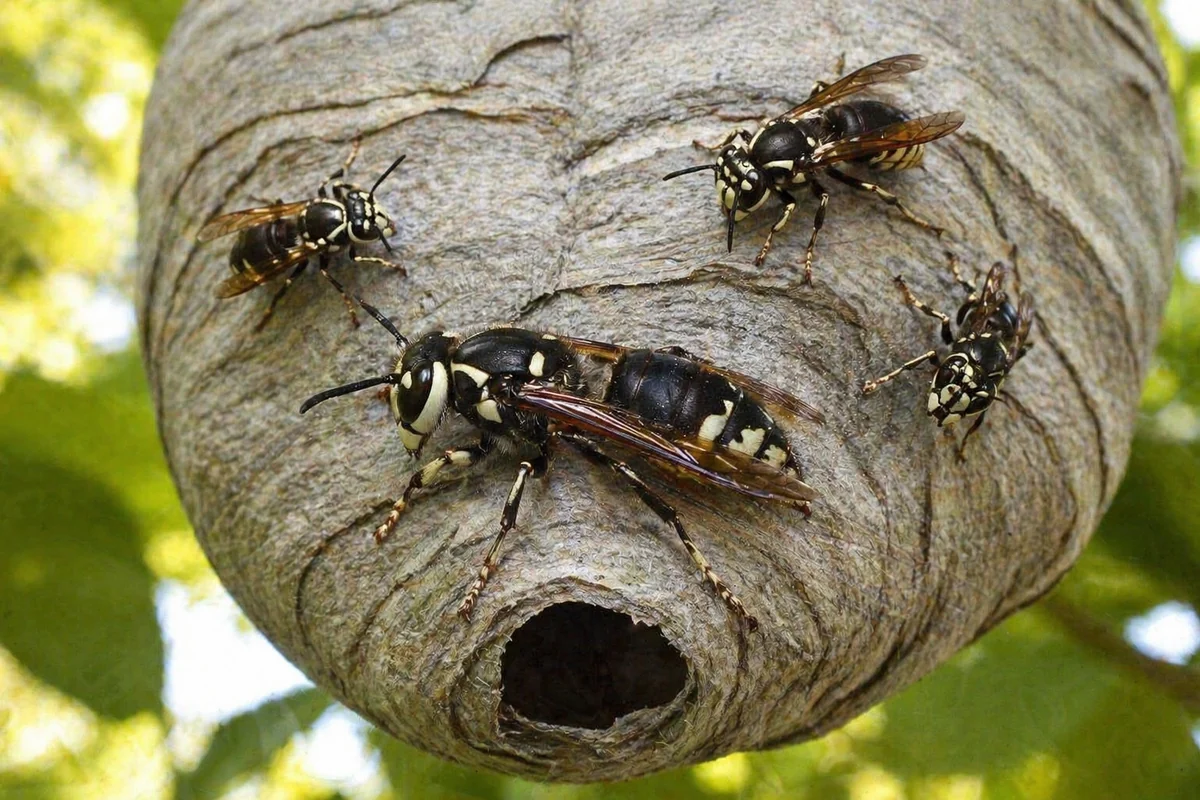
Black body, bold white facial markings, and a large enclosed gray paper ball in a tree. Nothing else in North Texas looks like this combination.
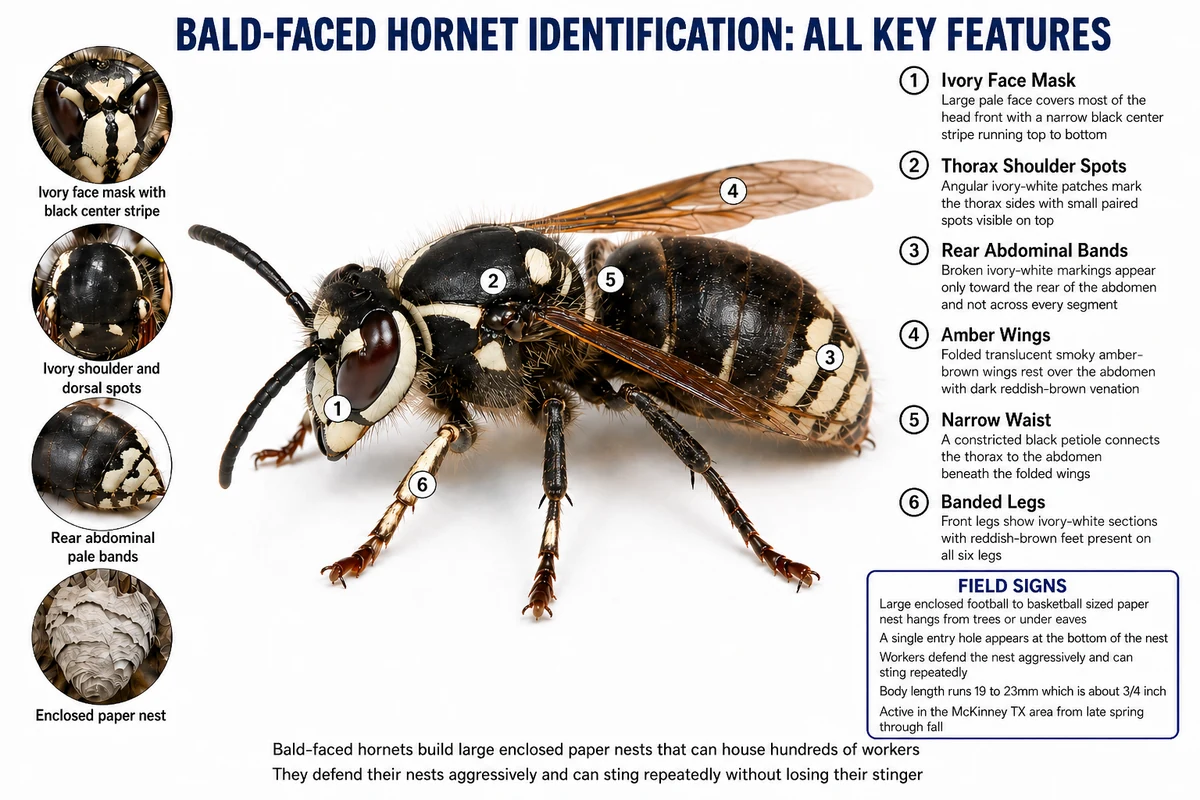
- Black body with bold white or ivory markings on the face, upper midsection, and the tip of the abdomen. No other common North Texas wasp has this pattern
- Large, gray, enclosed paper structure hanging in a tree, large shrub, or from a structural overhang. The nest is the single most diagnostic feature
- Single circular entry hole visible at the bottom of the paper envelope; workers enter and exit in a straight, fast flight path
- Nest grows visibly from month to month through summer; a walnut-sized starter nest in May becomes football-sized in July and basketball-sized or larger by August
- Heavily built, larger and heavier-looking in flight than a paper wasp of the same length; no dangling legs
- Workers actively hunting flies and other insects near the nest or in the yard
AKA: White-Faced Hornet, Bald Hornet
White-faced hornet is the name many North Texas homeowners use, and it is more technically descriptive than the standard common name: the white facial markings are the one field-identification feature that separates this species from every other social wasp in Collin County at a glance. Despite the name “hornet,” this species is not a true hornet. True hornets belong to the genus Vespa; bald-faced hornets are in the genus Dolichovespula, making them large yellowjackets by taxonomy.
Workers measure 15 to 20 mm, roughly the size of a large paper clip to 3/4 inch. The enclosed gray paper nest is built from chewed wood fiber mixed with saliva and grows from walnut-sized in late spring to as large as 24 inches in length by late summer. The nest contains 2 to 4 horizontal internal combs accessible only through the single bottom entry hole. Unlike yellowjackets, which hide their nests in ground voids and walls, bald-faced hornets build in open air and the nest itself is a homeowner-visible alarm signal once it reaches full size.
Bald-Faced Hornet vs Similar Species
The enclosed gray paper ball is the definitive field identification feature. No other common North Texas stinging insect builds an enclosed aerial nest in trees. If you see a gray paper ball hanging in a tree or shrub, it is a bald-faced hornet until an inspection proves otherwise.
| Species | Size | Key Feature | Nesting Habit |
|---|---|---|---|
|
Bald-Faced Hornet
This species
AKA: White-Faced Hornet
Dolichovespula maculata
|
15 to 20 mm. Heavily built, larger and heavier than a yellowjacket. Black body with bold white markings on the face, upper midsection, and abdomen tip. Heavier-looking in flight than a paper wasp of the same length. | White markings on an otherwise black body are the definitive field ID; no other common North Texas wasp shares this pattern. Builds large enclosed gray football-shaped paper nests suspended in trees and shrubs. Most aggressively defensive social wasp in the service area. Can spray venom toward intruder eyes. | Enclosed gray paper ball or football-shaped structure hanging in a tree, large shrub, or from a structural overhang. Single bottom entry hole in the paper envelope. Never in the ground. Never an open comb. Nest is always visible once it reaches full size. |
Yellowjacket
AKA: Ground Hornet, Ground Wasp
Vespula spp.
|
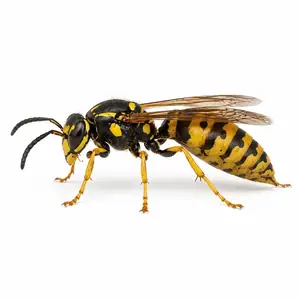
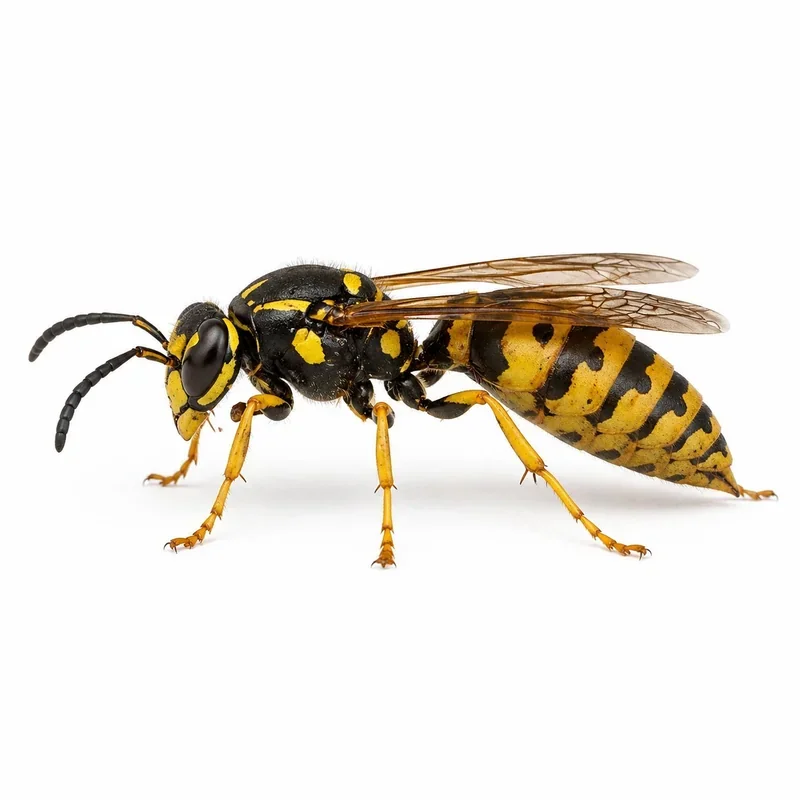
10 to 16 mm. Stocky, compact build. Bright yellow and black abdominal banding. Legs held close to the body in flight, not dangling. Noticeably shorter and more stocky than paper wasp at the same viewing distance. | Bold yellow and black pattern is brighter and more contrasting than bald-faced hornet coloring. No white facial markings. No visible nest on home surfaces: entry point is a hole or crack in soil, wall, or concrete. Much more hidden colony than bald-faced hornet. | Most Collin County yellowjacket colonies nest underground in soil burrows or inside wall voids accessed through a crack, weep hole, or expansion joint. A ground hole with fast in-and-out worker traffic is the homeowner-visible sign. Never builds an open comb or enclosed aerial nest on home surfaces. |
Paper Wasp
AKA: Umbrella Wasp, Red Wasp
Polistes spp.
|
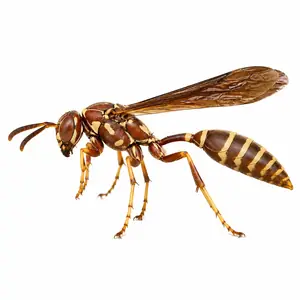
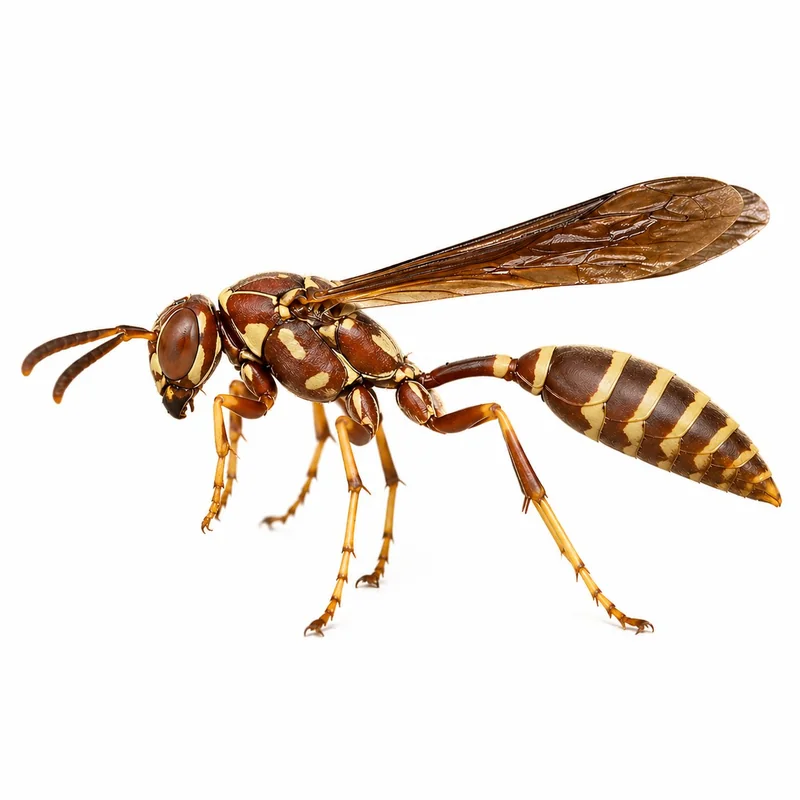
16 to 25 mm. Slender build with a very narrow waist. Brownish-orange to reddish-brown coloring. Longer and more slender than a bald-faced hornet of similar length. Long hind legs dangle visibly below the body during flight. | Open umbrella-shaped paper comb with visible hexagonal cells hanging from a single stalk; never enclosed. Nest is always visible from the exterior. Less aggressive colony defense than bald-faced hornet. Brown-orange coloring rather than black-and-white. | Nests exclusively on exposed structural surfaces under eaves, on porch ceilings, door frames, and window frames. Never inside ground burrows or enclosed nests. If there is a visible open-celled paper comb, this is paper wasp, not bald-faced hornet. |
Mud Dauber
AKA: Dirt Dauber, Mud Wasp
Sceliphron spp.
|
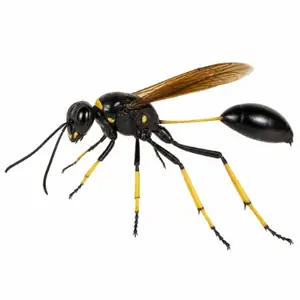
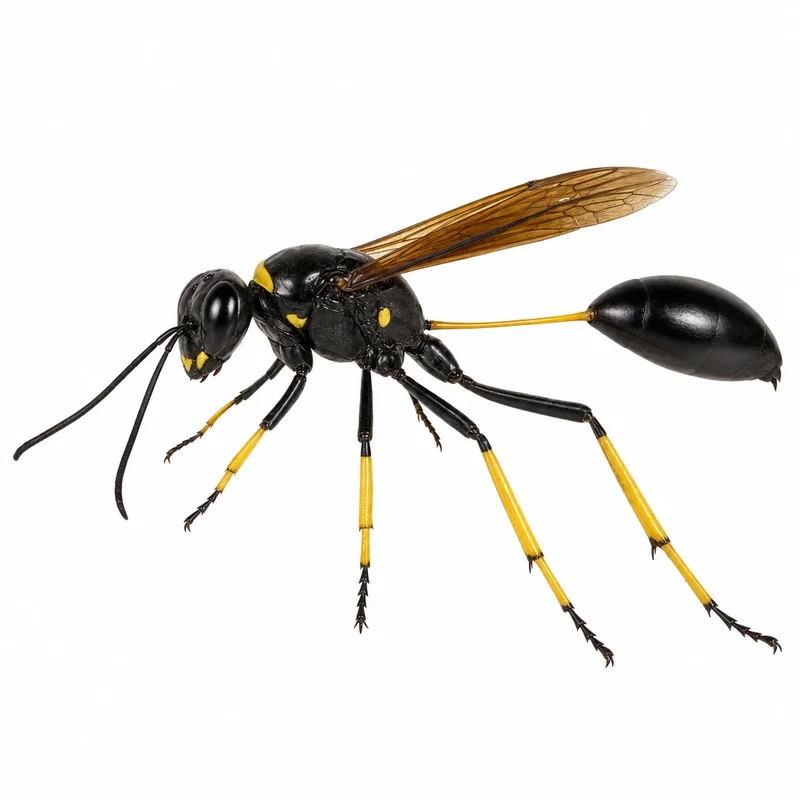
25 to 35 mm. Very long, slender body with an extremely narrow thread-like waist. Mostly black or iridescent blue-black. Significantly longer than a bald-faced hornet but far more slender. | Solitary wasp. No colony, no defensive behavior. Builds individual mud tubes or mud cells on protected surfaces. Non-aggressive and will not sting unless physically handled. No enclosed paper nest, no social colony structure whatsoever. | Constructs mud pipe nests on protected surfaces including garage walls, porch ceilings, attic beams, and exterior walls. Each cell contains a paralyzed spider stored as food for a single larva. No workers, no queen, no colony to disturb. |
Bald-Faced Hornet Sting: What to Expect
A bald-faced hornet sting delivers venom through a smooth, reusable stinger. Each worker can sting multiple times in a single encounter. The immediate response for non-sensitized individuals is intense localized pain, significant burning, and swelling that typically exceeds the reaction from a paper wasp sting of similar location. The defensive response of a disturbed colony is coordinated and rapid: workers recruit nest-mates aggressively, and multiple stings within seconds of the first contact is the norm rather than the exception when the defensive radius is breached.
The serious medical risk is anaphylaxis in individuals with known or undiagnosed sensitivity to wasp and hornet venom reactions. Anyone with a prior systemic reaction to any stinging insect should carry an epinephrine auto-injector and treat any bald-faced hornet sighting near human activity as a professional service. Purdue Extension guidance on venom hypersensitivity covers the evaluation criteria for sensitized individuals. For non-sensitized individuals, a mass attack from a colony of 200 to 400 workers can produce systemic toxic reactions even without prior sensitization. mass envenomation risk is independent of prior sensitization.
Call 911 or go to an emergency room immediately if a sting is followed by difficulty breathing, wheezing, or throat tightening. UF/IFAS guidance on stinging insect medical response identifies these as primary anaphylaxis indicators. Other signs that require emergency care include hives or skin flushing spreading beyond the sting site, dizziness, or a rapid pulse. Anyone with known venom sensitivity who receives even a single sting should seek emergency evaluation without waiting for symptoms to develop. Multiple stings on a child, elderly person, or anyone with any prior sting reaction also warrant emergency evaluation. These are signs of anaphylaxis and do not resolve on their own.
The one property-adjacent concern is the attachment point of a large nest to a tree limb or structural surface. A basketball-sized nest can weigh several pounds when fully built out; if the attachment branch is already stressed, the added weight combined with wind loading can affect it. This is a minor concern on healthy tree specimens but worth noting on ornamental trees with thin canopy or signs of prior stress. An abandoned nest left in place through winter will deteriorate naturally and pose no additional concern unless it is on a frequently accessed structure. Removal after colony death in winter is cosmetic rather than necessary for structural protection.
Bald-Faced Hornet Colony Cycle
How Pest Me Off Treats Bald-Faced Hornets
Bald-faced hornet treatment follows a nighttime protocol that differs from paper wasp treatment in timing, approach angle, and required distance. Texas A&M confirms nighttime treatment is required: approaching an active colony during daylight hours puts the applicator inside the defensive zone before product can be delivered.
Daylight Assessment from Safe Distance
We locate the nest during daylight from outside the defensive radius, map the entry hole position (always at the bottom of the paper envelope), and assess whether a ladder would be required. If a ladder is needed for the treatment angle, we use long-reach extension equipment instead. We assess the approach angle that allows product delivery into the entry hole while keeping the applicator at maximum safe distance and out of the direct fall path of workers.
After-Dark Application into the Entry Hole
All treatment is performed after dark when the full colony is inside the nest and metabolic activity is reduced. We use red-filtered light only, because bald-faced hornets are attracted to white light. A labeled wasp and hornet aerosol with a 15-to-20-foot spray distance is applied directly into the bottom entry hole. We apply from the side and slightly below, never directly below the nest, to avoid drip contact and falling workers. Application time is 10 to 15 seconds of sustained direct entry injection.
24-to-48-Hour Confirmation Window
We assess worker activity from a safe distance after 24 to 48 hours. A successfully treated colony shows sharply reduced or no worker traffic at the entry hole by 24 hours. If activity continues at normal levels, a second treatment application is scheduled. We do not approach for nest removal until zero worker activity is confirmed for a full observation period.
Nest Removal After Confirmed Elimination
After colony elimination is confirmed, we remove the nest using a pole pruner or telescoping tool and bag it immediately in a sealed plastic bag for disposal. We do not stand directly below the nest during removal. For nests on structural surfaces, the attachment point is cleaned to remove any residual comb material. Nest removal prevents secondary pest attraction and eliminates the visual presence that can alarm future visitors to the property.
& Other Companies
What You Can Do to Reduce Bald-Faced Hornet Pressure
Why Bald-Faced Hornet DIY Fails
Spraying the Exterior Paper Envelope
Consumer wasp and hornet aerosol sprayed at the outside of the paper nest does not penetrate the multiple paper envelope layers to reach the interior combs where the queen and brood are located. The layers act as a physical barrier against liquid spray applied to the surface. Workers near the entry hole may be killed, but the colony continues functioning with the queen and brood intact. A treated-but-alive colony of 200 to 400 workers is not smaller or less dangerous than an untreated one; it is simply more agitated.
Approaching During Daylight
The defensive radius of an active bald-faced hornet colony extends 10 to 20 feet from the nest. A homeowner approaching close enough to use a consumer aerosol with a 10-to-15-foot maximum spray range enters this radius before the first spray. Workers respond to any approach within this zone without warning. Daytime approach means the full foraging force is partially out of the nest, the remaining workers are at peak alertness, and the applicator has entered the attack zone before product can be delivered. After-dark treatment is not optional.
Using a Ladder Near the Nest
Ladder use near a bald-faced hornet nest is one of the most dangerous DIY combinations in residential pest control. A sting at height can produce an involuntary startled response that causes loss of grip on the ladder rails. A fall from a ladder while being stung by multiple workers simultaneously is the injury scenario, not just the stings themselves. Professional treatment uses long-reach extension equipment specifically to eliminate the need for any ladder near an active colony. If a ladder would be needed to reach the nest with consumer products, stop and call.
Removing the Nest Before the Colony Is Dead
Attempting to knock down, cut, or remove an active or partially treated bald-faced hornet nest releases the surviving workers from the paper enclosure into direct physical contact with whatever disturbed them. Workers in a disrupted nest respond as a coordinated mass. The protective paper envelope that contained them is gone, and the full colony encounters the threat simultaneously. This is the scenario that produces the most severe sting events associated with bald-faced hornets. Nest removal only happens after zero worker activity is confirmed for a full observation period.
Treating in Wind or Rain
Aerosol applications in wind conditions do not deliver product accurately into the entry hole at distance. Drift carries the spray away from the entry before it can penetrate to the interior combs, and product that contacts the exterior paper surface instead of the entry hole provides no colony kill. Wet conditions reduce residual adhesion on treated surfaces and dilute product concentration before workers can distribute it through the colony. Treatment requires still air and dry conditions. If weather does not cooperate, reschedule rather than apply in marginal conditions and count on a callback.
Bald-Faced Hornet FAQ
No. Despite the name, bald-faced hornets are actually a type of wasp. They are not the same insect as the yellowjackets described elsewhere on this site. They belong to a different branch of the wasp family and behave differently: they build a completely enclosed aerial nest, run larger colonies, and defend more aggressively than typical yellowjackets. The hornet name stuck because the enclosed paper ball nest and the size of the colony match what most people picture when they hear the word hornet. The treatment approach is also different from yellowjacket treatment. If you found it in the ground or in a wall void, it is almost certainly a yellowjacket. If you found a gray paper ball hanging in a tree or from an overhang, it is a bald-faced hornet.
Yes, if the nest is genuinely away from driveways, patios, play areas, and foot paths and the tree will not be trimmed or disturbed. The colony will die after the first hard freeze, typically November in Collin County, and the nest will be permanently abandoned. It can be removed safely in December or January when it is empty. The decision point is proximity to human activity: if any regularly used outdoor space, play area, or walking path is within 15 to 20 feet of the nest, professional treatment before August is the practical recommendation. The colony only gets larger and more defensive through summer; there is no benefit to waiting once a nest is near human traffic.
No. The colony dies after the first hard freeze and the nest is permanently abandoned. The nest structure itself is not reused as a live colony the following spring. However, a new queen may select the same tree the following spring and build a completely new nest, because the same physical location that attracted the prior queen, including canopy cover, elevation, and proximity to foraging area, is still present. Year-over-year bald-faced hornet activity on the same property is common in Collin County neighborhoods with mature live oak, pecan, and cedar elm canopy. The old nest does not cause the return; the habitat does.
Starter nests in late spring are walnut-sized and are built inside leaf canopy where they are essentially invisible from ground level. By the time summer foliage begins to show seasonal stress in late July and August, the nest has grown to football size or larger and becomes visible for the first time. From the homeowner’s perspective the nest appeared suddenly and fully formed; in reality it was building for three to four months. The late-discovery pattern is the reason August and September calls dominate the bald-faced hornet service volume in Collin County; the nest was never small from the homeowner’s point of view.
Bald-faced hornets have been documented pursuing perceived threats for 50 to 100 feet from the nest. If you disturb an active nest, run in a straight line away from the nest and move as quickly as possible toward shelter inside a vehicle or building. Do not swat at workers during retreat; swatting signals ongoing aggression and can increase the number of workers pursuing. Cover your face if possible while running. Do not jump into water as workers will wait at the surface. Once inside shelter, workers typically disengage within a few minutes.
The two nests are immediately distinguishable. A bald-faced hornet nest is a large, completely enclosed gray paper ball with no visible comb and a single circular entry hole at the bottom. The exterior is a smooth or layered papery surface. A paper wasp nest is an open, flat or dome-shaped comb with all cells exposed and visible from below, no outer enclosure, and an attachment stalk on a single surface. If you can see individual cells from the ground, it is a paper wasp nest. If you see a gray enclosed ball or oval shape with no visible cells, it is a bald-faced hornet nest. Size is also a reliable separator: by August, a bald-faced hornet nest is at least football-sized; a large paper wasp nest is typically the size of a salad plate or smaller.
Yes. Worker bald-faced hornets are active predators of flies, caterpillars, and other insects through the summer foraging season, functioning as meaningful garden pest controllers at properties with established canopy. They also serve as minor pollinators when visiting flowers. These ecological functions are real and worth noting. They do not change the practical recommendation when a colony of 200 to 400 workers is located over a driveway or backyard play area. The recommendation for genuinely no-traffic nest locations is the same as for yellowjackets: leave it alone and let winter handle it. Call when the location creates regular human contact.
Gray Paper Ball in Your Tree. We Treat at Night, Confirm It Is Dead, Then Take It Down.
Most bald-faced hornet calls in August and September involve a nest that has been growing since May without being noticed. We assess it from outside the defensive radius, treat after dark using long-reach equipment and no ladder, confirm elimination before any approach for removal, and take the nest down clean. The whole sequence done right. Stinger Smackdown across McKinney, Allen, Frisco, Plano, and all of Collin County.
A bald-faced hornet job done right has two components: treatment and confirmed-dead removal. Rushing into nest removal before confirming elimination is how you turn a wasp call into an injury event. The 12-stop limit is what gives us time to treat, wait the confirmation window, and come back for removal rather than pushing the timeline to close the job today.