Cicada Killers in Collin County, TX | Identification and Control
The cicada killer (Sphecius speciosus) is the largest wasp a Collin County homeowner will ever see, reaching up to 2 inches in length with a rusty red head and a slow, low flight over lawns that looks threatening. solitary ground-nester native to Texas, with no colony, no queen, and no shared defense. The dive-bombing behavior that frightens homeowners is performed exclusively by males, and males cannot sting. This page covers how to identify cicada killers versus yellowjackets and other lookalikes, why aggregations in lawn soil compound damage each season without treatment, and how Pest Me Off treats active burrow sites across Collin County.
Larvae overwinter underground in a dormant state and pupate in late spring. Adults emerge in June, with males appearing one to two weeks ahead of females. The peak burrowing and provisioning window runs through July and August, timed precisely to coincide with the height of annual cicada season in Collin County. Activity slows sharply by September as egg-laying winds down and the adult population naturally declines. The larva of each brood cell overwinters underground and the cycle restarts the following summer.
What Cicada Killers Look Like
Giant size, rusty head, slow low flight, and burrows with fan-shaped soil mounds at the entrance.
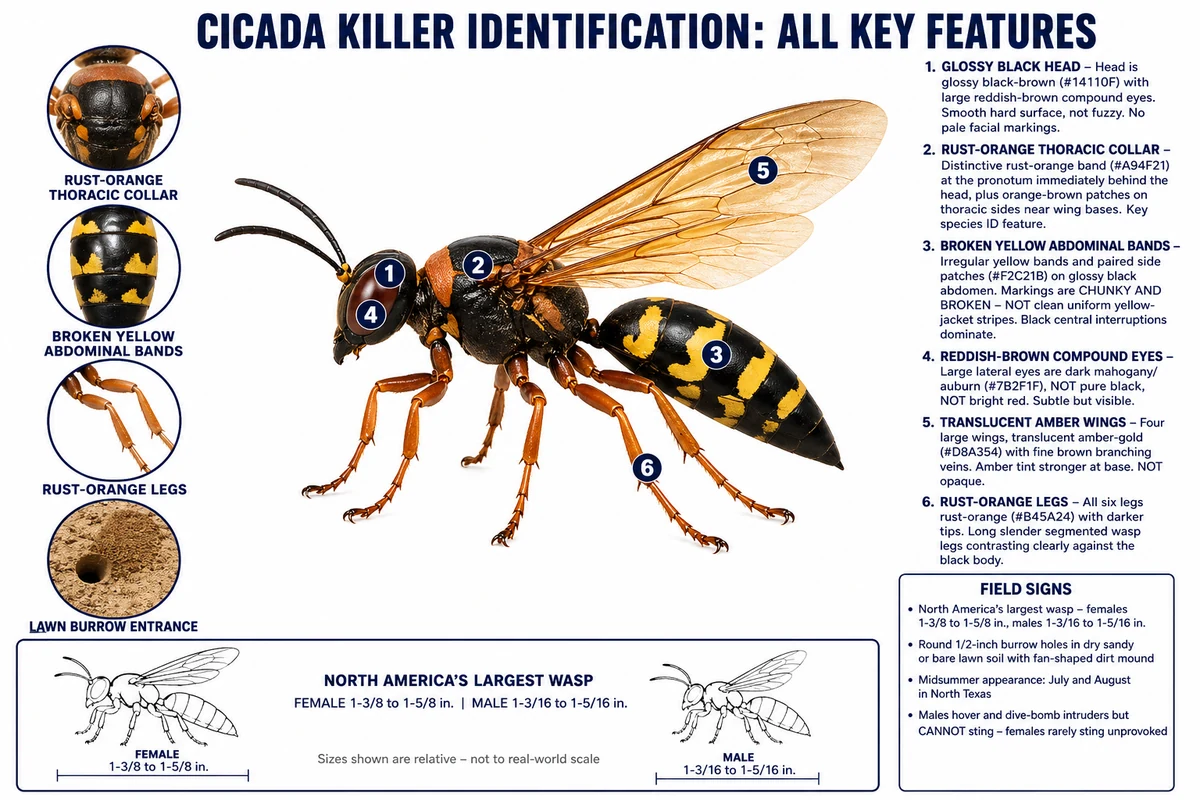
- Enormous size: 1.5 to 2 inches in length. Nothing else flying low over a Collin County lawn in summer is anywhere close to this size.
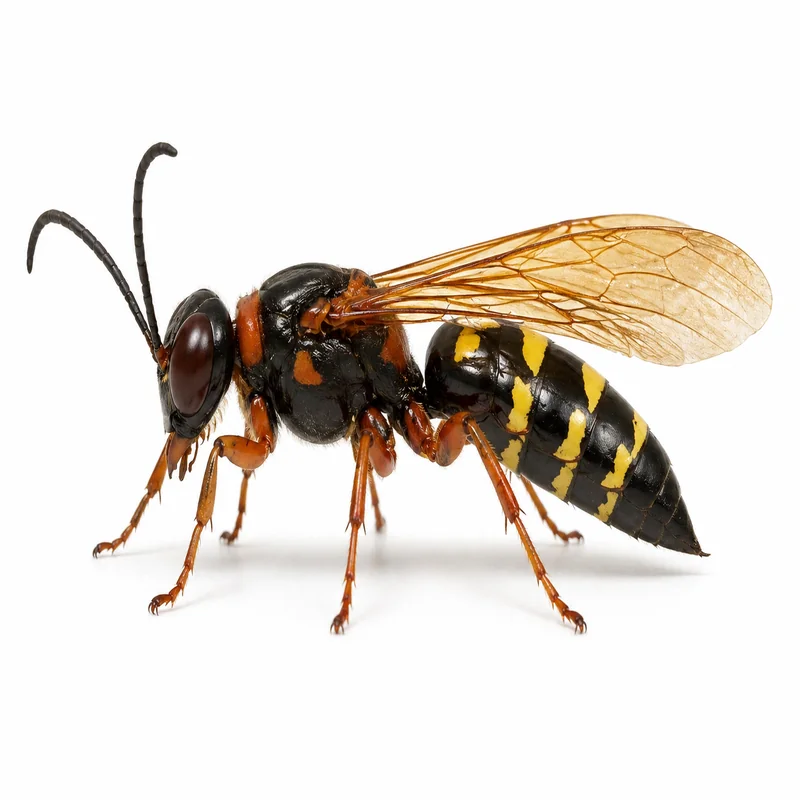
- Rusty red to reddish-brown head and midsection, which is the single most diagnostic color feature. Other large wasps in the area have black or yellow-dominant heads, not rusty red.
- Black abdomen with interrupted yellow banding and large amber-tinted wings with a russet cast. At a distance the abdomen pattern resembles a yellowjacket but the giant size and rusty head are unmistakable.
- Slow, low, deliberate flight 2 to 4 feet above lawn surfaces. Males hover and patrol the same territory repeatedly. Females fly low and purposefully toward the ground or toward trees where cicadas are present.
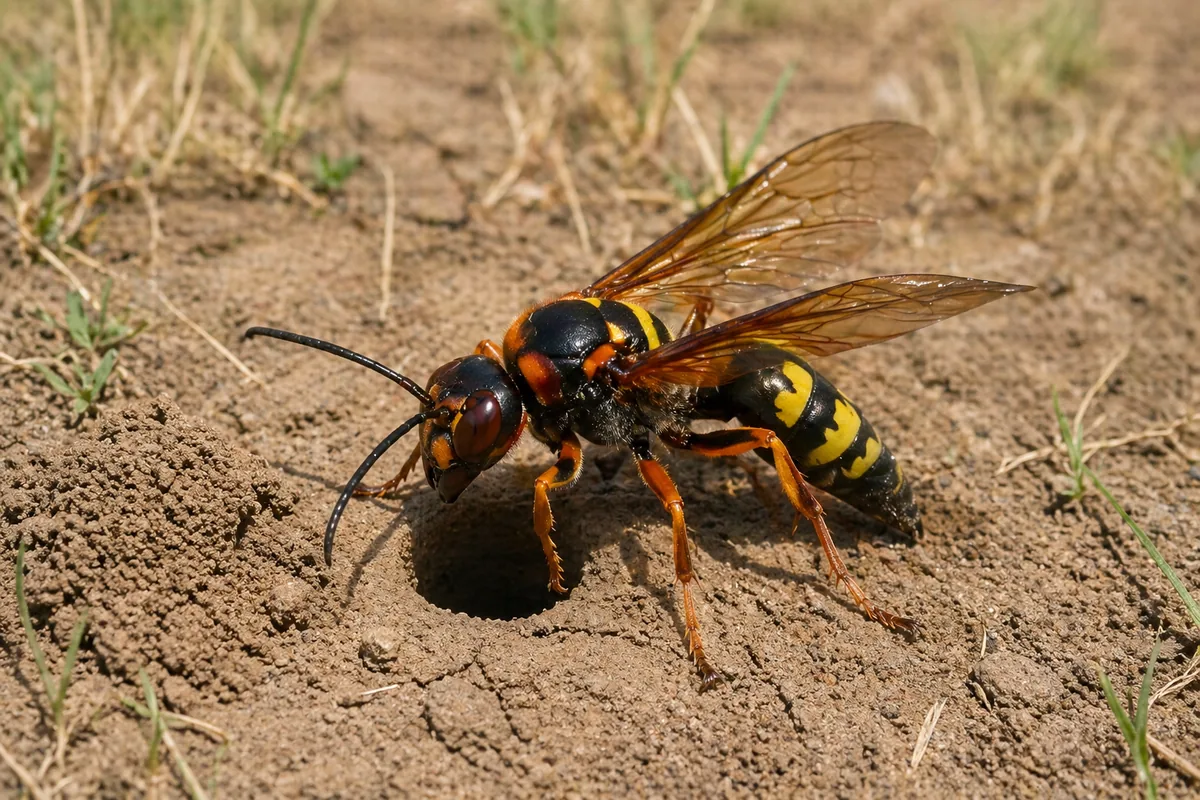
- Round burrow entrances in dry soil with a U-shaped or fan-shaped mound of excavated dirt at each entrance. Multiple burrows within a 10 to 20 foot area indicate an aggregation.
- Males dive-bomb people, pets, and moving objects but veer off without contact. This behavior looks aggressive but males cannot sting under any circumstances.
AKA: Giant Ground Wasp, Ground Hornet, Cicada Hawk, Sand Hornet
Giant ground wasp and ground hornet are the names most Collin County homeowners use when calling about cicada killers, driven by the same instinct that applies the word hornet to anything large that comes out of the ground. Cicada hawk is used in rural areas and refers to the hunting behavior: the female locates cicadas in trees, paralyzes them with a precisely placed sting, and hauls them back to the burrow as a food cache for her larvae. Sand hornet reflects the preference for dry, sandy, or loose soil at nest sites. All four names describe the same species on this page.
no colony, no shared defense, no alarm pheromone: that is the most important biology point for homeowners who call about them. There is no colony, no queen to protect, no shared defense, and no alarm pheromone system. A female cicada killer will not recruit other females to sting someone. Each burrow belongs to one independent female who maintains it, provisions it with paralyzed cicadas, and lays her eggs inside. What looks like a colony of 30 holes along a driveway border is actually 30 independent females who happened to select the same favorable soil conditions.
Cicada Killer vs Similar Species
The size and rusty head are the field identification features that separate cicada killers from every other wasp in Collin County. If the wasp is 2 inches long with a reddish-brown head and is flying low over lawn soil, it is almost certainly a cicada killer. The table below addresses the lookalikes that generate misidentification calls.
| Species | Size | Key Feature | Nesting Habit |
|---|---|---|---|
|
Cicada Killer
AKA: Giant Ground Wasp, Ground Hornet
Sphecius speciosus
|
38 to 50 mm (1.5 to 2 inches). The largest wasp a Collin County homeowner will encounter. Females are larger than males. | Rusty red to reddish-brown head and midsection is the single most reliable field separator from all lookalikes. Combined with giant size, this color pattern is unique among Collin County wasps. | Solitary ground burrow in dry, well-drained soil. Round entrance with fan-shaped excavated soil mound. Each burrow belongs to one independent female. Multiple burrows in the same area are an aggregation, not a colony. |
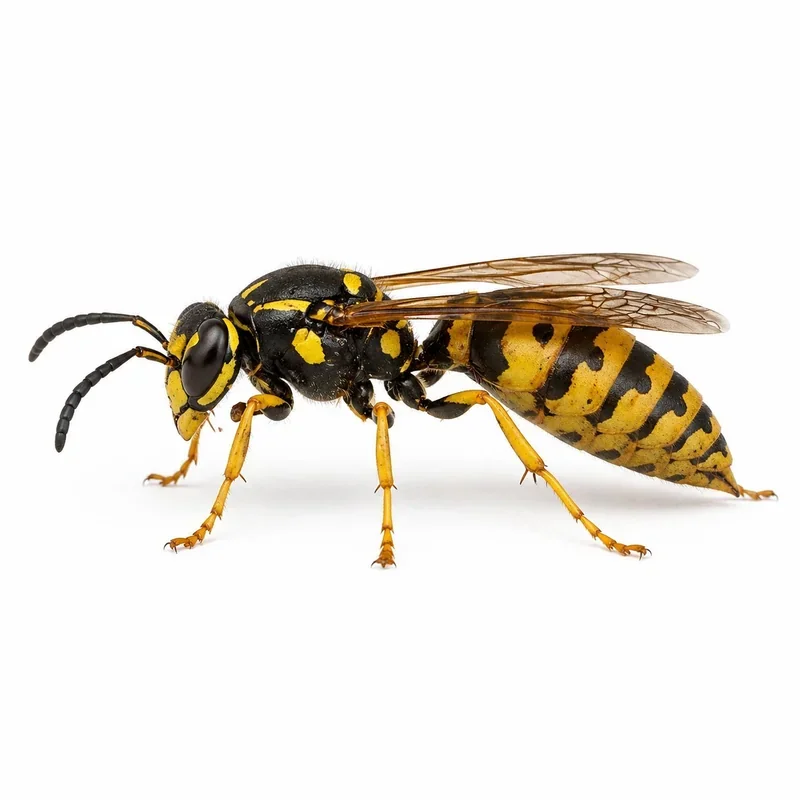
Yellowjacket
AKA: Ground Hornet, Ground Wasp
Vespula spp.
|
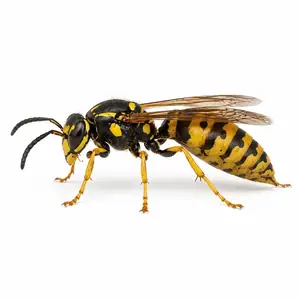
10 to 16 mm (roughly half an inch). Three to four times smaller than a cicada killer. The size difference is obvious at a glance. | Bright yellow and black banding; black head; hairless, shiny body. Compact and stocky. Yellowjackets are social with a large colony inside the burrow, colony defense, and an alarm pheromone that recruits mass attack. Cicada killers have none of these features. | Hidden ground burrow or wall void with a small entry hole. Colonial: a single nest may hold 1,000 to 4,000 workers. Disturbing a yellowjacket ground nest during mowing produces a mass sting event. Disturbing a cicada killer burrow does not. |
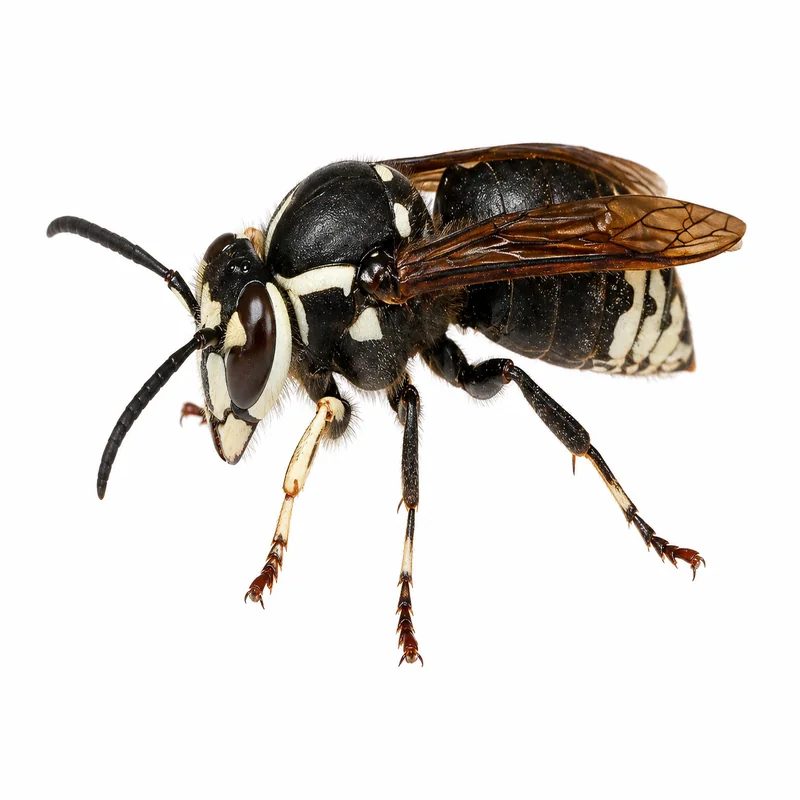
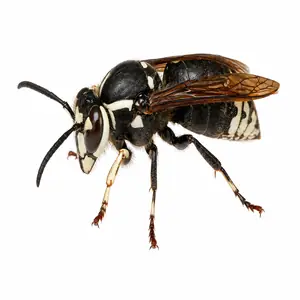
Bald-Faced Hornet
AKA: White-Faced Hornet
Dolichovespula maculata
|
15 to 20 mm. Substantially smaller than a cicada killer. Black and white color pattern with no rusty tones. | White facial markings on a black head are completely distinct from the cicada killer’s rusty head. Bald-faced hornets build an enclosed gray paper nest above ground, not a soil burrow. | Aerial paper nest enclosed in a gray paper envelope, typically in trees, shrubs, or under eaves. Does not excavate ground burrows. Colony-defending and highly aggressive near the nest. |
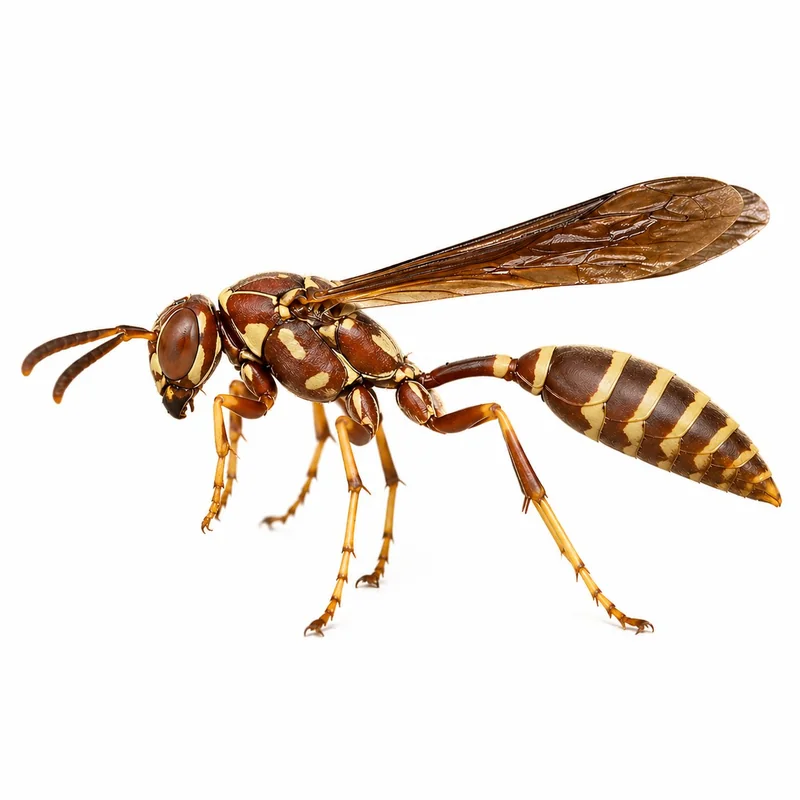
Paper Wasp
AKA: Red Wasp, Guinea Wasp
Polistes spp.
|
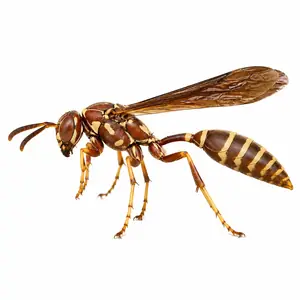
16 to 25 mm. Significantly smaller than a cicada killer. Slender waist and dangling legs in flight versus the cicada killer’s large, heavy-bodied build. | Narrow body with a pinched waist; long hind legs that dangle below the body in flight. Paper wasps never excavate ground burrows. Their nests are open paper combs suspended from a single stalk under an eave or overhang. | Open paper comb attached to horizontal surfaces under overhangs, porch ceilings, or window frames. Entirely above-ground nesting. Does not interact with lawn soil. |
Cicada Killer Sting: What to Expect
A female cicada killer sting produces localized pain and swelling at the sting site, comparable to other large wasp stings. Cicada killer venom is not documented in clinical literature as a major cause of systemic allergic reactions, though any individual with known hymenopteran venom sensitivity faces the same general anaphylaxis risk they would with any wasp. sting risk is low for most homeowners: females are not territorial, do not defend the burrow site, and do not release alarm pheromones that recruit mass attack. Getting stung by a female cicada killer in a normal outdoor setting requires directly handling or stepping on one.
The source of most homeowner distress is the males. Male cicada killers are territorial and genuinely aggressive in their aerial behavior: they will hover inches from a person’s face, charge lawnmowers, buzz children, and grapple with other males mid-flight. None of this is medically dangerous because males cannot sting. Understanding that the terrifying-looking wasp dive-bombing your face is physically incapable of stinging is the single most useful piece of information on this page.
Seek emergency care for any systemic reaction following a cicada killer sting: difficulty breathing, hives spreading beyond the sting site, throat tightening, dizziness, or rapid pulse. These signs indicate anaphylaxis, which is a medical emergency regardless of which wasp caused it. Non-allergic individuals stung by a female cicada killer will experience local pain and swelling that resolves without treatment. If you have a known allergy to hymenopteran venom, carry an epinephrine auto-injector and treat any insect sting as a potential emergency.
The practical property concern for Collin County homeowners is aggregation site loyalty. dry, well-drained soil with minimal turf cover, which describes precisely the soil condition found along concrete driveway edges, foundation bed borders, and graded backfill areas typical of slab-on-grade construction throughout the region. New construction lots often have compacted or disturbed soil with sparse turf establishment along hardscape borders, which is exactly the habitat profile that attracts aggregations. each female selects her own burrow site independently, so an untreated aggregation site is likely to be reused each July as new females find the same favorable soil. The disturbed soil area expands slightly each season as each new female excavates a fresh tunnel.
There is no structural damage risk. Cicada killer burrows in lawn soil do not threaten foundations, slabs, driveways, or any structural element. The concern is turf quality, aesthetic soil disturbance, and the compounding footprint of aggregations across multiple seasons.
Cicada Killer Lifecycle and Why Aggregation Sites Come Back
How Pest Me Off Treats Cicada Killers
Cicada killer treatment requires targeting the burrow at depth, not spraying the flying adults. dust applied directly into each burrow entrance using a wand tip applicator are the effective protocol. The key rules are simple but consistent: do not seal the entrance, do not use liquid spray at the surface, and treat every active burrow in the aggregation individually. Missing any burrow leaves the corresponding female untreated and her brood cells intact.
Aggregation Mapping
We walk the full aggregation area at 7 to 9 AM when females are most actively exiting burrows, mark every active entrance, and assess the aggregation footprint before any product goes down. An aggregation of 30 visible burrow entrances may have additional concealed entrances under groundcover, along fence lines, or in adjacent soil. Treating only the visible holes while leaving the concealed ones produces partial results and a callback in the same season.
Direct Burrow Dust Application
We apply commercial-grade insecticidal dust into each mapped burrow entrance using a hand duster with a flexible wand extension to reach the full tunnel depth. We do not seal the entrance after application. The entrance stays open so the female contacts the product as she enters and exits, carrying it toward the brood chambers. Liquid spray applied to the soil surface does not reach 12 to 24 inches underground where the brood cells are located.
48 to 72 Hour Re-Inspection
We re-inspect after 48 to 72 hours and identify any burrows showing fresh soil disturbance from females that re-excavated or were not contacted during the initial application. Fresh soil at an entrance is the indicator that treatment needs to be reapplied at that specific burrow. Active aggregations with multiple females often require at least one re-treatment to fully eliminate the site.
Habitat Assessment
After confirmed elimination, we assess the soil conditions that drove the aggregation and provide recommendations to reduce site reuse the following season. Improving turf density in dry soil strips along concrete edges, adding organic matter to sandy foundation bed soil, and addressing irrigation gaps in bare soil zones along driveways are the habitat modifications that reduce the attractiveness of a prior-year site to new females the following July.
& Other Companies
What You Can Do to Reduce Cicada Killer Pressure
Why Cicada Killer DIY Leaves the Problem Intact Season After Season
Cicada killers are the wasp where the most intuitive DIY approaches produce the most consistent failures. The reasons are the same every time: wrong product form, wrong application point, wrong timing, or missed burrows. These are the failure modes PMO sees on callbacks.
Spraying Flying Adults
Consumer wasp spray directed at hovering males or females in flight kills individual wasps above ground but has no effect on the burrows, the brood cells 12 to 24 inches underground, or the other females in the aggregation who are away hunting cicadas at treatment time. The next day, the untreated females return, the burrows are still active, and any brood cells already provisioned continue developing underground regardless of what happened to the adults. Killing the visible wasps is not the same as treating the source.
Filling Burrows With Garden Soil
Filling open burrow entrances with loose garden soil or sand is re-excavated by the female within 24 to 48 hours without exception. The burrow represents multiple days of the female’s labor and is provisioned with paralyzed cicadas she has already invested considerable energy to capture. She will dig it out. Physical filling without insecticide in the tunnel does not deter, trap, or eliminate the wasp. It wastes time and leaves the aggregation fully intact.
Applying Liquid Insecticide at the Burrow Entrance
Pouring or spraying liquid insecticide into or around burrow openings fails because the liquid absorbs into the surrounding soil and does not reach the brood chambers 12 to 24 inches below ground. Only dust formulations driven deep into the tunnel by a wand-tip applicator make contact with the wasp inside the burrow channel and carry product toward the brood cells through worker movement. Liquid spray at the surface is the most common product-type mistake homeowners make with ground-nesting wasps.
Treating One Burrow in a Large Aggregation
An aggregation of 20 to 40 burrows along a driveway border represents 20 to 40 independent females, each running her own burrow separately. Treating one or two visible entrances while leaving the rest untouched eliminates two wasps and leaves the other 18 to 38 entirely unaffected. There is no colony communication, no shared defense, and no way for treatment at one burrow to affect the others. Every active burrow entrance in the aggregation must be treated individually for the treatment to be complete.
Treating Too Late in the Season
By mid-August, most females have completed egg-laying. Adult activity declines rapidly as the season ends. Treatment applied after mid-August kills the remaining adults but does not address brood cells that are already provisioned and sealed underground. Those cells contain the larvae that will overwinter, pupate in spring, and emerge at the same site the following July. Late-season treatment feels like it worked because adult activity drops, but it does not interrupt the next generation’s development. Mid-July is the correct treatment window.
Sealing Burrows Without Insecticide
Sealing burrow entrances with expanding foam, caulk, or packed soil without applying insecticide first traps the female inside and the brood cells underground but does not eliminate either. The female may die inside from starvation if completely sealed, but the brood cells are already provisioned and development continues regardless. The sealed brood produces the next generation of adults who emerge the following summer. Worse, a female that is partially sealed can find an alternate exit path. Sealing is only meaningful as a last step after confirmed elimination, not as a substitute for treatment.
Cicada Killer Questions Collin County Homeowners Ask
All four names describe the same insect on this page. Giant ground wasp is the most accurate: these are large solitary wasps that nest entirely underground. Ground hornet is what most Collin County homeowners say when they call about a very large wasp coming out of a hole in the lawn; the name is not taxonomically precise because cicada killers are wasps, not true hornets, but it is descriptive enough to be widely used. Cicada hawk refers to the female’s hunting behavior: she locates cicadas in trees, paralyzes them, and hauls them back to feed her larvae underground. Sand hornet is used in areas with sandy soil and reflects the same ground-nesting habit. All four names, giant ground wasp, ground hornet, cicada hawk, and sand hornet, mean the same species with the same biology and the same treatment approach.
Females can sting but rarely do so under normal outdoor conditions. Getting stung requires picking one up, stepping on one with bare feet, or physically trapping one against skin. Females are not colony defenders; they do not patrol the burrow entrance or respond aggressively to people walking nearby. Males cannot sting at all. The stinger is a modified reproductive organ present only in females. The males performing all the dive-bombing and aggressive aerial display are physically incapable of stinging regardless of how threatening the behavior looks.
Those are male cicada killers establishing and defending flight territories over the same ground area where females will be nesting. Males emerge one to two weeks before females and spend their entire adult life patrolling a roughly 10 to 20 foot zone at 2 to 4 feet above the soil surface, charging anything that enters, including people, dogs, other males, and moving lawn equipment. This territorial display is competitive behavior between males competing for mating access, not defense of a nest. The males will charge your face from a foot away and then veer off without contact. They cannot sting. If this activity is happening over a dry soil strip along your driveway, females will likely begin burrowing in that same area within days.
No. Each burrow hole belongs to one independent female. What looks like a colony of 30 holes is actually 30 separate females who selected the same dry soil conditions independently. There is no shared queen, no common nursery, no alarm pheromone system, and no colony defense. Disturbing one burrow does not recruit the other females to attack. The term for multiple solitary wasps nesting in the same favorable soil patch is aggregation, not colony. This distinction matters for treatment: each burrow must be treated individually because there is no communication between them, and treating one does not affect the others.
Cicada killers do not leave a chemical signal that attracts future females the way some social insects do. The driver is habitat: dry, loose, well-drained soil with minimal turf cover is selected independently by each new generation because it provides ideal excavation conditions. The soil strip along your driveway that dried out and lost turf coverage four summers ago is still the same dry, easy-to-excavate habitat this July. New females arriving from underground emergence find those same soil conditions and make the same choice their predecessor did. Improving turf density and soil moisture in the affected area is the long-term intervention that changes the habitat profile enough to redirect future females to other sites.
Active cicada killer burrows produce loud buzzing during midday heat in two ways. First, a female returning to her burrow while carrying a paralyzed cicada generates significant sound because the cicada is alive but immobilized and may be producing sound reflexively. Second, the aerodynamics of a very large wasp flying slowly with a heavy load close to the ground produces audible wing noise. Multiple females in a large aggregation entering and exiting burrows simultaneously amplifies this sound considerably. The buzzing is alarming to hear at ground level from an aggregation of 20 or 30 burrows but it is not a sign of a dangerous colony. It is the sound of individual females doing provisioning work.
No. Filling burrow entrances with garden soil, sand, or any loose material is re-excavated by the female within 24 to 48 hours. The burrow represents a substantial investment of the female’s limited adult lifespan, and the brood cells inside are provisioned with cicadas she has already worked to capture. She will dig it back out. Expanding foam or caulk produces a physical seal but does not eliminate the wasp or the brood cells; the sealed brood develops underground and emerges the following summer. The only approach that actually eliminates the burrow is insecticidal dust applied to full tunnel depth with a wand applicator while the entrance is left open for the contact period.
No, and the confusion is understandable because the scale is similar. The northern giant hornet, sometimes called the murder hornet in news coverage, reaches 38 to 45 mm and has a large orange head. The cicada killer also reaches 38 to 50 mm and has a rusty orange-brown head. The visual resemblance at a distance is real. The critical difference is that the northern giant hornet is not an established pest in Collin County and has not been documented in Collin County. If you are seeing a very large wasp with a rusty head flying low over your lawn in July and entering holes in the ground, it is almost certainly a cicada killer, which is native to Texas and has co-existed here for millions of years. The northern giant hornet has very different abdominal markings, a distinctly different body shape, and builds enclosed paper nests in tree cavities, not ground burrows.
Mid-July is the optimal treatment window. This timing catches females during peak burrowing and provisioning activity, when they are entering and exiting burrows frequently and contact transfer of dust product is most efficient. Early July is acceptable; late July is workable but less optimal. Treatment applied in August is less effective because much of the egg-laying and provisioning is already complete by mid-August. Adult activity will drop in either case as the season ends naturally, but late-season treatment does not interrupt the brood cells already sealed underground. Those cells contribute to next season’s population regardless of what happens to the adults at the surface. Treating in mid-July addresses the current season’s adults at their most active point and reduces the number of larvae that complete development underground.
Cicada Killers Tearing Up Your Lawn. We Map Every Burrow, Treat to Depth, and Tell You What to Fix So They Do Not Come Back Next Summer.
Most cicada killer attempts spray the flying adults or pack dirt in the holes. Neither works. We map the full aggregation, apply professional-grade dust into every active burrow with a wand applicator to reach depth, re-inspect after 48 to 72 hours, and give you specific habitat recommendations to reduce site reuse the following July. That is the sequence that actually closes out the season. Stinger Smackdown across McKinney, Allen, Frisco, Plano, and all of Collin County.
A cicada killer job done right involves walking the full aggregation area, mapping every active burrow before the first product goes down, treating each entrance individually to depth, and reinspecting days later to catch any active burrows that were missed. That process takes time. The 12-stop limit is what allows us to do it completely rather than treating the visible holes and leaving the rest for next year.