Mud Daubers in Collin County, TX | Identification and Control
Mud daubers (Sceliphron caementarium and Chalybion californicum) are solitary wasps that build sealed mud tube nests on exterior walls, garage ceilings, porch soffits, and covered patio surfaces across McKinney and Collin County. both species established throughout DFW, and properties with high spider populations see the highest nest density. This page covers how to tell the two species apart, why mud daubers are nearly harmless to people, what the blue mud dauber actually hunts, how to remove nests without staining your exterior, and when it makes sense to call Pest Me Off.
Adults are dormant through winter as pupae sealed inside mud cells. Activity picks up in late March as adults emerge. Peak nest-building runs June through August when spider populations are highest and warm humid conditions keep mud workable. Activity slows in fall and ceases after the first hard freeze.
What Mud Daubers Look Like
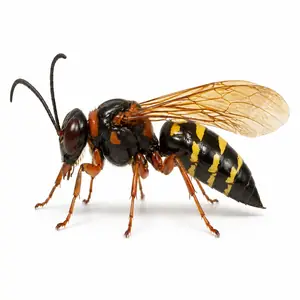
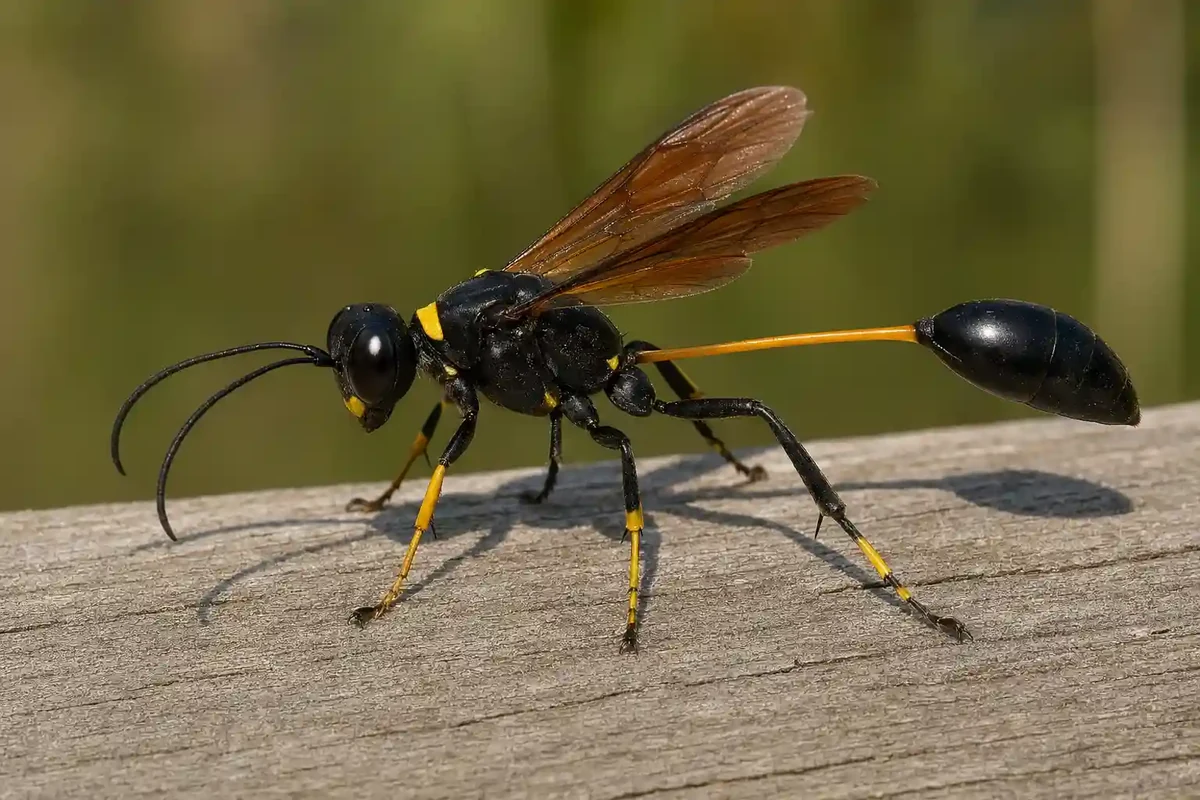
Long, narrow body with a thread waist, and mud tube nests sealed to sheltered exterior surfaces.
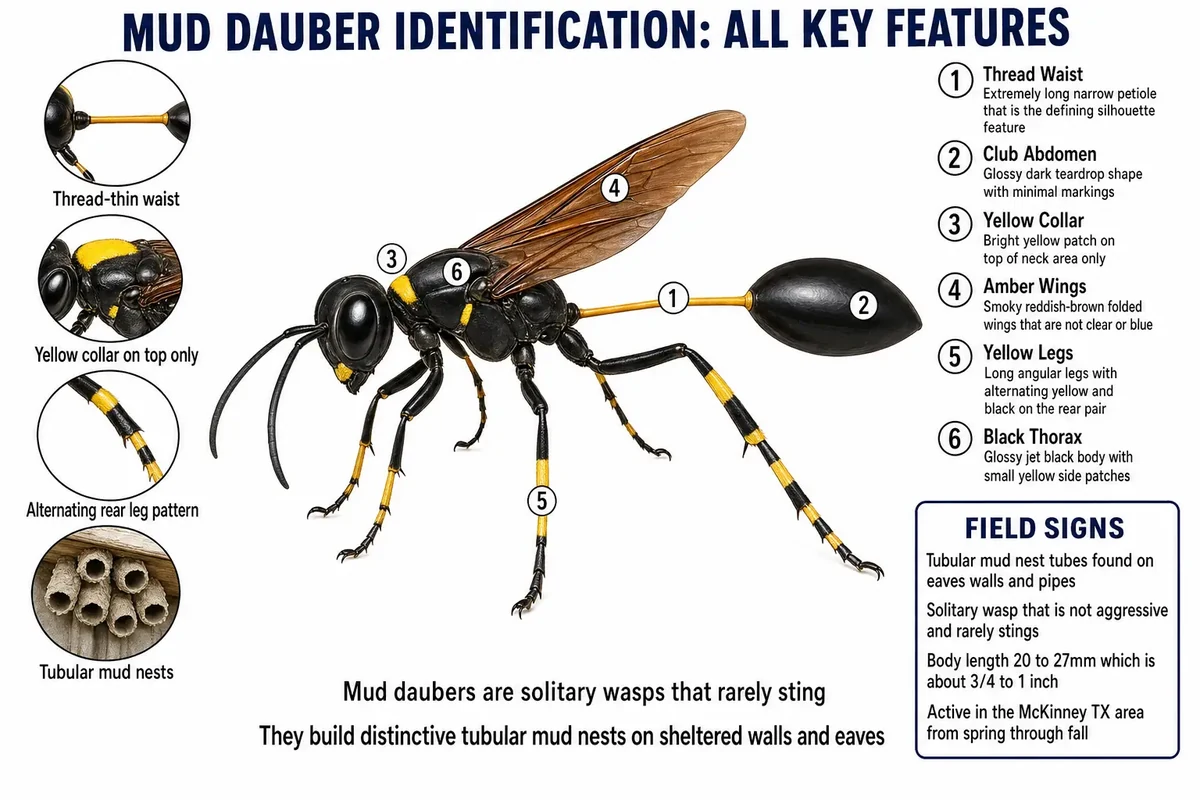
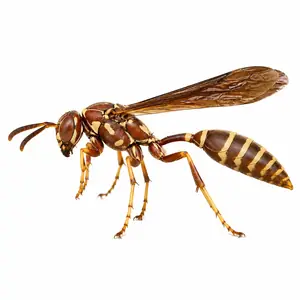
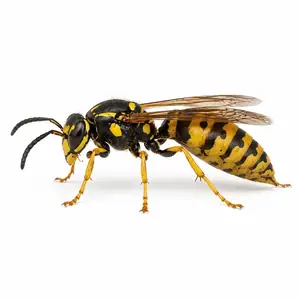
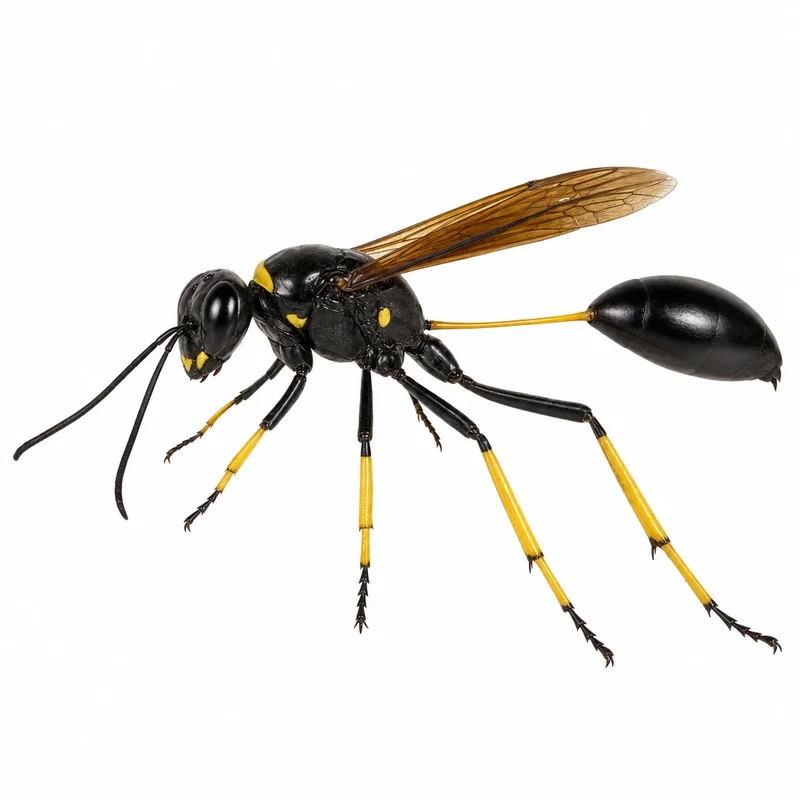
- Extremely narrow thread waist (petiole) connecting the midsection to the abdomen; thinner than any social wasp in North Texas and visible from several feet away
- Long, slender build; yellow-and-black species has bright yellow markings on legs, midsection, and first abdominal segment; blue species is metallic blue-black with iridescent wings
- Sealed cylindrical mud tubes attached to vertical or overhead sheltered surfaces; smoother and more uniform than wasp paper nests; no open cells visible
- Individual females working alone at the nest; never a swarm, never multiple wasps defending the same structure at the same time
- Round exit holes in older mud cells where adults have already emerged; cell may look cracked or opened from the inside
- Slow, methodical flight behavior near nest sites; no aggressive hovering or dive-bombing near people
AKA: Dirt Dauber, Mud Wasp
Dirt dauber is the name most Collin County homeowners use for both mud dauber species, particularly in the older neighborhoods of McKinney and Allen where the term is part of the local vocabulary. Mud wasp is a third common name used interchangeably. All three names describe the same animals: solitary wasps in the subfamily Sceliphrinae that provision sealed mud cells with paralyzed spiders as food for their larvae. The yellow-and-black species (Sceliphron caementarium) is the one most homeowners notice building fresh mud tubes; the blue mud dauber (Chalybion californicum) is a nest pirate that takes over abandoned or active Sceliphron nests and re-provisions them with spiders, primarily black widows. Seeing a shiny blue-black wasp entering an existing mud nest almost always means the blue species is hunting the black widows in your weep holes and foundation plantings.
Both species share the defining feature that separates them from every social wasp in Collin County: the extreme thread waist. Paper wasps, yellowjackets, and bald-faced hornets all have clearly visible waists, but the mud dauber petiole is dramatically thinner and longer than any of them. The second field ID point is the nest itself. Mud tubes attached to a sheltered surface with no workers guarding them is mud dauber; an open paper comb with workers present is paper wasp; no visible nest with workers entering a hole is yellowjacket. These three field observations separate the three most common stinging insect call types in the region without getting close to the insect.
Mud Dauber vs Similar Species
The sealed mud tube nest is the field ID feature that rules out every social wasp in North Texas at a glance. If the nest is made of mud and sealed, it is a solitary wasp. No social colony builds sealed mud cells.
| Species | Size | Key Feature | Nesting Habit |
|---|---|---|---|
|
Mud Dauber
This species
AKA: Dirt Dauber, Mud Wasp
Sceliphron caementarium / Chalybion californicum
|
18 to 30 mm. Long and slender with a dramatically narrow thread waist (petiole). Yellow-and-black or metallic blue-black. The thread waist is the single most reliable ID point at a glance. | Sealed mud tube nests on sheltered exterior surfaces. No workers defending the nest. Solitary female works alone. No alarm pheromone. No colony. Mud tubes with no visible open cells or hovering wasps is mud dauber until proven otherwise. | Mud tubes on eaves, garage ceilings, porch beams, covered patio surfaces, utility penetrations, and outdoor light fixtures. Exclusively outdoor. Never inside walls, ground burrows, or attics. Blue species reuses old Sceliphron nests rather than building new ones. |
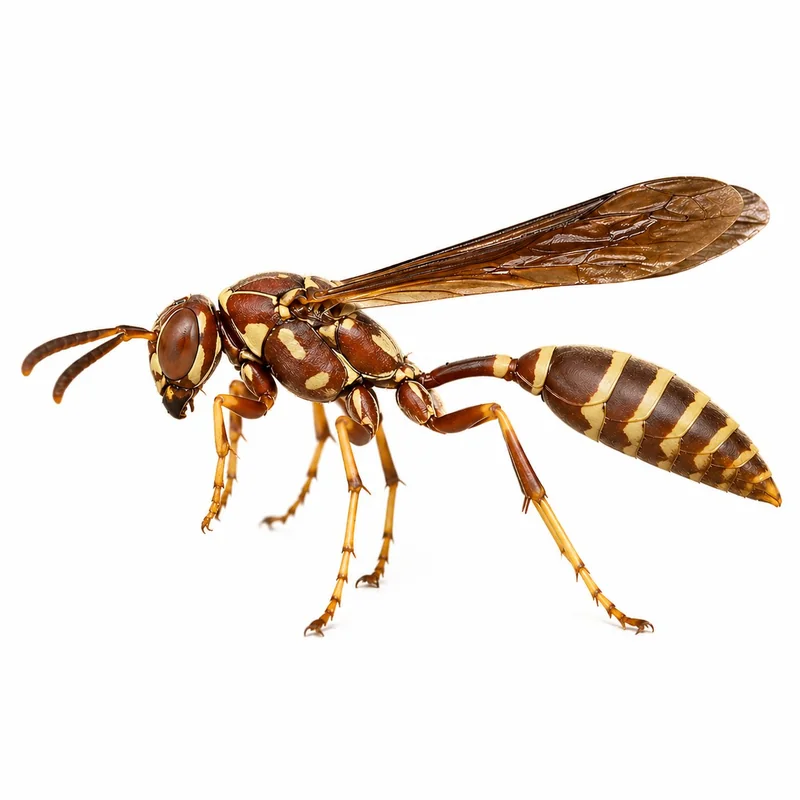
Paper Wasp
AKA: Umbrella Wasp, Red Wasp
Polistes spp.
|
16 to 25 mm. Slender like a mud dauber but lacks the extreme thread waist. Brownish-orange to reddish-brown coloring with yellow markings. Longer hind legs that dangle visibly in flight distinguish it from mud daubers. | Open umbrella-shaped paper comb with visible hexagonal cells. Workers actively present and defensive near the nest. Colony defense triggered by approach within 18 inches. Mud daubers never build open-cell paper nests and never defend a nest in a swarm. | Open paper combs on structural surfaces: eaves, porch ceilings, door frames, window sills. Always attached by a single central stalk and always open-faced. If the nest has visible hexagonal cells and workers, it is paper wasp, not mud dauber. |

Potter Wasp
AKA: Mason Wasp
Eumenes fraternus
|
9 to 13 mm. Noticeably smaller than either mud dauber species. Black with pale yellow or white markings. Similar narrow waist to mud daubers but much shorter overall body length. The size difference is obvious when both are seen near the same surface. | Builds small individual mud pots shaped like miniature jugs or vases, not the clustered parallel tubes of Sceliphron. One pot at a time; never a cluster of cylinders. Also solitary and non-defensive. The jug or pot shape is the definitive field separator from mud dauber tube nests. | Single mud pots on twigs, plant stems, wood fences, and sometimes exterior walls. Provisions with caterpillars rather than spiders. Pot shape is sealed like a mud dauber cell but clearly jug-shaped rather than cylindrical. Far less common on residential structures than either mud dauber species. |

Steel-Blue Cricket Hunter
AKA: Blue Wasp
Chlorion aerarium
|
15 to 25 mm. Similar size range to the blue mud dauber and essentially identical metallic blue-black coloring. The color match is close enough that most homeowners cannot reliably separate these two species at a glance without examining the nest site or prey. | Hunts crickets, not spiders. Does not build or use mud tube nests. Found on lawns and near cricket hiding areas rather than on exterior wall surfaces. If the metallic blue wasp is near the ground in grass rather than near a mud nest, it is more likely a cricket hunter. No mud nest means no mud dauber. | Constructs burrows in bare or sparsely vegetated soil, not mud tube nests on vertical surfaces. A metallic blue wasp flying over your lawn or along a flower bed edge is far more likely to be a steel-blue cricket hunter than a blue mud dauber. Blue mud daubers are almost exclusively found near existing mud tube structures. |
Mud Dauber Sting: Rare and Mild
A mud dauber sting is a defensive response from a female who has been physically handled, trapped against skin, or disturbed directly at the nest entrance. It does not occur from walking near a nest, brushing past an exterior wall with mud tubes, or entering a garage where mud daubers are building. The venom produces localized pain and swelling that resolves within a few hours for most people. Individuals with known hymenopteran venom sensitivity should treat any wasp encounter as a potential risk, but the realistic probability of a mud dauber sting in normal outdoor activity is low. mud daubers rank among the least aggressive stingers encountered on residential properties.
The practical property concern for most Collin County homeowners is the cumulative visual impact of mud tubes across a frequently used exterior surface and the staining that follows incomplete removal. Garages are the most common complaint surface because mud daubers favor sheltered overhead areas near the garage door track, at upper wall corners, and along any exposed beam or rafter. A homeowner who scrapes the tubes off in the fall and leaves the mud residue will see new nests built on top of the same residue the following summer because the surface texture and traces left behind remain attractive to scouting females.
Mud Dauber Biology and Why the Same Spots Keep Getting Used
How Pest Me Off Handles Mud Daubers
Mud dauber service focuses on two outputs: removing what is there and reducing the conditions that bring them back. blue mud daubers prey on black widows and the decision to remove all nests or leave isolated nests in low-traffic areas is always the customer’s call. Our job is complete removal when removal is what you want, and a clear explanation of what is driving the pressure so the problem does not repeat next season.
Surface Inspection and Nest Inventory
We walk all exterior surfaces and identify every mud tube nest location: eaves, soffits, garage ceiling and wall corners, porch and covered patio surfaces, outdoor light fixtures, utility penetrations, and fence headers. Active nests (female present, fresh mud) are documented separately from sealed overwintering nests and abandoned tubes. The blue mud dauber’s presence at a nest is also noted because it indicates black widow activity in the immediate area.
Complete Nest Removal and Surface Cleaning
All nests are removed physically using appropriate tools for the surface type. On painted or finished surfaces, removal is done carefully to avoid surface damage. After nest removal we clean mud residue from the attachment area. Leaving residue behind marks the surface for the following season; complete cleaning is what breaks the cycle on any specific spot. On brick and masonry surfaces we use methods matched to the surface finish to avoid staining.
Perimeter Spider Treatment
We treat foundation plantings, exterior wall surfaces, eave lines, and garage interior surfaces with a residual product that reduces the spider population sustaining mud dauber pressure. Mud daubers are prey-driven: a property with fewer active spider webs and fewer spiders in weep holes and wall corners is a less attractive provisioning site. This step addresses the food supply that made the property attractive in the first place.
Surface Residual and Follow-Up
Treated exterior surfaces receive a residual application at known attachment points that deters new females from selecting cleaned areas as nest sites. The product is applied to sheltered overhead surfaces, upper wall corners, and other high-frequency nesting zones identified during the initial inspection. A follow-up check is scheduled for mid-season when new nesting pressure typically peaks, and any new activity is addressed before tubes accumulate.
& Other Companies
How to Reduce Mud Dauber Nesting on Your Property
Mud dauber pressure is driven by site quality: sheltered surfaces, spider populations, and access to wet mud near the foundation. Reducing any of these factors lowers nesting pressure without requiring chemical treatment.
Why DIY Mud Dauber Removal Usually Does Not Last
Mud daubers look simple to deal with: visible nests, no colony, no swarm. The work seems straightforward until the tubes are back in the same spots three months later. Here is where homeowners consistently go wrong.
Scraping the Tube Without Cleaning the Surface
Knocking the mud tube off and walking away leaves the attachment residue on the wall. That residue has the texture and chemical traces that signal prior nesting success to any female scouting the same surface the following season. New tubes go up in the exact same spots, often denser than before. The job is not done until the surface is scrubbed clean down to bare material. This is the single most common reason mud dauber calls repeat year after year on the same property.
Spraying Liquid Insecticide on Sealed Mud Tubes
Consumer wasp spray beads off the hard dried mud surface and does not penetrate the sealed cells inside. The larva, the egg, and the paralyzed spider cache are completely protected by the mud wall. Liquid product applied to the outside of an intact tube accomplishes nothing except adding a wet residue to the surface. Scraping the tube off physically is the only way to deal with sealed cells. Dust formulations applied into any open or cracked cells are more useful than any liquid spray.
Removing Nests Without Addressing Spider Pressure
Mud daubers do not show up randomly. They follow spider prey. A garage with heavy cobwebs in the upper corners, weep holes loaded with black widows, and dense foundation plantings full of web-building spiders is a well-stocked pantry that will draw new mud daubers every season no matter how many times the tubes are removed. Nest removal without spider treatment is surface cleaning without source control. The underlying prey population remains unchanged and the surface will recolonize.
Scraping in the Middle of the Day With an Active Female Inside
Mud daubers are solitary and non-aggressive away from the nest, but a female working inside an active cell will sting if the structure is disturbed while she is provisioning. Daytime removal on a warm sunny day is the highest-risk scenario because females are actively working. Evening or early morning removal, or waiting until a cell is fully sealed and the female has moved on to the next cell, reduces sting risk significantly. A cell that is sealed with no visible wasp nearby is safe to scrape. An open cell with movement inside is not.
Leaving Old Nests in Place Through Winter
A mud tube that looks empty and abandoned in October or November may still contain live overwintering pupae that will produce adults in March or April. Homeowners who plan to deal with the nests in spring are allowing the following year’s local population to complete development on their structure. Late fall removal, before adults emerge, is what breaks the cycle. Spring removal after adults have already chewed out still leaves residue and removes the disruption timing advantage entirely.
Mud Dauber FAQ
These are all names for the same wasps. Dirt dauber is the more common informal name used across North Texas and throughout the South. Mud dauber is the term used in most pest control references. Mud wasp shows up in casual conversation. In Collin County all three names refer to the same two wasps: the familiar yellow-and-black species that builds the tube nests you see on garage ceilings and under eaves, and the metallic blue-black species that raids those nests to provision them with spiders. All three names are accurate. The choice between them is regional habit, not a distinction between different insects.
Mud daubers are among the least dangerous stinging insects that regularly appear on residential properties. They are solitary wasps with no colony to protect, no queen to defend, and no alarm pheromone that recruits additional wasps to attack. A female may sting if she is handled directly or trapped against skin but will not sting someone who walks past the nest. The volume of mud tubes on a wall is not an indicator of aggression; it is an indicator of how many independent females chose the same surface. Individuals with known venom allergies should take the same precautions they would around any wasp, but for most people mud daubers represent no meaningful sting risk during normal outdoor activity.
That is the blue mud dauber, a separate species from the yellow-and-black mud dauber you may be more familiar with. The blue species does not build its own mud nests. Instead it takes over nests already built by other mud daubers, removes or replaces the contents, and fills the cells with spiders it has paralyzed. It has a strong preference for black widows and actively hunts them in weep holes, garage corners, attic vents, and dense foundation plantings. If you are seeing the blue species working around your mud nests, it is a reliable indicator that black widows are present somewhere nearby. The blue mud dauber is doing active pest suppression, which is why some homeowners choose to leave isolated nests in no-traffic areas rather than remove everything.
Because the site is genuinely good nesting real estate and you have not removed it from the available inventory. The same conditions that attracted the first female: shelter from rain, warmth, proximity to spider prey, and nearby wet mud, are still present. If you scraped the tubes off but left mud residue on the surface, the residue itself marks the spot as a prior nesting success and makes it more attractive to new females scouting in spring. Complete removal down to bare surface, combined with reducing the spider population in the same area, is what changes the site’s attractiveness. Tube removal alone, without surface cleaning and spider reduction, produces the same result year after year.
You have individual females who found a sheltered surface with access to spider prey and a nearby mud source. This is not an infestation in the sense of an established colony that needs to be eliminated. It is a response to site conditions. The tubes in your garage represent closed, sealed nursery cells; the female who built them may not even be on the property anymore. The spider population inside the garage and near the garage door frame is the food supply that made the location attractive. Addressing the spider population inside the garage and removing the mud tubes cleanly in fall will reduce or eliminate the pressure. For heavy tube accumulation across large garage surfaces or overhead areas that require equipment to reach, a professional service visit is more thorough than a DIY attempt with a stepladder and a scraper.
The ecological value is real, and for isolated nests in genuinely low-traffic spots (a fence post on the back perimeter, a rarely used shed, a corner of a covered patio where no one sits) leaving them is a reasonable choice. The blue mud dauber specifically provides measurable black widow suppression in the areas where it hunts. The decision to remove versus leave is always yours. Where removal makes sense is on high-use exterior surfaces, above garage doors, near entry doors, or anywhere the visual accumulation of mud tubes is a problem regardless of what is inside them. Pest Me Off will explain what we find and let you make that call rather than defaulting to removing everything on every property.
On unpainted wood surfaces like exposed rafters or fence posts, a stiff putty knife or wire brush removes tubes without surface damage. On painted surfaces, a plastic scraper is safer than metal for avoiding paint gouging. On brick and masonry, a wet scrub brush after tube removal takes care of most mud residue. The staining risk comes from mud residue left after scraping and from the discoloration produced when scraping pulls paint off the surface beneath. On any painted surface, work slowly with a plastic tool and follow up with a damp scrub rather than a hard dry scrape. Where large areas of tubes are attached to finished soffits or painted garage ceilings, a professional removal using appropriate tools for the specific surface type avoids surface damage that costs more to repair than the original tube removal would have cost to have done professionally.
Mud Tubes on Your Garage Ceiling or Exterior Wall. We Remove Every Nest, Clean the Surface, and Stop the Cycle.
Scraping tubes off and leaving residue is why they come back to the same spots every summer. We remove the nests completely, clean each attachment point down to bare surface, treat the spider population driving the pressure, and apply a residual deterrent at known nesting zones. If the blue mud dauber was hunting your foundation area, we address the black widow pressure too. Stinger Smackdown across McKinney, Allen, Frisco, Plano, and all of Collin County.
Mud dauber service done right involves a full surface inspection, careful removal on multiple exterior surfaces, surface cleaning at each attachment point, and a perimeter spider treatment. That sequence takes time. The 12-stop limit is what gives us time to do every step rather than scraping the obvious tubes and leaving the rest for next season.