Honey Bees in Collin County, TX | Swarm or Colony? ID and Treatment
The honey bee (Apis mellifera) is the one stinging insect in Collin County where the single most important first step is determining what you are actually looking at. A swarm (a dense temporary cluster resting on a branch or fence post) is non-aggressive, has no nest to defend, and will almost always move on within 24 to 48 hours without intervention. An established colony entering a wall void, soffit, or meter box is a permanent structure that builds wax comb, stores honey, and will not leave. Treating a swarm as a colony wastes your money. Treating a colony as a swarm that will move on is how you end up with honey running down your interior drywall in July. Africanized hybrids confirmed in Collin County and are visually identical to European bees, which means every established feral colony should be approached with professional caution regardless of apparent temperament. Field observations for honey bee across Texas confirm year-round colony activity throughout the Dallas-Fort Worth region.
Unlike social wasps, honey bee colonies are perennial and active every month of the year inside heated wall voids and structural cavities. The seasonal pattern below reflects swarm activity and peak colony pressure on structures, not colony survival. Swarms peak March through May when overcrowding drives colonies to divide. Established wall-void colonies produce year-round structural risk regardless of season.
Honey Bee Identification
Fuzzy golden-brown body, pollen balls on hind legs, and the critical swarm-versus-colony distinction
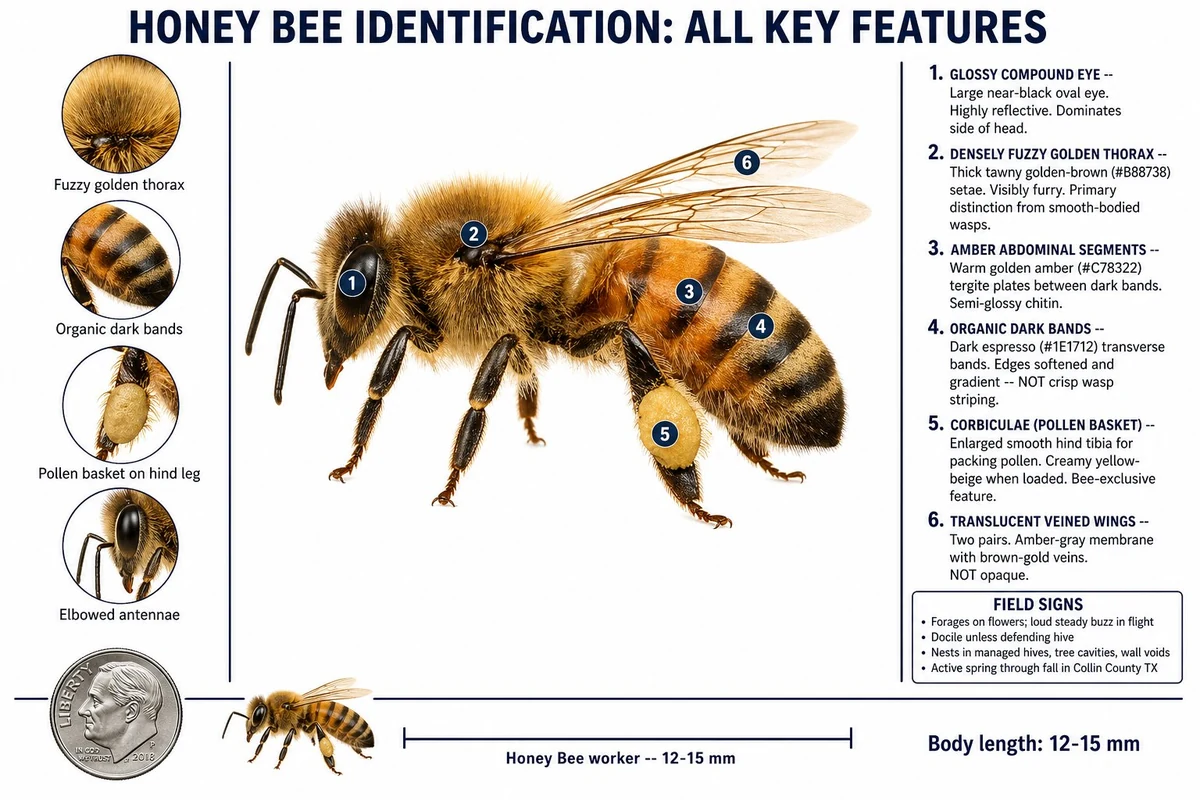
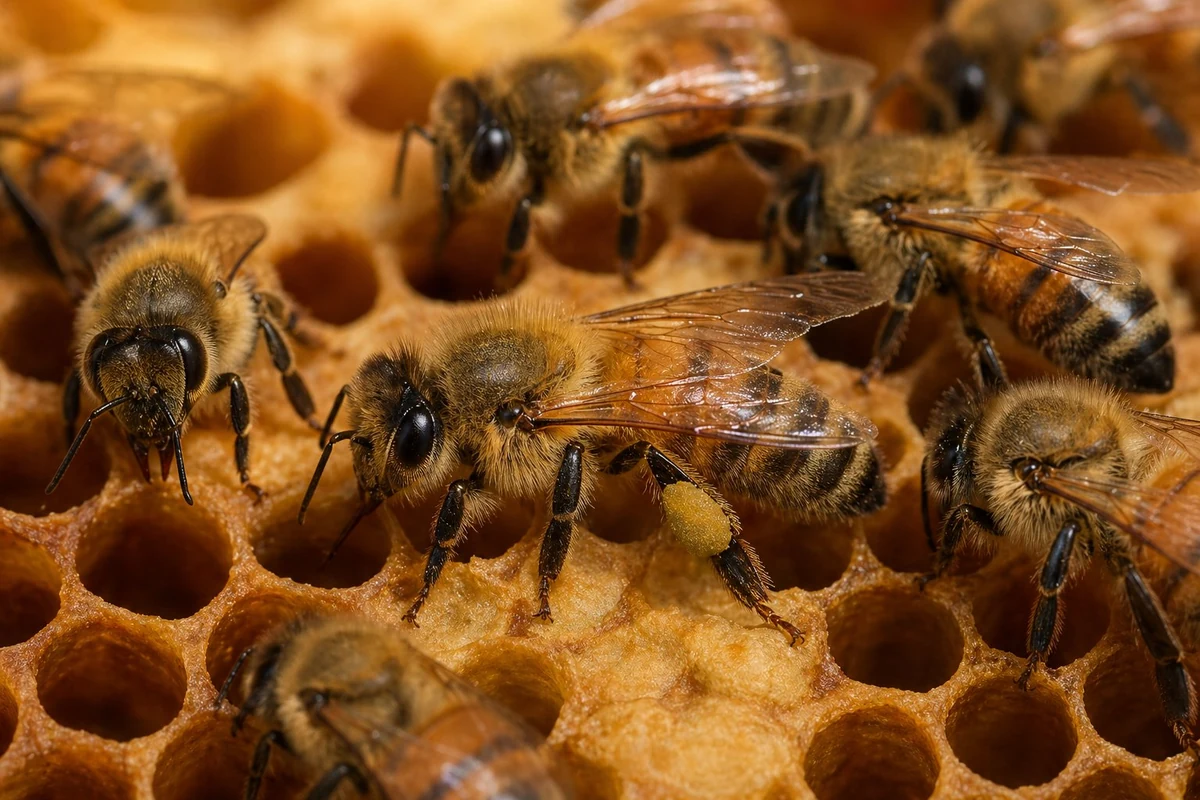
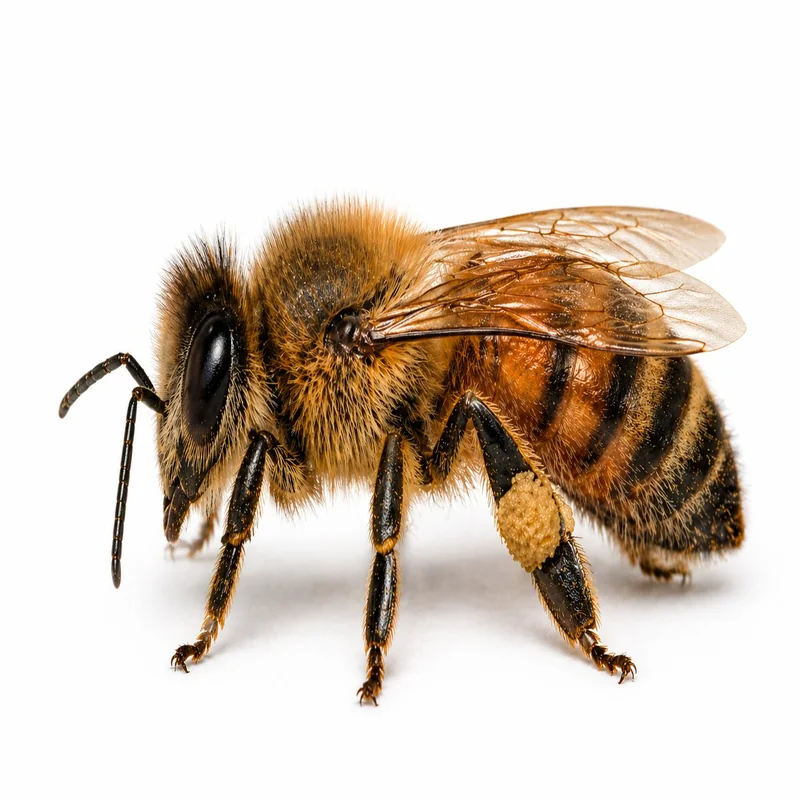
- Fuzzy body covered in branched hairs: the single clearest visual separator from yellowjackets, which are hairless and shiny
- Golden-brown to dark brown coloring with alternating pale and darker abdominal bands; less brightly colored than yellowjacket
- Orange or yellow pollen masses visible on the hind legs of foraging workers returning to the colony
- 12 to 15 mm: similar size to yellowjacket but with a rounder, more tapered abdomen
- Swarm: a dense cluster of thousands of bees on a branch, fence, or surface with no cavity entry; non-aggressive
- Colony: consistent in-and-out worker traffic through a fixed gap in siding, soffit, chimney, meter box, or other cavity
AKA: European Honey Bee, Western Honey Bee
European honey bee and western honey bee are the formal common names for Apis mellifera, the species introduced to North America by European colonists in the 1600s. In everyday North Texas use, homeowners say honey bee for any bee entering their walls, which is the working identification for service calls. University of Florida IFAS honey bee documentation covers the full biology and management context. The informal name that matters most for Collin County homeowners is the one that is not on this page: Africanized honey bee. Africanized hybrids are visually identical to European bees and confirmed present in Collin County. They cannot be distinguished without laboratory analysis. Any established feral colony should be treated as potentially Africanized.
The swarm-versus-colony distinction is the most critical identification judgment for treatment. A swarm is a temporary staging cluster of bees searching for a new nest location. Bees in a swarm have no comb, no brood, and no stored honey to defend; they are docile and will move on in 24 to 48 hours in the vast majority of cases. An established colony has bees consistently entering and exiting a fixed opening, has been present for more than a few days, and has wax comb building inside the cavity. It will not leave on its own. Every week of delay on a colony call means more comb, more honey, and a more expensive resolution.
Honey Bee vs Similar Species
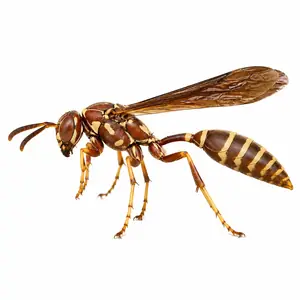
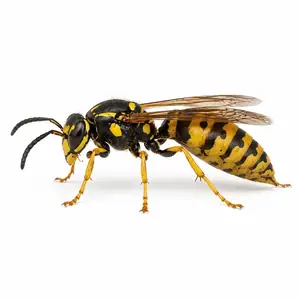
Honey bees are most commonly confused with yellowjackets by homeowners who see the yellow-and-black pattern and stop there. The fuzz is the fastest separator at any distance.
| Species | Size | Key Feature | Nesting Habit |
|---|---|---|---|
|
Honey Bee
This species
AKA: European Honey Bee
Apis mellifera
|
12 to 15 mm. Golden-brown to dark brown with alternating pale bands on a rounded, tapered abdomen. Body covered in branched hairs visible at close range, giving a distinctly fuzzy appearance compared to any wasp. Pollen-carrying workers show visible orange or yellow masses on hind legs. | Fuzzy body with visible hair is the single fastest separator from all wasps. Barbed stinger embeds in skin and continues delivering venom after the bee detaches. Perennial colony: does not die in winter. Builds wax comb, not paper. Swarms in spring when overcrowded. | Natural cavities (tree hollows) or structural cavities (wall voids, soffits, chimneys, meter boxes, irrigation boxes) accessed through a small fixed entry gap. Swarms rest temporarily on any above-grade surface in transit; they do not enter cavities immediately. Established colonies remain permanently without intervention. |
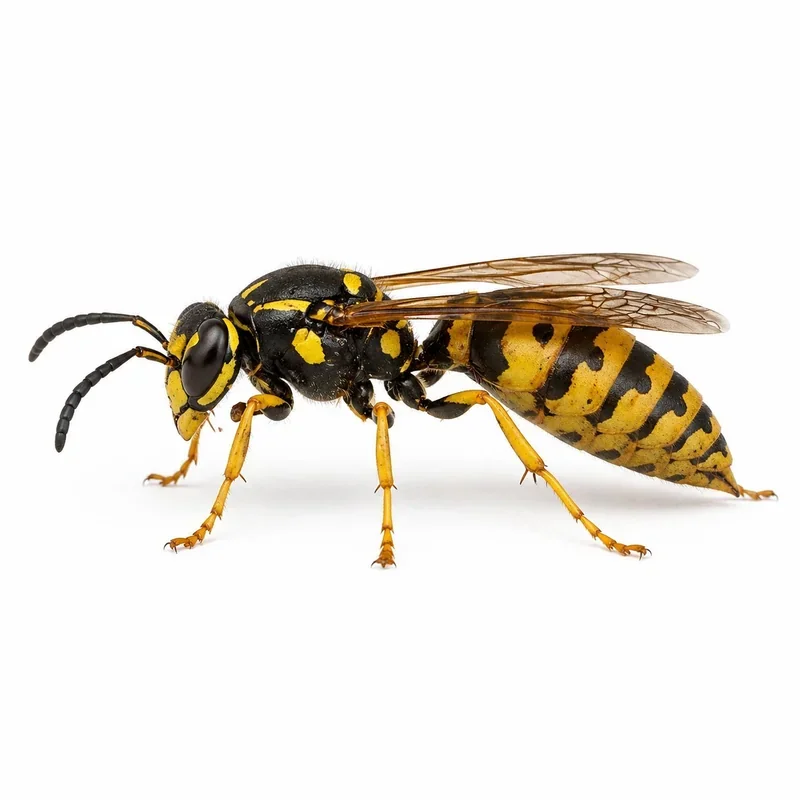
Yellowjacket
AKA: Ground Hornet, Ground Wasp
Vespula spp.
|
10 to 16 mm. Bright yellow and black, sharply banded. Body is hairless and shiny, the reverse of honey bee’s fuzzy appearance. Compact, stocky build. Legs held close to the body in flight, not dangling. | Hairless and shiny is the fastest separator from honey bee. Smooth stinger, can sting multiple times. Does not carry pollen; scavenges meat and sugary drinks in late summer. Builds paper nests, not wax comb. Annual colony: dies after first hard freeze. | Most Collin County colonies nest underground in soil burrows or inside wall voids accessed through a crack or weep hole. A hole in the ground with fast worker traffic, or workers entering a wall crack at low level, points to yellowjacket rather than honey bee. |

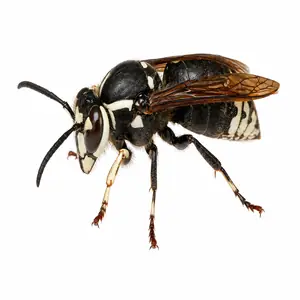
Bald-Faced Hornet
AKA: White-Faced Hornet
Dolichovespula maculata
|
15 to 20 mm. Black body with bold white or ivory markings on the face, upper midsection, and abdomen tip. Larger and heavier-built than a honey bee. No hair visible at distance; smooth-looking like all wasps. strong, heavy flight profile. | Bold white-on-black pattern separates from honey bee instantly. Builds the largest enclosed aerial nest in North Texas: a gray paper ball suspended in trees. Smooth stinger, stings multiple times, can spray venom toward intruder eyes. Annual colony. | Large enclosed gray paper ball hanging in a tree, large shrub, or from a structural overhang. Single bottom entry hole. No ground nesting, no wall-void colonies. The visible aerial gray paper structure is unmistakable and separates bald-faced hornets from honey bees in every field scenario. |
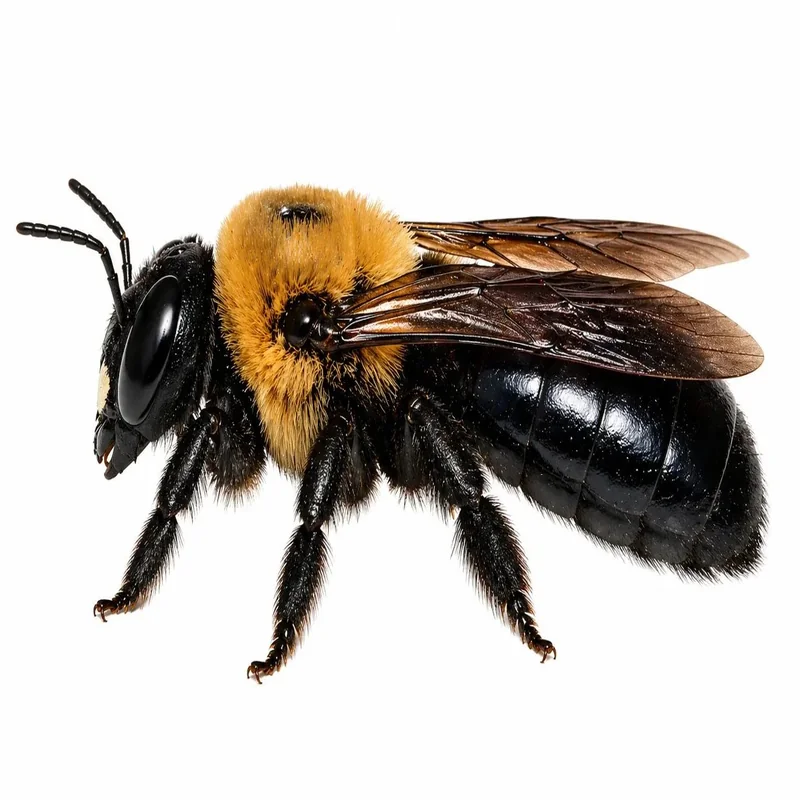
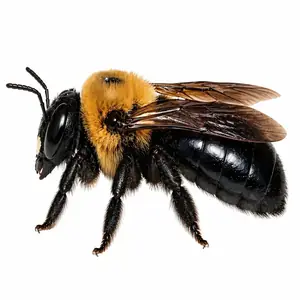
Carpenter Bee
AKA: Wood Bee
Xylocopa spp.
|
20 to 25 mm (larger than honey bee). Black body with a shiny, hairless abdomen, the reverse of the honey bee’s fuzzy abdomen. Yellow-orange hair may be present on the upper body but the abdomen is visually smooth. Solitary; no colony, no workers, no swarm. | Shiny hairless abdomen is the fastest visual separator from honey bee. Solitary species: no colony, no swarm, no mass defensive behavior. Drills round entry holes in unpainted wood (fascia boards, pergolas, cedar fences). Entering a wood surface through a round drilled hole means carpenter bee, not honey bee. | Individual tunnels drilled into unpainted wood surfaces. No colony, no comb, no honey. One or two bees per tunnel gallery. Does not enter wall voids through structural gaps the way honey bees do. Finding a perfectly round hole being drilled into a wood surface points exclusively to carpenter bee. |
Honey Bee Stings: What to Know
A honey bee stinger is barbed and embeds in skin on contact, pulling free from the bee’s body along with the attached venom sac. Unlike wasp stings, the venom sac continues pumping venom into the sting site for up to 90 seconds after separation. The correct response is immediate removal by scraping the stinger sideways with a fingernail, credit card, or any flat edge. Squeezing or pinching the stinger compresses the venom sac and delivers more venom. Immediate scraping matters more than the method of removal.
For most non-sensitized individuals, honey bee stings cause localized pain, redness, and swelling that resolves within hours to a day. The serious medical concern is anaphylaxis in sensitized individuals, which can be triggered by a single sting. Honey bee sting risk and management guidance from the National Pest Management Association covers both sensitization risk and recommended precautions for households with known venom sensitivity. Anyone with a prior systemic reaction to any bee or wasp sting should carry an epinephrine auto-injector and treat any established bee colony near their home or regular activity as a professional service call rather than a DIY approach.
Go to an emergency room or call 911 immediately if a sting is followed by difficulty breathing, wheezing, or throat tightening. Other emergency signs include hives or skin flushing spreading beyond the sting site, rapid pulse, dizziness, or nausea. Anyone with known venom sensitivity should seek emergency evaluation after any sting without waiting for symptoms to develop. Mass stings (50 or more) can cause systemic toxic reactions even in non-sensitized individuals and require emergency evaluation regardless of prior reaction history. These are signs that do not resolve on their own.
The AHB risk in Collin County adds a practical layer to all established colony encounters. Africanized hybrids respond to disturbances faster, in larger numbers, and have been documented pursuing threats for a quarter mile in severe cases. Their venom is identical to European honey bees in potency; the danger is the volume of stings, not the chemistry. Because no visual separation is possible without laboratory analysis, the conservative approach for all established feral colonies is professional treatment rather than DIY intervention.
Structural Cavity Colonization in Collin County Slab Homes
Honey bees enter slab-on-grade structures through gaps in siding and soffit boards, fascia gaps at the roofline, chimney flashing gaps, gaps around HVAC line set penetrations, gable vent screen failures, weep holes, water meter box openings, and any other unsealed penetration in the building envelope. Once inside, workers begin building wax comb attached to interior framing within hours of arrival. A colony active for one summer can build a comb system spanning multiple stud bays. A colony in place for two or more seasons without detection can accumulate substantial honey stores that become the primary structural risk event when the colony eventually dies.
The honey melt scenario unfolds predictably. A wall-void colony is killed by insecticide application, or dies from queen failure, disease, or cold. Without the workers’ ventilation to regulate temperature, the wax softens in summer heat within days to weeks. The honey stored in the comb runs downward through the wall cavity. Homeowners first notice honey-colored staining on interior drywall, a sticky substance on the exterior siding, or a sudden increase in yellow jackets, ants, and other secondary pests attracted to the honey odor. Opening the wall reveals honeycombed stud bays and structural saturation from honey that worked into framing and insulation. Contractor repair beyond pest control is typically required at this stage.
Why Honey Bee Colonies Persist
How Pest Me Off Handles Honey Bee Calls
Honey bee calls start with the swarm-versus-colony determination. That single decision changes every step that follows. We assess before we treat, because the correct recommendation for a temporary spring swarm (wait 24 to 48 hours; contact a beekeeper if it stays) is the opposite of the correct recommendation for an established wall-void colony (intervene now; every week of delay is more comb).
Swarm or Colony: Confirm Before Any Action
Confirm whether the situation is a temporary swarm (dense cluster resting on a surface with no cavity entry, has been present for fewer than 48 to 72 hours) or an established colony (consistent worker in-and-out traffic through a fixed gap, present for more than a few days, possible buzzing audible through wall, honey odor or staining at entry). A swarm in a low-risk location gets a 24-to-48-hour observation window. A confirmed colony skips observation and proceeds to treatment assessment immediately.
Beekeeper Assessment for Live Removal
For accessible colonies where opening the wall is feasible, live removal (cut-out) by a licensed beekeeper is the preferred first step. The beekeeper opens the wall, removes the comb, relocates the queen and workers into a hive box, and cleans the cavity. This approach preserves the colony, removes all comb and honey in one step, and eliminates the honey melt risk entirely. We coordinate beekeeper referral when cut-out is the right approach, which it is for most ground-floor colonies in accessible wall locations.
Chemical Treatment When Live Removal Is Not Feasible
For colonies in inaccessible wall locations, second-floor voids, or structural areas where opening the wall is not practical, we apply insecticidal dust into the entry gap. We allow 48 to 72 hours for colony elimination, confirm zero worker activity before sealing the entry, and discuss comb removal options with the homeowner including wall opening scope and timeline. We do not seal the entry while workers are still active inside; trapped bees will attempt to exit through interior drywall.
Comb Removal and Entry Sealing
After colony elimination is confirmed, comb removal is mandatory to prevent honey melt and secondary pest cascade. For accessible locations this may be combined with the live cut-out in Step 2. For chemical treatment cases this typically requires opening the wall section over the colony to extract all wax and honey. The entry gap and any secondary gaps in the area are sealed after comb removal is complete. We document the comb location and volume for the homeowner’s contractor if wall repair is needed.
& Other Companies
Swarm Management and Structural Prevention
Why Honey Bee DIY Fails
Treating a Swarm as an Established Colony
A spring swarm on a tree branch or fence post has a very high probability of moving on within 24 to 48 hours without any action. Applying insecticide to a swarm kills the colony unnecessarily and does not address any structural problem, because a swarm has not entered a cavity yet. The correct response to a swarm in a low-risk location is to keep people and pets away and wait. Contact a beekeeper if the swarm is in a high-traffic location or has remained beyond 72 hours. The cost of waiting for a swarm to move on is zero. The cost of treating a swarm that would have left is the colony’s life and the treatment expense.
Sealing the Entry While Bees Are Still Active Inside
Blocking the entry hole to a live colony does not eliminate the colony. The workers inside the wall have no exit to the outside and will immediately seek an alternative way out. In Collin County slab homes, that path is typically through electrical chase openings, ceiling drywall seams, or any gap in the interior wall surface. Homeowners who seal the entry hole of an active colony frequently find bees emerging inside the home within hours. The entry must be sealed after elimination is confirmed and all worker activity has stopped, not before.
Eliminating the Colony Without Removing the Comb
Killing the bees is half the job. The wax comb and stored honey inside the wall void are the second problem that follows a kill-only treatment. In North Texas summer heat, a sealed wall void can reach temperatures that melt wax comb within weeks of the colony’s death. Honey runs through wall framing and soaks drywall, sometimes visibly. The honey scent attracts ants, cockroaches, carpet beetles, wax moths, and rodents into the void. The same scent is a powerful draw for new swarms the following spring. Comb removal after every honey bee colony treatment is mandatory, not optional.
Waiting Too Long on a Confirmed Colony
A colony entering a wall void in June and left alone through summer will build substantially more comb by September than it had in June. An established wall-void colony does not leave on its own the way a swarm will: it is building a permanent home and will remain until treated. Every week of delay means more comb, more honey, and a more involved comb removal when treatment finally happens. The cost-control strategy is early intervention. The same treatment performed in June before extensive comb builds is significantly simpler and less expensive than the equivalent treatment in September with a fully built-out wall cavity requiring contractor wall opening.
Assuming Docile Behavior Means European Bees
Africanized honey bee hybrids are confirmed in Collin County and cannot be distinguished from European bees without laboratory analysis. A colony that appears calm when observed from a distance may respond very differently to disturbance at close range during a DIY treatment attempt. The defensive response of an Africanized colony to an approach on the entry gap can include coordinated stinging in larger numbers than a European colony and pursuit well beyond the immediate treatment area. The practical guidance is the same for all established feral colonies: professional treatment, not DIY. The inability to visually separate Africanized from European bees in the field is the reason this guidance applies to every colony call regardless of the colony’s apparent temperament from a distance.
Honey Bee FAQ
A swarm is a temporary cluster of bees searching for a new nest location. Bees in a swarm have no comb, no brood, and no stored honey to defend; they are docile and will move on in 24 to 48 hours in the vast majority of cases. A colony has established comb inside a structural cavity: bees are entering and exiting the same fixed gap consistently, and they have been present for more than a couple of days. The swarm is a spring phenomenon that peaks March through May when overcrowded colonies divide and half the population leaves with the old queen. The colony is a permanent resident that will not leave without intervention. Treating a swarm as a colony is unnecessary expense. Treating a colony as a swarm and waiting for it to leave is how you end up with a wall full of comb and honey.
Dead comb in a sealed wall void melts in North Texas summer heat. Wax becomes soft and liquid honey runs through wall cavities, saturating drywall and framing. This creates staining visible on interior walls, attracts ants, cockroaches, carpet beetles, wax moths, and rodents into the void, and produces a honey scent that remains for years and is a powerful attractor for new swarms searching for a nest site. A new swarm finding old comb residue will move directly into the same cavity rather than searching further; properties where comb was left after a prior treatment reliably host another colony within one to two spring seasons. Comb removal breaks this cycle. It is not optional.
There is no way to tell without laboratory analysis. Africanized honey bee hybrids are visually identical to European honey bees; even experienced beekeepers and entomologists cannot reliably distinguish them in the field. Behavior is not a reliable indicator either: an Africanized colony may appear calm until disturbed at close range, at which point the defensive response can be significantly more intense than a European colony in the same circumstance. Africanized hybrids have been confirmed in Collin County, present in 163 of 254 Texas counties as of 2006. The practical guidance is the same for all established feral colonies: treat as potentially Africanized and use professional service rather than DIY treatment.
Live removal by a licensed beekeeper is the preferred first step whenever structurally feasible. Honey bees are ecologically significant pollinators and the loss of a healthy European colony is a genuine cost. Many beekeepers will perform live cut-out removal of accessible wall-void colonies for a fee that is often less than professional chemical treatment plus wall repair. Live cut-out is also the only treatment path that addresses the comb in a single step, since the beekeeper removes the comb as part of the process. Chemical treatment is appropriate when the colony location is inaccessible for cut-out, when the structural situation makes wall opening impractical, or when AHB status creates safety concerns for the beekeeper. The answer is: try live removal first; chemical treatment when live removal is not feasible.
Remove the stinger immediately by scraping it sideways with a fingernail, credit card, or any flat edge. Do not squeeze or pinch the stinger: this compresses the attached venom sac and delivers more venom into the sting site. Scraping immediately after the sting reduces total venom delivered regardless of how the stinger is removed. Wash the area with soap and water. Apply a cold pack to reduce swelling. Monitor for any signs of an allergic reaction: hives spreading beyond the sting site, difficulty breathing, throat tightening, dizziness, or rapid pulse. Any of those signs require emergency care immediately. For non-allergic individuals, most sting reactions resolve within hours to a day. If you know you have a prior sting allergy, carry an epinephrine auto-injector and seek emergency evaluation after any sting without waiting for symptoms.
Indefinitely, if not treated. Unlike yellowjackets and paper wasps that die after the first hard freeze, honey bee colonies are perennial and survive North Texas winters inside heated wall voids. A colony that establishes in your wall in June can still be there in June of the following year, and the year after that. Colonies that survive multiple seasons build extensive comb systems that can span multiple stud bays. The longer the colony is in place, the more comb accumulates, and the more complex and expensive the remediation when treatment eventually happens. Early detection and early intervention is the cost control strategy. A colony at six weeks is easier and less expensive to address than the same colony at eighteen months.
The most likely explanation is that the comb was not removed after the prior treatment. Wax comb and honey residue left in a wall void after colony elimination produce a strong scent that persists for years and is one of the most attractive signals for swarms searching for a nest cavity. A swarm evaluating potential nest sites is strongly drawn to a location with existing comb residue because it signals that the cavity has successfully housed a colony before. The entry gap may also still be present if it was not properly sealed after treatment. The combination of accessible entry and residual comb scent means the same cavity will be recolonized reliably each spring until both problems are addressed: all comb removed, all entry gaps sealed.
Bees in Your Wall. We Confirm Colony or Swarm, Coordinate the Beekeeper, Remove All the Comb.
Most honey bee wall calls we get come from homeowners who had the colony killed by someone else but the comb was left behind. Now there is honey running down the drywall and a new swarm found the same gap. We assess swarm versus colony, coordinate live removal when the wall location makes cut-out practical, and make sure all the comb comes out so the call does not repeat next April. Stinger Smackdown across McKinney, Allen, Frisco, Plano, and all of Collin County.