Fire Ants in Collin County, TX | Identification and Control
The Red Imported Fire Ant (Solenopsis invicta), commonly called the red ant or mound ant, runs the most aggressive ant operation in Collin County. Mature mounds hold 200,000 to 500,000 workers, the queen lays 800 eggs a day for years, and stings can trigger anaphylaxis (severe allergic reaction) in people with insect sting allergies.
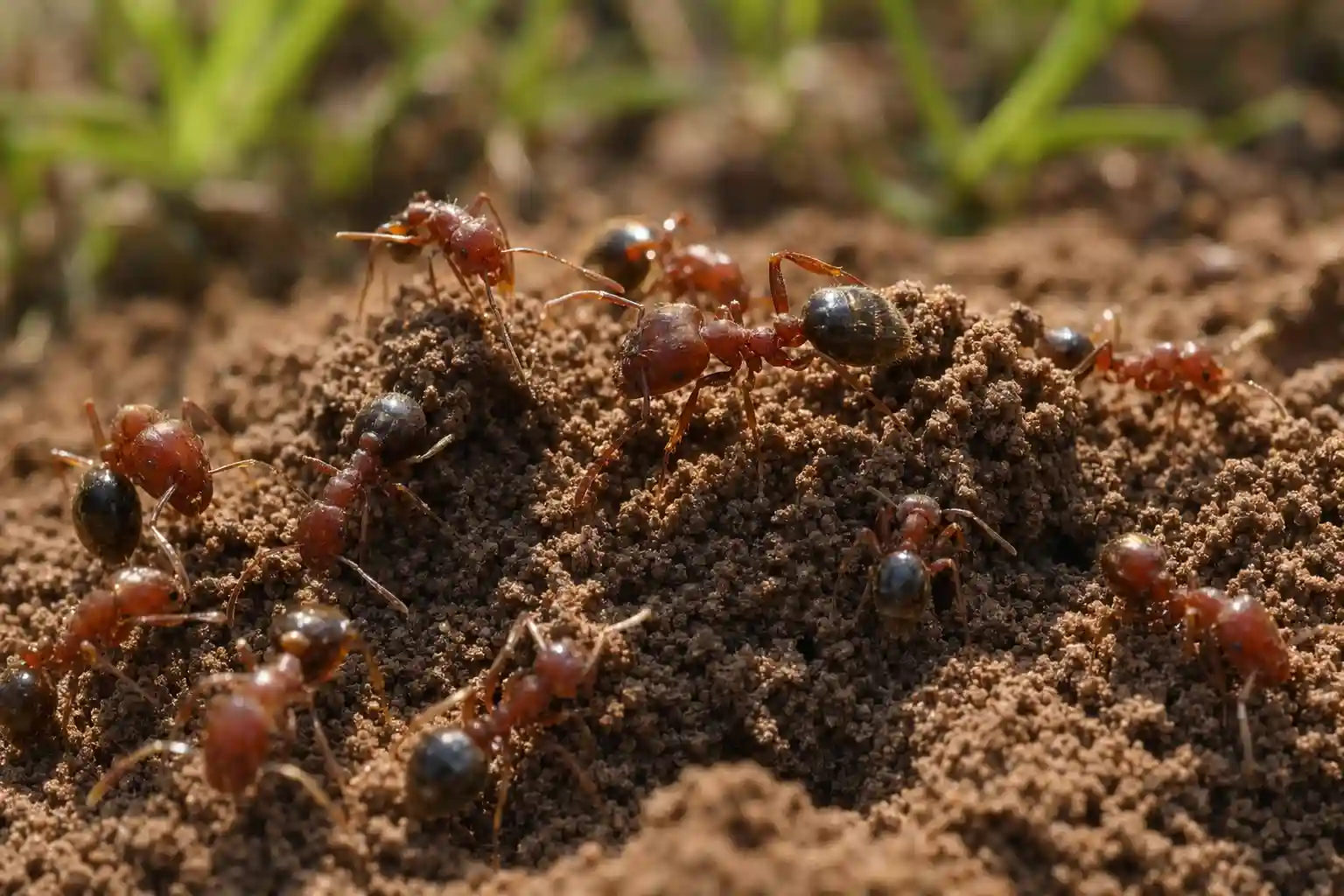
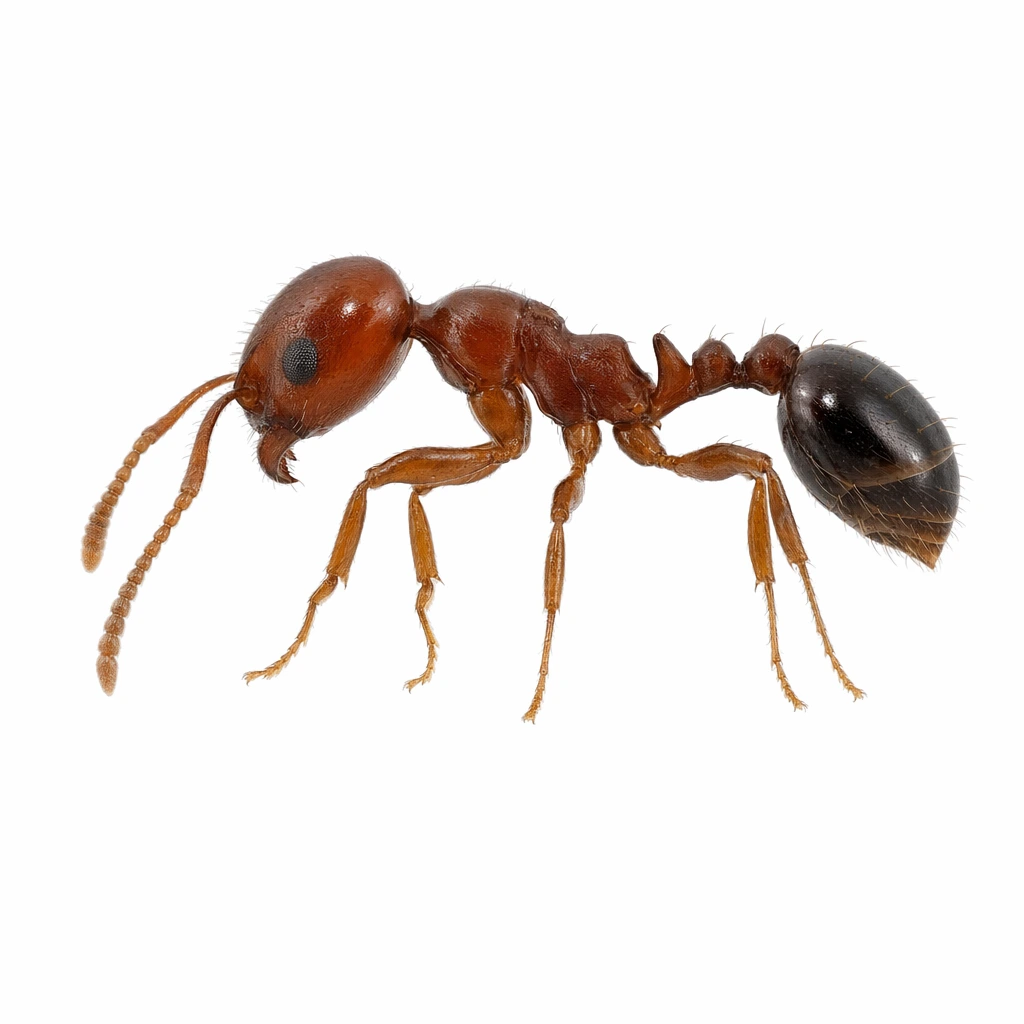
An aggressive, sting-equipped invasive ant native to South America. Established across the southern United States since the 1930s and confirmed in Collin County since the 1990s.
Mound activity peaks in late spring and again in early fall, with brief mid-summer suppression during the hottest weeks. Year-round surface activity continues in mild winters.
Pattern from Texas A&M AgriLife Fire Ant Project monitoring data and Pest Me Off service call records across Collin County, 2023 to 2026.
What Fire Ants Look Like
The mixed-size lineup that gives them away
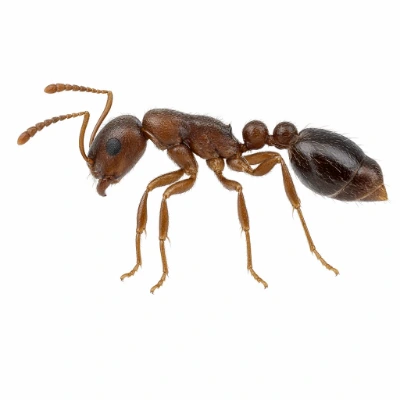
Worker fire ants are reddish-brown on the head and midsection with a darker, almost black abdomen. They are not uniform in size. A single mound contains workers from 1.6 mm to 6 mm. That mixed-size lineup is the easiest tell. Most other ants in Collin County pick one size and stick with it. Fire ants come in every size at once, like the colony forgot to pick a uniform.
The body has a pinched two-segment waist that immediately rules out most ants found indoors here. Antennae have ten segments ending in a two-segmented club. The midsection is smooth without spines.
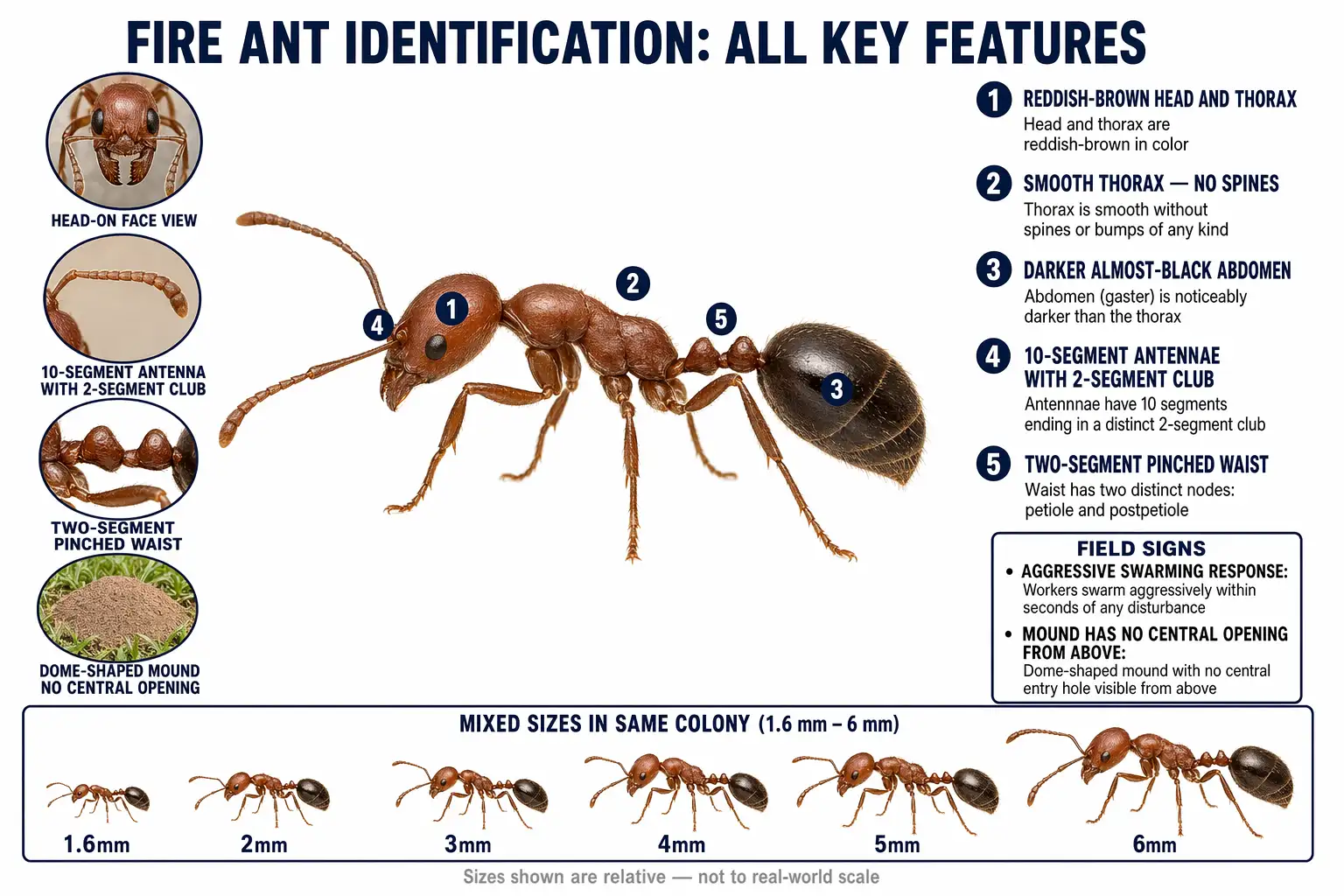
Fire ant identification diagram with anatomical callouts
- Commonly called red ants for the reddish-brown head and midsection, or mound ants for the dome with no central opening
- Mixed sizes inside the same colony, 1.6 to 6 mm
- Two-segment pinched waist
- Ten-segment antennae with two-segment club
- No spines on the midsection
- Mound has no visible central opening from above
- Aggressive swarming response within seconds of disturbance
Why Collin County Calls Them Red Ants
The reddish-brown head and midsection give fire ant workers their most common alternate name. Red ant is the informal shorthand most homeowners use, and it fits well enough for the mixed-size workers you see in a disturbed mound. The “fire” in the formal name comes from the sting: the alkaloid venom creates immediate burning that is unlike anything produced by other Collin County ants. The burning is what people remember, so fire ant is the name that stuck over red ant in most everyday use.
“Mound ant” is a third informal name that comes directly from the dome-shaped mound with no central opening. The mound is the best field diagnostic, but the sting is what people remember, so fire ant is the name that stuck.
Worth knowing about the red ant label: fire ant workers are not uniform in color. Smaller minor workers can appear noticeably darker than the larger major workers. If workers in a disturbed mound look brown or dark to you, they are still almost certainly fire ants. The mixed-size lineup in a single mound and the dome shape with no central opening are more reliable than color alone.
How to Tell Fire Ants from Other Ants in Collin County
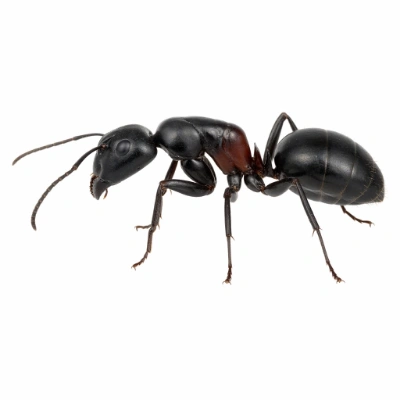
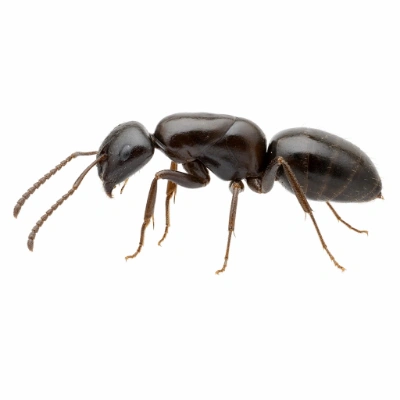
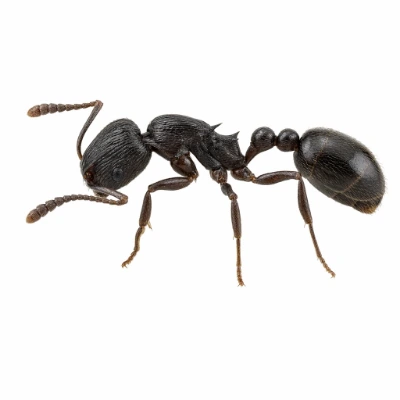
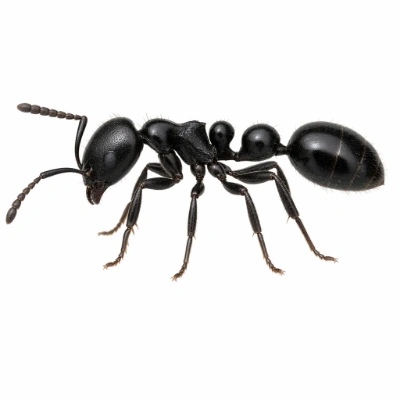
Four ants are regularly mistaken for fire ants or found in the same yard. Color, size pattern, mound shape, and sting response separate them without a microscope.
| Species | Size | Key Feature | Nesting Habit |
|---|---|---|---|
|
Fire Ant
AKA: Red Ant, Mound Ant
Solenopsis invicta
This species
|
1.6 to 6 mm. Reddish-brown head and midsection, darker rear section. Mixed sizes within a single colony is the fastest visual tell; no other common Collin County ant runs this size range in one mound. | Reddish-brown head and midsection with a darker rear section; aggressive group sting response within 10 to 15 seconds of any mound disturbance. Sting burns immediately and produces a white pustule within 24 hours. The combination of instant group attack and the pustule response makes fire ant ID fast in the field. | Dome-shaped mound with no visible central opening from above. Mound feels fluffy and loose after rain. Most active at foundation edges, irrigation zones, and sun-warmed open lawn. |
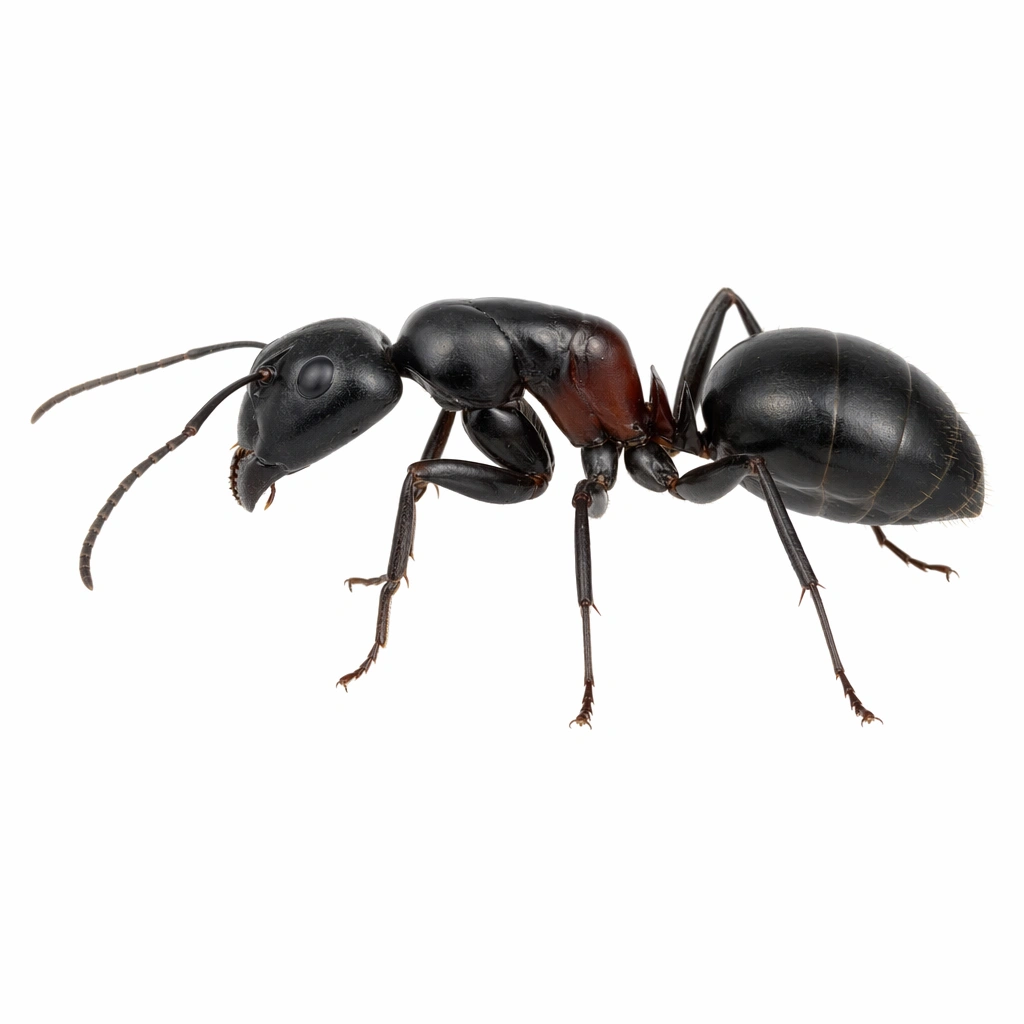
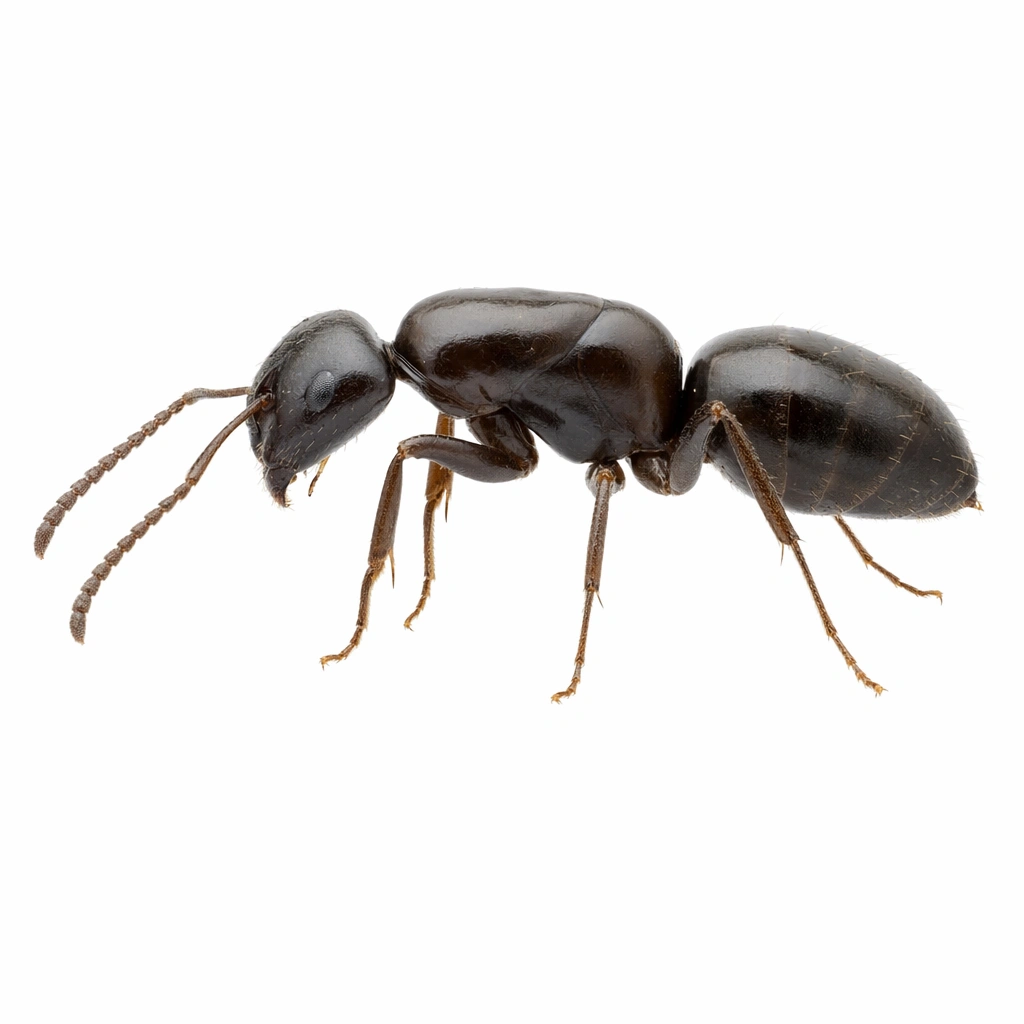
Carpenter Ant
AKA: Big Black Ant, Large Black Ant
Camponotus spp.
|
6 to 13 mm. All black or red-and-black coloring. All workers are larger than the largest fire ant worker you will find in the same mound. | No sting; bites with mandibles only. Slow, deliberate single-file movement, typically active after dark. Does not produce a visible outdoor mound. | No outdoor mound. Nest galleries run along wood grain; look for coarse fibrous debris (wood shavings mixed with insect parts, like sawdust with grit) near door frames, window sills, or roof trim. |
Odorous House Ant
AKA: Sugar Ant, Stink Ant
Tapinoma sessile
|
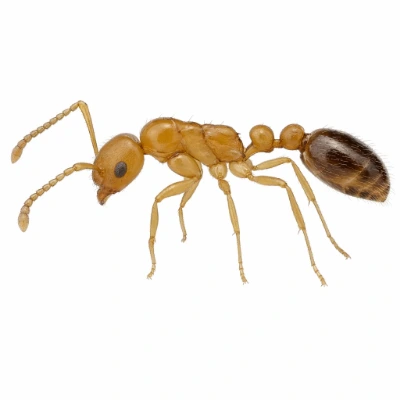
2.4 to 3.3 mm. Uniform size; dark brown to black body. Much smaller than fire ant workers and notably uniform, with no size variation across the colony. | One-node waist (fire ant has two nodes). Crushed workers produce a strong blue cheese or rotten coconut odor. Kitchen and pantry forager; no meaningful sting. | No outdoor mound. Nests inside wall voids, under insulation, and in mulch beds. Workers enter through the smallest gaps in door sweeps and window frames. |
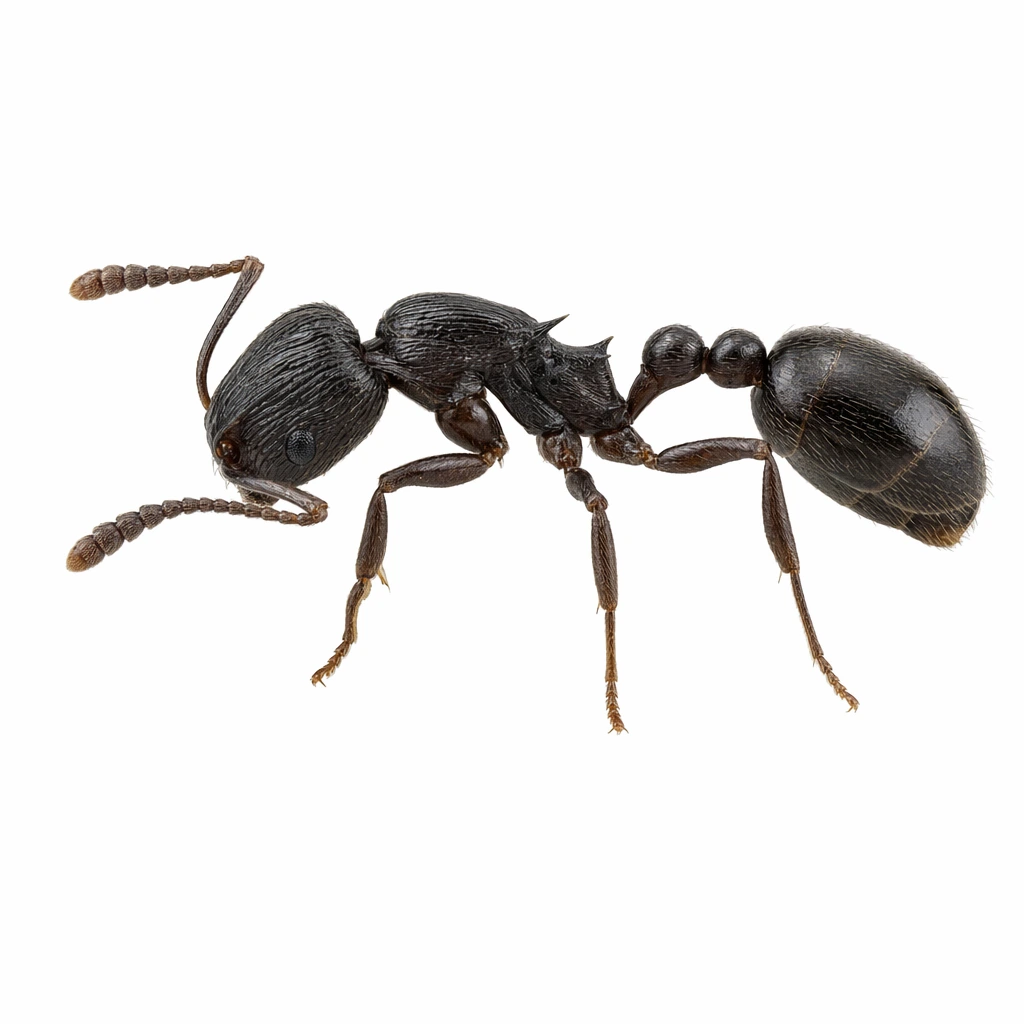
Pavement Ant
AKA: Sugar Ant, Sweet Ant
Tetramorium immigrans
|
2.5 to 3 mm. Dark brown to black, uniform across workers. Smaller than fire ants and lacks the reddish-brown coloring on the head and midsection. | Parallel grooves (striations) run lengthwise on the head AND midsection, visible under magnification. Two-node waist. Capable of a weak sting but rarely defensive; no group attack response. | Nests in soil beneath slabs, sidewalks, and driveways. Workers push sandy soil up through cracks, forming small cone-shaped piles at surface openings. |
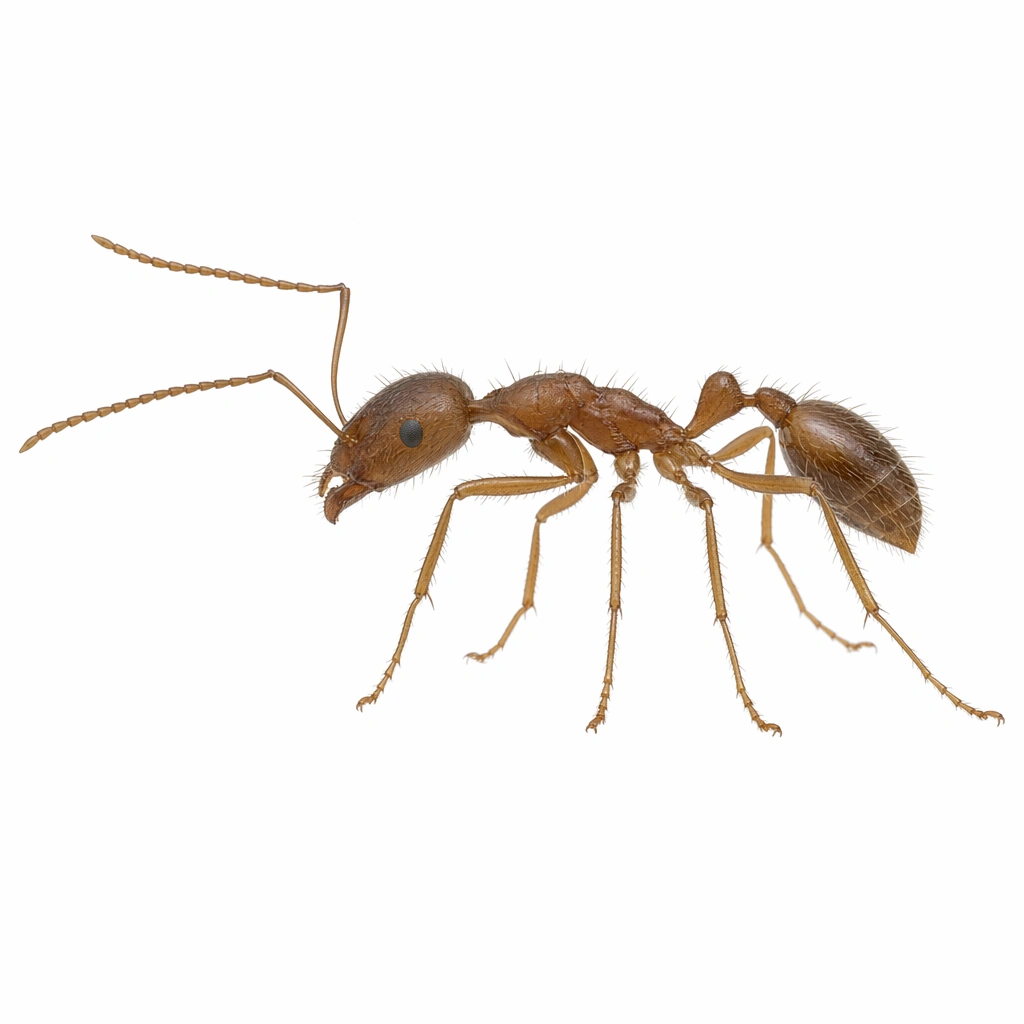
Tawny Crazy Ant
AKA: Raspberry Crazy Ant, Hairy Crazy Ant
Nylanderia fulva
|
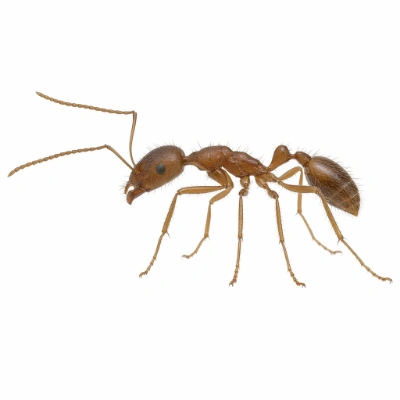
2 to 3 mm. Reddish-brown body, the coloring most similar to fire ant among the species on this page. Uniform size with noticeably long legs and long antennae relative to body length. | Erratic, rapid, non-directional movement with no organized foraging trails. Does not have a functional sting. Does not produce an aggressive group defense response when disturbed. | No central mound structure. Nests in loose aggregations under leaf litter, rotting wood, and ground debris. Not currently established in Collin County. |
Fire Ant Stings and When to Seek Medical Care
A fire ant sting causes immediate burning pain. Within 24 hours an itchy white pustule (pus-filled bump) typically forms over the site and may persist seven to ten days. Multiple stings are typical because workers attack in coordinated groups. The toxin is a piperidine alkaloid called solenopsin combined with allergenic proteins. The pustule occurs in nearly all stung individuals. Systemic reactions (body-wide responses such as widespread hives, swelling beyond the sting area, or gastrointestinal symptoms) occur in an estimated 0.5 to 2 percent of those stung. Life-threatening anaphylaxis is rarer, with U.S. population estimates below 0.1 percent of stung individuals per published hypersensitivity research (Stafford, Ann Allergy Asthma Immunol, 1996). Fire ant sting medical guidance for Texas covers first-aid steps and when to seek emergency care.
For routine stings without systemic symptoms, wash with soap and water, apply a cool compress, and use over-the-counter antihistamines or hydrocortisone if itching is significant. Do not break or scratch the pustule.
Seek immediate emergency care for difficulty breathing, throat or tongue swelling, hives spreading beyond the sting site, dizziness, rapid heartbeat, nausea, or loss of consciousness. These are signs of systemic (body-wide) allergic reaction. Higher-risk groups include children, elderly individuals, those with documented insect sting allergies, and anyone with cardiovascular conditions.
Cross-reactivity with striped bark scorpion venom is documented in sensitized individuals, meaning prior fire ant sensitization can heighten a scorpion sting response. Published fire ant and scorpion venom allergy research has confirmed this cross-reactivity between fire ant and scorpion venom allergens. The CDC NIOSH fire ant hazard guidance covers practical risk management for people with known sting allergies.
How Bad Is Your Fire Ant Problem
Spotting fire ants is easy. The harder question is whether you have one mound that needs spot treatment or a multiple-queen colony spreading across your property and your neighbors. These are the signals that change the answer. Fire ant colony assessment and severity guidance covers field identification of colony type. Read the property like a technician would.
Multiple Mounds Within 20 Feet
Three or more mounds visible in the same area of the yard usually means a multiple-queen colony. Single mounds can be spot-treated. Multiple-queen colonies require yard-wide bait broadcasting.
Mounds Within 10 Feet of the Foundation
Foundation-adjacent mounds eventually drive workers indoors during drought or flooding. Treatment becomes time-sensitive when children, pets, or elderly family members use the yard regularly.
Sting Event on the Property
Any sting event involving a child, elderly family member, pet, or someone with insect sting allergies elevates the priority immediately. A sustained colony in a play area is a medical risk, not just a yard problem.
Activity in Irrigation or Electrical Equipment
Fire ants colonize sprinkler control boxes, air conditioner condensers, and pool pump housings. The first symptom is usually intermittent equipment failure before you see the colony.
Mounds Reappear Within Weeks of DIY
If mounds reappear in the same yard within 3 to 6 weeks, the queen survived. Surface treatments rarely reach her. Continued reappearance means professional bait broadcasting is the next step.
Neighboring Yards Are Untreated
Multi-queen colonies share workers across property lines. If the next-door yard has visible mounds, your treatment window is shorter. Perimeter barriers become essential, not optional.
Where Fire Ants Build Mounds
Mounds appear most often where soil meets concrete: foundation perimeters, driveway edges, slab corners, and pool decking. Workers exit through underground tunnels that emerge several inches from the visible mound, which is why direct mound treatments often miss the queen. Indoor activity is uncommon under normal conditions but increases during prolonged drought or after flooding. Fire ants also colonize air conditioner condensers, irrigation control boxes, and pool pump housings, where they cause shorts and equipment damage.
Fire Ant Pressure Across Collin County
Red Imported Fire Ants are confirmed and widespread across Collin County. The clay-heavy soil holds moisture and warmth, the two conditions that favor queen overwintering and rapid spring mound expansion. Activity runs March through October with year-round surface activity in mild winters. State-level fire ant research in Texas documents the species as fully established throughout Collin County, including Collin County.
Pressure runs highest in HOA neighborhoods with continuous green space across property lines. Stonebridge Ranch, Craig Ranch, and Windsong Ranch consistently produce the highest call volumes. New construction grading in Anna (Liberty Hills, Sherley Farms), McKinney (Trinity Falls), and Lucas (Inspiration) repeatedly disrupts existing mounds, breaking single colonies into multiple satellite mounds. Pressure is also consistently high in Allen, Frisco, Plano, and Prosper. Creek corridors like Slayter Creek function as migration paths during dry summer stretches.
Cost of Doing Nothing
One untreated mound becomes 10 in a year. A typical Collin County lawn averages 4 to 7 mounds at first visit. Without intervention, those colonies expand laterally into neighboring yards within 6 weeks. The ER visit average for fire ant anaphylaxis (severe allergic reaction) in Texas runs $1,500 to $3,500 before insurance. Equipment damage from colonization in AC condensers and irrigation controllers averages $400 to $1,200 per repair event.
How Fire Ant Colonies Spread
Things You Should Know About Fire Ants
Colony math, sting behavior, and why one yard becomes five
How Pest Me Off Treats Fire Ant Colonies
Ant-nihilation is our proprietary ant protocol that combines queen-targeted bait broadcasting with a perimeter barrier system we call the Scorched Earth Barrier. The protocol is built around a simple truth: if the queen survives, you did not solve the problem. You just thinned the crowd. A treatment that eliminates surface workers but leaves the queen intact will see the colony rebuild within weeks. Decades of fire ant management research in Texas has documented this queen-survival failure pattern in single-mound contact treatments since the 1990s.
Property Assessment
Walk the full property to map active mounds, locate foundation-adjacent colonies, and identify satellite activity in irrigation zones and equipment housings. Count mound clusters to determine whether a single-queen or multi-queen situation is present.
Broadcast Bait Application
Broadcast bait is spread across the entire treated area. Foraging workers carry the bait back to the queen and brood. Mound activity collapses over 1 to 2 weeks. The broadcast approach also addresses satellite colonies that have not yet built a visible mound. The bait product we use is a non-repellent formulation, meaning workers walk right through it without detecting it and carry it back to the colony.
Direct Mound Treatment
Each active mound receives direct treatment to accelerate colony collapse. The mound treatment works in combination with the broadcast bait to eliminate the queen faster, particularly in established single-mound situations where the colony has not spread widely across the yard.
Scorched Earth Barrier
A non-repellent perimeter application (the kind scout workers walk through without detecting and carry back to their source colony) is placed around the foundation, along irrigation infrastructure, and at property edges. Scout workers from neighboring yards encounter the barrier before they reach open lawn and carry the product back to the source colony. The barrier is reapplied on a quarterly schedule because reinfestation from neighboring untreated yards is continuous.
& Other Companies
DIY Fire Ant Prevention for Your Property
Once fire ants establish a colony, treatment is the only reliable way out. But there are DIY steps you can take to make your property less attractive to scout workers and slow the spread from neighboring yards.
Why DIY Can Fail for Fire Ants
When fire ants show up, the instinct is to attack the visible mound with something from the garage or a tip from a social media video. Most of these approaches do more harm than good. Here is what to know before you reach for the boiling water.
Boiling Water or Gasoline
Boiling water reaches only the upper inches of the colony. The queen sits much deeper and walks away. Gasoline is dangerous, contaminates soil, does not reliably reach the queen, and is illegal under Texas pesticide use law.
Repellent Sprays and Dusts
Repellent contact sprays and diatomaceous earth kill surface workers and signal the colony to relocate. The queen splits off and starts satellite mounds. What began as one mound becomes three or four, now spread across a wider area.
Grits, Vinegar, and Cornmeal
Popular internet remedies with no entomological basis. Fire ants do not die from eating grits, and they are not harmed by vinegar or club soda. These approaches waste time when a growing colony needs real intervention.
Spot-Treating One Mound
In a multi-queen colony, one mound is connected underground to several others. Treating one alerts the rest. The colony relocates workers before you find the next mound, making follow-up treatment harder.
Treating in Cold Weather
Fire ant bait requires active foraging to work. Below 60 F, workers stop foraging. Bait broadcast in cold weather sits unused and degrades before workers retrieve it. Optimal treatment windows are March through May and September through October.
Ignoring Neighbor Yards
Even a perfect yard-wide DIY treatment cannot stop reinfestation from an untreated neighboring yard. Scout workers cross property lines within six weeks of any treatment. Without a perimeter barrier, the cycle restarts every season.
Common Fire Ant Questions
Fire Ants in Your Yard. We Get Rid of Them.
We broadcast bait across the entire yard, treat every active mound directly, and run the Scorched Earth Barrier across McKinney, Allen, Frisco, Plano, and the rest of Collin County.